Outfitting a family of four, with every number shown
Four people is where ski gear stops being a purchase and becomes a budget. Here is the arithmetic, split into what to buy now, buy later and never buy.
By Sawyer V. · Published
We have not tested this gear. Everything below is compiled from published specifications and published safety standards, and the arithmetic is public so you can check it. This page carries affiliate links: if you buy through one we earn a commission at no extra cost to you, and it does not change the order of the picks. Full disclosure.
The short answer
At published prices, kitting out two adults and two children in helmets, goggles, outerwear, gloves and socks comes to about $1,200 - and you should not pay that, because a published price is a maker’s list price and not a street price. Rent skis, boots and poles for all four. Buy in three waves: protection, then warmth, then hardware only if your own break-even says so.
| # | Pick | Best for | Score | Price |
|---|---|---|---|---|
| 1 | OutdoorMaster Kelvin 2 Mips Families buying several helmets at once | $2.80 a dayon snow | 6.9/10 | $59.99 - View on Amazon |
| 2 | OutdoorMaster PRO Magnetic A skier who wants to change lenses without taking gloves off | $2.00 a dayon snow | 6.1/10 | $39.99 - View on Amazon |
| 3 | Retrospec Comstock Kids A first helmet for a toddler who may not ski again | $4.00 a dayon snow | 5.0/10 | $39.99 - View on Amazon |
| 4 | Arctix Kids Insulated Bib Overalls A child who wrecks the ankles of every pair of snow pants they own | Not publishedon snow | 0.0/10 | $34.99 - View on Amazon |
Prices last verified October 19, 2026. Prices move constantly; the figure on Amazon at the moment you click is the real one.
The shape of the problem
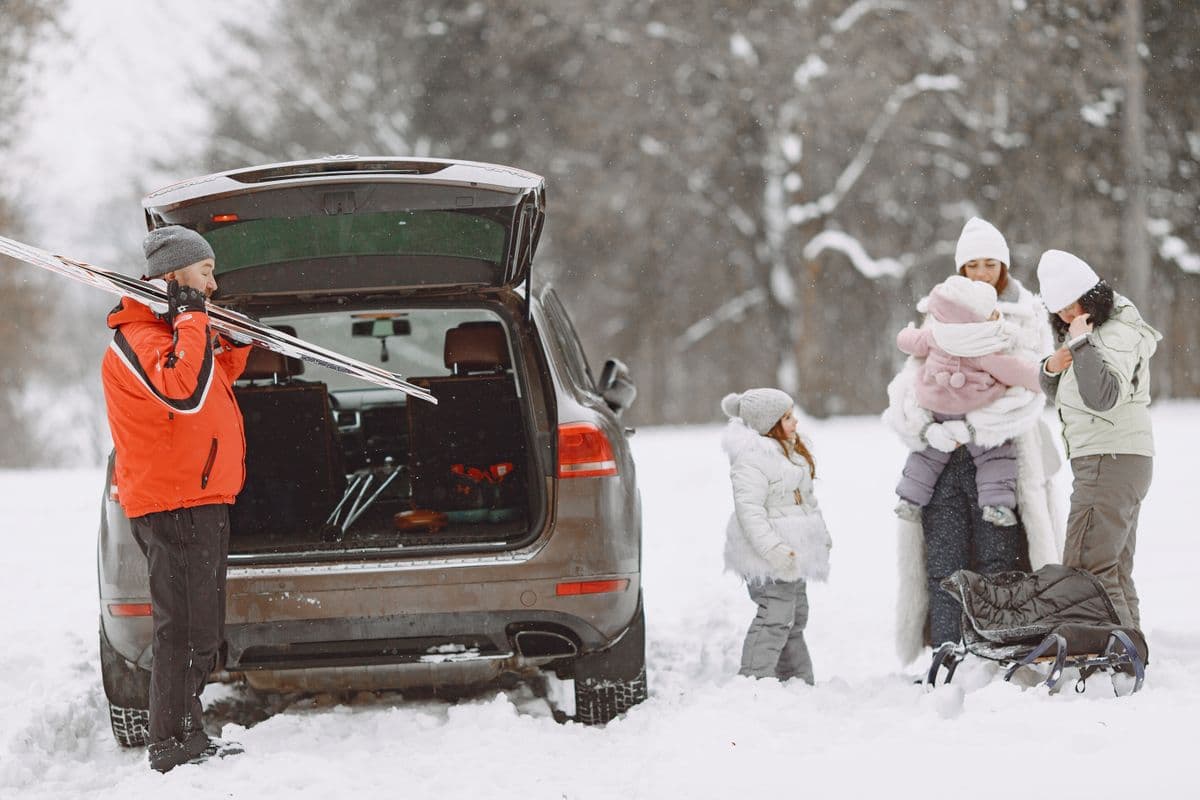
One person buying ski gear makes a series of small decisions. Four people buying ski gear makes one large decision, because every item is multiplied by four and the mistakes are multiplied too.
The single most useful thing to know before you start: for a family that skis once or twice a year, the hardware - skis, boots, poles - is the part you should not buy, and it is also the part that looks most like ski gear. The what-to-buy-first page sets out why, and the cost page has the per-item arithmetic.
Wave one: protection, about $340 for four
Helmets and goggles, for everyone, before anything else. These are the two items where renting is genuinely a bad idea rather than merely uneconomic.
- Helmets. A rental helmet has been on other heads and may have been dropped in a way nobody recorded. A helmet that has taken an impact is done, and you cannot see it. Four certified helmets under $100 each is achievable and the kids roundup covers the small sizes.
- Goggles. Rental goggles are scratched, and a scratched lens in flat light is genuinely dangerous because you stop being able to read the terrain. The kids goggle roundup is here.
Two adult helmets at a published $69.99, two children’s helmets at a published $39.99, two adult goggles at $49.99 and two children’s at $29.99 comes to $379.92. That is the floor, and it is not negotiable in the way the rest of this page is. The full case for owning both is here.
One honest caveat on the cheapest children’s helmet: at $39.99 it publishes both certifications and no rotational-impact system. A children’s helmet that publishes one costs around $110, which adds $140 across two children. Whether that system is worth it has its own page and the answer is not obvious in either direction.
Wave two: warmth, about $820 for four
Pants first, then gloves, then a jacket, then base layers and socks. That order is deliberate and it is not the order a shop will sell you.
| Item | One adult | One child | Four people |
|---|---|---|---|
| Snow pants | $50.00 | $39.99 | $179.98 |
| Jacket | $105.00 | $55.00 | $320.00 |
| Gloves | $39.99 | $29.99 | $139.96 |
| Base layer | $65.00 | Not published | $130.00 plus |
| Socks | $30.00 | Not published | $60.00 plus |
| Wave two total | $289.99 | $124.98 plus | $829.94 plus |
Every figure in that table is a maker’s published price, compiled on the date shown on each product entry below, and two cells say “not published” because no maker publishes one for those items - which is a real answer rather than a gap we filled in.
Two notes on that table that save real money. First, buy two pairs of gloves per child, not one - a child’s gloves are soaked by eleven o’clock and a dry second pair rescues the afternoon. The kids glove roundup covers what to look for. Second, buy thin socks, not thick: a thick sock in a fitted boot makes a foot colder, not warmer, and the socks page explains the mechanism.
For children specifically, bibs beat pants. There is no waistband gap for snow to get into and no waistband to fall down, and the kids pants roundup covers the reinforcement that matters. For adults the same logic applies with less urgency - the comparison has its own page.
Wave three: hardware, which for most families never comes
Skis, boots and poles for four people at published prices is comfortably over $2,000 and closer to $3,000 once boots are fitted properly - the ski packages in this ledger alone are $400 to $550 a set before boots.
We will not tell you what your family rental costs, because rates vary too much between resorts, town shops and pre-bookings for a single figure to be honest. The cost page takes the same position. Divide instead:
Break-even days = total purchase price / your family’s daily rate
| Hardware for four | At $80 a day | At $120 a day | At $180 a day |
|---|---|---|---|
| $2,000 | 25 days | 17 days | 12 days |
| $2,500 | 32 days | 21 days | 14 days |
| $3,000 | 38 days | 25 days | 17 days |
Read the middle column. If you take one week-long trip a year, that is three seasons of skiing before the purchase pays back - during which at least two of the four people will have changed size.
The arithmetic only shifts if you ski a lot, live near a hill, or have a household with enough size overlap to hand gear down. The when-to-buy page covers the timing and the seasonal lease page covers the middle option, which for growing children is usually the right one.
The two things that are different for children
Growth
A child grows out of gear before they wear it out, which inverts the usual buy-versus-rent logic. Buy the things that can be sized up - a jacket, a bib with adjustable straps - and rent or lease the things that must fit exactly, which is boots and skis. The growing-room page is explicit about which is which.
The possibility that they hate it
Worth planning for rather than being surprised by. A child who is cold, wet or frightened on day one frequently does not want day two, and the three causes are in that order: cold hands, wet clothing, and a lesson that started above their level. The skiing-with-kids page covers what actually ruins the day.
The practical consequence is to spend the first-year budget on warmth rather than equipment. Gloves and pants change whether a child enjoys the day; skis do not, because a beginner cannot tell one pair of rental skis from another.
The total, and what it buys
- First trip, four people: about $1,200 at published prices to buy, plus rental hardware at your resort’s rate.
- Second trip: almost nothing, unless a child has grown. This is the point of buying the clothing.
- Third trip onwards: consider leasing for the children and consider buying boots for the adults, which is the first hardware purchase that justifies itself.
If that first number is more than the trip is worth, the budget setups page builds kits at $100, $200 and $300 per person with the constraint genuinely enforced, and the kids budget page builds a full child’s kit under $200.
Every pick, with the working
Each entry shows the published inputs, the axis scores they produce, and what you give up. The order is the computed order, not a commercial one, and the arithmetic is open underneath each score.
1 · Families buying several helmets at once
OutdoorMaster Kelvin 2 Mips
The cheapest helmet here that carries both certifications and a rotational liner, at a published $69.99. For a family buying four helmets at once that difference is most of a lift ticket, and nothing in the published safety spec is missing.
- Published price
- $69.99
- Cost per day on snow
- $2.80 a day
- Amortized over
- 5 seasons (25 days)
- Certified to
- ASTM F2040-18, CE EN 1077:2007 Class B
- Rotational system
- Mips
- Published sizes
- Three published sizes, S through L
- Warranty
- OutdoorMaster 2-year warranty
What it gets right
- ASTM F2040-18 and CE EN 1077:2007 Class B, with Mips, for a published $69.99
- Two-year warranty, double Giro's published term
- Fourteen vents and a dial adjuster
What you give up
- Three published sizes rather than four, so the extremes of the range are less well covered
- No published weight, so you cannot compare it on the scale before you buy
The working behind the 6.9
- Cost per day on snow: 9.0
- $69.99 over 5 seasons at 5 days each = 25 days = $2.80 a day
- Published protection: 9.0
- ASTM F2040 (+4); CE EN 1077 (+2); Mips rotational system (+3)
- Size availability: 4.9
- 3 published sizes (3.4 of 8.5); continuous in-size adjuster published (+1.5); range: Three published sizes, S through L
- Warranty and support: 2.5
- 2 yr (2.5 of 6); no published crash replacement (+0); no published repair route (+0)
Axes with unpublished inputs are dropped and the remaining weights re-normalized, so a product is not punished for a manufacturer’s silence. Specifications compiled September 3, 2026 from OutdoorMaster published specifications.
2 · A skier who wants to change lenses without taking gloves off
OutdoorMaster PRO Magnetic
Skip this one. Buy one, not four. Adult goggles at this level are excellent value and the magnetic lens swap is genuinely useful, but four sets is around $160 of a first-year budget that would do more good spread across pants and gloves. Buy adult goggles for the adults and put children in the cheaper kids models, which publish the same UV protection.
A magnetic lens swap at a published $49.99, with 100% UV400 and an over-the-glasses frame. Spare lenses are a separate purchase, so the real cost of a two-lens setup lands closer to the Smith than the sticker suggests.
- Published price
- $49.99
- Cost per day on snow
- $2.00 a day
- Amortized over
- 5 seasons (25 days)
- Certified to
- Not published
- UV protection
- 100% published
- Anti-fog
- Anti-fog coating
- Lenses included
- 1
- Published sizes
- One size
- Warranty
- No term published for goggles
What it gets right
- Magnetic lens change, workable in gloves on a lift
- 100% UV400 protection and an anti-fog coating
- Over-the-glasses frame at a published $49.99
What you give up
- One lens included; the interchangeable system only pays off after you buy another
- No published impact standard
The working behind the 6.1
- Cost per day on snow: 9.6
- $49.99 over 5 seasons at 5 days each = 25 days = $2.00 a day
- Published protection: 6.0
- 100% UV protection published (+4); no published impact standard (+0); anti-fog treatment published (+2); single lens (+0)
- Size availability: not scored
- Sold in one size, so size availability does not apply.
- Warranty and support: 0.0
- no published term (0 of 6); no published crash replacement (+0); no published repair route (+0)
Axes with unpublished inputs are dropped and the remaining weights re-normalized, so a product is not punished for a manufacturer’s silence. Specifications compiled September 3, 2026 from OutdoorMaster published specifications.
3 · A first helmet for a toddler who may not ski again
Retrospec Comstock Kids
Skip this one. If the child is going to ski more than one weekend, the extra $70 for a Mips youth helmet works out at about $3.50 per day on snow on our two-season convention. That is a small number for the one feature this helmet lacks.
Properly certified, dial-adjusted and $39.99, which makes it the cheapest legitimate route to getting a small child into a helmet. It has no rotational-impact liner, and on a two-season horizon the Mips helmets are only about three dollars a day more.
- Published price
- $39.99
- Cost per day on snow
- $4.00 a day
- Amortized over
- 2 seasons (10 days)
- Certified to
- ASTM F2040, CE EN 1077 Class B
- Rotational system
- None published
- Published sizes
- Kids XS 48-51 cm and Youth 52-55 cm
- Warranty
- Limited warranty; no term published
What it gets right
- ASTM F2040 and CE EN 1077 Class B at $39.99
- ErgoKnob dial adjuster
- Covers 48-55 cm, which reaches younger than most youth helmets
What you give up
- No rotational-impact system
- No published warranty term
The working behind the 5.0
- Cost per day on snow: 8.1
- $39.99 over 2 seasons at 5 days each = 10 days = $4.00 a day
- Published protection: 6.0
- ASTM F2040 (+4); CE EN 1077 (+2); no rotational-impact system (+0)
- Size availability: 3.2
- 2 published sizes (1.7 of 8.5); continuous in-size adjuster published (+1.5); range: Kids XS 48-51 cm and Youth 52-55 cm
- Warranty and support: 0.0
- no published term (0 of 6); no published crash replacement (+0); no published repair route (+0)
Axes with unpublished inputs are dropped and the remaining weights re-normalized, so a product is not punished for a manufacturer’s silence. Specifications compiled September 3, 2026 from Retrospec published specifications.
4 · A child who wrecks the ankles of every pair of snow pants they own
Arctix Kids Insulated Bib Overalls
The same 85 g insulation as the adult Essential bib with 600-denier ballistic reinforcement at the ankle, scuff and hem, which is precisely where a child's snow pants die. Adjustable shoulder straps mean one pair genuinely covers two winters of growing.
- Published price
- Not published
- Cost per day on snow
- Not published
- Amortized over
- 2 seasons (10 days)
- Certified to
- Not published
- Waterproof rating
- Not published
- Published sizes
- Published in youth sizes; no numeric size list published on the product page
- Warranty
- No term published; Arctix states a satisfaction guarantee
Arctix lists this across sizes and colorways rather than publishing one MSRP, so the cost-per-day axis is not scored.
What it gets right
- 600-denier ballistic reinforcement published at ankle, scuff and hem, the three places a ski edge cuts
- 85 g ThermaTech insulation with a ThermaLock coated shell
- Adjustable shoulder straps and an elastic back waist, so it grows with the child
- Boot gaiters with grippers and articulated knees both published
What you give up
- No published numeric size list on the product page
- No published waterproof rating in millimeters for the kids version
- A bib is slow at a bathroom stop, and children do not plan ahead
The working behind the 0.0
- Cost per day on snow: not scored
- No manufacturer-published price, so this axis is not scored.
- Published protection: not scored
- No waterproof rating or seam construction published.
- Size availability: not scored
- Sold in one size, so size availability does not apply.
- Warranty and support: 0.0
- no published term (0 of 6); no published crash replacement (+0); no published repair route (+0)
Axes with unpublished inputs are dropped and the remaining weights re-normalized, so a product is not punished for a manufacturer’s silence. Specifications compiled September 12, 2026 from Arctix published specifications.
Prices last verified October 19, 2026. Prices move constantly; the figure on Amazon at the moment you click is the real one.
Questions people actually ask
How much does ski gear cost for a family of four?
About $1,200 at published prices to buy helmets, goggles, outerwear, gloves and socks for two adults and two children, plus rental hardware at whatever your resort charges. Published prices are list prices rather than street prices, so treat that figure as a ceiling. Buying skis, boots and poles for four costs well over $2,000 and rarely pays back.
What should a family buy first for skiing?
Helmets and goggles for everyone, then snow pants, then gloves. Helmets and goggles are the two items where rental is genuinely a bad idea rather than merely uneconomic, and pants and gloves are what decide whether a beginner enjoys the day.
Is it worth buying skis for a family?
Divide the total purchase price by your family’s daily rental rate: $2,500 of hardware at $120 a day is twenty-one days on snow, which for a household taking one trip a year is three seasons. By then at least one child will have changed size. Rent the hardware and spend the money on clothing that fits and lasts.
How many pairs of gloves does a child need for skiing?
Two. A child’s gloves are usually soaked before lunch because they spend the morning with their hands in the snow, and a dry second pair is the difference between an afternoon on the hill and an afternoon in the lodge.
Should children wear ski bibs or ski pants?
Bibs, for children. There is no waistband for snow to get past when they sit down and nothing to fall down when they run. The trade is that a bib is slower at a bathroom stop, which is a real consideration with a small child.