Ski goggles under $50, and the two specs that must survive the price cut
Cheap goggles are fine. Goggles that publish nothing are the problem, because in this category the things that matter are invisible until the first flat-light afternoon.
By Sawyer V. · Published
We have not tested this gear. Everything below is compiled from published specifications and published safety standards, and the arithmetic is public so you can check it. This page carries affiliate links: if you buy through one we earn a commission at no extra cost to you, and it does not change the order of the picks. Full disclosure.
The short answer
Two things must survive the price cut: published UV protection and a named anti-fog treatment. Everything on this page publishes both. The OutdoorMaster PRO Magnetic at about $40 is the adult pick and the only one here with a magnetic interchangeable lens and an over-the-glasses cut. For children, the Bolle Nevada Junior at $40 is the pick: a junior frame published with an over-the-glasses cut and Flow-Tech venting. Under $50 you are buying fewer lenses and less venting - not less eye protection.
| # | Pick | Best for | Score | Price |
|---|---|---|---|---|
| 1 | OutdoorMaster PRO Magnetic A skier who wants to change lenses without taking gloves off | $2.00 a dayon snow | 6.1/10 | $39.99 - View on Amazon |
| 2 | Bolle Nevada Junior A child between the junior and adult goggle sizes | $4 a dayon snow | 5.4/10 | $31.95 - View on Amazon |
| 3 | OutdoorMaster Falcon Kids A first goggle, or a spare in the car for the one that gets lost | $3.00 a dayon snow | 5.8/10 | $24.99 - View on Amazon |
Prices last verified October 19, 2026. Prices move constantly; the figure on Amazon at the moment you click is the real one.
What has to survive the price cut
Goggles are the one piece of ski equipment where the cheap version is genuinely fine, provided two published specifications are intact. Everything else at this price is a convenience question.
- UV protection. Non-negotiable, and not because of comfort. Snow reflects a large share of the ultraviolet hitting it and altitude intensifies the dose, so your eyes get it from above and below at once. Every goggle on this page publishes UV protection; the UV page covers what the exposure actually does.
- A named anti-fog treatment. “Anti-fog” as an adjective means nothing. A named treatment - Smith’s Fog-X inner lens, a stated anti-fog coating - means the maker has committed to something. A goggle you cannot see through is not cheap, it is useless.
| Goggle | UV | Anti-fog | Other published |
|---|---|---|---|
| OutdoorMaster PRO Magnetic | Published | Anti-fog coating | Magnetic interchangeable lens, OTG cut |
| Bolle Nevada Junior | Published | Anti-fog inner lens coating | Flow-Tech venting, OTG cut, junior fit |
| OutdoorMaster Falcon Kids | Published | Anti-fog coating | Kids fit; no VLT or lens count published |
How these were ranked
Three published specifications, in this order, and nothing else.
- 1. UV protection published. A pass/fail gate. A goggle that does not state it does not appear on this page at all.
- 2. A named anti-fog treatment. Fog-X, a stated coating, a named venting system. The word “anti-fog” on its own is not a specification.
- 3. Anything else genuinely published - a VLT number, an OTG cut, a lens system, a fit range. At this price most makers publish nothing beyond the first two, so the ones that do are ranked above the ones that do not.
We have not tested any of these. There is no lab here and no lux meter, and a page claiming to have measured optical clarity on three budget goggles would be inventing it. What this page does instead is compare what three makers were willing to commit to in print - the method is public.
What another fifty dollars buys
Useful context for deciding whether to stretch, because the honest answer for some readers is yes.
| Under $50 | $75-150 | |
|---|---|---|
| UV protection | Published on all three here | Published |
| Anti-fog | Named treatment on all three | Named, usually with more vent area |
| Lenses included | One | Frequently two |
| VLT published | Not on any pick here | Usually, per lens |
| Spare lens availability | Unreliable after a season | Generally stocked |
| Warranty | Rarely published | Often multi-year |
The honest line: if you ski a handful of days a year in mixed light, the extra money buys convenience. If you ski a lot of flat light or need a lens you can swap, it buys vision, and that is a different argument. The main goggle roundup covers that bracket.
Buying at this price for a whole family
This is where the page earns its keep. Four people in goggles at premium prices is a serious number; four people at these prices is less than one premium pair.
- Buy adults and children separately. A child in an adult frame gaps at the temples no matter the strap tension - the frames are shaped differently, not just smaller. The kids sizing page.
- Buy one spare, not four. Goggles get lost and scratched. A single cheap spare in the car covers the whole group.
- Do not share between people. Foam compresses to one face, and shared goggles is how scratches multiply.
- Label them. Four identical pairs in a lodge is a bad afternoon. A strip of tape inside each strap solves it.
- Put the savings into helmets. That is the item where the price gap does buy certified protection rather than convenience - certified helmets under $100.
What you give up under $50
Being straight about the ceiling, because the gap between a $40 goggle and a $150 one is real - it is just not where people assume.
- A second lens. Premium goggles frequently include two. At this price you get one, so you are choosing a tint and living with it - which matters most on flat-light days.
- Venting sophistication. Expensive frames have more vent area and better-engineered airflow. Cheaper frames fog more readily when you stop moving, which is why wearing habits matter more at this price.
- Published optical tuning. Contrast-enhancing lens technologies are a genuine thing and they cost money. What you do not lose is UV protection, which is the safety-relevant part.
- Spare lens availability. Budget frames rarely have spares stocked in later seasons. Why that matters before you buy.
The picks
OutdoorMaster PRO Magnetic
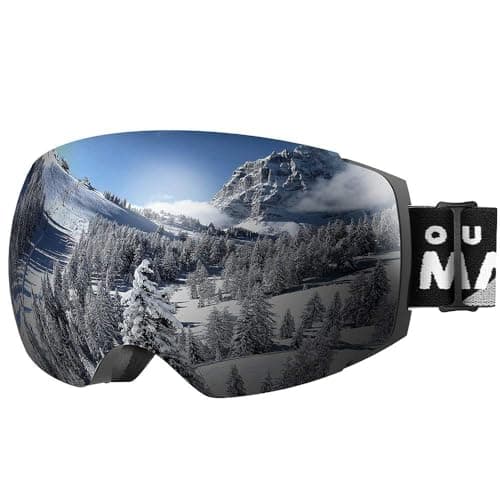
The adult pick, and the value case is the lens system. OutdoorMaster publishes a magnetic interchangeable design, an anti-fog coating, UV protection and an over-the-glasses cut - at a live price around $40. A magnetic swap takes seconds with gloves on, which is the difference between owning a second lens and actually using one.
The OTG cut is the other reason it earns the top spot here: it is the only frame on this page cut to take eyeglasses underneath, and glasses wearers are the buyers most often forced up-market. The full OTG comparison.
Honest cons: it ships with one lens, so the magnetic system is a capability you have to fund later. No VLT figure is published, so you cannot compare its tint numerically with anything else here. And an adult frame will gap on a small face - check the fit before buying.
Bolle Nevada Junior
The best-vented cheap goggle here. Bolle publishes an anti-fog inner lens coating plus named Flow-Tech venting, UV protection, an OTG cut and a junior fit, at around $32.
Venting is the specification that matters most for children specifically, because children stand still more - in lift lines, in ski school, waiting for a parent - and standing still is when goggles fog. A frame that moves air passively while stationary is doing the thing a child cannot be relied on to do for themselves.
Honest cons: no published VLT figure, so tint comparison is by eye. One lens. And junior sizing means it is outgrown, which at this price is acceptable rather than painful.
OutdoorMaster Falcon Kids
Here as the honest floor of the category and as the skip. It publishes UV protection and an anti-fog coating - the two non-negotiables - at a live price around $15, which is less than a resort lunch.
What it does not publish is a VLT figure, a lens count or an OTG cut. For a child on a first trip, or a spare pair kept in the car for the day the main pair is lost, that is a perfectly defensible buy. It is the skip only because the Nevada Junior publishes venting for a few dollars more, and venting is what keeps a child seeing.
Choosing the one lens you get
Under fifty dollars you are buying a single lens, so the tint decision is the whole optical decision. Get it right and the goggle performs far above its price; get it wrong and you will blame the goggle for a choice you made.
| Where you ski | What to pick | Why |
|---|---|---|
| Mixed weather, a few days a year | A mid-range tint | Handles bright and overcast acceptably; nothing at this price publishes a VLT figure, so compare lens names |
| East coast trees, storms, dusk | The lightest tint offered | Flat light is the condition a dark lens genuinely fails in |
| Spring, high altitude, bluebird | A darker tint | Glare off snow at altitude is the other failure direction |
| Night skiing | Clear only | No tint substitutes, and this is the one case where a second pair beats a second lens |
If you genuinely ski across all of those, that is the argument for stepping up to a frame with an interchangeable system rather than buying two cheap goggles. The interchangeable roundup.
Making a cheap goggle last a season
The failure mode at this price is almost never the optics giving up - it is the lens getting scratched or the anti-fog coating being wiped off, both of which are avoidable.
- Shake, do not wipe. Water out, air dry, put them somewhere warm. Wiping a wet inner lens removes the treatment permanently, and it is the single most common way a budget goggle dies early.
- Bag them between runs off the hill, not loose in a jacket pocket with keys and a phone.
- Dry them face-up at room temperature so the foam dries as well as the lens. The care page has the full routine.
- Buy the child two cheap pairs rather than one good one if losing things is the pattern in your household. A spare in the car costs less than a rental at the resort.
At this price, habits do more than money
A cheap goggle worn correctly outperforms an expensive one worn badly, and the rules are short.
- Never park them on your forehead. The warmest, dampest air on your body is rising off your head, and it fogs a lens in seconds.
- Keep the gaiter below your nose. Breath funneled up into the vents is the single most common fogging cause, and it is free to fix. Balaclavas with published breathing panels.
- Never wipe a wet inner lens. The anti-fog treatment is a surface layer and it comes off on the cloth - permanently.
- Use the bag, every time. Scratches happen in packs, not on the hill.
The anti-fog page covers all four in detail, and it is the highest-value page on this site for anyone buying at this price.
Check it against your helmet before the trip
The specification no budget goggle publishes is whether it will seal against the helmet you already own, and that pairing decides more about your day than the lens does. The failure is a strip of bare forehead between the goggle top and the helmet brim: cold on its own, and a fogging source because warm air escaping past your brow runs straight up the inside of the lens.
Do it the evening the parcel arrives, not in a parking lot. Helmet on, goggles on over the outside of the shell with the strap clipped, and look in a mirror for a gap. Then bend forward as though you are picking up a dropped glove: if the goggle lifts off your face or the helmet pushes it down onto your cheekbones, that combination does not work, and it is far easier to return a goggle in October than to spend a week squinting.
The helmet and goggle fit page covers what to do when the two you own nearly work, and the retailer comparison covers which return windows give you time to check.
Three red flags at this price
- No UV statement anywhere. UV protection is cheap to deliver, so a maker not claiming it is telling you something about how little they have documented overall.
- A mirrored lens with no VLT figure and no light guidance. Mirrored lenses are usually low-VLT, which is wrong for flat light. Without a number you are guessing at the one spec that decides whether you can see.
- "Fits all ages" framing. Adult and youth frames are shaped differently, not just sized differently. A frame claiming to fit everyone seals properly on nobody.
Who should buy what
- An adult wanting one pair that can grow. The PRO Magnetic, and add a second lens when you know which light bothers you.
- A child who fogs up constantly or wears glasses. The Nevada Junior, for the venting and the OTG cut.
- A spare pair, or a first-ever trip. The Falcon, and no guilt about it.
- Anyone skiing a lot of flat light. Spend above this page. The flat-light picks are where the extra money genuinely buys vision.
Every pick, with the working
Each entry shows the published inputs, the axis scores they produce, and what you give up. The order is the computed order, not a commercial one, and the arithmetic is open underneath each score.
1 · A skier who wants to change lenses without taking gloves off
OutdoorMaster PRO Magnetic
A magnetic lens swap at a published $49.99, with 100% UV400 and an over-the-glasses frame. Spare lenses are a separate purchase, so the real cost of a two-lens setup lands closer to the Smith than the sticker suggests.
- Published price
- $49.99
- Cost per day on snow
- $2.00 a day
- Amortized over
- 5 seasons (25 days)
- Certified to
- Not published
- UV protection
- 100% published
- Anti-fog
- Anti-fog coating
- Lenses included
- 1
- Published sizes
- One size
- Warranty
- No term published for goggles
What it gets right
- Magnetic lens change, workable in gloves on a lift
- 100% UV400 protection and an anti-fog coating
- Over-the-glasses frame at a published $49.99
What you give up
- One lens included; the interchangeable system only pays off after you buy another
- No published impact standard
The working behind the 6.1
- Cost per day on snow: 9.6
- $49.99 over 5 seasons at 5 days each = 25 days = $2.00 a day
- Published protection: 6.0
- 100% UV protection published (+4); no published impact standard (+0); anti-fog treatment published (+2); single lens (+0)
- Size availability: not scored
- Sold in one size, so size availability does not apply.
- Warranty and support: 0.0
- no published term (0 of 6); no published crash replacement (+0); no published repair route (+0)
Axes with unpublished inputs are dropped and the remaining weights re-normalized, so a product is not punished for a manufacturer’s silence. Specifications compiled September 3, 2026 from OutdoorMaster published specifications.
2 · A child between the junior and adult goggle sizes
Bolle Nevada Junior
An over-the-glasses junior frame with vented anti-fog construction at forty dollars, ten under the non-OTG Smith, which makes the glasses question free rather than a premium.
- Published price
- $40
- Cost per day on snow
- $4 a day
- Amortized over
- 2 seasons (10 days)
- Certified to
- Not published
- UV protection
- 100% published
- Anti-fog
- Anti-fog inner lens coating with Flow-Tech venting
- Lenses included
- 1
- Published sizes
- Junior
- Warranty
- No term published for goggles
What it gets right
- Over-the-glasses junior frame with an anti-fog inner coating and Flow-Tech venting
- 100% UV protection and an anti-scratch coating
- Double-density face foam with a fleece lining, which is the part children complain about
What you give up
- Single lens included
- Bolle publishes no VLT figure for the junior colorways we could read, so you cannot match it to conditions in advance
The working behind the 5.4
- Cost per day on snow: 8.1
- $40 over 2 seasons at 5 days each = 10 days = $4 a day
- Published protection: 6.0
- 100% UV protection published (+4); no published impact standard (+0); anti-fog treatment published (+2); single lens (+0)
- Size availability: not scored
- Sold in one size, so size availability does not apply.
- Warranty and support: 0.0
- no published term (0 of 6); no published crash replacement (+0); no published repair route (+0)
Axes with unpublished inputs are dropped and the remaining weights re-normalized, so a product is not punished for a manufacturer’s silence. Specifications compiled September 3, 2026 from Bolle published specifications.
3 · A first goggle, or a spare in the car for the one that gets lost
OutdoorMaster Falcon Kids
Skip this one. The cheapest thing on this page by a distance and the one that publishes least: UV protection and an anti-fog coating, and no VLT figure, no OTG cut and no lens count. For a child who will lose them, that is a defensible trade and it is genuinely certified for UV. It is the skip because the Bolle Nevada Junior publishes more - named Flow-Tech venting and an OTG cut - for a few dollars more, and venting is the specification that decides whether a child can see after a lift ride.
The cheapest published price here that still carries 100% UV protection and an anti-fog coating, which are the only two specs that matter on a child's first goggle. Everything above this price is buying optics, not safety.
- Published price
- $29.99
- Cost per day on snow
- $3.00 a day
- Amortized over
- 2 seasons (10 days)
- Certified to
- Not published
- UV protection
- 100% published
- Anti-fog
- Anti-fog coating
- Lenses included
- 1
- Published sizes
- Kids
- Warranty
- No term published for goggles
What it gets right
- 100% UV protection and an anti-fog coating at a published $29.99
- Cheap enough that losing it on a chairlift is annoying rather than expensive
What you give up
- No published VLT figure
- Single lens, no interchange system
The working behind the 5.8
- Cost per day on snow: 8.9
- $29.99 over 2 seasons at 5 days each = 10 days = $3.00 a day
- Published protection: 6.0
- 100% UV protection published (+4); no published impact standard (+0); anti-fog treatment published (+2); single lens (+0)
- Size availability: not scored
- Sold in one size, so size availability does not apply.
- Warranty and support: 0.0
- no published term (0 of 6); no published crash replacement (+0); no published repair route (+0)
Axes with unpublished inputs are dropped and the remaining weights re-normalized, so a product is not punished for a manufacturer’s silence. Specifications compiled September 3, 2026 from OutdoorMaster published specifications.
Prices last verified October 19, 2026. Prices move constantly; the figure on Amazon at the moment you click is the real one.
Questions people actually ask
Are cheap ski goggles worth buying?
Yes, provided they publish UV protection and a named anti-fog treatment. Those two are the safety-relevant specifications and they survive the price cut. What you give up under $50 is a second lens, venting sophistication and contrast-tuned optics.
Do budget ski goggles protect against UV?
The ones worth buying publish it, and every goggle on this page does. UV protection is inexpensive to deliver, so its absence is a red flag about the rest of the product rather than a cost saving. Snow reflects UV from below as well as above, so this is not optional.
What VLT should a single pair of goggles have?
Something in the mid range if you are only buying one lens - it handles bright and overcast days acceptably rather than either perfectly. The Smith Snowday, a step above this page in price, publishes 36% - a good example of the band to aim for.
Are kids' goggles OK for adults with small faces?
Often yes. Youth frames seal on narrow faces that adult frames gap on, and the optics are not downgraded - Smith's youth goggles carry the same Fog-X anti-fog treatment as its adult line. Fit beats frame category.
Why do cheap goggles fog more?
Usually less vent area and simpler airflow, so they clear more slowly when you stop moving. That makes wearing habits matter more: keep them off your forehead, keep a gaiter below your nose, and never wipe the inside when it is wet.
Sources
- OutdoorMaster published PRO Magnetic lens system, OTG cut, UV and anti-fog coating
- Smith published Snowday lens and fit specification, cited for the mid-range VLT example in the FAQ
- Bolle published junior goggle Flow-Tech venting, anti-fog coating and OTG fit
- OutdoorMaster published Falcon Kids UV protection and anti-fog coating