The best ski goggles, ranked on what is actually published
Three goggles compared on UV protection, anti-fog construction, how many lenses are in the box, and what a genuinely usable two-lens setup really costs.
By Sawyer V. · Published
We have not tested this gear. Everything below is compiled from published specifications and published safety standards, and the arithmetic is public so you can check it. This page carries affiliate links: if you buy through one we earn a commission at no extra cost to you, and it does not change the order of the picks. Full disclosure.
The short answer
The best ski goggle for most families is the one that publishes 100% UV protection, a treated anti-fog inner lens, and a second lens in the box, because one lens cannot cover both a bright day and a snowstorm. Only one goggle here ships with two: the Smith Squad ChromaPop at $155. The OutdoorMaster PRO Magnetic at $49.99 is the value answer if you accept buying the second lens separately.
| # | Pick | Best for | Score | Price |
|---|---|---|---|---|
| 1 | OutdoorMaster PRO Magnetic A skier who wants to change lenses without taking gloves off | $2.00 a dayon snow | 6.1/10 | $39.99 - View on Amazon |
| 2 | Bolle Y7 OTG A skier who wears glasses and does not want contacts | $3.60 a dayon snow | 5.5/10 | Check price on Amazon |
| 3 | Smith Squad ChromaPop Anyone who skis in more than one kind of light | $6.20 a dayon snow | 5.3/10 | $119.95 - View on Amazon |
Prices last verified October 19, 2026. Prices move constantly; the figure on Amazon at the moment you click is the real one.
The number nobody prints: the real two-lens cost
Interchangeable-lens goggles are sold on the idea that you can swap lenses for the conditions. That only works once you own a second lens, and on almost every goggle the second lens is a separate purchase. So the sticker price and the usable price are different numbers, and comparing the sticker prices is comparing the wrong thing.
| Goggle | Lenses in the box | Published price | Two-lens reality |
|---|---|---|---|
| Smith Squad ChromaPop | 2 | $155.00 | $155.00, done |
| OutdoorMaster PRO Magnetic | 1 | $49.99 | $49.99 plus a spare lens |
| Bolle Y7 OTG | 1 | $90.00 | $90.00 plus a spare lens |
That does not automatically make the Smith the right buy. For a family skiing five days a year in whatever weather the trip brings, one mid-range lens is genuinely enough, and the cheapest goggle here with published UV protection and an anti-fog coating does that job. But if you are comparing an interchangeable system against a two-lens box, compare them properly.
The three specs worth shopping on
- UV protection. Should be published as 100% or UV400. Snow reflects a large share of the ultraviolet that hits it, so this is not optional, and every goggle here publishes it.
- Anti-fog construction. Two things together: a double lens with an air gap between the panes, and a treatment bonded to the inner pane. All three picks publish a treatment; two publish a double lens. Why that combination works.
- VLT, the light transmission percentage. The single most useful number and the one most people ignore in favor of lens color. The full VLT guide.
Picking one lens, if you are only buying one
Most family ski days in the US are not bright. Overcast, flat light and snowfall are the normal case, and a dark mirrored lens on that kind of day makes it hard to read the surface in front of you.
If you are buying a single lens, aim for a VLT somewhere around 25% to 45%. It is a compromise at both ends and it is the right compromise for a trip where you do not get to choose the weather.
Fit, which decides fogging more than the lens does
A goggle that does not seal at the nose lets warm breath up onto the inside of the lens, and no anti-fog coating survives that. Check the foam is in contact all the way round, especially at the bridge of the nose, and check the goggle against your helmet for a gap at the brow. The helmet-and-goggle fit check takes ten seconds and prevents a surprising share of fogging complaints.
If the question behind your search is how much to spend, cheap against expensive sets out what is identical at both ends - which is more than most people expect - and what the money genuinely buys.
Frame size, which is not a spec you can look up
Goggle frames are sold in sizes that do not correspond to any published measurement, and a frame that is too large leaves gaps at the temples while one that is too small presses at the cheekbones. The Squad in particular is sold in several frame sizes as separate models, so check which one you are looking at.
For a smaller face, look for a model explicitly described as a small or medium fit. For children, buy a children’s goggle rather than a small adult one: the youth picks are here.
One condition is worth shopping for separately, because it is where a wrong lens genuinely stops you seeing the terrain. The flat-light roundup ranks on published VLT and on whether a second lens is in the box, and it is honest that a spare light lens is usually cheaper than a second goggle.
Should you buy goggles at all?
Yes, and this is one of the least argued-with recommendations on the site. Goggles are rarely rented, a shared scratched lens is genuinely unsafe on a flat-light day, and they are one of the cheapest items in a ski kit. The buy versus rent arithmetic puts goggles firmly in the buy column alongside a helmet and socks, and puts skis and boots firmly in the rent column, which earns us nothing.
Every pick, with the working
Each entry shows the published inputs, the axis scores they produce, and what you give up. The order is the computed order, not a commercial one, and the arithmetic is open underneath each score.
1 · A skier who wants to change lenses without taking gloves off
OutdoorMaster PRO Magnetic
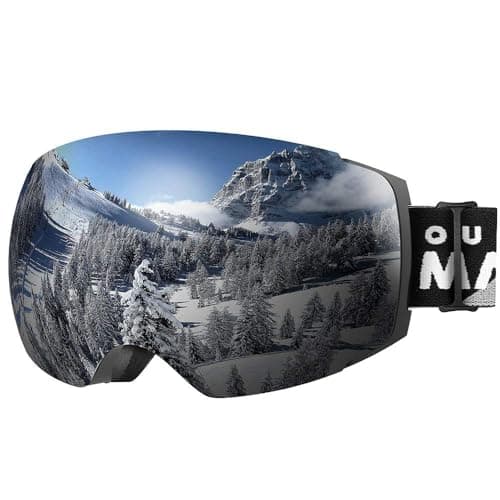
A magnetic lens swap at a published $49.99, with 100% UV400 and an over-the-glasses frame. Spare lenses are a separate purchase, so the real cost of a two-lens setup lands closer to the Smith than the sticker suggests.
- Published price
- $49.99
- Cost per day on snow
- $2.00 a day
- Amortized over
- 5 seasons (25 days)
- Certified to
- Not published
- UV protection
- 100% published
- Anti-fog
- Anti-fog coating
- Lenses included
- 1
- Published sizes
- One size
- Warranty
- No term published for goggles
What it gets right
- Magnetic lens change, workable in gloves on a lift
- 100% UV400 protection and an anti-fog coating
- Over-the-glasses frame at a published $49.99
What you give up
- One lens included; the interchangeable system only pays off after you buy another
- No published impact standard
The working behind the 6.1
- Cost per day on snow: 9.6
- $49.99 over 5 seasons at 5 days each = 25 days = $2.00 a day
- Published protection: 6.0
- 100% UV protection published (+4); no published impact standard (+0); anti-fog treatment published (+2); single lens (+0)
- Size availability: not scored
- Sold in one size, so size availability does not apply.
- Warranty and support: 0.0
- no published term (0 of 6); no published crash replacement (+0); no published repair route (+0)
Axes with unpublished inputs are dropped and the remaining weights re-normalized, so a product is not punished for a manufacturer’s silence. Specifications compiled September 3, 2026 from OutdoorMaster published specifications.
2 · A skier who wears glasses and does not want contacts
Bolle Y7 OTG
Skip this one. Skip it unless you wear glasses. It is a good goggle and it is here because the over-the-glasses frame is genuinely useful, but if you do not wear glasses you are paying for frame depth you will never use and getting one lens for it.
Built around the frame depth that lets a pair of glasses sit inside without the arms pressing, which is the only thing that actually distinguishes an over-the-glasses goggle. Double lens, treated inner surface, 100% UV.
- Published price
- $90
- Cost per day on snow
- $3.60 a day
- Amortized over
- 5 seasons (25 days)
- Certified to
- Not published
- UV protection
- 100% published
- Anti-fog
- Anti-fog and anti-scratch lens treatment
- Lenses included
- 1
- Published sizes
- One size
- Warranty
- No term published for goggles
Bolle publishes several Y7 OTG lens variants; the photochromic version is published at a higher price.
What it gets right
- Purpose-built over-the-glasses frame depth rather than a normal goggle sold as OTG
- 100% UV protection with anti-fog and anti-scratch lens treatment
- Double lens with vents top and bottom, the construction that resists fogging
What you give up
- One lens in the box, so flat-light days mean buying a second
- Deeper frame is bulkier against a helmet brow than a standard goggle
The working behind the 5.5
- Cost per day on snow: 8.4
- $90 over 5 seasons at 5 days each = 25 days = $3.60 a day
- Published protection: 6.0
- 100% UV protection published (+4); no published impact standard (+0); anti-fog treatment published (+2); single lens (+0)
- Size availability: not scored
- Sold in one size, so size availability does not apply.
- Warranty and support: 0.0
- no published term (0 of 6); no published crash replacement (+0); no published repair route (+0)
Axes with unpublished inputs are dropped and the remaining weights re-normalized, so a product is not punished for a manufacturer’s silence. Specifications compiled September 3, 2026 from Bolle published specifications.
3 · Anyone who skis in more than one kind of light
Smith Squad ChromaPop
The only goggle here that ships with a second lens in the box, which is the single change that makes a goggle usable in both bright sun and flat light. That, plus 100% UV and a treated inner lens, is the whole specification worth paying for.
- Published price
- $155
- Cost per day on snow
- $6.20 a day
- Amortized over
- 5 seasons (25 days)
- Certified to
- Not published
- UV protection
- 100% published
- Anti-fog
- Fog-X anti-fog inner lens
- Lenses included
- 2
- Published sizes
- One size
- Warranty
- No term published for goggles
What it gets right
- Two lenses in the box, so a flat-light day does not need a second purchase
- 100% UV protection and a Fog-X treated inner lens
- Cylindrical frame that sits flat against most helmet brows
What you give up
- $155 is more than three of the helmets on this site
- Smith publishes no impact standard for this goggle, so we cannot score it on one
- Sold in one frame size; the smaller and larger faces need a different model entirely
The working behind the 5.3
- Cost per day on snow: 6.5
- $155 over 5 seasons at 5 days each = 25 days = $6.20 a day
- Published protection: 8.0
- 100% UV protection published (+4); no published impact standard (+0); anti-fog treatment published (+2); 2 lenses included (+2)
- Size availability: not scored
- Sold in one size, so size availability does not apply.
- Warranty and support: 0.0
- no published term (0 of 6); no published crash replacement (+0); no published repair route (+0)
Axes with unpublished inputs are dropped and the remaining weights re-normalized, so a product is not punished for a manufacturer’s silence. Specifications compiled September 3, 2026 from Smith published specifications.
Prices last verified October 19, 2026. Prices move constantly; the figure on Amazon at the moment you click is the real one.
Questions people actually ask
What are the best ski goggles for all conditions?
There is no single lens that is genuinely good in bright sun and in a snowstorm. The two ways to cover both are a goggle that ships with two lenses, or a photochromic lens that darkens and lightens on its own. If you are buying one fixed lens, aim for a VLT around 25-45%.
How much should I spend on ski goggles?
For a family skiing a handful of days a year, a goggle with published 100% UV protection and an anti-fog inner lens does the job, and that starts around $30 for children and $50 for adults. Above that you are buying optics and extra lenses, which are real but not safety.
Can I use snowboard goggles for skiing?
Yes. There is no meaningful difference between goggles sold for skiing and goggles sold for snowboarding: same lenses, same frames, same construction.
How tight should ski goggles be?
Snug enough not to move when you shake your head, loose enough to leave no red mark and not squash the foam flat. Over-tightened foam blocks the vents, which is a common cause of fogging.
Do expensive ski goggles fog less?
Not necessarily. What reduces fogging is a double lens with an air gap, a treated inner pane, clear vents and a good seal at the nose, and all four exist at moderate prices. Habits matter as much: never wipe the inside of the lens and never park goggles on your forehead.