The best goggles for flat light, ranked on published VLT
Flat light is the condition that makes good skiers ski badly: no shadows, no texture, no idea where the next bump is. The lens fixes more of it than anything else you can buy.
By Sawyer V. · Published
We have not tested this gear. Everything below is compiled from published specifications and published safety standards, and the arithmetic is public so you can check it. This page carries affiliate links: if you buy through one we earn a commission at no extra cost to you, and it does not change the order of the picks. Full disclosure.
The short answer
In flat light you want the highest light transmission you own - roughly 40 to 70 percent VLT in a rose, amber or yellow tint. A dark lens removes contrast you cannot spare. The best buy is a goggle that ships with a second lens, because no single tint covers both a bluebird morning and a snowing afternoon. If you already own goggles, a spare light lens is far cheaper than a second goggle.
| # | Pick | Best for | Score | Price |
|---|---|---|---|---|
| 1 | Smith Squad ChromaPop Anyone who skis in more than one kind of light | $6.20 a dayon snow | 5.3/10 | $119.95 - View on Amazon |
| 2 | OutdoorMaster PRO Magnetic A skier who wants to change lenses without taking gloves off | $2.00 a dayon snow | 6.1/10 | $39.99 - View on Amazon |
| 3 | Smith Snowday A young child who will only ever own one lens, glasses or not | $5 a dayon snow | 5.1/10 | $50.00 - View on Amazon |
| 4 | OutdoorMaster Falcon Kids A first goggle, or a spare in the car for the one that gets lost | $3.00 a dayon snow | 5.8/10 | $24.99 - View on Amazon |
Prices last verified October 19, 2026. Prices move constantly; the figure on Amazon at the moment you click is the real one.
What flat light actually does
Flat light is not simply dim. On an overcast day the cloud layer scatters sunlight so it arrives from every direction at once, and light arriving from everywhere casts no shadows. Shadows are how you read a snow surface: a bump has a bright side and a dark side, and without that difference a mogul, a rut and a flat patch all look identical.
Snowfall makes it worse by adding a moving screen between you and the terrain. This is why competent skiers suddenly ski defensively in a whiteout - the technique is intact and the information is gone.
A lens cannot put shadows back. What it can do is let in more of the light that is there and increase the perceived difference between the blue-white of snow and the slightly darker blue-white of a hollow. That is the whole job, and it is worth more on these days than any other piece of equipment.
The number to shop on
Visible light transmission is the percentage of light a lens lets through, and it is the only figure in this category that means the same thing across brands. The full VLT guide is here; the short version for this page:
| VLT band | Conditions | Typical tint |
|---|---|---|
| About 5-20% | Bright sun on snow | Dark gray, black, heavy mirror |
| About 20-40% | Mixed sun and cloud | Rose, bronze, all-round tints |
| About 40-60% | Overcast, genuinely flat light | Rose, amber, light bronze |
| About 60-75% | Snowing, dusk, heavy storm | Yellow, high-contrast light tints |
| About 70-90% | Night skiing | Clear or very pale yellow |
For flat light you are shopping in the 40 to 70 percent range. The common error is buying by tint alone: a rose lens can be a 25 percent lens or a 55 percent lens depending on the model, and the tint name tells you nothing without the number. If a maker does not publish a VLT figure, you cannot match it to conditions - and this site treats that absence as information rather than filling it in.
Contrast-enhancing lenses, honestly
Most premium lenses are now sold on contrast enhancement rather than on VLT: selectively filtering specific wavelengths to widen the perceived gap between snow and shadow. It is a real technology and it is genuinely aimed at this exact problem.
The difficulty for a site that ranks on published figures is that no two brands publish a comparable contrast metric. Smith publishes a named contrast-enhancing lens on the Squad; other brands publish their own names. There is no shared number, so we cannot rank on it and we are not going to pretend otherwise. That rule is published. What we can rank on is VLT and lens count, and those are what the picks below turn on.
The picks
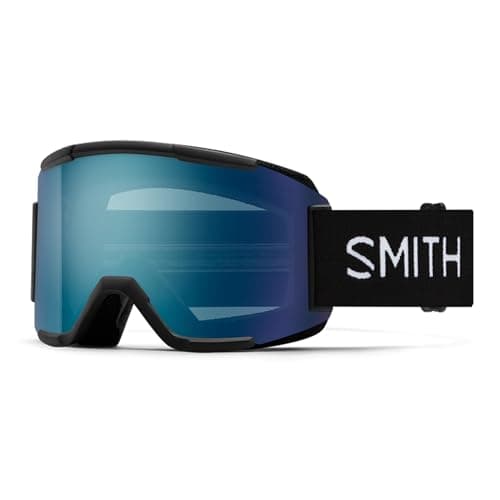
Smith Squad ChromaPop
The pick, for one structural reason: it is the only goggle in this ledger that publishes a second lens in the box. That matters more here than any single tint, because flat light is a condition rather than a place - it arrives halfway through an afternoon and leaves again - and the only complete answer is being able to change lens.
It also publishes 100% UV protection and a Fog-X treated inner lens, and the cylindrical frame sits flat against most helmet brows. Check which second lens the specific colorway includes before buying: a spare storm lens is what you want, and a spare mirror lens is not.
The honest cons: it is the most expensive goggle here, Smith publishes no impact standard for it, and it is sold in one frame size, so smaller and larger faces need a different model entirely.
OutdoorMaster PRO Magnetic
The other structural answer: a magnetic lens change that works in gloves. For flat light specifically, being able to swap on a lift rather than in a lodge is the difference between doing it and not bothering.
The catch is published plainly on the product page - one lens is included, so the two-lens setup is a second purchase and the real cost lands closer to the Smith than the sticker suggests. The lens-swap roundup compares the systems.
Smith Snowday, for a child
Publishes 36% VLT, which is deliberately middling: not ideal in a whiteout and not ideal in bright sun, but never badly wrong in either. For a child who will own exactly one lens, a published mid-range figure is worth more than a specialist one, because the specialist lens is the wrong lens half the time and children do not carry spares.
If you already own goggles
Do not buy a second goggle. Three cheaper options, in order:
- Buy a spare lens for the frame you own, if it takes interchangeable lenses. Cheapest by a wide margin. Check it is the lens made for your exact frame - universal replacements rarely seal.
- Check the VLT of the lens you already have. A surprising number of people own a mid-VLT lens and assume it is a sun lens.
- Ski the terrain rather than the visibility. On a genuinely flat day, tree runs give you contrast for free - the trunks are the shadows the open slope is missing.
The things that are not the lens
Two conditions get blamed on flat light and are actually something else. A goggle that is fogging gives you the same loss of contrast and is a wearing problem - a gaiter tucked inside the frame, or wet goggles parked on a warm forehead. The anti-fog page covers it, and the gaiter page covers the specific mistake.
And a scratched inner lens scatters light exactly the way flat light does. The inner surface carries the anti-fog treatment and wiping it destroys that treatment permanently, which is the single most common way a good goggle is ruined. Never wipe the inside.
Who should buy what
- You ski in the Pacific Northwest, the Northeast, or anywhere that snows. A two-lens goggle. This is your default condition, not an exception.
- You ski a handful of bluebird days a year. One mid-VLT lens around 30 to 40 percent and accept the compromise.
- You want to swap on the hill. A magnetic system, plus the second lens as a separate purchase.
- A child. A published mid-VLT figure, one lens, and a spare goggle rather than a spare lens. The kids roundup.
- Night skiing. Different problem, different lens. Covered separately.
Every pick, with the working
Each entry shows the published inputs, the axis scores they produce, and what you give up. The order is the computed order, not a commercial one, and the arithmetic is open underneath each score.
1 · Anyone who skis in more than one kind of light
Smith Squad ChromaPop
The only goggle here that ships with a second lens in the box, which is the single change that makes a goggle usable in both bright sun and flat light. That, plus 100% UV and a treated inner lens, is the whole specification worth paying for.
- Published price
- $155
- Cost per day on snow
- $6.20 a day
- Amortized over
- 5 seasons (25 days)
- Certified to
- Not published
- UV protection
- 100% published
- Anti-fog
- Fog-X anti-fog inner lens
- Lenses included
- 2
- Published sizes
- One size
- Warranty
- No term published for goggles
What it gets right
- Two lenses in the box, so a flat-light day does not need a second purchase
- 100% UV protection and a Fog-X treated inner lens
- Cylindrical frame that sits flat against most helmet brows
What you give up
- $155 is more than three of the helmets on this site
- Smith publishes no impact standard for this goggle, so we cannot score it on one
- Sold in one frame size; the smaller and larger faces need a different model entirely
The working behind the 5.3
- Cost per day on snow: 6.5
- $155 over 5 seasons at 5 days each = 25 days = $6.20 a day
- Published protection: 8.0
- 100% UV protection published (+4); no published impact standard (+0); anti-fog treatment published (+2); 2 lenses included (+2)
- Size availability: not scored
- Sold in one size, so size availability does not apply.
- Warranty and support: 0.0
- no published term (0 of 6); no published crash replacement (+0); no published repair route (+0)
Axes with unpublished inputs are dropped and the remaining weights re-normalized, so a product is not punished for a manufacturer’s silence. Specifications compiled September 3, 2026 from Smith published specifications.
2 · A skier who wants to change lenses without taking gloves off
OutdoorMaster PRO Magnetic
A magnetic lens swap at a published $49.99, with 100% UV400 and an over-the-glasses frame. Spare lenses are a separate purchase, so the real cost of a two-lens setup lands closer to the Smith than the sticker suggests.
- Published price
- $49.99
- Cost per day on snow
- $2.00 a day
- Amortized over
- 5 seasons (25 days)
- Certified to
- Not published
- UV protection
- 100% published
- Anti-fog
- Anti-fog coating
- Lenses included
- 1
- Published sizes
- One size
- Warranty
- No term published for goggles
What it gets right
- Magnetic lens change, workable in gloves on a lift
- 100% UV400 protection and an anti-fog coating
- Over-the-glasses frame at a published $49.99
What you give up
- One lens included; the interchangeable system only pays off after you buy another
- No published impact standard
The working behind the 6.1
- Cost per day on snow: 9.6
- $49.99 over 5 seasons at 5 days each = 25 days = $2.00 a day
- Published protection: 6.0
- 100% UV protection published (+4); no published impact standard (+0); anti-fog treatment published (+2); single lens (+0)
- Size availability: not scored
- Sold in one size, so size availability does not apply.
- Warranty and support: 0.0
- no published term (0 of 6); no published crash replacement (+0); no published repair route (+0)
Axes with unpublished inputs are dropped and the remaining weights re-normalized, so a product is not punished for a manufacturer’s silence. Specifications compiled September 3, 2026 from OutdoorMaster published specifications.
3 · A young child who will only ever own one lens, glasses or not
Smith Snowday
Smith's youth goggle on the RC36 lens, which is the useful part: 36% light transmission is the middle of the range, so one lens works on a gray morning and a bright afternoon without the child noticing either way. The spherical Carbonic-x lens and Fog-X treated inner lens are the same optical package Smith puts in its adult frames.
- Published price
- $50
- Cost per day on snow
- $5 a day
- Amortized over
- 2 seasons (10 days)
- Certified to
- Not published
- UV protection
- 100% published
- Anti-fog
- Fog-X anti-fog inner lens
- Lenses included
- 1
- Published sizes
- Youth fit medium
- Warranty
- No term published for goggles
What it gets right
- 36% VLT on the RC36 lens, which covers most of the conditions a family actually skis in
- 100% UVA and UVB protection with a Fog-X treated inner lens
- Spherical Carbonic-x lens published for distortion-free optics and impact resistance
- Published over-the-glasses compatibility, with a floating foam membrane that takes the pressure off eyeglass temples
- Dual-slide strap for size adjustment and a silicone-backed strap that stays put on a helmet
What you give up
- Single lens, so a genuinely dark or genuinely flat day is a compromise
- Published as a youth fit MEDIUM, so it is too big for the smallest faces
- $50 published for the RC36 lens, where the mirrored lenses are $60
- No warranty term published for Smith goggles
The working behind the 5.1
- Cost per day on snow: 7.4
- $50 over 2 seasons at 5 days each = 10 days = $5 a day
- Published protection: 6.0
- 100% UV protection published (+4); no published impact standard (+0); anti-fog treatment published (+2); single lens (+0)
- Size availability: not scored
- Sold in one size, so size availability does not apply.
- Warranty and support: 0.0
- no published term (0 of 6); no published crash replacement (+0); no published repair route (+0)
Axes with unpublished inputs are dropped and the remaining weights re-normalized, so a product is not punished for a manufacturer’s silence. Specifications compiled October 18, 2026 from Smith published specifications.
4 · A first goggle, or a spare in the car for the one that gets lost
OutdoorMaster Falcon Kids
Skip this one. It publishes 100% UV protection and an anti-fog coating at the lowest price here, which is genuinely all a first goggle needs. What it does not publish is a VLT figure, and on a page ranked entirely on light transmission a product with no published number cannot be recommended for the job. Buy it as a spare, not as a flat-light lens.
The cheapest published price here that still carries 100% UV protection and an anti-fog coating, which are the only two specs that matter on a child's first goggle. Everything above this price is buying optics, not safety.
- Published price
- $29.99
- Cost per day on snow
- $3.00 a day
- Amortized over
- 2 seasons (10 days)
- Certified to
- Not published
- UV protection
- 100% published
- Anti-fog
- Anti-fog coating
- Lenses included
- 1
- Published sizes
- Kids
- Warranty
- No term published for goggles
What it gets right
- 100% UV protection and an anti-fog coating at a published $29.99
- Cheap enough that losing it on a chairlift is annoying rather than expensive
What you give up
- No published VLT figure
- Single lens, no interchange system
The working behind the 5.8
- Cost per day on snow: 8.9
- $29.99 over 2 seasons at 5 days each = 10 days = $3.00 a day
- Published protection: 6.0
- 100% UV protection published (+4); no published impact standard (+0); anti-fog treatment published (+2); single lens (+0)
- Size availability: not scored
- Sold in one size, so size availability does not apply.
- Warranty and support: 0.0
- no published term (0 of 6); no published crash replacement (+0); no published repair route (+0)
Axes with unpublished inputs are dropped and the remaining weights re-normalized, so a product is not punished for a manufacturer’s silence. Specifications compiled September 3, 2026 from OutdoorMaster published specifications.
Prices last verified October 19, 2026. Prices move constantly; the figure on Amazon at the moment you click is the real one.
Questions people actually ask
What VLT is best for flat light?
Roughly 40 to 70 percent visible light transmission, in a rose, amber or yellow tint. Below about 30 percent you are removing contrast you cannot spare. Buy on the published number rather than the tint name, because a rose lens can be anywhere from 25 to 55 percent depending on the model.
What lens color is best for overcast skiing?
Rose, amber or yellow - but mostly because those tints are made in high-VLT versions rather than because the color itself is special. A high-VLT rose lens and a yellow lens of the same transmission do much the same job. The number is what matters.
Do I need two goggle lenses?
If you ski somewhere that snows regularly, yes - no single tint covers a bluebird morning and a whiteout afternoon. The cheapest route is a goggle that ships with two lenses, or a spare lens for a frame you already own. Two complete goggles is the most expensive way to solve it.
Why can't I see bumps in flat light?
Because cloud scatters sunlight so it arrives from every direction, and light from everywhere casts no shadows. Shadows are how you read a snow surface, so a mogul, a rut and a flat patch all look the same. A higher-VLT lens helps; tree runs help more, because the trunks supply the contrast.
Are contrast-enhancing lenses worth it for flat light?
They are aimed squarely at this problem and they are real. The difficulty is that no two brands publish a comparable contrast figure, so there is no way to rank them honestly against each other. We rank on published VLT and lens count, and treat contrast claims as unverifiable rather than false.
Sources
- Smith published Squad ChromaPop lens count, UV protection and Fog-X inner lens
- OutdoorMaster published PRO Magnetic lens change system, UV400 and included lens count
- Smith published Snowday RC36 lens, Fog-X inner lens and spherical Carbonic-x construction
- Smith RC36 lens published at 36% VLT (retailer spec sheet; Smith names the lens on the product page but no longer publishes a VLT table of its own)
- OutdoorMaster published Falcon Kids UV protection and anti-fog coating