Snowshoes or cross-country skis: which one suits your family
Both cost a fraction of a downhill setup and neither needs a lift ticket. They suit completely different people, and the deciding factor is usually the terrain outside your door.
By Sawyer V. · Published
We have not tested this gear. Everything below is compiled from published specifications and published safety standards, and the arithmetic is public so you can check it. This page carries affiliate links: if you buy through one we earn a commission at no extra cost to you, and it does not change the order of the picks. Full disclosure.
The short answer
Snowshoes if you want to walk where you already walk, with children, on varied or steep ground, with no lesson and almost no learning curve. Cross-country skis if you have groomed trails or flat open ground nearby, want a real workout, and are willing to spend a couple of sessions being bad at it. Snowshoes are cheaper to start and size by published load limits; cross-country packages size by published rider weight and need boots and bindings that match.
| # | Pick | Best for | Score | Price |
|---|---|---|---|---|
| 1 | MSR Evo Trail Snowshoes Packed trails and rolling terrain, one pair shared between adults | $6.80 a dayon snow | 3.9/10 | $167.00 - View on Amazon |
| 2 | Rossignol XC-2 Nordic Touring Boots An adult renting nordic skis for the third time and tired of rental boots | $12.00 a dayon snow | 3.3/10 | $116.97 - View on Amazon |
| 3 | Tubbs Wayfinder Snowshoes A heavier adult, or an adult carrying a child and a bag | $8.20 a dayon snow | 3.2/10 | $173.70 - View on Amazon |
| 4 | Whitewoods Adult NNN Cross-Country Ski Package A first cross-country setup, bought once, without a compatibility puzzle | Not publishedon snow | 0.9/10 | $379.99 - View on Amazon |
Prices last verified October 19, 2026. Prices move constantly; the figure on Amazon at the moment you click is the real one.
The actual difference
Snowshoes let you walk on snow you would otherwise sink into. That is the whole concept: they spread your weight, they add traction underfoot, and the skill required is walking with your feet slightly further apart than usual.
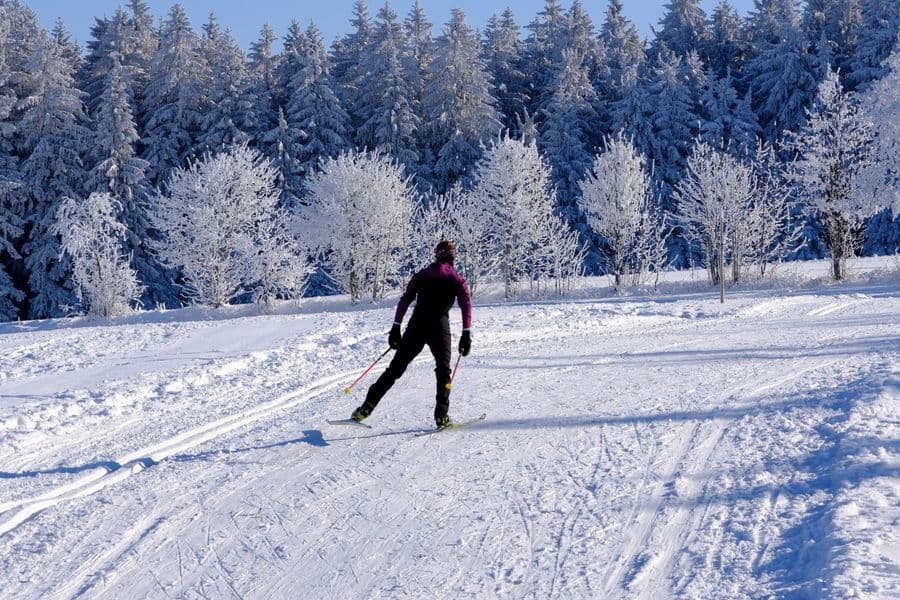
Cross-country skis let you glide. You are not walking; you are pushing off and sliding, which is faster and far more efficient over distance - and which is a technique that takes a few outings to stop feeling ridiculous.
| Snowshoes | Cross-country skis | |
|---|---|---|
| Learning curve | Minutes. If you can walk, you can snowshoe | A few sessions before it is fun rather than frustrating |
| Terrain | Anything - woods, hills, off-trail, deep snow | Flat to rolling, and much better on groomed track |
| Speed and distance | Walking pace, so a few miles is a day | Two to three times the distance in the same time |
| Workout | Steady, like hiking with weight | Full body, and genuinely hard |
| Kit required | Snowshoes, poles, winter boots you own | Skis, bindings, matched boots, poles |
| With young children | Works - they can stop, sit, throw snow | Hard until about school age |
What each actually costs to start
Both are cheap next to downhill skiing, and the difference between them is smaller than people expect once you count everything.
- Snowshoes need snowshoes, poles and the winter boots you already own. That last part is the real cost saving. The winter boots guide covers what works, and the poles page covers whether you need them at all.
- Cross-country needs skis, bindings, matched boots and poles. The boots are the part people forget: the sole standard has to match the binding system, which is why complete packages exist and why buying pieces separately goes wrong.
The Whitewoods Adult NNN Package publishes exactly that solution: skis, bindings, boots and poles already matched, with sizing published by dressed rider weight - 197 cm for 151 to 180 lb, 207 cm for 181 lb and up - and a machined waxless base, so there is no kick wax to learn. The packages page covers what to check in one.
Both size by weight, and both publish it
This is the useful thing these two categories have in common: they are sized by published load rather than by height.
Snowshoes
Sized by total load - you plus clothing plus pack. The Tubbs Wayfinder publishes three sizes against explicit bands: 25 in for 120 to 200 lb, 30 in for 170 to 250 lb, 36 in for 220 to 300 lb, with the bands deliberately overlapping so someone in between has a real choice. The MSR Evo Trail publishes a 180 lb limit that rises to 250 lb with add-on tails fitted, which means capacity can be increased later rather than replaced. The snowshoe sizing guide has the full method.
Cross-country skis
Sized by rider weight too, because a nordic ski has a camber that has to be flattened by your weight to grip. Too long or too stiff for you and the grip zone never touches the snow, so you slide backward on every push - which is what most people mistake for bad technique on their first outing. The cross-country page covers that in detail.
With children, honestly
Snowshoes win, and it is not close. A child on snowshoes can stop whenever they like, sit down, get up unaided, climb a bank, throw a snowball and keep going. A child on cross-country skis spends the first hour falling over on the flat, which is less fun than it sounds.
Kids’ snowshoes are sized by published load exactly like adult models - the kids snowshoe roundup compares them - and cost less than a day of lift tickets. Cross-country is a genuinely good family activity from roughly school age, especially on groomed track where the skis stay pointed where they should.
Which one you will actually keep doing
The honest tiebreaker after cost and terrain. Snowshoeing is walking, so it slots into a winter without any commitment - an hour after work, a detour on a drive, a thing you do because the snow is there. Cross-country skiing is a sport: it rewards repetition, it gets dramatically more enjoyable as technique improves, and it stalls if you go three times a season.
If the honest answer is a handful of outings a winter, snowshoes will get used and skis will not. If you want something to get better at, that is the argument for the skis.
Poles, which both use differently
Snowshoe poles are for balance and for taking load off your knees on a descent; they are optional on flat ground and genuinely useful on hills. Adjustable-length poles with snow baskets are the standard answer, and a pair of ski poles you already own will do.
Cross-country poles are propulsion, not balance. They are longer, they are used on every stride, and a pole that is too short costs you real efficiency. This is why cross-country packages ship with matched poles and snowshoe kits usually do not. The snowshoe poles page covers sizing for the first case, and the pole sizing chart covers the general method.
What you wear is different too
Both are aerobic, which changes the clothing rule completely from downhill skiing. On a chairlift you are cooling down; here you are working continuously, and the failure mode is overheating, sweating and then freezing on the walk back to the car.
- Dress to start slightly cold. If you are comfortable in the parking lot, you are overdressed. Five minutes in, you will be right.
- Layers you can shed and carry, which means a small pack rather than a big insulated jacket. Cross-country especially is done in far less clothing than people expect.
- Gaiters or high boots for snowshoeing - deep snow goes down the top of a boot on every step, and wet socks end the walk.
- Thin gloves, not ski gloves. Hands are working and holding poles; ski mittens are usually far too warm for either activity.
The base layer guide covers the fabric choice that matters most when you are sweating, and the mid layer picks compare the published gram weights worth carrying.
What each costs to run over five years
Neither activity has a lift ticket, which is most of the appeal. What they do have is different maintenance and different replacement cycles.
| Snowshoes | Cross-country skis | |
|---|---|---|
| Access | Free on most public land and trails | Often free; groomed nordic centers charge a trail fee |
| Maintenance | Essentially none - rinse salt off, check bindings | Waxless bases need cleaning; waxable bases need kick wax |
| Replacement | Decking and bindings outlast most owners | Skis last, boots wear out first |
| Growing children | New size every few years, sized by published load | New size every few years - skis, boots and poles together |
The children’s row is the honest reason many families end up on snowshoes: one item to replace rather than three, and the published load bands mean a hand-me-down can be checked against a number rather than guessed at.
Let the terrain decide
- Groomed nordic trails within reach? Cross-country, without much hesitation. Set track is what the equipment is designed for and it flattens the learning curve.
- Woods, hills, uneven ground, or no trail network? Snowshoes. They work anywhere there is snow and do not need a prepared surface.
- Deep fresh snow? Snowshoes, sized to the top of your load band.
- Hard, icy paths rather than snow? Neither - that is what ice cleats are for, and they cost a fraction of either.
The honest recommendation
If you are choosing one thing to buy for a family that already owns winter boots, buy the snowshoes. They are cheaper to complete, they work on whatever ground you have, nobody needs a lesson, and they get used on days too warm, too icy or too snowy for anything else.
Then rent cross-country gear for a day at a nordic center before buying it. If everyone enjoys the gliding, a package is one of the best-value purchases in winter sports. If they do not, you have spent the price of one day rather than a full setup that lives in the garage.
Every pick, with the working
Each entry shows the published inputs, the axis scores they produce, and what you give up. The order is the computed order, not a commercial one, and the arithmetic is open underneath each score.
1 · Packed trails and rolling terrain, one pair shared between adults
MSR Evo Trail Snowshoes
MSR publishes the number that decides whether snowshoes work: a 180 lb load limit, rising to 250 lb with add-on tails. Most brands publish a size chart instead and let you guess.
- Published price
- $169.95
- Cost per day on snow
- $6.80 a day
- Amortized over
- 5 seasons (25 days)
- Certified to
- Not published
- Published sizes
- One size, 22 in, with optional add-on tails
- Weight
- 1640 g
- Warranty
- No term published on the product page
What it gets right
- Published load limits: 180 lb, or 250 lb with tails fitted
- 1.64 kg per pair, light for a steel-traction snowshoe
- Tails are sold separately, so the capacity can be raised later rather than replaced
What you give up
- $169.95 is the most expensive snowshoe here
- One size only, so a heavier adult needs the tails as well
The working behind the 3.9
- Cost per day on snow: 6.1
- $169.95 over 5 seasons at 5 days each = 25 days = $6.80 a day
- Published protection: not scored
- Snowshoes carry no protective standard.
- Size availability: not scored
- Sold in one size, so size availability does not apply.
- Warranty and support: 0.0
- no published term (0 of 6); no published crash replacement (+0); no published repair route (+0)
Axes with unpublished inputs are dropped and the remaining weights re-normalized, so a product is not punished for a manufacturer’s silence. Specifications compiled September 3, 2026 from MSR published specifications.
2 · An adult renting nordic skis for the third time and tired of rental boots
Rossignol XC-2 Nordic Touring Boots
Fifteen published sizes from 35 to 49 is the widest range of any boot in this ledger, and on a cross-country boot that matters more than anywhere else because the boot is the only thing holding your foot to a ski that is not attached at the heel. Touring sole, central zipper over the laces, heat-moldable liner.
- Published price
- $179.95
- Cost per day on snow
- $12.00 a day
- Amortized over
- 3 seasons (15 days)
- Certified to
- Not published
- Published sizes
- EU 35 through 49 in whole sizes
- Warranty
- No term published on the product page
What it gets right
- Fifteen published whole sizes, EU 35 to 49, the widest run here
- Touring sole with central insert cleats published, which is the standard rental skis use
- Central zipper over the laces published, which is what keeps snow out of the tongue
- Thermoadjustable liner published as heat-moldable
What you give up
- No published warranty term
- No published insulation material, only a polyester thermoadjustable lining
- $179.95 is more than a season of nordic rentals in most places
The working behind the 3.3
- Cost per day on snow: 2.2
- $179.95 over 3 seasons at 5 days each = 15 days = $12.00 a day
- Published protection: not scored
- Boots carry no US protective standard, so this axis is not scored. On a winter boot the published temperature rating is the figure that matters; on a snowboard or nordic boot it is the sole standard and the fit.
- Size availability: 8.5
- 15 published sizes (8.5 of 8.5); no continuous adjuster published (+0); range: EU 35 through 49 in whole sizes
- Warranty and support: 0.0
- no published term (0 of 6); no published crash replacement (+0); no published repair route (+0)
Axes with unpublished inputs are dropped and the remaining weights re-normalized, so a product is not punished for a manufacturer’s silence. Specifications compiled September 12, 2026 from Rossignol published specifications.
3 · A heavier adult, or an adult carrying a child and a bag
Tubbs Wayfinder Snowshoes
The only snowshoe here that publishes a load band reaching 300 lb, which matters if you are a larger adult or carrying a small child. It is also the most expensive, and the size bands overlap enough that picking wrong is hard.
- Published price
- $204.95
- Cost per day on snow
- $8.20 a day
- Amortized over
- 5 seasons (25 days)
- Certified to
- Not published
- Published sizes
- 25 in (120-200 lb), 30 in (170-250 lb), 36 in (220-300 lb)
- Weight
- 1530 g
- Warranty
- No term published on the product page
What it gets right
- Three sizes published against explicit load bands from 120 lb to 300 lb
- 3 lb 6 oz per pair in the 30 in size
- Load bands overlap, so a person between two sizes has a real choice rather than a guess
What you give up
- $204.95, the most expensive item in this section
- The smallest size starts at 120 lb, so it does not cover children at all
The working behind the 3.2
- Cost per day on snow: 5.0
- $204.95 over 5 seasons at 5 days each = 25 days = $8.20 a day
- Published protection: not scored
- Snowshoes carry no protective standard.
- Size availability: 3.4
- 3 published sizes (3.4 of 8.5); no continuous adjuster published (+0); range: 25 in (120-200 lb), 30 in (170-250 lb), 36 in (220-300 lb)
- Warranty and support: 0.0
- no published term (0 of 6); no published crash replacement (+0); no published repair route (+0)
Axes with unpublished inputs are dropped and the remaining weights re-normalized, so a product is not punished for a manufacturer’s silence. Specifications compiled September 3, 2026 from Tubbs published specifications.
4 · A first cross-country setup, bought once, without a compatibility puzzle
Whitewoods Adult NNN Cross-Country Ski Package
The only complete cross-country package in this ledger, and the only one that publishes ski length against a dressed rider weight rather than height. Skis, Rottefella NNN Touring bindings, Whitewoods 302 NNN boots and poles arrive together and matched, which removes the compatibility problem that stops most people buying Nordic gear at all.
- Published price
- Not published
- Cost per day on snow
- Not published
- Amortized over
- 5 seasons (25 days)
- Certified to
- Not published
- Published sizes
- 197 cm published for 151-180 lb dressed weight, 207 cm for 181-210+ lb
- Warranty
- No term published on the product page
What it gets right
- Published sizing by dressed rider weight: 197 cm for 151-180 lb, 207 cm for 181 lb and up
- Complete package published: skis, bindings, boots and poles, already matched
- Machined negative waxless base published, so there is no kick wax to learn
- Rottefella NNN Touring bindings published, which is the common standard rather than a proprietary one
What you give up
- Two published lengths only, so lighter adults are not catered for at all
- Laminated wood core with cap construction; this is a touring package, not a performance ski
- No published warranty term
- Boot sizing is published per package, so the boot size and the ski length are not independently chosen
The working behind the 0.9
- Cost per day on snow: not scored
- No manufacturer-published price, so this axis is not scored.
- Published protection: not scored
- Skis carry no protective standard of their own. The binding release setting does, and a shop sets it.
- Size availability: 1.7
- 2 published sizes (1.7 of 8.5); no continuous adjuster published (+0); range: 197 cm published for 151-180 lb dressed weight, 207 cm for 181-210+ lb
- Warranty and support: 0.0
- no published term (0 of 6); no published crash replacement (+0); no published repair route (+0)
Axes with unpublished inputs are dropped and the remaining weights re-normalized, so a product is not punished for a manufacturer’s silence. Specifications compiled September 12, 2026 from Whitewoods published package contents and sizing.
Prices last verified October 19, 2026. Prices move constantly; the figure on Amazon at the moment you click is the real one.
Questions people actually ask
Are snowshoes or cross-country skis easier?
Snowshoes, by a wide margin. If you can walk, you can snowshoe within minutes. Cross-country skiing takes a few sessions to stop feeling awkward, because you are gliding rather than walking and the technique has to be learned.
Which is better for kids, snowshoeing or cross-country skiing?
Snowshoeing for young children: they can stop, sit, get up and play whenever they like, and the gear is sized by published weight bands. Cross-country works well from roughly school age, and much better on groomed track than on open snow.
Is snowshoeing a good workout compared to cross-country skiing?
Both are genuinely hard work, in different ways. Snowshoeing is steady and hiking-like, especially uphill in deep snow. Cross-country is a full-body effort and covers two to three times the distance in the same time, which is why it is a serious endurance sport.
How do I size snowshoes?
By total load - your body weight plus clothing and anything you carry - against the maker’s published band. Tubbs publishes 25, 30 and 36 inch sizes covering 120 to 300 lb, and MSR publishes a 180 lb limit that rises to 250 lb with add-on tails, so capacity can be raised later.
Can I use my winter boots for cross-country skiing?
No. Nordic bindings need a matching nordic boot, and the systems are not interchangeable between brands. That is why complete packages with pre-matched skis, bindings, boots and poles are the sensible way to start. Snowshoes, by contrast, work with the winter boots you already own.