The best snowshoes, sized on published load rather than guesswork
Snowshoes are sized by the total weight they have to float. Good makers publish that in pounds; the rest publish a length in inches and let you guess.
By Sawyer V. · Published
We have not tested this gear. Everything below is compiled from published specifications and published safety standards, and the arithmetic is public so you can check it. This page carries affiliate links: if you buy through one we earn a commission at no extra cost to you, and it does not change the order of the picks. Full disclosure.
The short answer
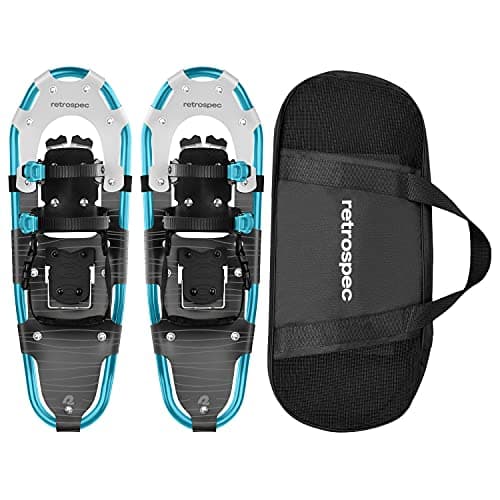
Size snowshoes against total load: your body weight plus clothing plus anything you carry. Good makers publish that as a range in pounds. For a family, the Retrospec Drifter at $149 is the pick, because it publishes three sizes covering 80 to 210 lb and is the only pair here that reaches down to a child.
| # | Pick | Best for | Score | Price |
|---|---|---|---|---|
| 1 | Retrospec Drifter Snowshoes A family where a child and an adult both need a pair | $5.96 a dayon snow | 4.0/10 | $49.99 - View on Amazon |
| 2 | MSR Evo Trail Snowshoes Packed trails and rolling terrain, one pair shared between adults | $6.80 a dayon snow | 3.9/10 | $167.00 - View on Amazon |
| 3 | Tubbs Wayfinder Snowshoes A heavier adult, or an adult carrying a child and a bag | $8.20 a dayon snow | 3.2/10 | $173.70 - View on Amazon |
Prices last verified October 19, 2026. Prices move constantly; the figure on Amazon at the moment you click is the real one.
The only spec that matters
A snowshoe works by spreading your weight over a larger area so you sink less. Too small for your load and you sink anyway, which defeats the purpose. Too large and it is awkward to walk in, catches on itself and tires you out.
So the number to look for is the published load range in pounds, and it should include everything: your body weight, your winter clothing, boots, and any pack or child you are carrying. Add roughly 10 to 15 lb to your body weight for a day out, more if you are carrying a toddler.
| Snowshoe | Published sizes | Load range | Price |
|---|---|---|---|
| Retrospec Drifter | 21, 25, 30 in | 80-120 lb, 110-160 lb, 160-210 lb | $149.00 |
| MSR Evo Trail | 22 in, one size | Up to 180 lb, or 250 lb with add-on tails | $169.95 |
| Tubbs Wayfinder | 25, 30, 36 in | 120-200 lb, 170-250 lb, 220-300 lb | $204.95 |
The tails idea, which is quietly clever
The MSR here publishes a 180 lb limit that rises to 250 lb with add-on tails sold separately. That is a real advantage for a family: one pair works for a lighter adult now and a heavier one, or one carrying a child, later, without buying a second pair.
It is also how you handle deep, soft snow. The same person needs more flotation on fresh powder than on a packed trail, and clipping tails on for a specific day is cheaper than owning two sizes.
What else to look at
- Binding. The strap system that holds your boot. Ratchet bindings are quicker with cold hands than webbing straps, which matters when a child needs adjusting for the third time.
- Traction. Steel crampons under the ball of the foot and steel rails along the frame. The frame rails matter on a traverse across a slope, where a snowshoe with only a toe crampon slides sideways.
- Weight per pair. Published by all three here, from 1.64 kg. You lift them with every step, so a few hundred grams is felt by the end of an afternoon.
- Heel lift bars. A wire bar that props your heel up on a steep climb, which transforms a long uphill. Not needed for a flat trail.
What a family actually needs to start
Very little, which is the appeal of this whole section.
- Snowshoes. One pair per person, sized on load.
- Waterproof boots. Any warm waterproof winter boot works; no special boot is needed.
- Gaiters, or waterproof pants. The snow you kick up goes at your ankles, and snow pants you already own for skiing cover this.
- Poles. Optional but genuinely helpful on uneven ground, and ordinary hiking poles with snow baskets work.
No lift ticket, no lesson and no fitting appointment. Walking in snowshoes is walking, with your feet slightly further apart. That is the whole technique.
Dress cooler than you think
Snowshoeing generates far more heat than skiing does, because it is continuous effort rather than intervals of activity and standing still. Start slightly cold and expect to shed the mid layer within fifteen minutes. The layering system is the same one, used differently.
Poles are the other purchase, and the one people get wrong by buying the pole rather than the basket on the end of it. The snowshoe poles page covers why a summer trekking basket is useless in soft snow, and whether the ski poles in your garage will do the job with one cheap change.
Children
Only the Retrospec here publishes a size that reaches down to 80 lb, which is roughly a nine- or ten-year-old. Below that, dedicated children’s snowshoes exist and are usually simple plastic decks; expect a young child to manage a much shorter distance than you plan for.
For a family day out with a younger child, a sled is frequently the better answer and costs less. The sled picks.
Every pick, with the working
Each entry shows the published inputs, the axis scores they produce, and what you give up. The order is the computed order, not a commercial one, and the arithmetic is open underneath each score.
1 · A family where a child and an adult both need a pair
Retrospec Drifter Snowshoes
Three published sizes mapped to weight ranges from 80 to 210 lb, which is the honest way to size a snowshoe and the reason this is the one to buy for a mixed-age family rather than for one adult.
- Published price
- $149
- Cost per day on snow
- $5.96 a day
- Amortized over
- 5 seasons (25 days)
- Certified to
- Not published
- Published sizes
- 21 in (80-120 lb), 25 in (110-160 lb), 30 in (160-210 lb)
- Weight
- 1900 g
- Warranty
- Limited warranty; no term published
What it gets right
- Three sizes published against explicit weight ranges, starting at 80 lb
- 6061-T6 aluminum frame
- $149 published, twenty dollars under the MSR
What you give up
- 1.9 kg per pair in the 25 in size, heavier than the MSR
- Limited warranty with no published term
The working behind the 4.0
- Cost per day on snow: 6.7
- $149 over 5 seasons at 5 days each = 25 days = $5.96 a day
- Published protection: not scored
- Snowshoes carry no protective standard.
- Size availability: 3.4
- 3 published sizes (3.4 of 8.5); no continuous adjuster published (+0); range: 21 in (80-120 lb), 25 in (110-160 lb), 30 in (160-210 lb)
- Warranty and support: 0.0
- no published term (0 of 6); no published crash replacement (+0); no published repair route (+0)
Axes with unpublished inputs are dropped and the remaining weights re-normalized, so a product is not punished for a manufacturer’s silence. Specifications compiled September 3, 2026 from Retrospec published specifications.
2 · Packed trails and rolling terrain, one pair shared between adults
MSR Evo Trail Snowshoes
MSR publishes the number that decides whether snowshoes work: a 180 lb load limit, rising to 250 lb with add-on tails. Most brands publish a size chart instead and let you guess.
- Published price
- $169.95
- Cost per day on snow
- $6.80 a day
- Amortized over
- 5 seasons (25 days)
- Certified to
- Not published
- Published sizes
- One size, 22 in, with optional add-on tails
- Weight
- 1640 g
- Warranty
- No term published on the product page
What it gets right
- Published load limits: 180 lb, or 250 lb with tails fitted
- 1.64 kg per pair, light for a steel-traction snowshoe
- Tails are sold separately, so the capacity can be raised later rather than replaced
What you give up
- $169.95 is the most expensive snowshoe here
- One size only, so a heavier adult needs the tails as well
The working behind the 3.9
- Cost per day on snow: 6.1
- $169.95 over 5 seasons at 5 days each = 25 days = $6.80 a day
- Published protection: not scored
- Snowshoes carry no protective standard.
- Size availability: not scored
- Sold in one size, so size availability does not apply.
- Warranty and support: 0.0
- no published term (0 of 6); no published crash replacement (+0); no published repair route (+0)
Axes with unpublished inputs are dropped and the remaining weights re-normalized, so a product is not punished for a manufacturer’s silence. Specifications compiled September 3, 2026 from MSR published specifications.
3 · A heavier adult, or an adult carrying a child and a bag
Tubbs Wayfinder Snowshoes
Skip this one. Skip it unless you are at the heavy end. It publishes the widest load bands here, up to 300 lb, and that is genuinely useful for a larger adult or someone carrying a child. For everyone else it is the most expensive pair on the page for capacity you will not use, and its smallest size starts at 120 lb, so it does not cover children at all.
The only snowshoe here that publishes a load band reaching 300 lb, which matters if you are a larger adult or carrying a small child. It is also the most expensive, and the size bands overlap enough that picking wrong is hard.
- Published price
- $204.95
- Cost per day on snow
- $8.20 a day
- Amortized over
- 5 seasons (25 days)
- Certified to
- Not published
- Published sizes
- 25 in (120-200 lb), 30 in (170-250 lb), 36 in (220-300 lb)
- Weight
- 1530 g
- Warranty
- No term published on the product page
What it gets right
- Three sizes published against explicit load bands from 120 lb to 300 lb
- 3 lb 6 oz per pair in the 30 in size
- Load bands overlap, so a person between two sizes has a real choice rather than a guess
What you give up
- $204.95, the most expensive item in this section
- The smallest size starts at 120 lb, so it does not cover children at all
The working behind the 3.2
- Cost per day on snow: 5.0
- $204.95 over 5 seasons at 5 days each = 25 days = $8.20 a day
- Published protection: not scored
- Snowshoes carry no protective standard.
- Size availability: 3.4
- 3 published sizes (3.4 of 8.5); no continuous adjuster published (+0); range: 25 in (120-200 lb), 30 in (170-250 lb), 36 in (220-300 lb)
- Warranty and support: 0.0
- no published term (0 of 6); no published crash replacement (+0); no published repair route (+0)
Axes with unpublished inputs are dropped and the remaining weights re-normalized, so a product is not punished for a manufacturer’s silence. Specifications compiled September 3, 2026 from Tubbs published specifications.
Prices last verified October 19, 2026. Prices move constantly; the figure on Amazon at the moment you click is the real one.
Questions people actually ask
What size snowshoes do I need?
Size against total load: body weight plus clothing plus anything you carry, which is usually 10 to 15 lb above your body weight. Look for a maker who publishes a load range in pounds rather than only a length in inches.
Do you need special boots for snowshoeing?
No. Any warm waterproof winter boot works. Snowshoe bindings are designed to accept ordinary boots, which is a large part of why this is such a cheap way to spend a day in the snow.
Is snowshoeing hard?
The technique is walking with your feet slightly further apart. The effort is real: it is continuous, so expect to be warm within fifteen minutes and to cover less distance than you would on a summer trail.
What are snowshoe tails for?
Add-on tails clip to the back of a snowshoe to increase surface area and raise its load limit. They let one pair cover a heavier load or deeper snow without buying a second size.
Can kids go snowshoeing?
Yes, with a pair sized for their weight. Only one of the pairs here publishes a size reaching down to 80 lb; below that, look at dedicated children’s snowshoes and plan a much shorter route than you would for adults.