The best ice cleats, and why the parking lot is the dangerous part of a ski day
Nobody buys traction for the walk from the car. It is still the stretch of a ski trip where people get hurt, in ski boots, on a sheet of polished ice, carrying everything they own.
By Sawyer V. · Published
We have not tested this gear. Everything below is compiled from published specifications and published safety standards, and the arithmetic is public so you can check it. This page carries affiliate links: if you buy through one we earn a commission at no extra cost to you, and it does not change the order of the picks. Full disclosure.
The short answer
For the walk from the car to the lodge, buy coils, not spikes. The Yaktrax Pro is the one to get if you will be walking in ski or snow boots: it publishes a thicker 1.4 mm coil, a removable over-foot strap that stops it rolling off a bulky heel, and a tested cold rating of -41F. If the icy part of your winter is trails rather than pavement, step up to spikes. Size to the boot you will actually be wearing, not your sneaker size.
| # | Pick | Best for | Score | Price |
|---|---|---|---|---|
| 1 | Yaktrax Walk Traction Device Icy parking lots, sidewalks and the walk from the car to the lodge | $1.50 a dayon snow | 6.0/10 | $18.60 - View on Amazon |
| 2 | Yaktrax Pro Traction Device Anyone walking in ski or snow boots, where a strapless band slips off | $2.00 a dayon snow | 6.2/10 | $29.99 - View on Amazon |
| 3 | Kahtoola EXOspikes Footwear Traction Mixed pavement and packed trail, where steel spikes are overkill | $5.33 a dayon snow | 5.8/10 | $79.95 - View on Amazon |
| 4 | Kahtoola MICROspikes Footwear Traction Real ice, icy trails, and anyone walking a dog before the drive to the hill | $6.00 a dayon snow | 6.1/10 | $89.95 - View on Amazon |
Prices last verified October 19, 2026. Prices move constantly; the figure on Amazon at the moment you click is the real one.
The most dangerous hundred yards of a ski day
A ski resort spends real money keeping the slopes safe and almost none keeping the parking lot from turning into a skating rink. The lot gets driven on, packed down, melted by warm tires at midday and refrozen by four o’clock, which produces a surface no winter boot tread was designed for.
Now add the way people cross it: in unbuckled ski boots with zero ankle articulation, carrying skis over one shoulder, holding a child’s hand, at the end of a day when their legs are finished. That is the accident, and it happens to people who skied all day without falling once.
A traction device is the cheapest piece of safety equipment on this entire site. The one on this page costs less than a resort lunch and lives in a jacket pocket. It is worth owning for the same reason a helmet is: the failure it prevents is the one you do not see coming.
Coils, carbide and spikes: three different products
Everything in this category gets called an ice cleat, and the three designs are not interchangeable. What separates them is what touches the ground and how deep it goes.
| Design | What grips | Published for | Wrong for |
|---|---|---|---|
| Steel coils (Yaktrax Walk, Pro) | Wire coils wrapped around an elastomer or rubber band | Packed snow, slush and mixed conditions | Hard glare ice and steep ground |
| Carbide lugs (Kahtoola EXOspikes) | Twelve tungsten carbide tips in TPU lugs | Road-to-trail, moving between icy streets and moderate trail | Deep unconsolidated snow |
| Steel spikes (Kahtoola MICROspikes) | Twelve 400-series stainless spikes, 10.4 mm, on welded chain | Ice and packed snow in mountainous terrain | Pavement-only use, and any indoor floor |
| Nothing at all | Your boot tread | Dry pavement, fresh soft snow | The refrozen afternoon parking lot |
For the buyer this site is written for - a family that skis a few days a year - coils are almost always the right answer. They grip the surface a resort actually has, they cost a quarter of what spikes cost, and they will not gouge a lodge floor or the mat in your car footwell.
What these makers publish, which is unusually a lot
Most soft-goods categories on this site publish adjectives. Traction is the happy exception: coil gauge, spike count, spike length, per-pair weight and size bands in real shoe sizes are all stated, so the comparison below is arithmetic rather than opinion.
| Product | Grip | Sizes | Published warranty |
|---|---|---|---|
| Yaktrax Walk | 1.2 mm high-strength steel coils | 4 bands, women's 2.5-6 to women's 13-15 | 90-day replacement of defective parts |
| Yaktrax Pro | 1.4 mm abrasion-resistant coils, tested to -41F | 4 bands, women's 6.5-10 to women's 15.5+ | 90-day replacement of defective parts |
| Kahtoola EXOspikes | 12 tungsten carbide spikes per foot | 5 bands, XS to XL in US and EU sizes | 4-year limited warranty |
| Kahtoola MICROspikes | 12 stainless spikes per foot at 10.4 mm | 6 bands, XS to XXL, plus an insulated-boot chart | 4-year limited warranty |
Size it to the boot, not to your shoe
This is the single most common mistake in the category. These devices are sized to the footwear you stretch them over, and a size 9 winter boot is dimensionally nothing like a size 9 sneaker - it is wider, taller in the heel and thicker in the sole.
- Yaktrax states it plainly: for oversized shoes or boots, buy one size larger than your normal shoe size.
- Kahtoola publishes a separate size chart for insulated boots on the MICROspikes page, which is the most useful single piece of documentation in this category and the reason that product fits ski-trip footwear predictably.
- Too small is the failure mode that hurts: the band stretches thin, rolls toward the arch and comes off mid-stride, usually on the step where you needed it.
If you plan to wear them over winter boots, measure the boot rather than guessing from the shoe you had on when you ordered.
The picks
Yaktrax Walk
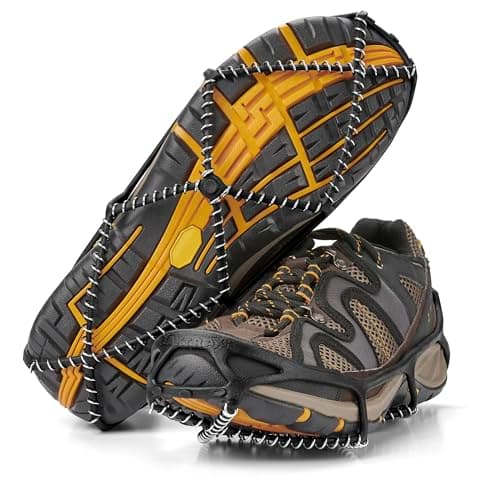
The cheapest useful answer, and for a lot of families the only one they need. Yaktrax publishes 1.2 mm steel coils on a polyelastomer band, four size bands stated in women’s and men’s shoe sizes, and the intended terrain in plain words: packed snow, slush and mixed conditions. That is a description of a resort parking lot in February.
It has no spikes, which sounds like a downside and is partly a feature - you can walk across a lodge floor or a bathroom tile in them without leaving a trail of gouges, and you will not shred your car mats on the drive home.
Honest cons: coils are not spikes, so hard blue ice on any kind of slope is outside what this is for. The elastomer band is the part that wears out. And the warranty is 90 days.
Yaktrax Pro
The pick for anyone crossing a lot in ski boots, and the difference is one strap. The Pro adds a removable over-foot strap on a natural rubber frame, which is what stops the band walking itself off the back of a tall, stiff, smooth-heeled boot. It also publishes a thicker 1.4 mm abrasion-resistant coil and the only cold-temperature figure in this group: tested safe from breakage down to -41F.
That cold number matters more than it looks. Elastomer and rubber stiffen as the temperature drops, and a band that is brittle at dawn in a Rocky Mountain lot is a band that splits while you are stretching it over a boot with cold hands.
Honest cons: it is still a coil device, so steep or glare ice is not its job. It costs about a third more than the Walk for a difference most walkers only notice on boots. Same 90-day warranty.
Kahtoola EXOspikes
The step up that makes sense for someone whose winter includes actual ice. Twelve tungsten carbide spikes per foot set in aluminum and TPU lugs, a published 208 g per pair in medium, five size bands given in US men’s, US women’s and EU sizes, and a four-year warranty. Kahtoola calls it road-to-trail, and that is the honest description: it bites on frozen sidewalk and on packed trail without being the full mountaineering answer.
If you walk a dog before the drive to the hill, or the path from your rental condo to the lifts is a refrozen boot-pack, this is the one that stops being annoying.
Honest cons: carbide tips are shorter than the MICROspikes’ 10.4 mm steel, so they bite less in deeper snow. It is over three times the price of the Walk. And spikes on a lodge floor are a problem, so these come off at the door.
Kahtoola MICROspikes
The most thoroughly specified product in this category and the skip for most readers of this page. Twelve heat-treated 400-series stainless spikes per foot at a published 10.4 mm, welded stainless chains, six sizes, per-size weights from 285 g to 422 g a pair, a separate published fit chart for insulated boots, and a four-year warranty.
Everything about it is better documented than its rivals. It is also the heaviest and the most expensive thing here, and it is engineered for icy trails in mountainous terrain. Buy it if you hike in winter. For a hundred yards of parking lot, you are carrying 338 g of stainless steel to solve a problem that 1.4 mm of coil already solved.
Fitting them over the three kinds of footwear you actually own
Traction devices are stretched over a shoe, so the shoe decides how well they work. There are three cases on a ski trip and they behave differently.
- Winter boots. The easy case, and what these are designed around. A lugged rubber sole gives the band something to grip and the heel gives it something to hook behind. Size up one from your shoe size, as Yaktrax states.
- Ski or snowboard boots. The hard case. A ski boot heel is smooth, tall and hard, and a plain elastomer band slides off it. This is where the Yaktrax Pro’s removable over-foot strap stops being a nice extra and becomes the reason the thing stays on. If your device has no strap, do not count on it over a ski boot.
- Sneakers or town shoes. Works, and this is the use most people get the most value from - the walk from a parking garage to a restaurant in an icy resort town. Coils are better than spikes here, because spikes on a cleared sidewalk wear down and skitter.
What they do not replace
Worth being clear about the boundaries of this category, because the marketing is cheerful about all of them.
| Situation | Cleats? | What actually works |
|---|---|---|
| Icy parking lot, flat | Yes - this is exactly the use case | Coils are enough |
| Packed icy trail on foot | Yes, spikes | Carbide or steel spikes with a published size chart |
| Deep unpacked snow | No | Snowshoes, sized by published load |
| Steep icy slopes, mountaineering | No | Crampons and training; outside this site's scope |
| Driving, indoors, stairs with hard treads | No | Take them off |
The line between the second and third rows is where snowshoes take over: cleats grip a hard surface, snowshoes float on a soft one, and neither does the other’s job. The traction guide covers the full range, and the backcountry page is where the fourth row goes.
Two rules about when to take them off
- Indoors, always. Coils are survivable on a hard floor; spikes are not, and neither is safe on a wet tile entryway, where metal on tile is its own kind of skating rink.
- Never drive in them. Metal against a pedal is exactly as bad an idea as it sounds. They come off before you get in the car, which is also when you are most likely to lose one - clip them to a bag rather than putting them on the roof.
What to check each autumn
These live in a drawer for eight months and then get grabbed in the dark on the first icy morning, which is exactly the wrong moment to discover a problem. Two minutes in November is worth it.
- Stretch the band fully. Elastomer perishes with age and UV. Cracking at the stretch points means it will split the first time you pull it over a boot in the cold.
- Look for rust and count the coils. A broken coil leaves a gap with no grip, and a rusted one is on its way to breaking.
- Check spikes for wear on spiked models - carbide and steel tips blunt on pavement faster than on ice.
- Put them in the car, not the house. They are only useful where the ice is, and the place you need them is the parking lot you are already standing in.
Care, which is two lines
Rinse the salt off and dry them before they go in a drawer. Road salt is what eats the steel, and a device stored wet in a warm bag is a device with a rusted coil in October. The end-of-season storage page covers the rest of what gets put away wet and regretted.
Who should buy what
- A family driving to a resort a few days a year. The Yaktrax Walk, one pair per adult. Children stay off the ice, not on it in cleats.
- Anyone crossing the lot in ski boots. The Yaktrax Pro, for the strap.
- Winter walkers and dog owners. The EXOspikes, for the carbide and the four-year warranty.
- Anyone on genuinely icy trails. The MICROspikes, and use the insulated-boot chart rather than guessing.
- Anyone on hard-packed trails on foot. The wider traction guide covers where cleats stop and snowshoes start.
Every pick, with the working
Each entry shows the published inputs, the axis scores they produce, and what you give up. The order is the computed order, not a commercial one, and the arithmetic is open underneath each score.
1 · Icy parking lots, sidewalks and the walk from the car to the lodge
Yaktrax Walk Traction Device
The cheapest thing on this site that meaningfully reduces the odds of falling in a resort parking lot. Yaktrax publishes 1.2 mm steel coils on a polyelastomer band and four size bands in real shoe sizes, and states the intended terrain as packed snow, slush and mixed conditions - which is exactly where a family walks in ski boots.
- Published price
- $22.49
- Cost per day on snow
- $1.50 a day
- Amortized over
- 3 seasons (15 days)
- Certified to
- Not published
- Published sizes
- Four bands from women's 2.5-6 / men's 1-4.5 up to women's 13-15 / men's 11.5-13.5
- Warranty
- 90-day replacement of defective parts
What it gets right
- 1.2 mm high-strength steel coils published, with 70 percent recycled content
- Four published size bands stated in women's and men's shoe sizes rather than S/M/L
- No spikes, so it can be worn on the hard floors of a lodge without gouging them
- Packs flat into a jacket pocket and costs less than a resort lunch
What you give up
- Coils, not spikes: grip on hard blue ice is nothing like a spiked device
- The elastomer band is the part that fails, and the warranty is 90 days
- Yaktrax publishes no cold-temperature rating for this model, only for the Pro
The working behind the 6.0
- Cost per day on snow: 10.0
- $22.49 over 3 seasons at 5 days each = 15 days = $1.50 a day
- Published protection: not scored
- This category carries no protective standard.
- Size availability: 5.1
- 4 published sizes (5.1 of 8.5); no continuous adjuster published (+0); range: Four bands from women's 2.5-6 / men's 1-4.5 up to women's 13-15 / men's 11.5-13.5
- Warranty and support: 0.0
- no published term (0 of 6); no published crash replacement (+0); no published repair route (+0)
Axes with unpublished inputs are dropped and the remaining weights re-normalized, so a product is not punished for a manufacturer’s silence. Specifications compiled September 23, 2026 from Yaktrax published Walk specifications.
2 · Anyone walking in ski or snow boots, where a strapless band slips off
Yaktrax Pro Traction Device
The Walk with the two upgrades that matter on a ski trip: a thicker 1.4 mm abrasion-resistant coil, and a removable over-foot strap that stops the band rolling off a boot heel. It is also the only device here with a published cold rating - Yaktrax states it is tested safe from breakage down to -41F.
- Published price
- $29.99
- Cost per day on snow
- $2.00 a day
- Amortized over
- 3 seasons (15 days)
- Certified to
- Not published
- Published sizes
- Four bands from women's 6.5-10 / men's 5-8.5 up to women's 15.5+ / men's 14+
- Warranty
- 90-day replacement of defective parts
What it gets right
- 1.4 mm abrasion-resistant steel coils, a step up from the Walk's 1.2 mm
- Published as tested safe from breakage in temperatures as low as -41F
- Removable over-foot strap on a natural rubber frame, which is what keeps it on a bulky boot
- Four published size bands, including one that goes to men's 14 and up
What you give up
- Still coils rather than spikes, so steep or glare ice is outside what it is for
- About a third more than the Walk for a difference most walkers feel only on boots
- Same 90-day warranty term as the cheaper model
The working behind the 6.2
- Cost per day on snow: 9.6
- $29.99 over 3 seasons at 5 days each = 15 days = $2.00 a day
- Published protection: not scored
- This category carries no protective standard.
- Size availability: 6.6
- 4 published sizes (5.1 of 8.5); continuous in-size adjuster published (+1.5); range: Four bands from women's 6.5-10 / men's 5-8.5 up to women's 15.5+ / men's 14+
- Warranty and support: 0.0
- no published term (0 of 6); no published crash replacement (+0); no published repair route (+0)
Axes with unpublished inputs are dropped and the remaining weights re-normalized, so a product is not punished for a manufacturer’s silence. Specifications compiled September 23, 2026 from Yaktrax published Pro specifications.
3 · Mixed pavement and packed trail, where steel spikes are overkill
Kahtoola EXOspikes Footwear Traction
Twelve tungsten carbide spikes per foot set in aluminum and TPU lugs, at a published 7.3 oz per pair in medium - roughly two thirds the weight of the MICROspikes. Kahtoola describes it as road-to-trail, which is the honest description: it is the one to own if the icy part of your day is pavement rather than a mountain.
- Published price
- $79.95
- Cost per day on snow
- $5.33 a day
- Amortized over
- 3 seasons (15 days)
- Certified to
- Not published
- Published sizes
- XS to XL, published in US men's, US women's and EU shoe sizes
- Weight
- 208 g
- Warranty
- Kahtoola 4-year limited warranty
What it gets right
- Twelve tungsten carbide spikes per foot, published, in a TPU traction matrix
- 208 g per pair in medium published, the lightest spiked option here
- Five published size bands given in US men's, US women's and EU sizes
- Four-year limited warranty, the longest published term in this group
What you give up
- Carbide tips are shorter than the MICROspikes' 10.4 mm steel, so deep snow bites less
- Over three times the price of the Yaktrax Walk
- Spikes on a lodge floor are a problem; these come off before you go inside
The working behind the 5.8
- Cost per day on snow: 7.2
- $79.95 over 3 seasons at 5 days each = 15 days = $5.33 a day
- Published protection: not scored
- This category carries no protective standard.
- Size availability: 6.8
- 5 published sizes (6.8 of 8.5); no continuous adjuster published (+0); range: XS to XL, published in US men's, US women's and EU shoe sizes
- Warranty and support: 2.5
- 4 yr (2.5 of 6); no published crash replacement (+0); no published repair route (+0)
Axes with unpublished inputs are dropped and the remaining weights re-normalized, so a product is not punished for a manufacturer’s silence. Specifications compiled September 23, 2026 from Kahtoola published EXOspikes specifications.
4 · Real ice, icy trails, and anyone walking a dog before the drive to the hill
Kahtoola MICROspikes Footwear Traction
Skip this one. The best-specified product on this page and the wrong one for most of the people reading it. Twelve 10.4 mm steel spikes are built for icy mountain trails, not for a hundred yards of resort parking lot - and they are the heaviest thing here, four times the price of the Yaktrax Walk, and have to come off before you walk into a lodge. Buy them if you hike on ice. For the walk to the gondola, the coils do the job.
The most specified product in this category: twelve 400-series stainless spikes per foot at a published 0.41 in (10.4 mm), welded stainless chains, six sizes, per-size weights, and a separate size chart for insulated boots. It is the only one here that publishes a fit chart for the boots a ski trip actually involves.
- Published price
- $89.95
- Cost per day on snow
- $6.00 a day
- Amortized over
- 3 seasons (15 days)
- Certified to
- Not published
- Published sizes
- XS to XXL, published in US men's, US women's and EU sizes, with a separate insulated-boot chart
- Weight
- 338 g
- Warranty
- Kahtoola 4-year limited warranty
What it gets right
- Twelve heat-treated 400-series stainless spikes per foot at a published 10.4 mm
- Six published sizes plus a separate published chart for insulated boots
- Per-size weights published, 285 g to 422 g per pair
- Four-year limited warranty
What you give up
- The most expensive device here, roughly four times the Yaktrax Walk
- 338 g per pair in medium, the heaviest here, and you feel it clipped to a bag
- Aggressive spikes are wrong for pavement-only use and must come off indoors
The working behind the 6.1
- Cost per day on snow: 6.7
- $89.95 over 3 seasons at 5 days each = 15 days = $6.00 a day
- Published protection: not scored
- This category carries no protective standard.
- Size availability: 8.5
- 6 published sizes (8.5 of 8.5); no continuous adjuster published (+0); range: XS to XXL, published in US men's, US women's and EU sizes, with a separate insulated-boot chart
- Warranty and support: 2.5
- 4 yr (2.5 of 6); no published crash replacement (+0); no published repair route (+0)
Axes with unpublished inputs are dropped and the remaining weights re-normalized, so a product is not punished for a manufacturer’s silence. Specifications compiled September 23, 2026 from Kahtoola published MICROspikes specifications.
Prices last verified October 19, 2026. Prices move constantly; the figure on Amazon at the moment you click is the real one.
Questions people actually ask
Do I really need ice cleats for a ski trip?
You need them for the parking lot rather than the mountain. Resort lots get packed, melted and refrozen daily, and people cross them in unbuckled ski boots carrying gear. A coil device costs less than a resort lunch and folds into a pocket, which is a cheap answer to the part of the day most likely to hurt someone.
Coils or spikes for walking on ice?
Coils for packed snow, slush and mixed conditions, which is what a resort lot and most sidewalks actually are. Spikes for hard ice and icy trails. Spikes also have to come off indoors and should never be worn while driving, so for short crossings they are more equipment than the job needs.
Will ice cleats fit over ski boots?
Some will, if you size up and pick one with a strap. Yaktrax tells you to buy one size larger than your normal shoe size for oversized boots, and the Pro adds a removable over-foot strap that stops the band rolling off a tall smooth heel. Kahtoola publishes a separate size chart for insulated boots on its MICROspikes page.
Can you wear ice cleats indoors or while driving?
No to both. Metal coils or spikes on a wet lodge floor are their own slipping hazard and will mark the floor, and anything metal between your foot and a car pedal is a genuinely bad idea. Take them off at the door and clip them to a bag so they do not get left on the roof of the car.
How long do ice cleats last?
The published warranty is the honest guide: Yaktrax states 90 days for defective parts, Kahtoola states four years. On coil devices the elastomer band is what fails, usually after being stretched over boots in the cold and stored wet. Rinse road salt off and dry them before storage and you will get more seasons out of either.
Sources
- Yaktrax published Walk coil gauge, materials, size bands and warranty terms
- Yaktrax published Pro coil gauge, over-foot strap, -41F cold test and size bands
- Kahtoola published EXOspikes spike count, materials, per-size weights and 4-year warranty
- Kahtoola published MICROspikes spike length, sizes, insulated-boot chart and warranty