Kids' snowshoes, sized by published load rather than by age
Every maker labels these by age and every one of them publishes a weight limit instead. The weight limit is the number that matters.
By Sawyer V. · Published
We have not tested this gear. Everything below is compiled from published specifications and published safety standards, and the arithmetic is public so you can check it. This page carries affiliate links: if you buy through one we earn a commission at no extra cost to you, and it does not change the order of the picks. Full disclosure.
The short answer
Size a child’s snowshoe by the maker’s published load limit, which is the child’s weight plus whatever they are carrying - not by the age on the packaging. The models here publish 80 lb and 125 lb. Then check the published footwear size range against the boots they already own, because a snowshoe binding is fitted to a boot, not to a foot.
| # | Pick | Best for | Score | Price |
|---|---|---|---|---|
| 1 | MSR Tyker Kids Snowshoes A child of roughly 4 to 8, in whatever boots they already own | $5.66 a dayon snow | 6.0/10 | $84.95 - View on Amazon |
| 2 | Tubbs Snowglow Youth Snowshoes The child who does not want to go snowshoeing | $4.00 a dayon snow | 5.2/10 | $39.85 - View on Amazon |
| 3 | MSR Shift Youth Snowshoes A preteen who will outgrow anything smaller within a season | $8.66 a dayon snow | 4.6/10 | $129.95 - View on Amazon |
Prices last verified October 19, 2026. Prices move constantly; the figure on Amazon at the moment you click is the real one.
Weight, not age
Snowshoes work by spreading weight over a bigger area so you sink less. That is the whole mechanism, and it means the correct size is a function of how much weight is going on top of them - the child plus their clothing plus a pack if they carry one.
Every maker prints an age on the box because ages sell. Every maker also publishes a load limit, and that is the number to use. MSR publishes 80 lb for the Tyker and 125 lb for the Shift; Tubbs publishes weight bands per size on the Snowglow.
A child over the limit sinks through, which is exhausting and ends the walk. A child well under it is carrying more snowshoe than they need, which is also exhausting. The snowshoe sizing guide covers the adult version of the same arithmetic.
The three, compared
| MSR Tyker | MSR Shift | Tubbs Snowglow | |
|---|---|---|---|
| Published load | Up to 80 lb | Up to 125 lb | Bands by size, 40-90 lb |
| Dimensions | 6.5 x 17 in | 7 x 19 in | 14, 16, 17 and 22 in |
| Weight per pair | 2 lb (930 g) | 2 lb 8 oz (1,145 g) | Not published |
| Footwear range | Kids 7.5-13.5, 1-4.5 M | US 1-7 M (EU 32-41) | Not published |
| Traction | Molded bars, steel crampons | Steel bars and crampons | Molded rails |
| Published price | $84.95 | $129.95 | $59.95 |
The picks
MSR Tyker
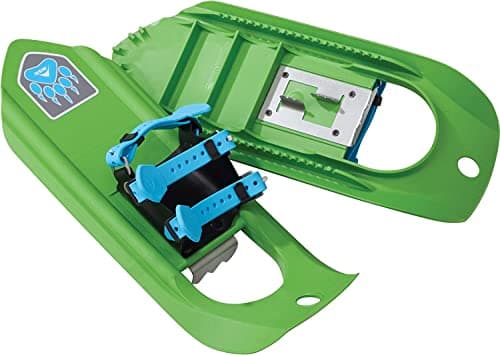
The pick for a child of roughly four to eight. A published 80 lb load limit, 930 g a pair - which is light enough that a tired child can still lift their feet - and a binding published to work on most footwear rather than a specific boot.
The interesting design decision is the traction. MSR publishes molded traction bars rather than full steel underfoot, with steel crampons at the toe. That is a deliberate safety choice on a snowshoe a child will regularly step on with their own other foot, and it is the right call for this age even though it looks like a downgrade on a spec sheet.
The limitation is the ceiling. At 80 lb a child outgrows it around eight, and there is no adjustment past it.
MSR Shift Youth
The pick if the child is already close to 80 lb, and the better buy for a household that wants one pair to last. A published 125 lb load limit carries a child from roughly eight years old to the point where they can use adult snowshoes.
It publishes the same steel traction bars and crampons as MSR’s adult Evo, which means it grips on hard and steep snow rather than only on packed trail, and a footwear range of US 1 to 7 that survives several boot sizes.
It costs $45 more than the Tyker and is 215 g heavier a pair, which a small child notices and an older one does not. No televator bar is published, so long sustained climbs are harder work than on an adult snowshoe with one.
Tubbs Snowglow Youth
Marked as the skip above, with an obvious exception. LEDs in the deck that flash with every stride are, on paper, a gimmick. In practice they are sometimes the only reason a six-year-old keeps walking, and a walk that happens beats a better snowshoe that stays in the car.
It is also the cheapest here by $25, publishes four sizes with weight bands rather than one size with an age, and uses a QuickLock buckle that a child can operate themselves - a genuinely underrated feature when the alternative is a parent kneeling in snow adjusting four straps.
The traction is the limit. Molded rails and no published steel crampon means packed trails only.
Do children need poles?
Not usually, and often they are worse off with them - a small child with poles has two more things to drop and two more things to trip over. Snowshoeing without poles is perfectly normal.
If they do want poles, adjustable ones with proper snow baskets are the version that works. The snowshoeing poles page explains why the basket is the specification that matters, and the ski pole roundup covers the junior pole with eight published lengths.
What goes on their feet
A snowshoe binding fits around a boot, so the boot comes first. A waterproof snow boot with a published temperature rating is what you want - not a ski boot, which is rigid in exactly the wrong direction, and not a sneaker, which is wet within minutes.
The kids snow boot roundup covers the two that publish a temperature rating, and the winter boots guide covers the adult equivalent.
Then thin socks, one pair. The instinct to add a second pair inside a boot makes feet colder rather than warmer by squeezing out the air that does the insulating. The kids sock roundup explains the mechanism.
Why this is the best value in winter sports
A pair of kids’ snowshoes costs between $60 and $130 and needs no lift ticket, no lesson and no resort. A single family day of skiing costs more than any snowshoe on this page.
It is also the activity with the shortest learning curve in this whole category: if a child can walk, they can snowshoe, and there is no version of it that involves going faster than they meant to. The adult snowshoe roundup covers the grown-up pairs and the traction page covers the cheaper option for packed trails, which for a first try may be all you need.
Every pick, with the working
Each entry shows the published inputs, the axis scores they produce, and what you give up. The order is the computed order, not a commercial one, and the arithmetic is open underneath each score.
1 · A child of roughly 4 to 8, in whatever boots they already own
MSR Tyker Kids Snowshoes
80 lb of published load and 930 g a pair, with molded traction bars instead of full steel underfoot, which is a deliberate safety decision on a snowshoe a child will step on their own with. The published footwear range covers a snow boot as well as a sneaker.
- Published price
- $84.95
- Cost per day on snow
- $5.66 a day
- Amortized over
- 3 seasons (15 days)
- Certified to
- Not published
- Published sizes
- One size, 6.5 by 17 in, published to fit footwear kids 7.5 to 13.5 and 1 to 4.5 M, up to 80 lb total load
- Weight
- 930 g
- Warranty
- MSR limited lifetime or 3-year warranty depending on the product
What it gets right
- Published 80 lb load limit, so the size decision is a weight rather than an age
- 930 g per pair, light enough that a tired child can still lift their feet
- Kid-friendly molded traction bars rather than aggressive steel underfoot
- Binding published to work on most footwear, not a special boot
What you give up
- 80 lb is outgrown around age eight, and there is no adjustment past it
- Less traction than the adult-derived Shift on hard or steep snow
- MSR publishes its warranty as lifetime or three years without saying which applies here
The working behind the 6.0
- Cost per day on snow: 6.9
- $84.95 over 3 seasons at 5 days each = 15 days = $5.66 a day
- Published protection: not scored
- Snowshoes carry no protective standard.
- Size availability: not scored
- Sold in one size, so size availability does not apply.
- Warranty and support: 4.5
- 3 yr (2.5 of 6); no published crash replacement (+0); repair or replacement parts published (+2)
Axes with unpublished inputs are dropped and the remaining weights re-normalized, so a product is not punished for a manufacturer’s silence. Specifications compiled September 12, 2026 from MSR published specifications.
2 · The child who does not want to go snowshoeing
Tubbs Snowglow Youth Snowshoes
Skip this one. Buy it for the lights, not the traction. Molded traction rails with no published steel crampon are fine on a packed trail and will slide on anything hard or steep, which rules out most of what an older child will want to do. The LED deck is not a gimmick if it is the reason a reluctant six-year-old keeps walking - but understand you are buying a motivational device with snowshoes attached.
LED lights in the deck that flash with each stride, which is a marketing feature and also the reason a reluctant six-year-old keeps walking. The cheapest snowshoe here by $25, with four published sizes and a single buckle a child can work themselves.
- Published price
- $59.95
- Cost per day on snow
- $4.00 a day
- Amortized over
- 3 seasons (15 days)
- Certified to
- Not published
- Published sizes
- 14, 16, 17 and 22 in, published for ages 4 to 8, with a published weight band of under 50 lb or 40 to 90 lb depending on size
- Warranty
- No term published on the product page
What it gets right
- Cheapest snowshoe in this ledger, with four published sizes
- QuickLock buckle published as a single tightening and locking action
- MotionBright LED lighting published, with a replaceable battery
- Published weight bands per size rather than age alone
What you give up
- Molded traction rails only, with no published steel crampon, so hard snow is a limit
- No published warranty term and no published pair weight
- The lights are the reason it gets used and also one more battery to replace
The working behind the 5.2
- Cost per day on snow: 8.2
- $59.95 over 3 seasons at 5 days each = 15 days = $4.00 a day
- Published protection: not scored
- Snowshoes carry no protective standard.
- Size availability: 5.1
- 4 published sizes (5.1 of 8.5); no continuous adjuster published (+0); range: 14, 16, 17 and 22 in, published for ages 4 to 8, with a published weight band of under 50 lb or 40 to 90 lb depending on size
- Warranty and support: 0.0
- no published term (0 of 6); no published crash replacement (+0); no published repair route (+0)
Axes with unpublished inputs are dropped and the remaining weights re-normalized, so a product is not punished for a manufacturer’s silence. Specifications compiled September 12, 2026 from Tubbs published specifications.
3 · A preteen who will outgrow anything smaller within a season
MSR Shift Youth Snowshoes
125 lb published load and the same steel traction bars and crampons as MSR's adult Evo, in a 19 inch frame. This is the one that carries a child from about eight years old to the point where they can use an adult snowshoe, which is a long time to own one pair.
- Published price
- $129.95
- Cost per day on snow
- $8.66 a day
- Amortized over
- 3 seasons (15 days)
- Certified to
- Not published
- Published sizes
- One size, 7 by 19 in, published to fit US 1 to 7 M (EU 32 to 41), up to 125 lb total load
- Weight
- 1145 g
- Warranty
- MSR limited lifetime or 3-year warranty depending on the product
What it gets right
- Published 125 lb load, the highest of any kids snowshoe here
- Steel traction bars and crampons published, the same as the adult Evo
- Published footwear range of US 1 to 7, so it survives several boot sizes
- Injection-molded deck, published as repairable and built to last
What you give up
- 1,145 g a pair, 215 g heavier than the Tyker, which a smaller child will feel
- Fifty dollars more than the Tyker
- No televator bar published, so long climbs are harder work
The working behind the 4.6
- Cost per day on snow: 4.7
- $129.95 over 3 seasons at 5 days each = 15 days = $8.66 a day
- Published protection: not scored
- Snowshoes carry no protective standard.
- Size availability: not scored
- Sold in one size, so size availability does not apply.
- Warranty and support: 4.5
- 3 yr (2.5 of 6); no published crash replacement (+0); repair or replacement parts published (+2)
Axes with unpublished inputs are dropped and the remaining weights re-normalized, so a product is not punished for a manufacturer’s silence. Specifications compiled September 12, 2026 from MSR published specifications.
Prices last verified October 19, 2026. Prices move constantly; the figure on Amazon at the moment you click is the real one.
Questions people actually ask
What size snowshoes does a child need?
Size by the maker’s published load limit rather than the age on the box. The models here publish 80 lb and 125 lb, and the load is the child plus clothing plus anything they carry - so a 60 lb child in winter gear is realistically putting 70 lb on the snowshoe.
What age can children start snowshoeing?
Around four, which is when the smallest snowshoes here start. The real limit is stamina rather than technique: if a child can walk, they can snowshoe, but a child of four will manage a short loop rather than a hike.
Do kids need poles for snowshoeing?
Usually not. A small child with poles has two more things to drop and two more things to trip over, and snowshoeing without poles is entirely normal. If they do want them, adjustable poles with proper snow baskets are the version that works.
What boots do kids wear with snowshoes?
Waterproof snow boots with a published temperature rating. Not ski boots, which are rigid in the wrong direction, and not sneakers, which are soaked within minutes. The snowshoe binding fits around the boot, so check the published footwear size range against the boots they own.
Are LED snowshoes worth it for kids?
If the lights are what keeps a reluctant child walking, yes - a walk that happens beats a better snowshoe that stays in the car. Understand the trade: the LED model here publishes molded traction rails with no steel crampon, which limits it to packed trails.