Heated vests, and why the thinnest one is the right one for skiing
A heated vest is a mid layer with a battery in it. That single fact rules out most of the category for skiing, and it is the one the ski shops never mention.
By Sawyer V. · Published
We have not tested this gear. Everything below is compiled from published specifications and published safety standards, and the arithmetic is public so you can check it. This page carries affiliate links: if you buy through one we earn a commission at no extra cost to you, and it does not change the order of the picks. Full disclosure.
The short answer
Buy the ORORO Heated Quilted Vest - the men’s or the women’s - because it is the thinnest one, and thin is what decides whether a heated vest fits under a ski jacket at all. ORORO publishes 410 g in men’s L and 369 g in women’s M, four heating zones, three settings, and 3 hours on high / 6 on medium / 10 on low from a published 4,800 mAh 7.4V battery, with UL, CUL, CE, FCC and RoHS certification and a 3-year warranty on the heating elements. The Softshell adds lower-back heating and carries the skip note. And the honest caveat before any of it: a vest heats your core, not your hands or feet, which is where most people are actually cold. Prices are live; published figures as of October 17, 2026.
| # | Pick | Best for | Score | Price |
|---|---|---|---|---|
| 1 | ORORO Men's Heated Quilted Vest Wearing under a ski jacket on a genuinely cold day | $6.80 a dayon snow | 5.8/10 | $149.99 - View on Amazon |
| 2 | ORORO Women's Heated Quilted Vest A woman who runs cold on a chairlift and needs the layer to disappear under a shell | $6.80 a dayon snow | 5.8/10 | $149.99 - View on Amazon |
| 3 | ORORO Men's Heated Softshell Vest Standing around at the base, clearing a driveway, or a back that stiffens in the cold | $7.20 a dayon snow | 5.6/10 | $149.99 - View on Amazon |
Prices last verified October 19, 2026. Prices move constantly; the figure on Amazon at the moment you click is the real one.
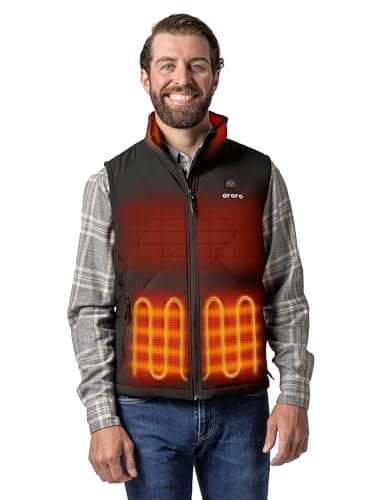
A heated vest is a mid layer, and that decides everything
Heated vests are photographed worn as outerwear, which is how they are sold and not how they work in snow. None of them publishes a waterproof rating - ORORO publishes water-RESISTANT shells - so on a ski day the vest goes under the jacket, against or near a base layer, with the shell doing the weather.
Which means the deciding specification is not warmth. It is thickness and weight, because a ski jacket is cut to fit a base layer and a mid layer, and a heated vest has to replace the mid layer rather than join it. ORORO publishes that its quilted vest is 50 percent thinner than its own Classic vest, which is precisely the gap between a vest that disappears under a shell and one that pins your arms.
If you need a reminder of how the system is meant to stack up, the mid layers page covers what the middle layer is for, and the temperature page covers how many layers a given forecast actually needs.
Who each of these is for, and who should skip all three
- A cold skier who already owns a good shell: the Quilted Vest. Thinnest, lightest, 10 published hours on low.
- Women, same answer, cut differently: the women’s Quilted Vest publishes 369 g in M, the lightest heated layer on this page.
- Standing-around cold rather than skiing cold: the Softshell. Lower-back heating and a wind-resistant stretch shell, with the skip note for slope use.
- Skip all three if your hands or feet are the problem. A vest heats the core. It helps the extremities indirectly - a warm core lets the body send blood outward again - but if the specific complaint is fingers or toes, heated gloves, heated socks or a pocket warmer are a quarter of the price and aimed at the right place.
- Skip them for a child. Nothing here publishes a child’s size, and a lithium battery in a pocket on a sledding hill is a different risk calculation. Layering is the answer at that age.
What this page ranks on
- 1. Published weight and thickness. The layering constraint, and the reason the quilted vests beat the softshell for skiing.
- 2. Published run time by setting. All three publish three figures, which is better than this category usually manages. The honest one to read is the HIGH figure, not the low.
- 3. Heating zones, and where they are. Collar and mid-back do more for a chairlift than a chest panel; hand pockets do more than either at a lift queue.
- 4. Battery specification and safety certification. This is a lithium cell worn against the body all day. UL, CUL, CE, FCC and RoHS are published here, and that is the specification to insist on.
- 5. Published warranty. Heating elements are the part that fails. All three publish 3 years on the elements and 1 year on the battery.
The three, compared
| Men's Quilted | Women's Quilted | Men's Softshell | |
|---|---|---|---|
| Published weight | 14.4 oz / 410 g (L) | 13.0 oz / 369 g (M) | 19.3 oz / 547 g (M) |
| Heating zones | 4: pockets, collar, mid-back | 4: pockets, collar, mid-back | 4: pockets, upper back, LOWER back |
| Run time, high / medium / low | 3 / 6 / 10 hours | 3 / 6 / 10 hours | 3 / 5 / 8 hours |
| Battery | 4,800 mAh, 7.4V, 35.4 Wh | 4,800 mAh, 7.4V (LG cells) | 4,800 mAh, 7.4V, 35.4 Wh |
| Charge time | 4 hours (5V/3A) | 4 hours (15W) | 4 hours (5V/3A) |
| Shell | 100% nylon, water resistant | Quilted nylon, water resistant | 92% polyester / 8% spandex softshell |
| Insulation | 180 g FELLEX | FELLEX | None published |
| Safety certification | UL, CUL, CE, FCC, RoHS | UL, CUL, CE, FCC, RoHS | UL, CUL, CE, FCC, RoHS |
| Warranty | 3 yr elements / 1 yr battery | 3 yr elements / 1 yr battery | 3 yr elements / 1 yr battery |
| Published price | $169.99 | $169.99 | $179.99 |
Read the run-time row as three hours, not ten. Ten is the low setting, which on a genuinely cold chairlift is not the setting anybody uses. Three hours on high is the real planning number, and it is why the published USB battery - and the option of carrying a second one - matters more than the heating zones do.
The picks
ORORO Men’s Heated Quilted Vest
The pick, on thickness. ORORO publishes 14.4 oz (410 g) in size L, and states it is 50 percent thinner and 19 percent lighter than its own Classic heated vest. That is the whole reason it works for skiing: it slides under a shell where a padded heated vest does not.
The heating specification is fully published: four carbon-fiber elements across both hand pockets, the collar and the mid-back; three settings; and 3 hours on high, 6 on medium, 10 on low from the 4,800 mAh / 7.4V / 35.4 Wh battery, which charges in 4 hours and carries a USB port for a phone.
The collar element is the one that surprises people. Cold gets in at the neck on a chairlift more than anywhere else on the torso, which is also why a gaiter does so much for so little money.
Honest cons. Three hours on high is less than a ski day, so either ration the setting or carry a second battery. The battery itself adds a published 185 g in an inside pocket. The shell is water resistant, not waterproof - this layer never goes outside a jacket in snow. And at a published $169.99 it costs more than most mid layers that need no charging at all.
ORORO Women’s Heated Quilted Vest
The same vest in a women’s cut, and the lightest heated layer on this page: ORORO publishes 13.0 oz (0.8 lb) in size M, stated as 50 percent thinner and 30 percent lighter than its Classic women’s vest.
Everything else matches the men’s: four zones including the collar and mid-back, three settings, 3 / 6 / 10 hours, the same 4,800 mAh 7.4V battery - published here as using LG cells - USB-C charging in 4 hours with a 15W charger, and the same UL, CUL, CE, FCC and RoHS certifications.
It is worth saying plainly that this is a cut, not a downgrade. Women’s ski gear frequently loses specification in translation; as the women’s jackets page covers, that is a reason to read the published figures rather than the label. Here the figures are identical and the vest is lighter.
Honest cons. The published size run stops at 3XL and varies by colorway, so a size that exists in one color may not in another. The same three-hour high setting applies. Quilted nylon is a layering piece, not an outer. And the battery adds its own 185 g.
ORORO Men’s Heated Softshell Vest, and why it carries the skip
The specification sheet here contains one thing nothing else on the page has: a published LOWER back heating zone as well as an upper one, in a 92 percent polyester / 8 percent spandex wind- and water-resistant stretch softshell with an adjustable drawcord hem.
For a back that stiffens in cold - shoveling a drive, standing on a sideline, waiting in a lift queue for an hour - that is a real feature and a real reason to buy this one instead.
It carries the skip for skiing because of the trade-offs ORORO publishes alongside it: 19.3 oz (547 g) in medium, the heaviest here before the battery goes in, and 8 hours on low rather than 10, with 5 on medium rather than 6. A stretch softshell is also bulkier under a fitted ski shell than a quilted nylon vest. Buy it for the parking lot and the driveway, not for the chairlift.
Living with the battery, which is the whole experience
- Charge it the night before, with the boots. Four hours published from empty, so this is not a morning job.
- Run it on low and save high for the lift. Three hours on high is published; ten on low. Heat the chairlift, not the descent - you generate your own heat skiing.
- Keep the battery in the inside pocket it came with. That is where the published wiring routes, and a lithium cell is warmer and safer against the body than in an outer pocket at -10C.
- Take it out before washing. Every published care instruction here is machine wash cold, no iron, no tumble dry - with the battery removed.
- Carry the vest, not a second jacket. If the vest replaces a fleece, the system works. If it is added to a full kit, the jacket stops fitting and the whole thing becomes uncomfortable.
Cheaper things that fix the same complaint
A heated vest is the dearest answer to being cold, and frequently not the best one. Before spending 170 dollars:
- A proper mid layer. A good fleece or grid layer costs a third as much, never needs charging, and works for the whole day rather than three hours - the mid layers roundup.
- A warmer base layer. Going from a 150 to a 250 weight merino changes a cold day more than most people expect - the base layers roundup.
- Heat where you are actually cold. Socks, gloves or insoles cost less and target the extremity that is complaining.
- Fixing the jacket. A vest cannot rescue a shell that leaks or lets wind through - the jacket features that actually matter.
Every pick, with the working
Each entry shows the published inputs, the axis scores they produce, and what you give up. The order is the computed order, not a commercial one, and the arithmetic is open underneath each score.
1 · Wearing under a ski jacket on a genuinely cold day
ORORO Men's Heated Quilted Vest
The pick for skiing because it is the thinnest one: ORORO publishes 14.4 oz (410 g) in size L, 50 percent thinner and 19 percent lighter than its Classic vest, which is the difference between a vest that fits under a ski jacket and one that does not. Four heating zones, three settings, and up to 10 hours on low from the published 4,800 mAh 7.4V battery.
- Published price
- $169.99
- Cost per day on snow
- $6.80 a day
- Amortized over
- 5 seasons (25 days)
- Certified to
- UL, CUL, CE, FCC, RoHS
- Waterproof rating
- Not published
- Published sizes
- XXS through 3XL plus MT and LT, per the published size list
- Weight
- 410 g
- Warranty
- 3-year limited on heating elements, 1-year on the battery
What it gets right
- Published 410 g in size L, the lightest vest ORORO publishes and thin enough to layer under a shell
- Four published heating zones - both hand pockets, the collar and the mid-back
- Published run times by setting: 3 hours on high, 6 on medium, 10 on low
- 4,800 mAh / 7.4V / 35.4 Wh battery published, charging in 4 hours from a 5V/3A charger, with a USB port for a phone
- UL, CUL, CE, FCC and RoHS published - which on a battery worn against the body is the specification to check
- 3-year limited warranty on the heating elements published, 1 year on the battery
What you give up
- Ten hours is the LOW setting; three hours on high is less than a ski day
- The battery sits in an inside pocket and adds 185 g of its own
- A nylon shell with a water-resistant finish, not a waterproof layer - this goes under the jacket, never over it
- No waterproof rating published, because it is not that kind of garment
The working behind the 5.8
- Cost per day on snow: 6.1
- $169.99 over 5 seasons at 5 days each = 25 days = $6.80 a day
- Published protection: not scored
- No waterproof rating or seam construction published.
- Size availability: 8.5
- 10 published sizes (8.5 of 8.5); no continuous adjuster published (+0); range: XXS through 3XL plus MT and LT, per the published size list
- Warranty and support: 2.5
- 3 yr (2.5 of 6); no published crash replacement (+0); no published repair route (+0)
Axes with unpublished inputs are dropped and the remaining weights re-normalized, so a product is not punished for a manufacturer’s silence. Specifications compiled October 17, 2026 from ORORO published Heated Quilted Vest specifications.
2 · A woman who runs cold on a chairlift and needs the layer to disappear under a shell
ORORO Women's Heated Quilted Vest
The same vest cut for a woman, and the lightest heated layer on this page: ORORO publishes 13.0 oz (0.8 lb) in size M, 50 percent thinner and 30 percent lighter than its own Classic women's vest. Four zones, three settings, up to 10 hours on low, and the same published 4,800 mAh battery, built on LG cells.
- Published price
- $169.99
- Cost per day on snow
- $6.80 a day
- Amortized over
- 5 seasons (25 days)
- Certified to
- UL, CUL, CE, FCC, RoHS
- Waterproof rating
- Not published
- Published sizes
- XS through 3XL across the published colorways
- Weight
- 369 g
- Warranty
- 3-year limited on heating elements, 1-year on the battery
What it gets right
- Published 369 g (13.0 oz) in size M - the lightest heated vest on this page
- Four published heating zones including the collar, which is where chairlift cold actually gets in
- Published 3 hours high / 6 medium / 10 low from the 4,800 mAh 7.4V battery
- USB-C charging published at 4 hours with a 15W charger, and a USB port that charges a phone
- UL, CUL, CE, FCC and RoHS published, with LG battery cells named
- 3-year limited warranty on heating elements published
What you give up
- Women's sizing stops at 3XL and each colorway carries a different size run
- Three hours on high, like every ORORO vest here
- Quilted nylon is a layering piece, not an outer layer in snow
- The battery is an extra 185 g in an inside pocket
The working behind the 5.8
- Cost per day on snow: 6.1
- $169.99 over 5 seasons at 5 days each = 25 days = $6.80 a day
- Published protection: not scored
- No waterproof rating or seam construction published.
- Size availability: 8.5
- 7 published sizes (8.5 of 8.5); no continuous adjuster published (+0); range: XS through 3XL across the published colorways
- Warranty and support: 2.5
- 3 yr (2.5 of 6); no published crash replacement (+0); no published repair route (+0)
Axes with unpublished inputs are dropped and the remaining weights re-normalized, so a product is not punished for a manufacturer’s silence. Specifications compiled October 17, 2026 from ORORO published Women's Heated Quilted Vest specifications.
3 · Standing around at the base, clearing a driveway, or a back that stiffens in the cold
ORORO Men's Heated Softshell Vest
Skip this one. Skip it for skiing, and buy it for standing around. It is the only vest here with a published LOWER back heating zone, which is a genuine answer to a back that stiffens in the cold - but it is also the heaviest at a published 19.3 oz in medium, the bulkiest under a shell, and it publishes the shortest run time of the three at 8 hours on low against 10 for the quilted vests. For snow-clearing, ice fishing, a sideline or a parking lot, it is the pick. Under a fitted ski jacket it is a layer too many.
The one to buy if the cold is in your back rather than your chest: it is the only vest here that publishes a LOWER back heating zone as well as an upper one, in a wind- and water-resistant stretch softshell. The trade is run time - ORORO publishes 8 hours on low against 10 for the quilted vests - and weight, at a published 19.3 oz in medium.
- Published price
- $179.99
- Cost per day on snow
- $7.20 a day
- Amortized over
- 5 seasons (25 days)
- Certified to
- UL, CUL, CE, FCC, RoHS
- Waterproof rating
- Not published
- Published sizes
- S through 5XL plus MT and LT, per the published size list
- Weight
- 547 g
- Warranty
- 3-year limited on heating elements, 1-year on the battery
What it gets right
- Four published zones with upper AND lower back heating, which no other vest here publishes
- Water- and wind-resistant stretch softshell published at 92 percent polyester, 8 percent spandex
- Published 3 hours high / 5 medium / 8 low from the same 4,800 mAh battery
- Adjustable drawcord hem published, plus hand, chest and dedicated battery pockets
- UL, CUL, CE, FCC and RoHS published, and the same 3-year heating element warranty
What you give up
- Published 8 hours on low, the shortest run time of the three ORORO vests here
- 547 g in medium, the heaviest vest on this page before the battery goes in
- Softshell is bulkier under a ski jacket than the quilted vests
- Water-resistant, not waterproof: still a mid-layer, never an outer
The working behind the 5.6
- Cost per day on snow: 5.8
- $179.99 over 5 seasons at 5 days each = 25 days = $7.20 a day
- Published protection: not scored
- No waterproof rating or seam construction published.
- Size availability: 8.5
- 10 published sizes (8.5 of 8.5); no continuous adjuster published (+0); range: S through 5XL plus MT and LT, per the published size list
- Warranty and support: 2.5
- 3 yr (2.5 of 6); no published crash replacement (+0); no published repair route (+0)
Axes with unpublished inputs are dropped and the remaining weights re-normalized, so a product is not punished for a manufacturer’s silence. Specifications compiled October 17, 2026 from ORORO published Heated Softshell Vest specifications.
Prices last verified October 19, 2026. Prices move constantly; the figure on Amazon at the moment you click is the real one.
Questions people actually ask
Can you wear a heated vest under a ski jacket?
Yes, and that is where it belongs. None of these vests publishes a waterproof rating - ORORO publishes water-resistant shells - so the ski jacket does the weather and the vest does the heat. The practical constraint is thickness: ORORO publishes the quilted vest at 50 percent thinner than its Classic vest, which is why it is the one that fits under a fitted shell. Treat it as a replacement for your fleece, not as an extra layer on top of one.
How long does a heated vest battery last?
Three hours on high and ten on low, as published by ORORO for both quilted vests, from a 4,800 mAh 7.4V battery; the softshell publishes 3 / 5 / 8. Plan on the high figure rather than the low one, because high is the setting people use on a cold chairlift. A second battery is the usual fix for a full day.
Are heated vests safe to wear skiing?
The specification to insist on is the safety certification, and all three vests here publish UL, CUL, CE, FCC and RoHS, with the battery in a dedicated inside pocket and a 1-year battery warranty. Most of the heated-apparel aisle publishes none of that. Keep the battery in its own pocket, remove it before washing, and do not use a third-party battery that the maker has not published as compatible.
Is a heated vest better than a heated jacket for skiing?
For skiing, a vest. The sleeves of a heated jacket add bulk exactly where a ski shell is already close-fitting, and arms are not where core cold is solved. A vest heats the torso and leaves the arms free, which is the right shape for a mid layer under a shell.
Will a heated vest keep my hands and feet warm?
Indirectly, and only up to a point. A cold body protects the core by reducing blood flow to the extremities, so warming the core genuinely helps the fingers and toes - but if your hands are cold because your gloves are wet or too tight, no amount of torso heat fixes it. Read the cold hands page and the cold feet page first; most of the fixes there are free.
Can you wash a heated vest?
Yes, with the battery out. ORORO publishes machine wash cold, no ironing, no dry cleaning, no tumble drying, line or flat dry for all three vests here. The same rules that apply to any technical layer apply here - washing ski clothing covers the detergent question.
Sources
- ORORO published Men's Heated Quilted Vest specifications: 14.4 oz (410 g) in L, 4 zones, 3/6/10 hours, 4,800 mAh 7.4V, UL/CUL/CE/FCC/RoHS, 3-year element warranty
- ORORO published Women's Heated Quilted Vest specifications: 13.0 oz in M, 4 zones, 3/6/10 hours, 4,800 mAh with LG cells, USB-C charging
- ORORO published Men's Heated Softshell Vest specifications: 19.3 oz in M, 4 zones including lower back, 3/5/8 hours, 92% polyester / 8% spandex