The best heated socks for skiing, ranked on published runtime
Every heated sock quotes a headline number of hours. That number is the lowest setting, and the lowest setting is not why you bought them.
By Sawyer V. · Published
We have not tested this gear. Everything below is compiled from published specifications and published safety standards, and the arithmetic is public so you can check it. This page carries affiliate links: if you buy through one we earn a commission at no extra cost to you, and it does not change the order of the picks. Full disclosure.
The short answer
Compare published runtime at the setting you will actually use, not the headline hours. Snow Deer publishes about 6 hours on low but only 2 on high; Lenz publishes up to 23 hours on low and around 7.5 at maximum. Before buying either, check the boot fit - a boot buckled too tight is the most common cause of cold feet and no battery fixes it. A disposable toe warmer publishes 8 hours for a fraction of the cost.
| # | Pick | Best for | Score | Price |
|---|---|---|---|---|
| 1 | Lenz Heat Sock 5.1 Toe Cap Someone who has decided heated socks are the answer and wants them to last the day | Not publishedon snow | 2.6/10 | $499.95 - View on Amazon |
| 2 | Snow Deer Rechargeable Heated Socks Someone whose feet genuinely go numb, after the boot fit has been checked | Not publishedon snow | 1.7/10 | $41.99 - View on Amazon |
| 3 | HotHands Toe Warmers Cold toes on the one or two days a season that genuinely need it | Not publishedon snow | 0.0/10 | $32.93 - View on Amazon |
| 4 | HotHands Insole Foot Warmers Winter boots and standing around, not a fitted ski boot | Not publishedon snow | 0.0/10 | $15.55 - View on Amazon |
Prices last verified October 19, 2026. Prices move constantly; the figure on Amazon at the moment you click is the real one.
Four things to fix before buying a battery
This is the section that will save most readers the money, and it is the same argument the heated gear page makes about hands.
- The boot is buckled too tight. The most common cause by a distance. Buckling hard restricts circulation, and a foot with restricted blood flow is cold regardless of insulation. Loosen the two lower buckles on the lift and see what happens.
- The sock is too thick. Counter-intuitive and true: a thick sock compresses inside a fitted boot, which reduces both circulation and the air gap doing the insulating. A modern ski boot wants a thin sock. The ski socks page explains why.
- There are two socks on. Same mechanism, worse. Never two pairs.
- The boot is the wrong size. A boot too large lets the foot move and the blood flow is fine but the insulation is not; a boot too small does the opposite. The Mondopoint chart is here.
Read the runtime table, not the headline
Every heated sock is advertised on its longest number, which is always the lowest setting. The useful comparison is what each publishes across all its settings.
| Product | Low | Medium | High |
|---|---|---|---|
| Lenz Heat Sock 5.1 Toe Cap | Up to 23 h | About 10.5-12.5 h | About 7.5 h |
| Snow Deer heated socks | Up to 6 h | About 3.5 h | About 2 h |
| HotHands toe warmer (disposable) | Up to 8 h, single output | - | - |
| HotHands insole warmer (disposable) | Up to 9 h, single output | - | - |
The Snow Deer row is the honest problem with cheap heated socks. Two hours on high does not cover a morning, and about six hours on low is only useful if low is enough heat - which for most people who bought heated socks, it is not. You end up rationing.
The Lenz row is why it costs what it costs: around 7.5 hours at maximum is longer than most people ski, so the setting decision stops being a rationing decision.
The picks
Lenz Heat Sock 5.1 Toe Cap
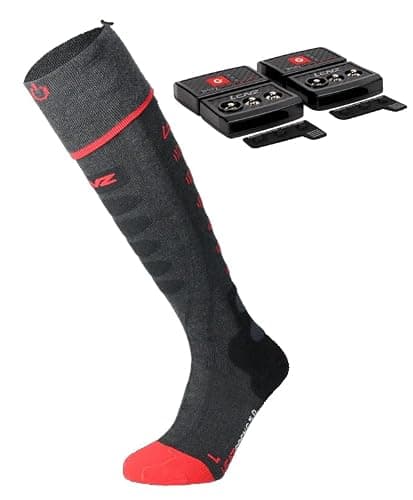
The pick, and it wins on the only figure that matters here: it is the one heated sock whose published runtime survives a full day at a setting you would actually use. Up to 23 hours on low, about 10.5 to 12.5 on medium and roughly 7.5 at maximum.
Two more published details matter. The heating element is flat and sewn into the toe rather than being a lump under the forefoot - inside a fitted ski boot that is the difference between comfortable and unwearable. And the sock itself is merino wool and silk, so it is a real ski sock before the electronics are considered. Nine heat levels over Bluetooth, or three on the battery itself with gloves on.
Honest cons: by a wide margin the most expensive item in this ledger, batteries are an extra on some configurations, no published warranty term, and an app-and-Bluetooth dependency on a product that has to work in the cold.
Snow Deer Rechargeable Heated Socks
The value entry, and it publishes its specification honestly: 7.4V, 2200 mAh lithium-polymer batteries, three heat levels with a runtime stated for each, and a 3 to 4 hour recharge. Three sizes published, which matters more on a heated sock than a plain one because the element has to sit under the toes.
Honest cons: about two hours on high is less than a lift ticket, there is no published warranty, and the battery pack at the calf is real bulk inside a ski boot cuff - some boots will not close over it.
HotHands Toe Warmers
The one most people should actually buy. A published 8 hours of continuous warmth, adhesive backed so it stays on the sock, nothing to charge and nothing to fail. Eight hours beats every rechargeable setting here except the Lenz on low.
Honest cons: single use, so the cost repeats every day you need one; it adds thickness inside a boot that is already fitted; and there is no adjustment at all.
The boot-fit problem nobody mentions
Both rechargeable options put something extra inside or against a ski boot, and a ski boot is fitted to within a few millimeters.
The battery pack sits at the top of the calf, on or just above the boot cuff. On a boot with a tall cuff, or on a rider with large calves, it does not fit under the cuff and has to sit above it - where a pant leg and a power strap go. Check this before a trip, not on a cold morning at the top of a lift.
Disposable warmers have the opposite problem: they add thickness under or over the toes in a boot that had none spare. The footbeds page covers what else is competing for that volume.
Who should buy what
- Cold feet once or twice a season. Toe warmers. Keep a pair in the jacket all winter.
- Cold feet every single day, boot fit checked. The Lenz, and treat it as a multi-season purchase.
- Curious, and unwilling to spend Lenz money. The Snow Deer, with eyes open about the high setting.
- Cold feet in winter boots rather than ski boots. The insole warmers - there is room in a winter boot and it is the right shape there. The winter boots page.
- A child. None of it. Fix the boot fit and the sock, and check whether the day is simply too cold.
Every pick, with the working
Each entry shows the published inputs, the axis scores they produce, and what you give up. The order is the computed order, not a commercial one, and the arithmetic is open underneath each score.
1 · Someone who has decided heated socks are the answer and wants them to last the day
Lenz Heat Sock 5.1 Toe Cap
The only heated sock here whose published runtime survives a full day: up to 23 hours on the lowest setting with the larger battery, about 10.5 to 12.5 on medium and around 7.5 at maximum. It is also merino and silk rather than synthetic, and it is by some distance the most expensive thing in this ledger.
- Published price
- Not published
- Cost per day on snow
- Not published
- Amortized over
- 3 seasons (15 days)
- Certified to
- Not published
- Published sizes
- Published in four sizes, plus a separate slim-fit range
- Warranty
- No term published on the product page
What it gets right
- Published runtimes of up to 23 hours on low, 10.5 to 12.5 on medium and about 7.5 at maximum
- Nine heat levels through the Lenz app over Bluetooth, or three levels on the battery itself with gloves on
- Flat sewn-in toe heating element rather than a lump under the forefoot
- Merino wool and silk construction, so the sock is a real ski sock before the battery is considered
What you give up
- The most expensive item in this ledger by a wide margin, and batteries are an extra on some configurations
- No published warranty term on the product page
- App-and-Bluetooth complexity for a thing that needs to work in the cold with gloves on
The working behind the 2.6
- Cost per day on snow: not scored
- No manufacturer-published price, so this axis is not scored.
- Published protection: not scored
- Socks carry no protective standard, so this axis does not apply.
- Size availability: 5.1
- 4 published sizes (5.1 of 8.5); no continuous adjuster published (+0); range: Published in four sizes, plus a separate slim-fit range
- Warranty and support: 0.0
- no published term (0 of 6); no published crash replacement (+0); no published repair route (+0)
Axes with unpublished inputs are dropped and the remaining weights re-normalized, so a product is not punished for a manufacturer’s silence. Specifications compiled September 12, 2026 from Lenz published Heat Sock 5.1 specifications.
2 · Someone whose feet genuinely go numb, after the boot fit has been checked
Snow Deer Rechargeable Heated Socks
The published runtime is the whole story: 7.4V 2200 mAh batteries giving about 6 hours on low, 3.5 on medium and 2 on high. Low will not get most people through a ski day on its own, and high will not get anybody through a morning, which is why these work as a fix for cold feet rather than as all-day heating.
- Published price
- Not published
- Cost per day on snow
- Not published
- Amortized over
- 3 seasons (15 days)
- Certified to
- Not published
- Published sizes
- S, M and L
- Warranty
- No term published on the product page
What it gets right
- Published battery specification: 7.4V, 2200 mAh, lithium-polymer, and a stated 3 to 4 hour recharge
- Three published heat levels with runtimes stated for each rather than a single vague figure
- Removable battery pack, so the level can be changed without taking a boot off
- Three sizes published, which matters more on a heated sock than a plain one because the element has to sit under the toes
What you give up
- About 2 hours on the highest setting, which is less than a lift ticket
- No published warranty term
- A battery pack at the calf is bulk inside a ski boot cuff, and some boots will not take it
The working behind the 1.7
- Cost per day on snow: not scored
- No manufacturer-published price, so this axis is not scored.
- Published protection: not scored
- Socks carry no protective standard, so this axis does not apply.
- Size availability: 3.4
- 3 published sizes (3.4 of 8.5); no continuous adjuster published (+0); range: S, M and L
- Warranty and support: 0.0
- no published term (0 of 6); no published crash replacement (+0); no published repair route (+0)
Axes with unpublished inputs are dropped and the remaining weights re-normalized, so a product is not punished for a manufacturer’s silence. Specifications compiled September 12, 2026 from Snow Deer published heated sock specifications.
3 · Cold toes on the one or two days a season that genuinely need it
HotHands Toe Warmers
A published 8 hours of continuous warmth, adhesive backed so it stays on the sock rather than migrating under the arch. Eight hours is longer than any rechargeable sock here manages on a useful setting, for a fraction of the outlay and with nothing to charge.
- Published price
- Not published
- Cost per day on snow
- Not published
- Amortized over
- 3 seasons (15 days)
- Certified to
- Not published
- Published sizes
- One size, single use, adhesive backed
- Warranty
- No term published; the product is single use
What it gets right
- Published up to 8 hours of continuous warmth, which covers a full lift day
- Adhesive backing, so it stays where you put it inside a boot
- Nothing to charge, nothing to fail, and a spare pair lives in a jacket pocket all season
- Air activated, so it starts working the moment the packet is opened
What you give up
- Single use, so the cost repeats every day you need one
- Adds thickness inside a ski boot that is already fitted, which can make the fit worse
- No adjustment: it is one heat output for its published duration
The working behind the 0.0
- Cost per day on snow: not scored
- No manufacturer-published price, so this axis is not scored.
- Published protection: not scored
- This category carries no protective standard.
- Size availability: not scored
- Sold in one size, so size availability does not apply.
- Warranty and support: 0.0
- no published term (0 of 6); no published crash replacement (+0); no published repair route (+0)
Axes with unpublished inputs are dropped and the remaining weights re-normalized, so a product is not punished for a manufacturer’s silence. Specifications compiled September 12, 2026 from HotHands published product specifications.
4 · Winter boots and standing around, not a fitted ski boot
HotHands Insole Foot Warmers
Skip this one. A published 9 hours, an hour longer than the toe warmer, and completely the wrong shape for skiing. A ski boot is fitted around a footbed with almost no spare volume, and a full-length insole warmer under it changes the fit everywhere instead of adding heat at the toes. Buy it for winter boots and sledding. For a ski day, the toe warmer is the one.
A full-length insole warmer published at up to 9 hours. The length is the problem and the point: it warms the whole foot rather than the toes, and it is the wrong shape for a ski boot that has been fitted properly around a footbed.
- Published price
- Not published
- Cost per day on snow
- Not published
- Amortized over
- 3 seasons (15 days)
- Certified to
- Not published
- Published sizes
- One size, full-length insole, single use
- Warranty
- No term published; the product is single use
What it gets right
- Published up to 9 hours, an hour longer than the toe warmer
- Full-length coverage rather than a patch over the toes
- Works in ordinary winter boots, where there is room for it
What you give up
- Wrong shape for a fitted ski boot, and it displaces the footbed that is doing the real work
- Single use, and the largest of the three foot options to carry spares of
- No published warranty term
The working behind the 0.0
- Cost per day on snow: not scored
- No manufacturer-published price, so this axis is not scored.
- Published protection: not scored
- This category carries no protective standard.
- Size availability: not scored
- Sold in one size, so size availability does not apply.
- Warranty and support: 0.0
- no published term (0 of 6); no published crash replacement (+0); no published repair route (+0)
Axes with unpublished inputs are dropped and the remaining weights re-normalized, so a product is not punished for a manufacturer’s silence. Specifications compiled September 12, 2026 from HotHands published product range.
Prices last verified October 19, 2026. Prices move constantly; the figure on Amazon at the moment you click is the real one.
Questions people actually ask
Are heated ski socks worth it?
Only after you have ruled out the four common causes of cold feet: a boot buckled too tight, a sock that is too thick, two pairs of socks, and a boot that is the wrong size. All four restrict circulation or the insulating air gap, and no battery fixes any of them. If your feet still go numb with all four sorted, heated socks are a legitimate purchase.
How long do heated socks last on a charge?
It depends entirely on the setting, and the advertised figure is always the lowest one. Snow Deer publishes about 6 hours on low, 3.5 on medium and 2 on high. Lenz publishes up to 23 hours on low, about 10.5 to 12.5 on medium and roughly 7.5 at maximum. Compare the setting you would actually use, not the headline.
Are disposable toe warmers better than heated socks?
For most people, yes. HotHands toe warmers publish up to 8 hours of continuous warmth, which beats every rechargeable setting here except the Lenz on low, for a tiny fraction of the outlay and with nothing to charge. The trade is that they are single use, so the cost repeats, and they add thickness inside a fitted boot.
Do heated socks fit inside ski boots?
The sock does; the battery pack is the question. It sits at the top of the calf on or above the boot cuff, and on a tall-cuffed boot or a larger calf it will not close underneath. Check it at home before a trip rather than at the top of a lift. The heating element itself should be flat and sewn in, not a lump under the forefoot.
Why are my feet cold in ski boots?
Almost always circulation rather than insulation. Buckling hard restricts blood flow, a thick sock compresses inside a fitted boot and reduces both circulation and the insulating air gap, and two pairs of socks make it worse still. Loosen the two lower buckles on the lift, wear one thin sock, and check the boot is the right Mondopoint size.