Ski base layers, ranked on the only number that compares
Every brand describes its base layers as warm and breathable. Only one specification lets you check: the published fabric weight in grams per square meter. Four compared on it.
By Sawyer V. · Published
We have not tested this gear. Everything below is compiled from published specifications and published safety standards, and the arithmetic is public so you can check it. This page carries affiliate links: if you buy through one we earn a commission at no extra cost to you, and it does not change the order of the picks. Full disclosure.
The short answer
Shop on published fabric weight in grams per square meter - it is the only base layer specification that means the same thing at every brand. 150 g/m² is a thin layer for working hard, 190 is the all-season answer, and 250 is the midweight most skiers want for a cold chairlift. Then pick the fiber: merino if you will wear it several days without washing, synthetic if you sweat hard and want it dry in minutes.
| # | Pick | Best for | Score | Price |
|---|---|---|---|---|
| 1 | MERIWOOL Merino 250 Base Layer Top The layer that decides whether a beginner is cold all day | $3.25 a dayon snow | 5.9/10 | $65.00 - View on Amazon |
| 2 | MERIWOOL Merino 190 Base Layer Top Anyone who overheats in a midweight, or wants one layer for the whole season | $2.95 a dayon snow | 5.9/10 | $59.00 - View on Amazon |
| 3 | Smartwool Classic Thermal Merino Base Layer Crew Someone who wants the warm option and wants it to be replaceable | $5.75 a dayon snow | 5.3/10 | $125.00 - View on Amazon |
| 4 | Helly Hansen HH LIFA Stripe Crew High-output days, and anyone who finds wool itchy at any micron | Not publishedon snow | 0.0/10 | $50.00 - View on Amazon |
Prices last verified October 19, 2026. Prices move constantly; the figure on Amazon at the moment you click is the real one.
What this page ranks on
Base layers are sold on adjectives. “Thermal,” “moisture wicking” and “four-way stretch” appear on nearly every listing and none of them is a number you can compare. Four things are.
- 1. Published fabric weight, in grams per square meter. The single most useful figure in this category, because 250 g/m² of merino at one brand is the same cloth weight as 250 g/m² at another. It is the closest thing base layers have to a warmth rating.
- 2. Fiber and, for wool, micron. Merino against synthetic is the real decision, and for merino the fiber diameter in microns is what decides whether it itches. MERIWOOL publishes 16.5 microns; most brands publish nothing.
- 3. The published size run. A base layer has to sit against the skin, so a four-size run genuinely fits fewer people than a ten-size run. Two of the four picks here do not publish a size run at all, and our arithmetic marks them down for it.
- 4. The published warranty or guarantee. Almost nobody publishes one on a base layer. Where a brand does, it is the clearest signal available about how long it expects the garment to last.
We have not tested any of these, here or anywhere on the site. The ranking is arithmetic over those published figures plus published price, and the method is printed in full. Where a brand publishes nothing, the row says “not published,” which is a real answer and frequently the most useful one on the page.
Fabric weight, and what each band is for
If you read one section, read this one. Base layer weights cluster into three bands, and buying the wrong band is the most common mistake in this category - far more common than buying the wrong brand.
| Published weight | Called | What it is for | Where it fails |
|---|---|---|---|
| About 150 g/m2 | Lightweight | Spring skiing, high-output days, people who run hot | A cold chairlift in January |
| About 190 g/m2 | Light to mid | One layer for the whole season if you only buy one | Deep cold without a real mid layer over it |
| About 250 g/m2 | Midweight | Most skiers, most days - the default for a lesson and a lift | Walking uphill, or a mild spring afternoon |
| 300 g/m2 and up | Expedition | Static cold, not skiing | Overheating within one run |
The reason midweight is the default for this site’s reader is the shape of a beginner’s day: a hot ten minutes of effort followed by a stationary ten minutes on a lift, repeated. A thin layer is wrong for the lift and a thick one is wrong for the effort, so the middle of the range loses least. How cold is too cold to ski covers the days where that stops being true.
The picks
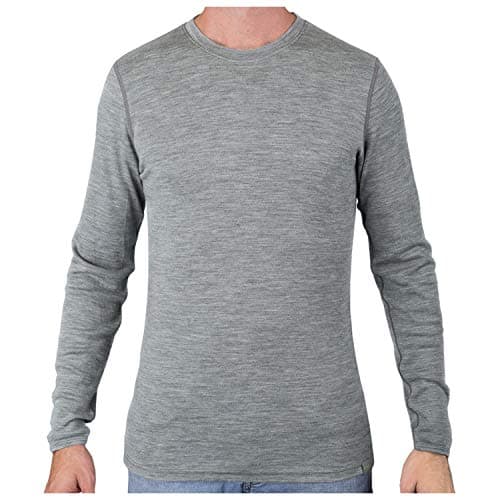
MERIWOOL Merino 250 Base Layer Top
The default recommendation, and it wins on arithmetic rather than affection. MERIWOOL publishes 250 g/m² of 100% merino across a published run of five sizes, S through XXL, at a published $65 - which is the midweight band at roughly half what the premium brands publish for the same density.
Wool is the point. It keeps insulating when it is damp, which is the entire argument against the cotton shirt most people start with, and it can be worn several days running without becoming unpleasant - which matters more than it sounds on a trip with one suitcase.
Honest cons. $65 for one top is more than some whole pairs of snow pants cost, and you want two if the trip is longer than a weekend. MERIWOOL publishes no warranty term on this product’s page, where its lightweight sibling publishes 90 days. And merino wants a cool wash and a long, flat dry - it is not a garment you tumble dry the night before a flight.
MERIWOOL Merino 190 Base Layer Top
The same wool one band lighter. MERIWOOL publishes 190 g/m² and, unusually, publishes the fiber diameter: 16.5 microns of 100% merino. It also publishes a 90-day manufacturer warranty and a 30-day return window, which is more than most brands put in writing at any price, and the published price is $59.
Buy this one instead of the 250 if you run hot, if you ski hard enough to sweat through a lesson, or if you want a single layer that still works in April. It is also the better choice for anyone who has found midweight merino stifling indoors - a base layer gets worn in the car and at lunch too.
Honest cons. Four published sizes against five for the midweight, and the middle sizes go out of stock. 190 g/m² is genuinely not enough on its own on a cold lift, so it only works with a real mid layer over it - which is a separate purchase. And 90 days is a short term next to a two-year guarantee.
Smartwool Classic Thermal Merino Base Layer Crew
The premium merino, and the only pick here with a real guarantee behind it. Smartwool publishes 100% merino wool and the Merino 250 designation, stating on its own collection page that the 250 refers to the fabric’s density in grams per square meter. Published list price is $115.
What the money actually buys is the published two-year guarantee - Smartwool’s “go far. feel good” term, which it publishes as covering seam failure, fabric pilling, punctures and zipper failure. That is a satisfaction guarantee rather than a defect-only warranty, and in apparel that is rare enough to be the headline.
Honest cons, and they are why this carries our skip note. It is roughly double the MERIWOOL midweight for the same published density band. Smartwool does not publish its size run on the product page we could read, which costs it points on our size-availability axis - and that is the axis that matters most for a garment worn against the skin. The guarantee is published as applying to Smartwool and its authorized retailers only, so who the seller is matters. And the warmest layer here is also the easiest to overheat in.
Helly Hansen HH LIFA Stripe Crew
The synthetic option, included because for a meaningful share of readers it is the right answer and the cheapest one. Helly Hansen publishes 100% polypropylene at a garment weight of 144 g - the lightest thing on this page - with published flatlock seams.
What makes it worth citing is that Helly Hansen publishes its own six-point ratings for the garment, and they are refreshingly unflattering: breathability 6 of 6, lightness 6 of 6, insulation 1 of 6. That is a maker telling you plainly that this moves sweat and does not keep you warm by itself, which is exactly what a base layer under a real mid layer should do.
Honest cons. Insulation 1 of 6 means this is wrong as your only layer on a cold day. Polypropylene holds odor in a way merino does not, so it is a one-day garment and you need several for a week. No warranty term is published on the product page. And Helly Hansen publishes no single MSRP for this colorway, so our cost-per-day axis cannot score it at all.
Merino or synthetic, decided by how you ski
The full comparison lives on the base layers explainer, which covers the fiber science and the layering system. The short, decision-shaped version:
- Buy merino if you are flying with one suitcase, if the trip is several days, if you dislike the smell of a synthetic shirt by day two, or if you want the layer to also work as a normal sweater in the evening.
- Buy synthetic if you sweat heavily, if you are skiing one or two days and can wash it at home, if wool itches you at any micron, or if the budget is tight and the money is better spent on gloves.
- Buy both is the honest answer for a regular skier: synthetic for hard days, merino for cold ones. Nobody needs to do that in year one.
Micron, and whether wool will itch
If you have tried wool and hated it, the number you were missing is micron - the diameter of the individual fiber. It has nothing to do with weight and everything to do with comfort.
- Under about 17.5 microns is the band marketed as next-to-skin, and it is where the fine merino base layers sit. MERIWOOL publishes 16.5.
- Around 19 to 22 microns is sweater wool. Perfectly good over a base layer, and the thing most people mean when they say wool itches.
- No published figure is the most common case, including on two of the picks here. It does not mean the wool is coarse; it means you cannot check.
The practical upshot for a first merino purchase: buy from somewhere with a published return window, wear it indoors for an hour before the trip, and send it back if your skin disagrees. Micron is the one base layer property no amount of reading substitutes for.
The bottom half is the forgotten purchase
Every pick on this page is a top, because that is what people shop for. Legs matter nearly as much, and they are where most people are under-dressed - particularly anyone who bought shell pants and never bought anything to wear under them.
Same rules apply: published weight band, same fiber decision, snug fit. What to wear under ski pants covers the leg half properly, including the case for skipping it entirely if your pants are insulated.
Fitting a base layer
A base layer works by contact. Air trapped between the fabric and your skin is air that is not being warmed by you, and a loose layer cannot move sweat off skin it is not touching.
- Snug, not compressive. It should follow your shape without pinching, and you should be able to raise both arms without the hem lifting out of your pants.
- Long in the body. A base layer that comes untucked when you bend over is a cold strip across your back on the next lift.
- Sleeves long enough to stay under a glove cuff when you reach forward. Wrists are a surprisingly effective place to lose heat.
- Do not size up for comfort. A size up in a base layer is a worse garment, not a roomier one - the opposite of most clothing advice.
- Crew or quarter-zip, not a hooded version under a helmet. A hood bunched behind the neck under a helmet is a genuine annoyance.
How many you need for a trip
The arithmetic that decides what you actually spend, and the reason merino’s higher price per garment is not the whole story.
| Fiber | Tops for a week | Why |
|---|---|---|
| Merino | One, two if you prefer | Can be worn several days without becoming unpleasant |
| Synthetic | Three or more | Holds odor from day two, so it is a one-day garment |
| Cotton | None | Stays wet, stops insulating, and gets you cold - never ski in it |
Run that against the published prices and two merino tops at $65 and $59 land close to four synthetic tops - which is why the merino premium is smaller in practice than it looks on one price tag. It is also why clothing is the part of a ski kit worth buying rather than renting: nobody rents a base layer, and you will wear it at home.
Washing them so they last
- Cool wash, gentle cycle, no fabric softener. Softener coats the fiber and kills the wicking on synthetics and the breathability on wool.
- Do not tumble dry merino. Heat shrinks and felts it, and one hot cycle can cost you a size. Lay it flat.
- Wash merino less than you think. Wool does not need a cycle after every wear, and washing is what wears it out.
- Wash synthetics after every wear. They do need it, and that is the real cost of the cheaper fiber.
The full washing and re-proofing routine covers the shell and mid layers too, which have different rules again.
Who should buy what
- One purchase, most skiers: the MERIWOOL Merino 250. Midweight merino, five published sizes, the best published density for the money.
- You run hot, or want one layer for the whole season: the MERIWOOL Merino 190, with a real mid layer over it.
- You want a guarantee in writing: the Smartwool Classic Thermal - two published years, at roughly double the price for the same published density band.
- You sweat hard, or wool itches you: the Helly Hansen HH LIFA, and buy three.
- Buying for children: not from this page - the kids roundup covers the sizing, and an adult small on a nine-year-old does not touch the skin where it needs to.
Every pick, with the working
Each entry shows the published inputs, the axis scores they produce, and what you give up. The order is the computed order, not a commercial one, and the arithmetic is open underneath each score.
1 · The layer that decides whether a beginner is cold all day
MERIWOOL Merino 250 Base Layer Top
250 g per square meter of merino is the midweight number, and midweight is the right answer for a beginner who alternates between standing still in a lesson and sweating on a magic carpet. Wool keeps working when it is damp; cotton does the opposite.
- Published price
- $65
- Cost per day on snow
- $3.25 a day
- Amortized over
- 4 seasons (20 days)
- Certified to
- Not published
- Published sizes
- S through XXL
- Warranty
- No term published on the product page
What it gets right
- 250 gsm published, so the weight can be compared against any other merino layer
- Wool retains warmth when damp, which is the entire argument against a cotton shirt
- Wearable for several days, which matters on a trip with one suitcase
What you give up
- $65 for a single top is more than a pair of snow pants here
- Merino needs cool washing and takes a long time to dry
The working behind the 5.9
- Cost per day on snow: 8.7
- $65 over 4 seasons at 5 days each = 20 days = $3.25 a day
- Published protection: not scored
- Base layers carry no protective standard, so this axis does not apply.
- Size availability: 6.8
- 5 published sizes (6.8 of 8.5); no continuous adjuster published (+0); range: S through XXL
- Warranty and support: 0.0
- no published term (0 of 6); no published crash replacement (+0); no published repair route (+0)
Axes with unpublished inputs are dropped and the remaining weights re-normalized, so a product is not punished for a manufacturer’s silence. Specifications compiled September 3, 2026 from MERIWOOL published specifications.
2 · Anyone who overheats in a midweight, or wants one layer for the whole season
MERIWOOL Merino 190 Base Layer Top
The same wool one weight down: MERIWOOL publishes 190 g/m2 of 100% merino at 16.5 micron, against 250 g/m2 for its midweight. That is the layer for someone who runs hot, skis hard, or wants one top that works in April as well as January.
- Published price
- $59
- Cost per day on snow
- $2.95 a day
- Amortized over
- 4 seasons (20 days)
- Certified to
- Not published
- Published sizes
- S, M, L and XL published
- Warranty
- 90-day manufacturer warranty published, plus a published 30-day return window
What it gets right
- 190 g/m2 published, directly comparable against any other merino layer
- 100% merino published at a 16.5-micron fiber, which is the figure that decides itch
- Published 90-day manufacturer warranty and a 30-day return window, both unusual at this price
- $59 published, the cheapest merino on this page
What you give up
- Four published sizes against five for the midweight, and the middle sizes sell out
- 190 g/m2 is not enough on its own on a cold chairlift - it needs a real mid layer
- 90 days is a short warranty next to a two-year guarantee
- Merino still wants a cool wash and a long drying time
The working behind the 5.9
- Cost per day on snow: 8.9
- $59 over 4 seasons at 5 days each = 20 days = $2.95 a day
- Published protection: not scored
- Base layers carry no protective standard, so this axis does not apply.
- Size availability: 5.1
- 4 published sizes (5.1 of 8.5); no continuous adjuster published (+0); range: S, M, L and XL published
- Warranty and support: 1.5
- 0.25 yr (1.5 of 6); no published crash replacement (+0); no published repair route (+0)
Axes with unpublished inputs are dropped and the remaining weights re-normalized, so a product is not punished for a manufacturer’s silence. Specifications compiled September 30, 2026 from MERIWOOL published specifications.
3 · Someone who wants the warm option and wants it to be replaceable
Smartwool Classic Thermal Merino Base Layer Crew
Skip this one. Skip it unless you specifically want the guarantee. Smartwool publishes the same Merino 250 density band as the MERIWOOL midweight and a published price roughly double it. What the extra money buys is a published two-year satisfaction guarantee covering pilling and seam failure, which is genuinely rare in apparel - and nothing else you can check from a spec sheet.
The warmest layer here and the only one with a real guarantee behind it. Smartwool publishes 100% merino and the Merino 250 designation, which it states is a grams-per-square-meter density figure, plus a published two-year guarantee that covers pilling and seam failure rather than defects alone.
- Published price
- $115
- Cost per day on snow
- $5.75 a day
- Amortized over
- 4 seasons (20 days)
- Certified to
- Not published
- Published sizes
- Not published on the product page
- Warranty
- Two-year go far. feel good guarantee published, covering seam failure, pilling, tears and zippers
What it gets right
- Published two-year guarantee covering seam failure, pilling, tears and zippers - the longest term on this page
- 100% merino published, at the 250 density designation Smartwool calls its warmest base layer
- The guarantee is a satisfaction term, not only a defect term, which is rare in apparel
What you give up
- $115 published, roughly double the MERIWOOL midweight for the same published density band
- Smartwool does not publish its size run on the product page, which costs it points on our size-availability axis
- The guarantee is published as applying to Smartwool and authorized retailers only - worth checking who the seller is
- Warmest here also means easiest to overheat in on a mild day
The working behind the 5.3
- Cost per day on snow: 6.9
- $115 over 4 seasons at 5 days each = 20 days = $5.75 a day
- Published protection: not scored
- Base layers carry no protective standard, so this axis does not apply.
- Size availability: not scored
- Sold in one size, so size availability does not apply.
- Warranty and support: 2.5
- 2 yr (2.5 of 6); no published crash replacement (+0); no published repair route (+0)
Axes with unpublished inputs are dropped and the remaining weights re-normalized, so a product is not punished for a manufacturer’s silence. Specifications compiled September 30, 2026 from Smartwool published collection specifications and guarantee.
4 · High-output days, and anyone who finds wool itchy at any micron
Helly Hansen HH LIFA Stripe Crew
The synthetic answer, and the one to buy if you sweat. Helly Hansen publishes 100% polypropylene at 144 g for the garment, with its own published ratings putting breathability at 6 of 6 and insulation at 1 of 6 - which is an unusually honest way of saying this moves sweat and does not keep you warm by itself.
- Published price
- Not published
- Cost per day on snow
- Not published
- Amortized over
- 4 seasons (20 days)
- Certified to
- Not published
- Published sizes
- Not published on the product page
- Weight
- 144 g
- Warranty
- No term published on the product page
Helly Hansen publishes no single MSRP for this colorway on its US product page, so the cost-per-day axis is not scored from a list price.
What it gets right
- 144 g published for the garment, the lightest layer on this page
- Published 100% polypropylene, which absorbs almost no water and dries in minutes
- Helly Hansen publishes its own 6-point ratings: breathability 6 of 6, lightness 6 of 6
- Published flatlock seams, which is the construction that stops chafing under a pack
What you give up
- Insulation published at 1 of 6 by Helly Hansen's own scale - this is a wicking layer, not a warm one
- Synthetic holds odor in a way merino does not, so it is a one-day layer on a trip
- No warranty term published on the product page
- No single published MSRP for the colorway, so our cost axis cannot score it
The working behind the 0.0
- Cost per day on snow: not scored
- No manufacturer-published price, so this axis is not scored.
- Published protection: not scored
- Base layers carry no protective standard, so this axis does not apply.
- Size availability: not scored
- Sold in one size, so size availability does not apply.
- Warranty and support: 0.0
- no published term (0 of 6); no published crash replacement (+0); no published repair route (+0)
Axes with unpublished inputs are dropped and the remaining weights re-normalized, so a product is not punished for a manufacturer’s silence. Specifications compiled September 30, 2026 from Helly Hansen published specifications.
Prices last verified October 19, 2026. Prices move constantly; the figure on Amazon at the moment you click is the real one.
Questions people actually ask
What weight base layer is best for skiing?
About 250 g/m² - the midweight band - suits most skiers most days, because a ski day alternates between hard effort and sitting still on a lift. Choose 190 g/m² if you run hot or want one layer that also works in spring, and 150 g/m² only for high-output days.
Is merino or synthetic better for skiing?
Merino if the trip is several days and you are packing light - it can be worn repeatedly without becoming unpleasant. Synthetic if you sweat heavily or wool itches you: it dries in minutes but holds odor, so you need several. Neither is wrong; cotton is.
Why does my merino base layer itch?
Fiber diameter, measured in microns, not fabric weight. Next-to-skin merino is generally under about 17.5 microns - MERIWOOL publishes 16.5 - while sweater wool is 19 to 22. Most brands publish no micron figure at all, so buy somewhere with a published return window and try it indoors first.
How many base layers do I need for a ski trip?
One or two merino tops for a week, because wool can be worn several days between washes. Three or more if you buy synthetic, which holds odor from about day two. Add bottoms if your ski pants are a shell rather than insulated.
Should a base layer be tight?
Snug, not compressive. It works by touching the skin, so a loose layer cannot move sweat off you and traps air you have to warm. Do not size up for comfort - a size up in a base layer is a worse garment, which is the opposite of most clothing advice.
Can I wash a merino base layer in the machine?
Yes - cool, gentle cycle, no fabric softener - but do not tumble dry it. Heat shrinks and felts merino and one hot cycle can cost you a size. Lay it flat to dry, and wash it less often than you would a synthetic, because washing is what wears wool out.
Sources
- MERIWOOL published Merino 250 fabric weight, fiber and size run
- MERIWOOL published Merino 190 fabric weight, 16.5-micron fiber, sizes, 90-day warranty and return window
- Smartwool published Classic Thermal Merino 250 density designation, fiber and list price
- Smartwool published two-year go far. feel good guarantee terms
- Helly Hansen published HH LIFA Stripe Crew composition, garment weight, flatlock seams and 6-point ratings