Heated insoles, and the boot-volume problem nobody mentions
Heated insoles solve cold feet by adding a battery under the foot. They also add thickness to a boot that was fitted without one, which is how warm feet become sore feet.
By Sawyer V. · Published
We have not tested this gear. Everything below is compiled from published specifications and published safety standards, and the arithmetic is public so you can check it. This page carries affiliate links: if you buy through one we earn a commission at no extra cost to you, and it does not change the order of the picks. Full disclosure.
The short answer
Buy the Therm-ic Insole Heat Kit with a C-Pack 1300 if your boots have footbeds worth keeping: it is the only system here that heats your own insoles, and Therm-ic publishes up to 13 hours across three heat settings - more than double anything else on this page. Buy the Thermrup insoles instead if you do not have footbeds to save: a complete pair with batteries, four heat levels, up to 6 hours and a published 0.24 in thickness, at roughly half the price. And the honest caveat first: for most skiers a heated SOCK is the better purchase, because it adds no thickness to a boot that was fitted without it. Prices are live; published figures as of October 17, 2026.
| # | Pick | Best for | Score | Price |
|---|---|---|---|---|
| 1 | Therm-ic Insole Heat Kit with C-Pack 1300 Batteries A skier with fitted footbeds who will not give them up for a generic insole | $11.67 a dayon snow | 1.6/10 | $235.45 - View on Amazon |
| 2 | Thermrup Heated Insoles with Rechargeable Batteries A rental or stock liner, and a first try at heated feet without $175 committed | $5.99 a dayon snow | 3.5/10 | $69.95 - View on Amazon |
| 3 | HotHands Insole Foot Warmers Winter boots and standing around, not a fitted ski boot | Not publishedon snow | 0.0/10 | $15.55 - View on Amazon |
Prices last verified October 19, 2026. Prices move constantly; the figure on Amazon at the moment you click is the real one.
The problem with putting anything extra in a ski boot
A ski boot is fitted to a foot in millimeters. The shell has a fixed internal volume, the liner packs down over the first fifteen days, and a good fit is one where the foot is held without pressure points. That is the context for every product on this page.
Adding a heated insole does two things at once. It adds heat, which is the point, and it adds thickness under the foot, which raises the instep into the shell and can turn a boot that fitted into one that pinches across the top - the single most common cause of cold feet in the first place, because pressure stops circulation.
Which gives the honest order of operations:
- 1. Rule out a fit problem. A boot that is too tight, too big or buckled too hard gives cold feet no heater can fix - the cold feet page covers the free fixes.
- 2. Try a thin merino sock. A thick sock in a fitted boot is colder, not warmer - the ski socks roundup explains why.
- 3. Consider a heated sock before a heated insole. Same heat, no added thickness under the foot - the heated socks roundup.
- 4. Then a heated insole, which is this page - and genuinely the right answer for anyone whose boots are roomy, who has a footbed worth heating, or who wants heat without buying new socks every season.
Who each of these is for
- A fitted boot with a footbed: the Therm-ic kit. Elements and trim-to-fit covers go into your own insole; the footbed stays.
- Stock liners, or a first try at heat: the Thermrup pair. Complete insoles with batteries included at roughly half the price.
- Winter boots, skating, sledding, the drive: the disposable insole warmers - with this page’s skip note explaining why they are the wrong shape for a ski boot.
- Skip all three if your boots are snug. There is no room in a well-fitted ski boot for an extra layer under the foot. Heated socks instead.
- Skip them for children. Nothing here publishes a children’s system, and a wired battery strapped to a child’s calf inside a rental boot is a poor idea. A thin merino sock and a dry boot is the answer at that age.
What this page ranks on
- 1. Published run time. A heated insole that dies at lunch is an insole. Thirteen hours against six is the biggest gap on this page.
- 2. Published thickness. The boot-volume problem above. One of these publishes a figure.
- 3. Whether it keeps your own footbed. A system that heats the insole you already ski on beats one that replaces it.
- 4. Heat levels and control. Levels matter less than being able to change them through a glove, on a chairlift, without taking a boot off.
- 5. What is actually in the box. Published battery or not: this is where the price comparison on this page quietly falls apart.
The three, compared
| Therm-ic Heat Kit + C-Pack 1300 | Thermrup heated insoles | Disposable insole warmers | |
|---|---|---|---|
| Published run time | Up to 13 hours | Up to 6 hours | Up to 9 hours |
| Heat levels | 3 settings | 4 levels | One, fixed |
| Battery | C-Pack 1300, sold separately | 2 x 7.4V 2,600 mAh, included | None |
| Published thickness | Not published (ultra-thin elements) | 0.24 in | Not published |
| Keeps your own footbed | Yes - elements fit into your insole | No - replaces the insole | Sits under the foot |
| Sizing | Trim-to-fit covers | Trim-to-fit 8.8-12.4 in | One size, adhesive |
| Where the battery sits | Clipped to the boot | Leg-mounted gaiters | Not applicable |
| Charge time | 5-7 hours | Not published | Not applicable |
| Published price | $34.99 kit + $139.99 batteries | $89.85 | Pennies per pair |
| Warranty | Not published | Not published | Not applicable |
Read the price row carefully, because it is the one the listings obscure. The Therm-ic kit is $34.99 for the heating elements alone; the C-Pack 1300 batteries are a separate $139.99, and Therm-ic publishes plainly that batteries are not included in the kit. The two together are a published $174.98 - roughly double the Thermrup pair, which publishes both batteries in the box.
The picks
Therm-ic Insole Heat Kit with C-Pack 1300
The pick on run time and on approach. Therm-ic publishes up to 13 hours of heat from the C-Pack 1300, across three heat settings on a single-button control - which is more than double the published run time of anything else here, and a figure that comfortably covers a full day with the lifts still turning.
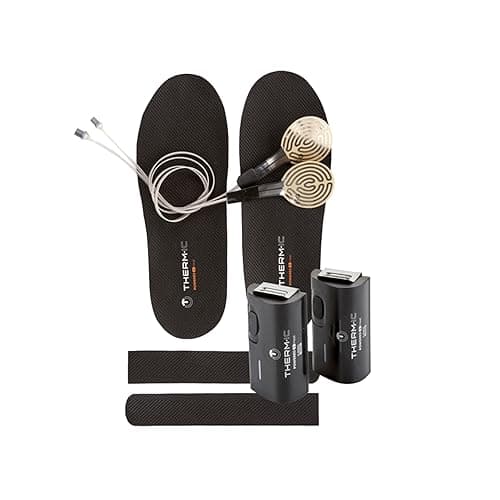
The design is the other reason it wins. The kit is two ultra-thin heating elements plus two self-adhesive, trimmable covers that go into the insole you already have. If a bootfitter built you a footbed, or your boots came with a liner that fits, nothing gets thrown away and the fit you paid for survives.
Therm-ic also publishes the battery as compatible across its Heat Flat, Heat 3D and Heat Kit insoles, so the expensive half of the purchase outlives the cheap half - and a USB charger is included, with a published 5 to 7 hour charge.
Honest cons, and there are several. Batteries are published as NOT included in the kit - the C-Pack 1300 is a separate $139.99, which makes this comfortably the dearest system here. Installing it means cutting a slot in your own insole for the cable, which is not reversible. The mains charger is published as not included. No warranty term is published on either component page. And Therm-ic publishes no thickness figure for the elements beyond “ultra-thin”.
Thermrup Heated Insoles with Rechargeable Batteries
The complete system, and the sensible first purchase for anyone without a footbed worth saving. Thermrup publishes a pair of far-infrared heated insoles with two 7.4V 2,600 mAh batteries included, four heat levels, up to 7 W per insole and up to 6 hours of heat.
The figure that matters most on this page is one Thermrup publishes and Therm-ic does not: 0.24 inches thick. In a boot fitted to millimeters, knowing the number before you buy is the difference between a warm day and a day spent unbuckling. It is published as trim-to-fit from 8.8 to 12.4 inches, covering US Women’s 5 and Youth 3.5 up to US Men’s 15, and as washable - which an insole in a ski boot genuinely needs.
The batteries sit in published leg-mounted gaiters rather than clipped to the boot shell, which keeps the hardware out of the way of a boot buckle and a ski pant cuff.
Honest cons. Up to 6 hours against the Therm-ic’s 13 - that gap is the whole reason it is second, and six hours on the lowest of four levels is not a long cold day. Trimming a generic insole to fit means losing whatever footbed shape your boot came with. A published 27.6 inch cable runs from each insole up the leg to the gaiter, which is one more thing to route and catch. And no warranty term is published.
Disposable insole warmers, and why they carry the skip
HotHands publishes adhesive insole foot warmers at up to 9 hours - longer than the Thermrup’s battery, for about a dollar, with nothing to charge and nothing to route.
In a winter boot, a snow boot or a work boot, that is a genuinely excellent purchase and the one this site would recommend first. The winter boots guide covers that kind of footwear.
They carry the skip in a ski boot for two published reasons and one practical one: air-activated warmers need air, and a buckled ski boot liner is close to airless; the adhesive pad adds thickness under the foot in the one piece of footwear fitted to millimeters; and once a ski boot is on, there is no adjusting a pad that has slipped. Keep a box for the sledding hill and the drive.
The cheaper answers, in order
Everything on this page costs more than the thing that usually fixes cold feet. In order of what to try:
- Loosen the boot. Buckled hard is the commonest cause of cold feet, and it is free - the cold feet page.
- One thin merino sock, never two. Two socks fill the volume and cut circulation - the ski socks roundup.
- Dry the boots overnight. A damp liner is a cold liner, every time - boot dryers and the overnight routine.
- A supportive footbed. Better support frequently means better circulation - the ski boot insoles roundup.
- Heated socks. Same heat, no thickness added under the foot - the heated socks roundup.
- Then this page.
Every pick, with the working
Each entry shows the published inputs, the axis scores they produce, and what you give up. The order is the computed order, not a commercial one, and the arithmetic is open underneath each score.
1 · A skier with fitted footbeds who will not give them up for a generic insole
Therm-ic Insole Heat Kit with C-Pack 1300 Batteries
The pick on published run time, and the only system here that heats the insoles you already ski on: two ultra-thin elements and two trimmable covers go into your own footbeds, powered by a C-Pack 1300 that Therm-ic publishes at up to 13 hours across three heat settings. Thirteen hours is more than double anything else on this page.
- Published price
- $174.98
- Cost per day on snow
- $11.67 a day
- Amortized over
- 3 seasons (15 days)
- Certified to
- Not published
- Published sizes
- One size; heating elements and covers published as trim-to-fit
- Warranty
- No term published on either component page
Therm-ic publishes $34.99 for the Insole Heat Kit and $139.99 for the C-Pack 1300 batteries; $174.98 is the sum of those two published components, not a published bundle price.
What it gets right
- Published up to 13 hours of heat, more than double the published run time of any other system here
- Three published heat settings on a single-button control, which is workable through a glove
- Heating elements published as ultra-thin and designed to go into your own insoles, so a custom footbed stays
- Self-adhesive covers published as trim-to-fit, so the install suits any footbed shape
- Published compatibility across Therm-ic's Heat Flat, Heat 3D and Heat Kit insoles, so the battery outlives the kit
What you give up
- The dearest system on this page by a wide margin
- The kit publishes that batteries are NOT included - the C-Pack is a separate $139.99
- Installation requires cutting a slot in your own insole for the cable, which is not reversible
- A mains charger is published as not included, and a 5-7 hour charge means charging overnight
- No warranty term published on either component page
The working behind the 1.6
- Cost per day on snow: 2.5
- $174.98 over 3 seasons at 5 days each = 15 days = $11.67 a day
- Published protection: not scored
- This category carries no protective standard.
- Size availability: 1.5
- 1 published size (0.0 of 8.5); continuous in-size adjuster published (+1.5); range: One size; heating elements and covers published as trim-to-fit
- Warranty and support: 0.0
- no published term (0 of 6); no published crash replacement (+0); no published repair route (+0)
Axes with unpublished inputs are dropped and the remaining weights re-normalized, so a product is not punished for a manufacturer’s silence. Specifications compiled October 17, 2026 from Therm-ic published C-Pack 1300 and Insole Heat Kit specifications.
2 · A rental or stock liner, and a first try at heated feet without $175 committed
Thermrup Heated Insoles with Rechargeable Batteries
The complete system at half the price, and the one to buy if you do not already have footbeds worth saving: a pair of far-infrared heated insoles with their own 7.4V 2,600 mAh batteries in leg gaiters, four heat levels, up to 7 W per insole and a published 0.24 in thickness. Published run time is up to 6 hours, less than half the Therm-ic.
- Published price
- $89.85
- Cost per day on snow
- $5.99 a day
- Amortized over
- 3 seasons (15 days)
- Certified to
- Not published
- Published sizes
- Trim-to-fit 8.8-12.4 in, published for US Women's 5 / Youth 3.5 through US Men's 15
- Warranty
- No term published on the product page
What it gets right
- A complete pair with batteries published in the box, where the Therm-ic kit publishes batteries as extra
- Four published heat levels and up to 7 W per insole
- Published 0.24 in thickness and trim-to-fit from 8.8 to 12.4 in, covering US Women's 5 to Men's 15
- Leg-mounted gaiters published, so nothing is strapped to the outside of the boot
- Published as washable, which an insole in a ski boot genuinely needs
What you give up
- Published up to 6 hours against the Therm-ic's 13 - that gap is the whole reason it is second
- Trimming a generic insole means losing whatever footbed shape your boot came with
- A 27.6 in cable runs from each insole up the leg to a gaiter, which is one more thing to catch
- No warranty term published
The working behind the 3.5
- Cost per day on snow: 6.7
- $89.85 over 3 seasons at 5 days each = 15 days = $5.99 a day
- Published protection: not scored
- This category carries no protective standard.
- Size availability: 1.5
- 1 published size (0.0 of 8.5); continuous in-size adjuster published (+1.5); range: Trim-to-fit 8.8-12.4 in, published for US Women's 5 / Youth 3.5 through US Men's 15
- Warranty and support: 0.0
- no published term (0 of 6); no published crash replacement (+0); no published repair route (+0)
Axes with unpublished inputs are dropped and the remaining weights re-normalized, so a product is not punished for a manufacturer’s silence. Specifications compiled October 17, 2026 from Thermrup published heated insole specifications.
3 · Winter boots and standing around, not a fitted ski boot
HotHands Insole Foot Warmers
Skip this one. Skip it in a ski boot, and keep it for everything else. An adhesive insole warmer is excellent in a winter boot, a work boot or a pair of snow boots - and in a ski boot, which is fitted to within a couple of millimeters, an extra adhesive pad under the foot is exactly the thickness that turns a snug boot into a painful one. It also needs air to activate, and a ski boot liner is about as airless as footwear gets. Buy it for the sledding hill, the ice rink and the drive, not for the thing you buckle.
A full-length insole warmer published at up to 9 hours. The length is the problem and the point: it warms the whole foot rather than the toes, and it is the wrong shape for a ski boot that has been fitted properly around a footbed.
- Published price
- Not published
- Cost per day on snow
- Not published
- Amortized over
- 3 seasons (15 days)
- Certified to
- Not published
- Published sizes
- One size, full-length insole, single use
- Warranty
- No term published; the product is single use
What it gets right
- Published up to 9 hours, an hour longer than the toe warmer
- Full-length coverage rather than a patch over the toes
- Works in ordinary winter boots, where there is room for it
What you give up
- Wrong shape for a fitted ski boot, and it displaces the footbed that is doing the real work
- Single use, and the largest of the three foot options to carry spares of
- No published warranty term
The working behind the 0.0
- Cost per day on snow: not scored
- No manufacturer-published price, so this axis is not scored.
- Published protection: not scored
- This category carries no protective standard.
- Size availability: not scored
- Sold in one size, so size availability does not apply.
- Warranty and support: 0.0
- no published term (0 of 6); no published crash replacement (+0); no published repair route (+0)
Axes with unpublished inputs are dropped and the remaining weights re-normalized, so a product is not punished for a manufacturer’s silence. Specifications compiled September 12, 2026 from HotHands published product range.
Prices last verified October 19, 2026. Prices move constantly; the figure on Amazon at the moment you click is the real one.
Questions people actually ask
Are heated insoles or heated socks better for skiing?
For most skiers, heated socks. A ski boot is fitted to within millimeters, and an insole adds thickness under the foot that can raise the instep into the shell - pressure that reduces circulation, which is the usual cause of cold feet to begin with. Heated insoles are the better answer when your boots are roomy, when you want to keep your own footbed (the Therm-ic kit heats the insole you already use), or when you would rather not replace socks every season.
How long do heated ski insoles last on a charge?
Between 6 and 13 hours on published figures. Therm-ic publishes up to 13 hours from the C-Pack 1300 across three heat settings; Thermrup publishes up to 6 hours from its 7.4V 2,600 mAh batteries across four levels. Both figures are for the lower settings - run anything on maximum all day and expect considerably less.
Will heated insoles fit in my ski boots?
Check the thickness before you buy. Thermrup publishes 0.24 inches and a trim-to-fit range of 8.8 to 12.4 inches; Therm-ic publishes its elements as ultra-thin but does not publish a figure. If your boots are snug - and a well-fitted ski boot is - either go the Therm-ic route, which adds elements to your existing insole rather than a whole new insole, or use heated socks instead.
Can you put disposable toe warmers in ski boots?
It works poorly. Air-activated warmers need air to generate heat, and a buckled ski boot liner is nearly airless, so they run cool. The adhesive pad also adds thickness in the one piece of footwear fitted to millimeters. Keep disposable insole and toe warmers for winter boots, skates and the drive - where they are genuinely excellent and cost about a dollar.
Do heated insoles replace a custom footbed?
The Thermrup pair does - it is a complete insole, so a custom footbed comes out. The Therm-ic kit specifically does not: it is two ultra-thin elements and two trimmable covers designed to be fitted into the insole you already ski on, which is why it is the pick for anyone who has paid a bootfitter. Installing it does require cutting a small slot for the cable, and that is not reversible.
Where does the battery go on heated insoles?
Outside the boot, either clipped to the boot cuff or in a gaiter on the calf. Thermrup publishes leg-mounted gaiters and a 27.6 in cable; Therm-ic’s C-Pack batteries clip to the boot. Either way it is extra hardware to route under a ski pant cuff, which is part of the trade against heated socks.
Sources
- Therm-ic published C-Pack 1300 specifications: up to 13 hours, 3 heat settings, USB charger included, 5-7 hour charge, compatible with Heat Flat, Heat 3D and Heat Kit
- Therm-ic published Insole Heat Kit specifications: 2 ultra-thin heating elements and 2 trimmable self-adhesive covers, batteries not included
- Thermrup published heated insole specifications: 4 heat levels, 7.4V 2,600 mAh batteries, up to 6 hours, up to 7 W per insole, 0.24 in thick, trim-to-fit 8.8-12.4 in
- HotHands published insole foot warmer duration