Getting ski gear to the mountain without losing a day to it
By car it is a question of what freezes and what gets stolen. By plane it is a question of what the airline counts as one item. Both have specific answers.
By Sawyer V. · Published
We have not tested this gear. Everything below is compiled from published specifications and published safety standards, and the arithmetic is public so you can check it. This page carries affiliate links: if you buy through one we earn a commission at no extra cost to you, and it does not change the order of the picks. Full disclosure.
The short answer
Flying: most US carriers now treat a ski or snowboard bag plus one boot bag as one checked item under the normal allowance rather than as sporting-goods surcharge. Delta publishes exactly that, with the combined weight counting against the standard allowance and a hard limit of 115 linear inches. Driving: skis go on the roof or in the trunk, boots come inside the cabin overnight, and helmets and goggles never live in a freezing car.
| # | Pick | Best for | Score | Price |
|---|---|---|---|---|
| 1 | Smith Cache Mips A head at the edges of the size range, or one between two sizes | $5 a dayon snow | 6.7/10 | $160.00 - View on Amazon |
| 2 | Darn Tough Alpine Over-the-Calf Lightweight Ski Socks The one piece of ski gear worth buying before anything else | $2 a dayon snow | 6.4/10 | $30.95 - View on Amazon |
| 3 | DryGuy Force Dry The fastest dry per dollar | $3.33 a dayon snow | 6.0/10 | $105.83 - View on Amazon |
Prices last verified October 20, 2026. Prices move constantly; the figure on Amazon at the moment you click is the real one.
By car: three decisions, in order
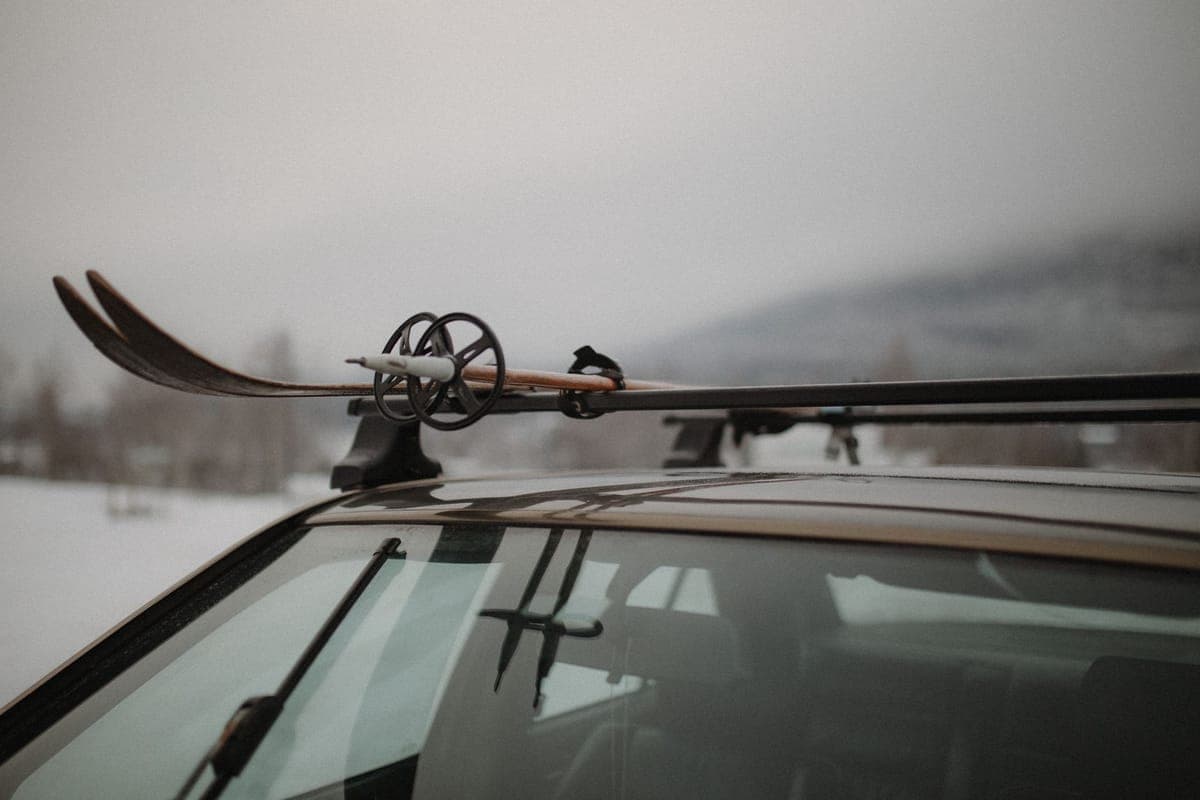
Almost everyone drives, and the decision tree is short. First, do the skis go inside or outside? Inside is free, secure, and costs you the back seat. A pair of adult skis is 160 to 180 cm long, which fits diagonally in most wagons and SUVs with a seat folded, and does not fit in a sedan at all. Outside means a roof rack or a roof box, which frees the cabin and costs fuel economy and a small amount of anxiety at every motel.
Second, what comes inside overnight? Boots, always. A boot liner that freezes solid overnight is genuinely unpleasant to put on and takes most of the first run to warm through, and repeated freeze-thaw cycles are hard on the foam. The liner care page goes into what that does over a season. Goggles, always, because a cold lens brought into a warm room is the classic route to permanent fogging between the two lenses.
Third, what gets stolen? Skis on a roof rack in a public lot are a well-known target, and a cable lock through the bindings takes ten seconds. In the parking lot at the resort, most people simply lean skis in a rack and cross their fingers. A cheap cable is the difference between an annoying afternoon and a very expensive one.
Roof racks, roof boxes and what actually matters
A dedicated ski rack holds skis flat between rubber jaws and is the cheapest option. A roof box holds skis, poles and soft bags out of the weather and is the one families end up with, because it also swallows the sled, the spare gloves and everything else the car cannot fit. Either way the same two rules apply.
- Bindings point up and toward the back. Wet grit thrown forward by the tires is what wears a ski base, and the bindings are the part you least want packed with road salt.
- Check the crossbar spacing against the box, not the car. Roof boxes publish a minimum and maximum bar spread. A box mounted outside that spread is the one that comes loose on a highway.
Rinse the skis with fresh water when you get home if they have spent hours in road spray. Salt on steel edges is exactly what it sounds like, and it is the most common cause of the rust that people then blame on the snow. The edge care page covers how to take it off once it is there.
By plane: what counts as one item
This is the part people get wrong, and it has quietly got better in recent years. The old assumption was that skis attract a sporting-goods surcharge on top of the normal bag fee. Several major carriers now publish something different. Delta, for example, publishes that one ski or snowboard bag plus one boot bag is accepted per person, and that the combined weight of the two counts against the standard checked allowance for your cabin rather than triggering an extra equipment charge. It publishes a hard size limit of 115 linear inches, which is length plus width plus height, and normal overweight charges above 50 lb.
| Question | What Delta publishes |
|---|---|
| Ski or snowboard bag | One per person, accepted as checked baggage |
| Boot bag | One per person, accepted alongside the ski bag |
| How they count | The ski bag and boot bag together count as one checked item under the standard allowance |
| Weight | Standard allowance applies; over 50 lb triggers overweight fees |
| Size | Not accepted above 115 linear inches (292 cm) |
Two practical consequences follow. First, the boot bag is free capacity, so it is where the heavy soft goods go: base layers, socks, a spare fleece. Second, because the two bags are weighed together, stuffing the boot bag with everything you own is how a family ends up paying an overweight fee on a bag that contains two boots and eleven pairs of socks.
What should never go in the hold
Two items, for different reasons. Your helmet, because a hold bag is thrown, and a helmet that takes a hard impact is done even if it looks fine, which is the whole argument on the helmet replacement page. Your goggles, because a crushed frame or a scratched inner lens is unrepairable and a mid-trip replacement at resort prices is painful. Both fit in a daypack. If the checked bag goes missing you can rent skis and boots at the far end within an hour; a helmet and goggles that fit you are harder to replace in a hurry.
If you do not own a bag yet, four are compared here on published length options, padding, capacity and empty weight - that last figure is the one that decides how much gear fits under an airline weight limit.
Packing the ski bag so nothing arrives broken
A padded ski bag is worth having but a plain one works if you pack it properly. Put the skis base to base so the edges face outward and are protected by each other rather than by the fabric. Band them together at tip and tail with the straps the shop gave you. Then pad the tips and tails, which is where impact damage happens, with the bulkiest soft goods you have: a jacket at one end, snow pants at the other.
Poles go alongside, not on top of the bindings. If you are packing a snowboard, the same logic applies with one addition: back the bindings off the board and pack them separately if you can, because a binding baseplate levered sideways in a hold is the classic broken part.
Do not pack anything sharp with the skis. Edges are sharp enough already, and a ski bag containing a tuning file is a ski bag containing something that will cut the bag. If you are bringing tools at all, read the tune kit page first, because for a one-week trip the honest answer is usually to leave them at home.
Drying gear somewhere that is not your house
A condo has no drying room, a motel has a radiator you must not use, and a hotel bathroom has a heated towel rail at best. The technique is the same everywhere: pull the liners out of the boot shells, open every buckle, and put both parts somewhere with moving air at room temperature. The full method is here and it costs nothing.
If you are skiing consecutive days with a family, this is the one trip where a small forced-air dryer earns its space in the car. It is a genuinely optional purchase and the boot dryer page argues both sides, but a machine that publishes a one-to-two hour dry time solves the problem that a rented condo hallway does not.
The short version
- Boots and goggles come inside overnight. Every night, without exception.
- Helmet and goggles travel in the cabin, not the hold, on any flight.
- Bindings face up and to the rear on a roof rack, and the skis get rinsed at home.
- Check your carrier: several now count a ski bag plus a boot bag as one item under the normal allowance rather than as a surcharge.
- Pack skis base to base, and pad the tips and tails with your bulkiest clothing.
- Socks are the one item worth carrying spares of, because they weigh nothing and nothing else ruins a day faster. The full packing list has the rest.
Every pick, with the working
Each entry shows the published inputs, the axis scores they produce, and what you give up. The order is the computed order, not a commercial one, and the arithmetic is open underneath each score.
1 · A head at the edges of the size range, or one between two sizes
Smith Cache Mips
The widest published head range of any helmet on this page and the only one certified to both the US and European standards while carrying a rotational-impact liner, a dial adjuster and a three-year warranty. It is also the second most expensive, and 550 g is not light.
- Published price
- $125
- Cost per day on snow
- $5 a day
- Amortized over
- 5 seasons (25 days)
- Certified to
- ASTM F2040, CE EN 1077:2007 Class B
- Rotational system
- Mips
- Published sizes
- 51-67 cm across S, M, L and XL
- Weight
- 550 g
- Warranty
- Smith 3-year limited warranty
What it gets right
- Certified to ASTM F2040 and CE EN 1077:2007 Class B
- Four published sizes covering 51-67 cm, so odd-sized heads are actually catered for
- Three-year warranty, the longest published term in this group
- Eleven vents, five of them adjustable, which matters more than it sounds on a warm spring afternoon
What you give up
- 550 g in size medium is the heaviest here, and a child or a light adult will notice it
- No published crash-replacement program
The working behind the 6.7
- Cost per day on snow: 7.4
- $125 over 5 seasons at 5 days each = 25 days = $5 a day
- Published protection: 9.0
- ASTM F2040 (+4); CE EN 1077 (+2); Mips rotational system (+3)
- Size availability: 6.6
- 4 published sizes (5.1 of 8.5); continuous in-size adjuster published (+1.5); range: 51-67 cm across S, M, L and XL
- Warranty and support: 2.5
- 3 yr (2.5 of 6); no published crash replacement (+0); no published repair route (+0)
Axes with unpublished inputs are dropped and the remaining weights re-normalized, so a product is not punished for a manufacturer’s silence. Specifications compiled September 3, 2026 from Smith published specifications.
2 · The one piece of ski gear worth buying before anything else
Darn Tough Alpine Over-the-Calf Lightweight Ski Socks
The only item in this entire ledger with an unconditional lifetime guarantee. It is a $30 sock that the maker will replace forever, which over any realistic number of ski days is the cheapest thing on the site.
- Published price
- $30
- Cost per day on snow
- $2 a day
- Amortized over
- 3 seasons (15 days)
- Certified to
- Not published
- Published sizes
- S through XL
- Warranty
- Unconditional lifetime guarantee
What it gets right
- Unconditional lifetime guarantee, published without qualifying conditions
- Lightweight merino, which is correct for a modern ski boot: a thick sock makes boots colder, not warmer
- Over-the-calf length, so the boot cuff never touches bare skin
What you give up
- $30 for one pair of socks reads as absurd until the replacement policy is read
- Lightweight is the right choice but feels wrong to anyone expecting a thick ski sock
The working behind the 6.4
- Cost per day on snow: 9.6
- $30 over 3 seasons at 5 days each = 15 days = $2 a day
- Published protection: not scored
- Socks carry no protective standard, so this axis does not apply.
- Size availability: 5.1
- 4 published sizes (5.1 of 8.5); no continuous adjuster published (+0); range: S through XL
- Warranty and support: 2.0
- no published term (0 of 6); no published crash replacement (+0); repair or replacement parts published (+2)
Axes with unpublished inputs are dropped and the remaining weights re-normalized, so a product is not punished for a manufacturer’s silence. Specifications compiled September 3, 2026 from Darn Tough published specifications.
3 · The fastest dry per dollar
DryGuy Force Dry
The same 105F forced air and 3-hour auto shut-off as the DX for sixty dollars less, with fixed ports and a published limit of items up to 10 inches. For a household drying boots and gloves rather than tall boots and outerwear, that limit rarely bites.
- Published price
- $49.99
- Cost per day on snow
- $3.33 a day
- Amortized over
- 3 seasons (15 days)
- Certified to
- Not published
- Published sizes
- One size
- Warranty
- 1 year, published
What it gets right
- Published 1-2 hour dry time at the price of a convection unit
- Articulating ports that lay flat, which is what lets a ski boot sit on it properly
- 3-hour auto shut-off published, so it cannot be left running for a week
What you give up
- Published to handle items up to 10 inches, so tall boots want the DX
- 1-year published warranty
- Two ports, so gloves and boots take turns
The working behind the 6.0
- Cost per day on snow: 8.6
- $49.99 over 3 seasons at 5 days each = 15 days = $3.33 a day
- Published protection: not scored
- This category carries no protective standard.
- Size availability: not scored
- Sold in one size, so size availability does not apply.
- Warranty and support: 1.5
- 1 yr (1.5 of 6); no published crash replacement (+0); no published repair route (+0)
Axes with unpublished inputs are dropped and the remaining weights re-normalized, so a product is not punished for a manufacturer’s silence. Specifications compiled September 4, 2026 from DryGuy published specifications.
Prices last verified October 20, 2026. Prices move constantly; the figure on Amazon at the moment you click is the real one.
Questions people actually ask
Do airlines charge extra for skis?
Several major US carriers no longer treat skis as a surcharged sporting item. Delta publishes that one ski or snowboard bag plus one boot bag is accepted per person and counts against the standard checked allowance, with normal overweight charges above 50 lb and a hard limit of 115 linear inches. Policies differ by carrier and by route, so check the airline you are actually flying.
Can I take a ski helmet as carry-on?
Yes, and you should. A hold bag takes impacts you cannot see, and a helmet that has taken a hard hit should be replaced even when it looks undamaged. A helmet and goggles in a daypack also mean that a delayed bag costs you skis and boots, which are rentable, rather than the two things that are fitted to you.
Should ski boots be left in the car overnight?
No. A frozen liner is unpleasant to put on, takes a run or more to warm up, and the repeated freeze and thaw is hard on the foam that your fit depends on. Bring boots inside, pull the liners out and let both parts dry at room temperature.
Which way round do skis go on a roof rack?
Bindings facing up and toward the rear of the car. That keeps the bindings out of the worst of the grit and salt thrown forward by the tires, which is what wears bases and rusts edges. Rinse the skis with fresh water when you get home if the drive was salted.
What is the best way to pack skis in a bag?
Base to base with the edges facing outward, banded at tip and tail, then padded at both ends with your bulkiest soft goods. Tips and tails are where hold damage happens. Keep anything sharp, including tuning tools, out of the same bag.