Snow gaiters, and the published height that decides whether they work
Six pages on this site tell you to wear gaiters in deep snow. This is the one that says how tall they need to be, measured in the figures the maker prints.
By Sawyer V. · Published
We have not tested this gear. Everything below is compiled from published specifications and published safety standards, and the arithmetic is public so you can check it. This page carries affiliate links: if you buy through one we earn a commission at no extra cost to you, and it does not change the order of the picks. Full disclosure.
The short answer
Buy on published height, and buy taller than feels necessary: a gaiter only works above the depth of snow you are standing in. For snowshoeing, the Kahtoola LEVAgaiter GTX in the Tall height publishes 13.5 in (34 cm) over a three-layer GORE-TEX laminate, which is the only genuinely waterproof option here. Watch the trap: the INSTAgaiter publishes no membrane at all - it is water-resistant, not waterproof, and costs more.
| # | Pick | Best for | Score | Price |
|---|---|---|---|---|
| 1 | Kahtoola LEVAgaiter GTX Gaiters, Tall Snowshoeing or winter hiking in snow deeper than your boot cuff | $2.83 a dayon snow | 5.5/10 | $33.98 - View on Amazon |
| 2 | Kahtoola INSTAgaiter Low Gaiters Trail running and summer hiking, where the job is grit rather than snow | $3.00 a dayon snow | 5.5/10 | $44.95 - View on Amazon |
| 3 | Kahtoola INSTAgaiter Mid Gaiters Packed trails and shallow snow, where comfort matters more than waterproofing | $3.66 a dayon snow | 5.2/10 | $54.95 - View on Amazon |
Prices last verified November 5, 2026. Prices move constantly; the figure on Amazon at the moment you click is the real one.
First, the word problem
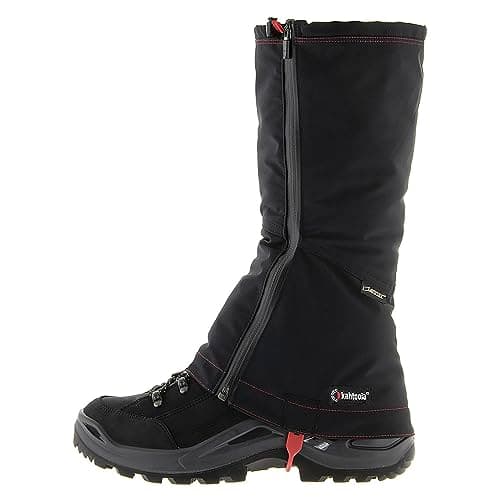
A snow gaiter is a sleeve that wraps the lower leg and the top of the boot, with a strap under the arch and a hook on the laces, to stop snow getting in at the top of the boot. A neck gaiter is a tube of fabric you wear around your neck. They share a name and nothing else, and searching for one reliably returns the other.
This page is about the leg kind. The neck gaiter roundup is here if you wanted the other one.
Height is the specification
Everything else on a gaiter is a detail. Height is the product. A gaiter stops snow up to the point where it ends, and snow that goes over the top has defeated it completely - there is no partial credit, because the snow that gets in melts against your sock and stays there.
So the question is not “which gaiter”, it is “how deep is the snow I walk in”. The three here span almost exactly the useful range, and every figure below is published by Kahtoola rather than estimated by us.
| Gaiter | Published height | What it stops |
|---|---|---|
| INSTAgaiter Low | 4.5 in / 11.4 cm | Trail grit, scree, a dusting - not snow |
| INSTAgaiter Mid | 7.5 in / 19.0 cm | A packed trail and shallow snow |
| LEVAgaiter GTX, Tall | 13.5 in / 34 cm | Breaking trail, deep snow, snowshoeing |
What else to compare, in order
- 1. Membrane, or the absence of one. This is where money is wasted. A gaiter with a GORE-TEX laminate keeps water out. A gaiter with only a DWR finish - a coating on the outside of the fabric - sheds light moisture and wets through under sustained contact with snow. Both get described as “waterproof” by people selling them. Only one of the three here publishes a membrane.
- 2. The instep strap. The strap that runs under the arch of your boot is the part that fails, because it is the part dragged across rock, ice and your own crampon points. Kahtoola publishes a thermoplastic polyurethane strap it calls DuraLink and warrants separately for 1,000 miles, which is an unusually specific claim in a category that normally publishes nothing.
- 3. The zipper. A side zip is how you get a gaiter on over a boot you are already wearing. An AquaGuard zipper is the water-resistant version; a plain one is not. Published, on all three.
- 4. Weight per pair. You lift them with every step for several hours. Published here from 62 to 133 g the pair, which is the difference between noticing and not.
- 5. Published size run. A gaiter has to close around a calf and seal against a boot. Three published sizes is the norm in this category and it is thin, so check the mapping the maker publishes rather than guessing from your shoe size.
The three, compared
| LEVAgaiter GTX, Tall | INSTAgaiter Mid | INSTAgaiter Low | |
|---|---|---|---|
| Published height | 13.5 in / 34 cm | 7.5 in / 19.0 cm | 4.5 in / 11.4 cm |
| Membrane | Three-layer GORE-TEX laminate | None - DWR finish only | None - DWR finish only |
| Fabric | GORE-TEX laminate, 100% polyester face and backer | 86% stretch-woven recycled nylon, 14% polyurethane | 86% stretch-woven recycled nylon, 14% polyurethane |
| Denier published | No | No | No |
| Instep strap | DuraLink TPU | DuraLink TPU | DuraLink TPU |
| Zipper | YKK AquaGuard coil, side | YKK VISLON, side | YKK VISLON, side |
| Boot attachment | Nylon lace hook | Nylon lace hook | Nylon lace hook |
| Published sizes | S, M, L | XS, S/M, L/XL | XS, S/M, L/XL |
| Weight, largest size | 133 g the pair (L) | 76 g the pair (L/XL) | 62 g the pair (L/XL) |
| Maker's published price | $84.95 MSRP, $42.47 now | $54.95 | $44.95 |
Read the first two rows together and the page answers itself. The tallest gaiter here is also the only waterproof one, and it is currently the cheapest of the three. That is not how this category usually works, and the reason is in the next section.
The picks
Kahtoola LEVAgaiter GTX, Tall
The pick for anyone on snowshoes. Kahtoola publishes 13.5 in (34 cm) in the Tall height, which clears the top of every winter boot in our boots roundup and then keeps going up the calf, and it publishes a three-layer GORE-TEX laminate behind it.
The combination is the point. Height without waterproofing gives you a wet sleeve holding snow against your leg; waterproofing without height gives you a dry ankle and a full boot. This publishes both, plus a DuraLink thermoplastic polyurethane instep strap carrying a separate 1,000-mile warranty, an asymmetrical side closure with a YKK AquaGuard coil zipper, and 133 g the pair in size L.
Honest cons, and the first one matters. This is the past-season model. Kahtoola’s current LEVAgaiter publishes a 7 in height instead, so the Tall is run-out stock and the price reflects that - which is why it undercuts the shorter, less waterproof gaiters below it. When it is gone it is gone. Beyond that: three published sizes only, no denier published for the fabric, and a one-year warranty on the gaiter itself, which is short beside the four-year term Kahtoola publishes on its traction devices.
Kahtoola INSTAgaiter Mid
The comfortable one, and the one to read the specification on before you buy. Kahtoola publishes 7.5 in (19 cm) over an 86% stretch-woven recycled nylon and 14% polyurethane blend, which moves with the calf instead of flapping around it, at 76 g the pair.
For a packed trail, a dog walk in a cold snap or a shallow-snow hike, that is a genuinely nice piece of kit - light, stretchy, quick to put on, and sized from XS, which is smaller than the GORE-TEX model goes.
Honest cons. There is no membrane. Kahtoola publishes a PFAS-free DWR finish and describes it as deflecting light moisture, which is water-resistant and is not the same claim as waterproof. The zipper is a plain YKK VISLON rather than the AquaGuard version. And at $54.95 published it is the dearest gaiter on this page while being shorter and less waterproof than the one above it.
Kahtoola INSTAgaiter Low
Marked as the skip above, and the reason is one published number: 4.5 in (11.4 cm). That does not reach the top of a winter boot. In snow it is decoration.
It is on this page because it is the pair people buy by accident. It carries the same brand, the same strap, the same fabric and a lower price than the Mid, and the height is the one specification a buyer skims past. If your reason for being here is snow, this is the wrong product at any price.
What it is genuinely good at is three seasons of the year: trail running, scree, dust and summer grit, at 62 g the pair, which is the lightest thing on this page by a distance.
Waterproof against water-resistant, which is most of the money
A DWR finish is a treatment applied to the outside of a fabric. It makes water bead and roll off, it works well for a while, and it wears off with abrasion and washing. It is a surface property.
A membrane is a layer laminated inside the fabric with pores small enough to block liquid water and large enough to pass water vapor. It is a structural property, it does not wear off, and it is why a GORE-TEX garment costs what it does.
On a jacket the difference is obvious within an hour of rain. On a gaiter it is slower and sneakier: the fabric is pressed against wet snow continuously, from the outside by the snowpack and from the inside by your calf, and a DWR-only gaiter eventually wets through and holds that moisture against you. The waterproof ratings page explains what the numbers behind this mean, where a maker publishes any.
None of which makes a water-resistant gaiter useless. It makes it a different product, for drier snow and shorter days, and worth knowing about before you pay more for it than the waterproof one costs.
How a gaiter attaches, and the bit that breaks
Three points hold a gaiter on, and they fail in a predictable order.
- The instep strap runs under the arch of the boot and takes every step, every rock and every crampon point. This is the part that goes. It is also the part makers almost never specify, which is why a published material and a published mileage warranty are worth paying attention to.
- The lace hook clips to the front laces and stops the gaiter riding up. A nylon hook is quiet and will not scratch a boot; a metal one lasts longer. All three here publish nylon.
- The top closure - a drawcord or elastic - seals against the calf. Too tight and it restricts circulation in exactly the place you do not want that in winter; too loose and snow drops in from above.
One practical habit: put gaiters on before you need them, not when the snow gets deep. Fitting a gaiter standing in a drift, in gloves, with a snowshoe already strapped to the boot, is a genuinely unpleasant five minutes.
When you do not need gaiters
Often, honestly. They are an accessory for a specific problem, and plenty of winter days do not have that problem.
- Groomed or packed trails. If the snow is below your boot cuff and staying there, your boots already solve this. The winter hiking comparison covers when a trail is packed enough that you need traction rather than flotation - and if that is your day, you probably do not need gaiters either.
- If you already ski. Snow pants have a built-in boot gaiter, the elasticated cuff that sits over the boot. For snowshoeing in moderate snow, the ski pants you already own do most of this job, which is exactly what our snowshoe pages have always said.
- Tall winter boots. A boot with a high shaft is a gaiter you are already wearing.
Where gaiters earn their place is the gap between those: ordinary hiking boots, unpacked snow, and a route where you are breaking trail rather than following one. That is most of what snowshoeing actually is. The snowshoe picks are here, and the sizing guide covers matching flotation to your loaded weight.
Who should buy what
- Snowshoeing, or breaking trail in deep snow: the LEVAgaiter GTX in the Tall height. It is the only one here that is both tall enough and actually waterproof, and while the run-out stock lasts it is also the cheapest.
- Packed trails and shallow snow: the INSTAgaiter Mid, as long as you know you are buying water-resistant rather than waterproof.
- Trail running, scree and summer grit: the INSTAgaiter Low, which is excellent at that and wrong for this page.
- Anyone who already owns snow pants with boot gaiters: try a day without, first. You may already be fine.
Every pick, with the working
Each entry shows the published inputs, the axis scores they produce, and what you give up. The order is the computed order, not a commercial one, and the arithmetic is open underneath each score.
1 · Snowshoeing or winter hiking in snow deeper than your boot cuff
Kahtoola LEVAgaiter GTX Gaiters, Tall
The tall one, and height is the whole argument: Kahtoola publishes 13.5 in (34 cm) in the Tall height, which is the only gaiter here that reaches above mid-calf. A three-layer GORE-TEX laminate upper means it is genuinely waterproof rather than water-resistant, and at 133 g the pair in size L it is light for the coverage.
- Published price
- $42.47
- Cost per day on snow
- $2.83 a day
- Amortized over
- 3 seasons (15 days)
- Certified to
- Not published
- Published sizes
- S, M and L published, mapped by Kahtoola to US men's 6-8, 8-11 and 11-13
- Weight
- 133 g
- Warranty
- Kahtoola 1-year limited warranty, plus a published 1000-mile warranty on the DuraLink instep strap
Kahtoola publishes an $84.95 MSRP for this gaiter and currently sells it at $42.47 on its past-season page, which is the figure the cost-per-day axis uses. Amazon prices it lower again.
What it gets right
- 13.5 in (34 cm) published in the Tall height, the only gaiter here that covers deep snow
- Three-layer GORE-TEX laminate published, so it is waterproof rather than DWR-treated
- DuraLink TPU instep strap published, with a 1000-mile warranty on the strap specifically
- YKK AquaGuard coil zipper published on an asymmetrical side closure, which keeps the zip out of the snow spray
- 133 g the pair in size L, light enough that you forget you are wearing them
What you give up
- This is Kahtoola's past-season model; the current LEVAgaiter publishes a 7 in height instead, so the Tall is run-out stock
- Three published sizes only, S to L, so very small and very large feet are not catered for
- Kahtoola publishes no denier for the fabric on this page, so abrasion resistance cannot be compared
- One-year warranty on the gaiter itself, which is short next to the brand's four-year traction warranty
The working behind the 5.5
- Cost per day on snow: 9.0
- $42.47 over 3 seasons at 5 days each = 15 days = $2.83 a day
- Published protection: not scored
- This category carries no protective standard.
- Size availability: 3.4
- 3 published sizes (3.4 of 8.5); no continuous adjuster published (+0); range: S, M and L published, mapped by Kahtoola to US men's 6-8, 8-11 and 11-13
- Warranty and support: 1.5
- 1 yr (1.5 of 6); no published crash replacement (+0); no published repair route (+0)
Axes with unpublished inputs are dropped and the remaining weights re-normalized, so a product is not punished for a manufacturer’s silence. Specifications compiled October 28, 2026 from Kahtoola published LEVAgaiter GTX specifications (past-season page, which is the one that publishes the Tall height).
2 · Trail running and summer hiking, where the job is grit rather than snow
Kahtoola INSTAgaiter Low Gaiters
Skip this one. Skip it for snow, and buy it for everything else. At a published 4.5 in it does not reach the top of a winter boot, which means snow goes straight past it the first time you step off a packed trail - and stopping that is the entire reason you are on this page. For trail running, scree and summer dust it is excellent and it is the lightest thing here at 62 g the pair. It is on this page because it is the model people buy by mistake, having seen the brand name and not the height.
The ankle-height version of the same gaiter, published at 4.5 in (11.4 cm). That is enough to stop trail grit, scree and a dusting of snow, and it is not enough for anything a snowshoe throws at you. Same stretch-woven fabric, same absence of a membrane, same DuraLink strap, 62 g the pair.
- Published price
- $44.95
- Cost per day on snow
- $3.00 a day
- Amortized over
- 3 seasons (15 days)
- Certified to
- Not published
- Published sizes
- XS, S/M and L/XL published
- Weight
- 62 g
- Warranty
- Kahtoola 1-year limited warranty, plus a published 1000-mile warranty on the DuraLink instep strap
What it gets right
- 62 g the pair in L/XL, the lightest thing on this page by a distance
- 4.5 in (11.4 cm) published, which is honest about what it is
- Same DuraLink TPU instep strap and 1000-mile strap warranty as the taller models
- Cheapest Kahtoola gaiter, and genuinely right for three seasons of the year
What you give up
- 4.5 in does not reach the top of a winter boot, let alone above it - the wrong tool for deep snow
- No waterproof membrane published, only a DWR finish
- No denier published for the fabric
- Costs more than twice what an unbranded 1000-denier gaiter costs, for less height
The working behind the 5.5
- Cost per day on snow: 8.9
- $44.95 over 3 seasons at 5 days each = 15 days = $3.00 a day
- Published protection: not scored
- This category carries no protective standard.
- Size availability: 3.4
- 3 published sizes (3.4 of 8.5); no continuous adjuster published (+0); range: XS, S/M and L/XL published
- Warranty and support: 1.5
- 1 yr (1.5 of 6); no published crash replacement (+0); no published repair route (+0)
Axes with unpublished inputs are dropped and the remaining weights re-normalized, so a product is not punished for a manufacturer’s silence. Specifications compiled October 28, 2026 from Kahtoola published INSTAgaiter specifications.
3 · Packed trails and shallow snow, where comfort matters more than waterproofing
Kahtoola INSTAgaiter Mid Gaiters
The comfortable one, and the one to read the specification on before buying. Kahtoola publishes 7.5 in (19 cm) in the Mid height over a stretch-woven recycled nylon blend - and no membrane at all. This is a water-RESISTANT gaiter with a DWR finish, which is a different product from the GORE-TEX models above it, at a price that does not make that obvious.
- Published price
- $54.95
- Cost per day on snow
- $3.66 a day
- Amortized over
- 3 seasons (15 days)
- Certified to
- Not published
- Published sizes
- XS, S/M and L/XL published
- Weight
- 76 g
- Warranty
- Kahtoola 1-year limited warranty, plus a published 1000-mile warranty on the DuraLink instep strap
What it gets right
- 7.5 in (19 cm) published in the Mid height, enough for a packed trail
- 86% stretch-woven recycled nylon with 14% polyurethane published, which moves with the leg rather than flapping
- 76 g the pair in L/XL, the lightest real coverage on this page
- Three published sizes from XS, so it fits smaller legs than the GORE-TEX model does
What you give up
- No waterproof membrane published at all - Kahtoola describes a DWR finish that deflects light moisture, which is water-resistant rather than waterproof
- Dearer than the taller, genuinely waterproof LEVAgaiter in its run-out sizes
- No denier published for the fabric, so abrasion resistance cannot be compared
- A plain YKK VISLON zipper rather than the AquaGuard version on the waterproof models
The working behind the 5.2
- Cost per day on snow: 8.4
- $54.95 over 3 seasons at 5 days each = 15 days = $3.66 a day
- Published protection: not scored
- This category carries no protective standard.
- Size availability: 3.4
- 3 published sizes (3.4 of 8.5); no continuous adjuster published (+0); range: XS, S/M and L/XL published
- Warranty and support: 1.5
- 1 yr (1.5 of 6); no published crash replacement (+0); no published repair route (+0)
Axes with unpublished inputs are dropped and the remaining weights re-normalized, so a product is not punished for a manufacturer’s silence. Specifications compiled October 28, 2026 from Kahtoola published INSTAgaiter specifications.
Prices last verified November 5, 2026. Prices move constantly; the figure on Amazon at the moment you click is the real one.
Questions people actually ask
What do snow gaiters do?
They wrap the lower leg and the top of the boot so that snow cannot drop in at the boot cuff. A strap runs under the arch of the boot and a hook clips to the front laces, which stops the gaiter riding up as you walk. They are not insulation and they are not footwear; they close one specific gap.
How tall should snow gaiters be?
Taller than the deepest snow you expect to stand in, plus a margin for the snow you kick up yourself - which on snowshoes is most of it. For snowshoeing and breaking trail, look for a published height around 13 to 18 in. An ankle gaiter at 4 or 5 in is for grit and dust, not for snow, whatever the brand on it.
Are all snow gaiters waterproof?
No, and the difference is rarely obvious from the listing. A gaiter with a laminated membrane such as GORE-TEX is waterproof; a gaiter with only a DWR finish is water-resistant, meaning it sheds light moisture and wets through under sustained contact with snow. Of the three on this page, only one publishes a membrane - and it is not the most expensive one.
Do you need gaiters for snowshoeing?
If you are breaking trail in unpacked snow in ordinary hiking boots, yes - that is exactly the gap they close. If you are on packed trails, wearing tall winter boots, or wearing snow pants with a built-in boot gaiter, you may already be covered. Try a day without before you buy.
What is the difference between a snow gaiter and a neck gaiter?
They are unrelated products that share a word. A snow gaiter is a sleeve for the lower leg and boot that keeps snow out. A neck gaiter is a tube of fabric worn around the neck and pulled over the face. Searching for one returns the other constantly, which is worth knowing before you order.
Which part of a gaiter wears out first?
The instep strap, every time. It is dragged under the boot across rock, ice and crampon points on every step. Look for a published strap material, and treat a maker that warrants the strap separately as telling you something useful about where it expects the wear.
Sources
- Kahtoola published LEVAgaiter GTX heights, GORE-TEX laminate, DuraLink TPU instep strap, zipper, sizes, per-size weights and warranty (past-season page, which is the one publishing the Tall height)
- Kahtoola published INSTAgaiter Low and Mid heights, stretch-woven fabric blend, DWR finish, DuraLink TPU instep strap, sizes, per-size weights and warranty