The best men's winter boots for a ski trip, on what the makers publish
The boot you wear when you are not skiing does more hours than the one you ski in. Two published specifications decide whether it works: the rating, and whether the liner comes out.
By Sawyer V. · Published
We have not tested this gear. Everything below is compiled from published specifications and published safety standards, and the arithmetic is public so you can check it. This page carries affiliate links: if you buy through one we earn a commission at no extra cost to you, and it does not change the order of the picks. Full disclosure.
The short answer
Buy on two published figures: a stated temperature rating and whether the liner is removable. Both Kamiks here publish -40F and a liner that comes out, which is what gets a soaked boot dry by morning. The Greenbay 4 is the pick - an 8 mm Thermal Guard removable liner, nine published sizes from 7 to 15 and a 13.75 in shaft, at under a hundred dollars. Insulation weight matters less than people think; drying matters more.
| # | Pick | Best for | Score | Price |
|---|---|---|---|---|
| 1 | Kamik Greenbay 4 Men's Winter Boots A parent doing drop-off, sledding and the walk to the lodge in the same boot | $6.67 a dayon snow | 5.6/10 | $99.99 - View on Amazon |
| 2 | Kamik Nation Plus Men's Winter Boots Someone who wants one boot for the slope-side village and the drive home | Not publishedon snow | 1.5/10 | $99.99 - View on Amazon |
| 3 | Columbia Men's Bugaboot III Boot Walking and driving rather than standing around in deep cold | Not publishedon snow | 0.0/10 | $129.99 - View on Amazon |
Prices last verified October 19, 2026. Prices move constantly; the figure on Amazon at the moment you click is the real one.
The boot that does the most hours
A ski trip is mostly not skiing. It is the parking lot, the walk to the lodge, the village in the evening, the morning trip for coffee, standing at the bottom of the nursery slope watching a child. Ski boots are miserable for all of that, and trainers are worse.
So the winter boot is doing more hours than anything else you pack, and the failure modes are specific: it gets soaked on day one, it does not dry overnight, and every subsequent morning starts colder than the last. That single sequence is why the specifications below are ordered the way they are.
The four things worth comparing
| Specification | What good looks like | Why it matters on a trip |
|---|---|---|
| Removable liner | Published as removable | Boot and liner dry separately overnight; the liner is replaceable later |
| Temperature rating | A published figure, e.g. -40F | The only comparable warmth number anyone states |
| Shaft height | Published in inches | Decides whether snow comes in over the top in a parking lot |
| Insulation | A named material, ideally with a weight | Comparable only when both makers publish it, which is rare |
Note that a rating is a comparative figure produced by the maker, not a guarantee about your feet on a given day - standing still in wind at 10F is colder than walking at -10F. Use it to compare boots, not to forecast comfort. The wider boot guide covers how to read them.
Why the removable liner is the headline
Of everything on this page, this is the specification that changes your trip. A boot with a fixed liner has to dry as a single unit: the moisture in the foam has to migrate out through the boot opening, in a warm room, over many hours. It frequently does not finish overnight.
Pull a liner out and both halves dry from the inside and the outside at once, usually by morning. There is a second benefit that shows up in year three: liners pack out and wear out faster than shells, and a removable liner is a replaceable one, which extends the life of the boot rather than ending it.
The same logic drives the boot dryer page and the overnight drying routine - and the rule there applies here too: dry with moving air at room temperature, never on a radiator.
The picks
Kamik Greenbay 4
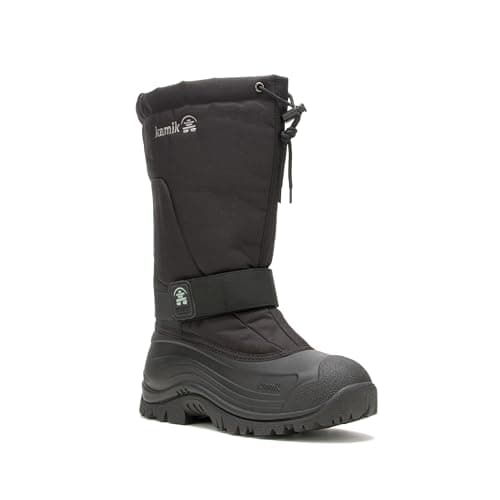
The pick, and it wins on the two specifications that matter plus price. Kamik publishes an 8 mm Thermal Guard removable liner, a -40F rating, a 600D nylon upper, a 13.75 in shaft and nine sizes from 7 to 15 - the widest published run here by a distance, and genuinely useful if your feet are at either end of normal.
The shaft height is worth dwelling on. Nearly fourteen inches means it clears the unplowed edge of a parking lot and the pile of snow at the end of a driveway without filling over the top, which is where an ankle-height boot fails on exactly the walk you bought it for.
Honest cons: at a published 4.07 lb a pair it is the heaviest boot on this page, and you feel that walking a village. It is a hook-and-loop midfoot strap rather than laces, so the fit adjusts coarsely. And a 600D nylon pac boot looks like exactly what it is - there is no version of this that passes for a dinner boot.
Kamik Nation Plus
The same removable-liner argument in leather. Kamik publishes a removable HEAT-MX 145 liner rated to -40F, a seam-sealed genuine suede upper over a waterproof synthetic rubber shell, and a deep self-cleaning tread - the detail that stops a lugged sole packing solid with snow and turning into a skating surface.
This is the boot to choose if the trip involves a village, a restaurant or a drive home where you would rather not be wearing a nylon pac boot. It gets you the same drying advantage as the Greenbay in a shape you will wear at home in January.
Honest cons: Kamik publishes no weight and no size run for this model, so it cannot be compared numerically with the others - a real gap. Suede needs treating before the first wet day and periodically afterward, unlike nylon or rubber. And there is no published US list price on the product page.
Columbia Men’s Bugaboot III
The best boot here to actually walk in, and the skip. Columbia publishes 200 g of insulation - the only stated insulation weight in this group - an Omni-Tech waterproof-breathable membrane, an injection-molded shell, a TechLite midsole for cushioning and an Omni-Grip outsole. It also publishes a wide version, which most winter boots do not.
All of that makes it feel like a boot rather than a pac, and for walking distance it is the most comfortable thing on this page. Two things move it to the skip for a ski trip specifically: the liner is fixed, so a soaked boot dries as one unit overnight, and Columbia publishes no temperature rating for the standard Bugaboot III while both Kamiks publish -40F.
Buy it if your winter is walking rather than standing, and if your boots have a warm dry room to live in. Do not buy it for a week where they get wet every day.
Insulation numbers, and why they are hard to compare
Winter boots publish insulation in two incompatible ways, which is the single most confusing thing about shopping for them.
- A gram figure - 200 g, 400 g, 600 g - describes the weight of synthetic insulation per square meter of material. Columbia publishes 200 g for the Bugaboot III. It is a real number and it only compares meaningfully against other gram figures.
- A named liner with a thickness - an 8 mm Thermal Guard liner, a HEAT-MX 145 liner - describes a whole removable component rather than a fill weight. Kamik publishes these.
- A temperature rating - -40F - is the maker’s own comparative claim across its range, not a standardized test.
Because the three do not convert into one another, this page ranks on whether the liner comes out rather than on insulation figures. That is the specification that behaves consistently across every brand, and on a ski trip it is the one that changes your mornings.
Shaft height, the spec nobody reads
Boot height is published in inches and almost nobody checks it, right up until they step off a cleared path into the unplowed edge of a parking lot and get a boot full of snow.
| Shaft height | Handles | Trade |
|---|---|---|
| Ankle (under 6 in) | Cleared paths and light snow | Snow over the top on any real depth |
| Mid (6-10 in) | Most resort walking and light trail use | The usual compromise |
| Tall (11 in and up) | Unplowed edges, deep snow, snowblowing at home | Heavier, warmer, more effort to get on |
The Greenbay 4 publishes 13.75 in, which is firmly in the tall band and is why it is the pick for a trip where you will be crossing unplowed ground. If your winter is cleared sidewalks, a mid-height boot is less effort and perfectly adequate.
The drying routine that makes them last
Same rules as ski boots, and they matter more here because winter boots get worn every day of a trip rather than just on snow.
- Pull the liner out every night if it comes out. Both halves dry, and the shell dries from the inside rather than trapping moisture.
- Take the footbeds out too. They hold more water than anything else in the boot and dry in an hour on a shelf.
- Moving air at room temperature, never a radiator or a stove. Heat shrinks and hardens liner foam permanently. Convection dryers compared.
- Rinse the salt off before storing at the end of the season. Road salt eats hardware and marks leather.
- Treat suede before the first wet day, and again mid-season, if you buy the leather option.
Can one boot do the whole trip?
For most people, yes - and that is the point of this page. A boot with a published rating, a removable liner and enough height covers the parking lot, the village, the drive and the evening. What it does not cover is skiing, and it is not meant to.
Two situations justify a second pair. If you are walking any real distance on trails, a lighter and more flexible boot is better company than a pac boot - the hiking comparison covers that setup. And if your evenings involve anywhere with a dress code, the suede option earns its place. Otherwise one pair, dried properly each night, does everything.
Sizing, and the sock that goes in
- Size for a midweight wool sock, not the thin sock you would put in a ski boot. This is the one boot in your bag where the thicker sock is correct, because there is room for it and the fit is not fixed by a rigid shell.
- Leave room to wiggle your toes. Circulation is what keeps feet warm, and a winter boot crammed tight is a cold boot for exactly the same reason a ski boot is. The cold feet page covers the mechanism.
- Try them at the end of the day when feet have swollen slightly, and walk up and down rather than standing.
- Check the heel does not lift when you walk. A lifting heel in a tall boot is a blister by the second evening.
What none of these solves
Tread patterns help on packed snow and do very little on hard ice. The refrozen afternoon parking lot is the single most dangerous surface of a ski day, and it is solved by a traction device over the boot rather than by the boot itself.
The ice cleat picks cover that for less than the price of a resort lunch, and the coil devices there are specifically the ones that work over a bulky winter boot.
Waterproof, water resistant, and treated leather
Three different claims appear on winter boots, and only one of them means the boot keeps slush out all day.
| Claim | What it means | What it does not survive |
|---|---|---|
| Molded waterproof shell with sealed seams | The lower boot is one waterproof piece | Snow over the top of the shaft |
| Waterproof-breathable membrane | A membrane inside the upper, like a ski jacket | Neglect - it needs the outer fabric to stay clean |
| Treated or seam-sealed leather | Water resistant, needs re-treating | Repeated slush without maintenance |
The molded-shell construction is why classic pac boots remain the default for genuinely wet snow: there is no seam low down to fail. Columbia publishes an Omni-Tech waterproof-breathable membrane on the Bugaboot III, which is the membrane approach, and Kamik publishes seam-sealed suede on the Nation Plus, which is the leather approach and the one that asks something of you.
Whichever you buy, the failure point is the same and it is not the waterproofing: it is the top of the shaft. Snow that goes in over the collar soaks the liner from the inside, where no membrane helps.
The boot is only half the warmth
Two mistakes undo a well-chosen boot, and both are about what goes inside it.
- Cotton socks. They hold moisture against the skin and stay wet all day. Wool or a wool blend is the only sensible choice in a winter boot.
- Two pairs of socks, or one thick pair in a snug boot. Both compress the air space that does the insulating and restrict circulation, which makes feet colder rather than warmer. If your boots are only warm with two pairs of socks on, they are the wrong size.
The single best warmth upgrade for a boot you already own is usually a dry pair of wool socks at lunchtime, carried in a pocket. What to look for in a winter sock.
Who should buy what
- A ski trip where boots get wet daily. The Greenbay 4, for the removable liner and the published rating, at the lowest price here.
- A trip with a village and a restaurant. The Nation Plus - same drying advantage, better looking, and you will wear it at home.
- Walking rather than standing, in a house with a drying room. The Bugaboot III, for the published insulation weight and the midsole.
- Buying for a woman or a child. Different pages - women’s winter boots and kids’ snow boots, both ranked the same way.
Every pick, with the working
Each entry shows the published inputs, the axis scores they produce, and what you give up. The order is the computed order, not a commercial one, and the arithmetic is open underneath each score.
1 · A parent doing drop-off, sledding and the walk to the lodge in the same boot
Kamik Greenbay 4 Men's Winter Boots
The removable-liner boot at the bottom of the price range. Kamik publishes an 8 mm Thermal Guard removable liner, a -40F rating, a 600D nylon upper and a 13.75 in shaft, in nine sizes from 7 to 15. A liner that comes out is the single most useful feature in a winter boot on a ski trip, because it is what gets a soaked boot dry by morning.
- Published price
- $99.99
- Cost per day on snow
- $6.67 a day
- Amortized over
- 3 seasons (15 days)
- Certified to
- Not published
- Published sizes
- US men's 7 through 15
- Weight
- 1846 g
- Warranty
- Kamik 1-year warranty
What it gets right
- 8 mm Thermal Guard removable liner published, so boot and liner dry separately overnight
- Published -40F rating at under a hundred dollars
- Nine published sizes, US 7 to 15, the widest run here
- 13.75 in shaft height published, so it clears deeper snow than an ankle boot
What you give up
- 4.07 lb a pair published, the heaviest boot on this page
- 600D nylon looks like a snow boot and nothing else; there is no dinner version of it
- A hook-and-loop midfoot strap rather than laces, so the fit adjusts coarsely
The working behind the 5.6
- Cost per day on snow: 6.2
- $99.99 over 3 seasons at 5 days each = 15 days = $6.67 a day
- Published protection: not scored
- Boots carry no US protective standard, so this axis is not scored. On a winter boot the published temperature rating is the figure that matters; on a snowboard or nordic boot it is the sole standard and the fit.
- Size availability: 8.5
- 9 published sizes (8.5 of 8.5); no continuous adjuster published (+0); range: US men's 7 through 15
- Warranty and support: 1.5
- 1 yr (1.5 of 6); no published crash replacement (+0); no published repair route (+0)
Axes with unpublished inputs are dropped and the remaining weights re-normalized, so a product is not punished for a manufacturer’s silence. Specifications compiled September 27, 2026 from Kamik published Greenbay 4 specifications.
2 · Someone who wants one boot for the slope-side village and the drive home
Kamik Nation Plus Men's Winter Boots
The same removable-liner idea in leather rather than nylon: Kamik publishes a removable HEAT-MX 145 liner rated to -40F behind a seam-sealed genuine suede upper on a waterproof synthetic rubber shell. It is the boot on this page you would wear to a restaurant, and it is the one that needs re-treating when the suede marks.
- Published price
- Not published
- Cost per day on snow
- Not published
- Amortized over
- 3 seasons (15 days)
- Certified to
- Not published
- Published sizes
- US men's sizes; no numeric run published on the product page
- Warranty
- Kamik 1-year warranty
Kamik does not publish a US list price on this product page, so the cost-per-day axis is not scored. The buy button carries the live figure.
What it gets right
- Removable HEAT-MX 145 liner published, rated to -40F
- Seam-sealed genuine suede upper over a waterproof rubber shell, both published
- Deep self-cleaning tread published, which is what stops a lugged sole packing with snow
- Removable liners are replaceable, so the boot outlives the liner packing out
What you give up
- Kamik publishes no weight and no size run for this model, so it cannot be compared numerically
- Suede needs treating before the first wet day and periodically after
- No published US list price on the product page
The working behind the 1.5
- Cost per day on snow: not scored
- No manufacturer-published price, so this axis is not scored.
- Published protection: not scored
- Boots carry no US protective standard, so this axis is not scored. On a winter boot the published temperature rating is the figure that matters; on a snowboard or nordic boot it is the sole standard and the fit.
- Size availability: not scored
- Sold in one size, so size availability does not apply.
- Warranty and support: 1.5
- 1 yr (1.5 of 6); no published crash replacement (+0); no published repair route (+0)
Axes with unpublished inputs are dropped and the remaining weights re-normalized, so a product is not punished for a manufacturer’s silence. Specifications compiled September 27, 2026 from Kamik published Nation Plus specifications.
3 · Walking and driving rather than standing around in deep cold
Columbia Men's Bugaboot III Boot
Skip this one. The best boot here to walk in and the one that dries slowest. Columbia publishes 200 g of insulation and an Omni-Tech membrane on an injection-molded shell with a TechLite midsole, which is a genuinely better walking boot than either Kamik - but the liner is fixed, and it publishes no temperature rating at all while both Kamiks publish -40F. On a ski trip, where boots get soaked daily and dry overnight or not at all, a removable liner beats a better midsole.
The only boot here that publishes an insulation weight - 200 g - alongside an Omni-Tech waterproof-breathable membrane, an injection-molded shell, a TechLite midsole and an Omni-Grip outsole. It is also the only one with a fixed liner, which is the trade: better to walk in, worse to dry.
- Published price
- Not published
- Cost per day on snow
- Not published
- Amortized over
- 3 seasons (15 days)
- Certified to
- Not published
- Published sizes
- US men's sizes, listed individually; a wide version is published separately
- Warranty
- No term published on the product page
Columbia lists this per size and colorway without a single MSRP we could read, so the cost-per-day axis is not scored. The linked listing is the size 11.
What it gets right
- 200 g insulation published, the only stated insulation weight in this group
- Omni-Tech waterproof-breathable membrane published rather than a coating
- Injection-molded shell with a TechLite midsole, so it walks like a boot rather than a pac
- A wide version is published separately, which most winter boots do not offer
What you give up
- Fixed liner, so a soaked boot has to dry as a whole unit overnight
- Columbia publishes no temperature rating for the standard Bugaboot III, unlike the two Kamiks
- No published warranty term and no single published price
The working behind the 0.0
- Cost per day on snow: not scored
- No manufacturer-published price, so this axis is not scored.
- Published protection: not scored
- Boots carry no US protective standard, so this axis is not scored. On a winter boot the published temperature rating is the figure that matters; on a snowboard or nordic boot it is the sole standard and the fit.
- Size availability: not scored
- Sold in one size, so size availability does not apply.
- Warranty and support: 0.0
- no published term (0 of 6); no published crash replacement (+0); no published repair route (+0)
Axes with unpublished inputs are dropped and the remaining weights re-normalized, so a product is not punished for a manufacturer’s silence. Specifications compiled September 27, 2026 from Columbia published Bugaboot III specifications.
Prices last verified October 19, 2026. Prices move constantly; the figure on Amazon at the moment you click is the real one.
Questions people actually ask
What should I look for in a men's winter boot for a ski trip?
A published temperature rating and a removable liner, in that order. The rating is the only comparable warmth figure makers state, and a removable liner is what gets a soaked boot dry by morning - which is the difference between one bad day and a bad week.
Are removable liners worth it in winter boots?
Yes, and it is the most useful feature in the category. Boot and liner dry separately and much faster, and the liner is replaceable when it packs out - which extends the life of the boot rather than ending it. Fixed-liner boots have to dry as one unit, and often do not finish overnight.
What does a -40F rating on a winter boot actually mean?
It is a comparative figure produced by the maker rather than a guarantee. Standing still in wind at 10F can be colder than walking at -10F. Use published ratings to compare one boot against another, not to predict how your feet will feel on a particular day.
What socks should I wear with winter boots?
A midweight wool sock - this is the one boot in a ski bag where the thicker sock is right, because there is room for it. Leave space to wiggle your toes; a winter boot crammed tight restricts circulation and gets cold for the same reason a ski boot does.
Do winter boots grip on ice?
Not reliably. Tread helps on packed snow and does little on hard ice, which is exactly what a refrozen resort parking lot is by late afternoon. A coil traction device worn over the boot solves it for a fraction of the boot's price.