Women's winter boots, compared on published temperature ratings
The boots you wear to and from the mountain get worn more hours than your ski boots do. Three that publish an actual tested rating rather than a vibe.
By Sawyer V. · Published
We have not tested this gear. Everything below is compiled from published specifications and published safety standards, and the arithmetic is public so you can check it. This page carries affiliate links: if you buy through one we earn a commission at no extra cost to you, and it does not change the order of the picks. Full disclosure.
The short answer
Buy on published temperature rating and seam-sealed construction, in that order - all three boots here publish -40F, which very few brands state at all. Then choose on weight and whether the liner comes out. A removable liner is the difference between dry boots in the morning and damp ones.
| # | Pick | Best for | Score | Price |
|---|---|---|---|---|
| 1 | Kamik Alborg Women's Winter Boots A family arriving back at a condo with wet boots every single evening | $8.67 a dayon snow | 5.4/10 | $129.99 - View on Amazon |
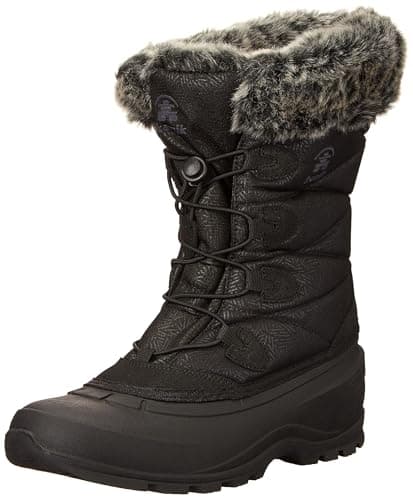
| 2 | Kamik Momentum 3 Women's Winter Boots A resort week where the boot is for the parking lot and the village, not the slope | $7.33 a dayon snow | 5.3/10 | $106.32 - View on Amazon |
| 3 | Kamik Snovalley 6 Women's Winter Boots Someone who wants one boot for the mountain and the evening | $9.33 a dayon snow | 4.6/10 | $119.06 - View on Amazon |
Prices last verified October 19, 2026. Prices move constantly; the figure on Amazon at the moment you click is the real one.
The boots you wear most
On a week-long ski trip you will spend perhaps five hours a day in ski boots and most of the rest of the time in these. Walking to the lift, standing in a lift line with a child, crossing an icy parking lot, walking to dinner - the winter boot does more hours than any other item in the bag.
It is also the item most often left to chance, on the reasoning that any boot will do for walking. Any boot will do until the parking lot is a sheet of ice or the snow at the curb is deeper than the boot is tall. The winter boots guide covers the general case; this page is about three specific pairs.
What a temperature rating is and is not
A published rating like -40F is a claim about the insulation package, usually derived from a standard test with a stationary or slowly moving foot. It is not a promise that your feet will be warm at -40F for an afternoon.
What actually decides whether your feet are warm is a combination of the rating, how dry the boot is, how tight it is laced and how much you are moving. A correctly rated boot laced too tight on a stationary foot gets cold well above its number.
So use the rating as a comparison between boots rather than as a forecast. All three here publish the same figure, which is convenient: it means the decision is made on the other specifications.
The three, compared
| Momentum 3 | Snovalley 6 | Alborg | |
|---|---|---|---|
| Temperature rating | -40F | -40F | -40F |
| Upper | Seam-sealed 600D nylon | Seam-sealed suede | Nubuck and full-grain leather |
| Liner | 145 g HeatMX, fixed | 145 g HeatMX, fixed | 8 mm Zylex, removable |
| Weight per pair | 2.25 lb | 2.61 lb | 3.81 lb |
| Published sizes | US 5-11 | US 5-11 | US 6-11 |
| Warranty | 1 year | 1 year | 1 year |
| Published price | $109.99 | $139.99 | $129.99 |
Three rows differ meaningfully: the upper material, the liner, and the weight. Those three are the whole decision.
The picks
Kamik Momentum 3
The pick for most trips, and the cheapest of the three. A seam-sealed 600-denier nylon upper over a waterproof rubber base, a 145 g HeatMX liner, a published -40F rating and a self-cleaning tread pattern - which matters more than it sounds, because a tread that packs with snow is a tread with no grip at all.
Nylon is the right upper for a boot that will get wet daily. It does not need treating the way suede and leather do, it dries faster, and it is the reason this is the cheapest pair here. It also scuffs where leather does not, which is a cosmetic objection rather than a functional one.
Seven published sizes, US 5 to 11, and a published one-year warranty. The fixed liner is the honest limitation: a wet boot has to dry as a whole, which takes longer than drying a liner and a shell separately.
Kamik Snovalley 6
The same 145 g HeatMX liner and the same -40F rating as the Momentum, behind a seam-sealed waterproof embossed suede upper with a faux-shearling cuff. Kamik publishes 2.61 lb a pair and a 10.62 in boot height, so it sits between the Momentum and the Alborg on weight and clears deeper snow than an ankle boot does.
The reason to choose it over the Momentum is that it looks like a boot you would wear to dinner rather than a boot you would wear to shovel a driveway. That is a legitimate reason on a trip where you are packing one pair - but it is the more expensive of the two fixed-liner boots here at a published $139.99, and it is the heavier of them, so you are paying for the look rather than the specification.
The reason not to is the suede. It marks, and it wants treating before the first wet day and periodically afterwards - which is a maintenance task the nylon pair does not have. The mid-season checkup page covers the kind of maintenance that gets forgotten.
Kamik Alborg
Marked as the skip above and it is the most capable boot on this page. The reason is one published feature: an 8 mm Zylex removable liner.
A removable liner changes the overnight problem entirely. Pull the liner out and both it and the shell dry from the inside overnight; leave a fixed-liner boot to dry and the inside is still damp in the morning. The overnight drying page covers how to do it without wrecking anything, and a boot dryer solves the same problem electrically. A removable liner is also replaceable, which extends the useful life of the boot beyond the liner packing out.
The cost is weight: 3.81 lb a pair, well over a pound more than the Snovalley and more than a pound and a half more than the Momentum. That is a genuinely heavy boot to walk a village in, and it is why this is the skip rather than the pick for a typical trip. Six published sizes, starting at 6 rather than 5.
Fitting a winter boot
- Fit them with the sock you will wear. Which for a winter boot is usually a midweight wool sock, not the thin sock you would put in a ski boot. The socks page explains why the two are different problems.
- Leave room to wiggle your toes. Unlike a ski boot, a winter boot insulates using trapped air, and a tight boot has no trapped air. Tight equals cold here, which is the opposite of ski boot fitting.
- Check the height against what you walk through. A mid-height boot is fine for a cleared sidewalk and useless at a curb with a plow bank on it.
- Look at the tread, not just the rating. Winter boot soles vary enormously on ice, and no maker publishes a grip figure. Slip-on traction devices cover the gap for a few dollars.
The rest of the family
The same reasoning applies to everyone in the household, and for children it applies harder because a cold or wet child ends the outing. The kids snow boot roundup covers two boots with published ratings.
And if the boots are for snowshoeing rather than walking, check the snowshoe’s published footwear range against them first - a snowshoe binding fits around a boot, so the boot decides what will work.
Every pick, with the working
Each entry shows the published inputs, the axis scores they produce, and what you give up. The order is the computed order, not a commercial one, and the arithmetic is open underneath each score.
1 · A family arriving back at a condo with wet boots every single evening
Kamik Alborg Women's Winter Boots
Skip this one. The best boot here and the wrong one for most trips. A removable 8 mm Zylex liner is the single most useful feature in this category - the boot and the liner dry separately overnight, and the liner is replaceable - but it is 3.81 lb a pair, well over a pound heavier than either fixed-liner boot here, and you feel every ounce of that walking a village. Buy it if your boots are soaked every evening. Skip it if you mostly walk from a car to a lodge.
The only boot in this ledger with a published removable liner, an 8 mm Zylex, which is the feature that decides whether a wet boot is dry by morning. It is also 3.81 lb a pair, more than a pound heavier than either fixed-liner boot here, and that weight is the price of the leather and the liner.
- Published price
- $129.99
- Cost per day on snow
- $8.67 a day
- Amortized over
- 3 seasons (15 days)
- Certified to
- Not published
- Published sizes
- US women's 6 through 11
- Weight
- 1728 g
- Warranty
- Kamik 1-year warranty
What it gets right
- 8 mm Zylex removable liner published, so boot and liner dry separately overnight
- Published -40F rating with fully seam-sealed construction
- Nubuck and full-grain leather upper, the most durable here
- Removable liners are also replaceable, which extends the life of the boot
What you give up
- 3.81 lb a pair against the Snovalley's 2.61 and the Momentum's 2.25, and you feel every ounce walking
- Six published sizes, starting at 6 rather than 5
- Most expensive of the three, and leather needs maintenance
The working behind the 5.4
- Cost per day on snow: 4.7
- $129.99 over 3 seasons at 5 days each = 15 days = $8.67 a day
- Published protection: not scored
- Boots carry no US protective standard, so this axis is not scored. On a winter boot the published temperature rating is the figure that matters; on a snowboard or nordic boot it is the sole standard and the fit.
- Size availability: 8.5
- 6 published sizes (8.5 of 8.5); no continuous adjuster published (+0); range: US women's 6 through 11
- Warranty and support: 3.5
- 1 yr (1.5 of 6); no published crash replacement (+0); repair or replacement parts published (+2)
Axes with unpublished inputs are dropped and the remaining weights re-normalized, so a product is not punished for a manufacturer’s silence. Specifications compiled September 12, 2026 from Kamik published specifications.
2 · A resort week where the boot is for the parking lot and the village, not the slope
Kamik Momentum 3 Women's Winter Boots
A published -40F rating on a seam-sealed 600-denier nylon upper, at the lowest price of the three, and the only one here published as vegan. 2.25 lb a pair is the middle weight, and the fleece lining plus a 145 g fixed liner is warm without being a boot you cannot drive in.
- Published price
- $109.99
- Cost per day on snow
- $7.33 a day
- Amortized over
- 3 seasons (15 days)
- Certified to
- Not published
- Published sizes
- US women's 5 through 11
- Weight
- 1021 g
- Warranty
- Kamik 1-year warranty
Kamik lists this below the stated regular price at the time of writing; the regular price is used here.
What it gets right
- Published -40F rating, tested to that figure rather than estimated
- Seam-sealed 600-denier nylon upper with a waterproof rubber base
- Seven published sizes, US 5 to 11
- Published 1-year warranty and a self-cleaning tread pattern
What you give up
- Fixed liner, so it cannot be pulled out to dry overnight
- 2.25 lb a pair is not light for a boot you walk a village in
- Nylon upper scuffs where the leather versions do not
The working behind the 5.3
- Cost per day on snow: 5.7
- $109.99 over 3 seasons at 5 days each = 15 days = $7.33 a day
- Published protection: not scored
- Boots carry no US protective standard, so this axis is not scored. On a winter boot the published temperature rating is the figure that matters; on a snowboard or nordic boot it is the sole standard and the fit.
- Size availability: 8.5
- 7 published sizes (8.5 of 8.5); no continuous adjuster published (+0); range: US women's 5 through 11
- Warranty and support: 1.5
- 1 yr (1.5 of 6); no published crash replacement (+0); no published repair route (+0)
Axes with unpublished inputs are dropped and the remaining weights re-normalized, so a product is not punished for a manufacturer’s silence. Specifications compiled September 12, 2026 from Kamik published specifications.
3 · Someone who wants one boot for the mountain and the evening
Kamik Snovalley 6 Women's Winter Boots
The suede boot in this group: a seam-sealed waterproof embossed suede upper with a faux-shearling cuff, over the same 145 g HeatMX liner and the same published -40F rating as the Momentum. It is not the lightest here - Kamik publishes 2.61 lb a pair against the Momentum's 2.25 - and at $139.99 it is the dearest of the two fixed-liner boots. You are paying for how it looks off the hill.
- Published price
- $139.99
- Cost per day on snow
- $9.33 a day
- Amortized over
- 3 seasons (15 days)
- Certified to
- Not published
- Published sizes
- US women's 5 through 11
- Weight
- 1184 g
- Warranty
- Kamik 1-year warranty
What it gets right
- Published -40F rating with seam-sealed waterproof construction
- Seam-sealed embossed genuine suede upper with a faux-shearling cuff
- Removable EVA footbed and a published 10.62 in boot height, so it clears deeper snow than an ankle boot
- Seven published sizes, US 5 to 11, and a 1-year warranty
What you give up
- 2.61 lb a pair published, heavier than the Momentum 3 at 2.25 lb
- Suede needs re-treating and will mark, unlike a nylon or rubber upper
- Fixed liner, so overnight drying means drying the whole boot
- $30 more than the Momentum at published prices for the same published warmth
The working behind the 4.6
- Cost per day on snow: 4.2
- $139.99 over 3 seasons at 5 days each = 15 days = $9.33 a day
- Published protection: not scored
- Boots carry no US protective standard, so this axis is not scored. On a winter boot the published temperature rating is the figure that matters; on a snowboard or nordic boot it is the sole standard and the fit.
- Size availability: 8.5
- 7 published sizes (8.5 of 8.5); no continuous adjuster published (+0); range: US women's 5 through 11
- Warranty and support: 1.5
- 1 yr (1.5 of 6); no published crash replacement (+0); no published repair route (+0)
Axes with unpublished inputs are dropped and the remaining weights re-normalized, so a product is not punished for a manufacturer’s silence. Specifications compiled September 26, 2026 from Kamik published specifications.
Prices last verified October 19, 2026. Prices move constantly; the figure on Amazon at the moment you click is the real one.
Questions people actually ask
What temperature rating do winter boots need for a ski trip?
A published rating is more useful than a specific number, because ratings are derived from standard tests with a stationary foot rather than promises about your afternoon. All three boots here publish -40F. Use the figure to compare boots, not to predict comfort.
Are removable liners worth it in winter boots?
If your boots get wet daily, yes. Pulling the liner out lets both it and the shell dry from the inside overnight, where a fixed-liner boot is often still damp in the morning. The liner is also replaceable, which extends the boot’s life. The trade is weight.
Should winter boots be tight or loose?
Loose enough to wiggle your toes. A winter boot insulates with trapped air, so a tight boot is a cold boot - the opposite of ski boot fitting, where a snug fit is what gives you control. Fit them with the thicker sock you will actually wear.
Are suede winter boots a bad idea for snow?
Not if they are seam sealed, which the pair here is, but they need treating before the first wet day and periodically afterwards. A nylon upper needs no maintenance, dries faster and costs less. Suede is a choice about how the boot looks, made with your eyes open.
Can you wear winter boots for snowshoeing?
Yes, and they are the correct footwear for it. Check the snowshoe’s published footwear size range against the boot before buying, because a snowshoe binding fits around a boot rather than a foot, and a very bulky boot can fall outside the range.