The best women's ski gloves, and when a unisex small is the smarter buy
Most gloves sold as women's are the same construction in a narrower hand and a different color. Two things genuinely differ, and only one of them is on the label.
By Sawyer V. · Published
We have not tested this gear. Everything below is compiled from published specifications and published safety standards, and the arithmetic is public so you can check it. This page carries affiliate links: if you buy through one we earn a commission at no extra cost to you, and it does not change the order of the picks. Full disclosure.
The short answer
Buy on cuff, membrane and warranty, not on the word women’s. The Burton Women’s Profile is the pick here: a named DRYRIDE membrane, ThermacoreECO insulation, an extended gauntlet cuff and a lifetime warranty at about $53. If your hands run cold rather than your gloves running thin, a mitten beats a warmer glove every time - and a well-sized unisex small often beats a women’s-labeled glove that publishes nothing.
| # | Pick | Best for | Score | Price |
|---|---|---|---|---|
| 1 | Burton Women's Profile Gloves A woman who wants one ski glove that will outlast the trip it was bought for | $3.53 a dayon snow | 6.2/10 | $52.95 - View on Amazon |
| 2 | OutdoorMaster 3M Thinsulate Waterproof Ski Gloves The default adult glove when nothing about your hands is unusual | $2.67 a dayon snow | 6.3/10 | $24.95 - View on Amazon |
| 3 | OutdoorMaster Ski Mittens Anyone whose hands get cold, which the gloves will not fix | $2.33 a dayon snow | 6.4/10 | $24.95 - View on Amazon |
| 4 | Savior Heat App-Control Heated Ski Gloves 2.0 An adult with genuinely cold hands who skis a full day | $11.33 a dayon snow | 2.3/10 | $169.99 - View on Amazon |
Prices last verified October 19, 2026. Prices move constantly; the figure on Amazon at the moment you click is the real one.
What a women’s cut actually changes
Two things, and it is worth knowing which is which before paying extra for the label.
- Hand pattern. A women’s glove is generally cut with shorter, narrower fingers and a narrower palm for the same overall length. This is real and it matters: a glove with fingers longer than your fingers leaves an air gap at the tip, and that empty space is where cold fingers come from. The warmest glove in the world fits badly and is cold.
- Size availability. The practical difference for a lot of buyers. Women’s lines carry XS and S properly; unisex lines often start at S and it is a men’s S.
What usually does not change is construction. The membrane, the insulation and the cuff design on a women’s glove are typically the same as the men’s version of the same model. So the question to ask is not “is this a women’s glove” but “does this glove fit my hand and publish what it is made of.”
The four things worth comparing
| Specification | What to look for | Why it matters |
|---|---|---|
| Cuff | Extended gauntlet over the jacket, or short under-cuff | A gauntlet keeps snow out of the sleeve on the chairlift and in a fall |
| Membrane | A named waterproof-breathable membrane, not just 'waterproof' | A wet glove is a cold glove within one run, whatever the insulation says |
| Insulation | A named insulation, ideally with a gram weight | The only comparable warmth figure anyone publishes, when they publish it |
| Warranty | A published term | Gloves are the most-replaced item in a ski kit; a term tells you what the maker expects |
Almost nothing in this category publishes an insulation weight in grams, which is why the picks below lean on the specifications that are stated. Where a maker publishes nothing, this page says so rather than inventing a number.
If your hands are the problem, buy a mitten
Before spending more on a warmer glove: fingers warm each other when they share a compartment, which is why a mid-priced mitten outperforms an expensive glove for anyone who runs cold. You give up dexterity for buckles and zippers, and on a family ski day that is a small price. The gloves-versus-mittens page runs the whole argument, and the cold hands page covers the causes that no glove fixes.
The picks
Burton Women’s Profile Gloves
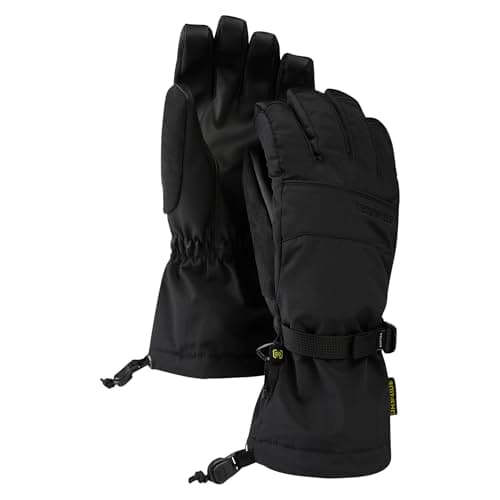
The pick, and the only genuinely women’s-cut glove here that publishes what it is made of. Burton states a bluesign-approved DRYRIDE two-layer shell with a waterproof, breathable membrane, ThermacoreECO insulation described as 95 percent recycled polyester, a brushed microfiber lining, an extended gauntlet cuff with an adjustable wrist cinch, a removable wrist leash and a nose wipe on the thumb.
The specification that separates it from everything else on this page is the lifetime warranty. Nothing else at this price on this site publishes one. On an item that gets lost, soaked, dragged along chairlift bars and left on radiators, a maker willing to stand behind it indefinitely is telling you something.
Honest cons: Burton publishes no insulation weight in grams, so its warmth cannot be compared numerically with anything. XS and XL were both showing sold out when this page was compiled, which leaves the smallest and largest hands out. And it is roughly twice the price of the budget gloves below.
OutdoorMaster 3M Thinsulate Ski Gloves
The unisex option that solves the sizing problem from the other direction. It is not cut on a women’s pattern, but it is cheap enough to buy the size that actually fits rather than the size that was in stock, and it publishes a named insulation - 3M Thinsulate - which most gloves at this price do not.
This is the honest budget answer for a first season: spend the difference on socks that fit or a second pair of gloves, because the second pair is what saves a day when the first pair is soaked by lunch.
Honest cons: a unisex cut on a narrow hand means long fingertips and an air gap where you least want one. The cuff is shorter than the Burton’s gauntlet. And no warranty term is published.
OutdoorMaster Ski Mittens
The warmest thing on this page for the money, for the reason above: four fingers in one compartment share heat that four separate compartments lose. If you have been buying warmer and warmer gloves and your hands are still cold at the top of the first lift, this is the change that actually works, and it costs less than the gloves you are replacing.
Honest cons: you will take them off for buckles, zippers, phones and lift tickets, and every removal is a chance to drop one from a chairlift. Dexterity is genuinely worse. And it is a unisex cut.
Savior Heat App-Control Heated Ski Gloves
Here as the honest top of the category and as the skip. Heated gloves are the correct answer to a medical or circulatory problem - hands that go white and numb in gloves that keep everyone else comfortable - and they work. They are the wrong answer to a thin glove, a short cuff or a wet liner, which is what most cold hands actually are.
At roughly three times the price of the Burton, plus a battery to charge the night before, this is a considered purchase rather than a first one. The heated gear page covers run times and what the batteries actually deliver.
Three things that do not make a glove warmer
- More insulation in a glove that already fits tightly. The same rule as ski boots: compressed insulation does not loft, and a glove squeezing your fingers restricts the circulation that carries heat to them. A slightly roomier glove with less fill is often warmer than a tight one with more.
- A waterproof rating on its own. Gloves get wet from the inside as often as the outside - hands sweat, and a glove with no breathability traps that moisture against your skin, which is exactly how hands get cold on a warm spring day.
- Buying a size up for a liner you do not own. The extra space fills with air that your hand has to heat. If you are running a liner, size for liner plus glove together and try both on at once.
The things that genuinely do make a glove warmer are unglamorous: a cuff that seals, a dry interior, a mitten instead of a glove, and a warm core so your body is not withdrawing blood from your extremities in the first place. None of those four appear on a hang tag, and three of them cost nothing at all.
What each price band actually buys
| Roughly | What appears | Worth it? |
|---|---|---|
| Under $30 | Basic insulation, short cuff, no published membrane or warranty | As a second pair, yes - as your only pair, no |
| $30-60 | Named insulation, a named membrane, a gauntlet cuff, sometimes a real warranty | The sweet spot for a few days a season |
| $60-120 | Leather palms, removable liners, longer warranties, better fit range | Worth it if you ski more than a week a year |
| $120 and up | Heated gloves, or premium leather and technical membranes | Only for circulation problems or serious mileage |
The jump worth paying for is the first one: from an unspecified glove to one that publishes a membrane, a cuff design and a warranty. Above that, you are buying durability and fit refinement rather than a warmer glove.
Glove, mitten or three-finger
Before comparing models, decide the format - it changes warmth more than any specification on any of these products.
| Format | Warmth | Dexterity | Best for |
|---|---|---|---|
| Glove | Lowest - each finger insulated separately | Highest | Anyone handling buckles, phones and children constantly |
| Mitten | Highest - fingers share heat | Lowest | Cold hands, cold days, and anyone who has tried warmer gloves without success |
| Three-finger (lobster) | Between the two | Between the two | A compromise that suits people who need a working index finger |
The pattern worth knowing: a mid-priced mitten beats an expensive glove for warmth, every time, because the physics is on its side. If you are shopping for warmth rather than function, changing format is cheaper and more effective than moving up a price bracket.
Care that doubles their life
- Never dry them on a radiator. Heat degrades the membrane and shrinks leather. Air drying, fingers up, away from direct heat.
- Pull the liners out if they are removable. Fixed liners - like the brushed microfiber lining Burton publishes on the Profile - dry more slowly, so give them longer and more airflow.
- Re-proof the shell once a season. A wash-in or spray treatment restores the water repellency that wore off, and a glove that stops wetting out is a glove that stays warm.
- Use the wrist leash. The most common way a glove dies is being dropped from a chairlift, and the leash exists precisely for that.
The glove care page has the full routine, including what to do with leather palms.
Liners, and the two-glove system
The most useful thing you can do with a glove budget is split it. A thin liner glove under a shell mitten or glove gives you three things a single heavier glove cannot.
- You can take the outer off without bare hands. Lift tickets, phones, buckles, a child’s zipper - all the moments that end with someone dropping a glove from a chairlift.
- You can adjust warmth. A spring afternoon runs the liner alone; a January morning runs both.
- The liner dries overnight even when the outer does not, so you start day two with something dry against your skin.
The trade is bulk and the fact that two thin layers are not as warm as one well-built glove of the same total thickness - air moves between them. For anyone who runs cold this is still the system that works, and it is cheaper than the heated option. The cold hands page covers the causes a glove cannot fix at all.
What happens to gloves over a season
Gloves wear out faster than anything else in a ski kit, and knowing how they fail tells you where the money is worth spending.
| Failure | Cause | What helps |
|---|---|---|
| Palm wears through | Dragging on edges, poles, lift bars and a board being carried | Leather or reinforced palms; a published warranty |
| Waterproofing stops working | DWR wears off; the shell wets out and stays wet | Re-proofing, and never drying on a radiator |
| Liner pulls out when you take them off | Fixed linings are stitched; loose ones are not | A published fixed lining, as on the Burton here |
| One goes missing | Taken off on a lift, in a pocket, on a car roof | A wrist leash, which most cheap gloves omit |
Two of those four are addressed by specifications this page can check: a fixed lining and a removable wrist leash are both published on the Burton. The other two are care rather than purchase - the glove care page covers drying and re-proofing without wrecking the shell.
Teenagers, and the size gap nobody stocks
The hardest hands to buy for are not small adults - they are teenagers, who have outgrown youth gloves and are not yet an adult small. Women’s XS is frequently the right answer, and it is the size most often out of stock, as it was on the Burton when this page was compiled.
If XS is unavailable, a youth XL from a kids line usually fits better than an adult small, and it costs less. The kids glove roundup runs to the top of the youth sizes, and the teen gear page covers the whole awkward-size problem across a kit.
Fitting a glove without trying it on
- Measure the palm. Around the knuckles, excluding the thumb, in inches. That number is what most size charts are built on. The sizing guide has the bands.
- Check the fingertips. There should be a few millimeters of room - enough to wiggle, not enough to leave a hollow cap of air.
- Decide cuff style before size. A gauntlet goes over the jacket sleeve; an under-cuff goes inside it. Buying the wrong one for your jacket is how snow gets to your forearm.
- Buy two cheap pairs over one expensive pair if you are skiing several days in a row. Wet gloves do not dry overnight on a hotel radiator, and a second dry pair is worth more at 8 a.m. than a better glove would have been.
Who should buy what
- One glove for several seasons. The Burton, for the membrane, the gauntlet and the lifetime warranty.
- A first ski trip. The budget gloves, in the right size, plus the money saved going toward a second pair.
- Hands that are always cold. Mittens first, heated gloves only if mittens and a dry liner have already failed.
- A child. Not this page - the kids’ gloves and mittens roundup is sized properly and priced for things that get lost.
Every pick, with the working
Each entry shows the published inputs, the axis scores they produce, and what you give up. The order is the computed order, not a commercial one, and the arithmetic is open underneath each score.
1 · A woman who wants one ski glove that will outlast the trip it was bought for
Burton Women's Profile Gloves
The one genuinely women's-cut glove on this page that publishes a membrane, a named insulation and a lifetime warranty at a family price. Burton states a bluesign-approved DRYRIDE two-layer shell, ThermacoreECO insulation and an extended gauntlet cuff - the cuff being the detail that separates a ski glove from a winter glove.
- Published price
- $52.95
- Cost per day on snow
- $3.53 a day
- Amortized over
- 3 seasons (15 days)
- Certified to
- Not published
- Waterproof rating
- Not published
- Published sizes
- XS to XL published; S, M and L were the sizes in stock on September 23, 2026
- Warranty
- Burton lifetime warranty
What it gets right
- Lifetime warranty published, which nothing else at this price on this site offers
- DRYRIDE waterproof and breathable membrane named on the product page, bluesign approved
- Extended gauntlet cuff with an adjustable wrist cinch, so snow cannot get up the sleeve
- Cut on a women's hand pattern rather than sold as a small unisex glove
What you give up
- Burton publishes no insulation weight in grams, so warmth cannot be compared numerically
- XS and XL were both showing sold out when this row was compiled
- Roughly twice the price of the unisex budget gloves on this page
The working behind the 6.2
- Cost per day on snow: 8.5
- $52.95 over 3 seasons at 5 days each = 15 days = $3.53 a day
- Published protection: not scored
- No waterproof rating or seam construction published.
- Size availability: 8.3
- 5 published sizes (6.8 of 8.5); continuous in-size adjuster published (+1.5); range: XS to XL published; S, M and L were the sizes in stock on September 23, 2026
- Warranty and support: 0.0
- no published term (0 of 6); no published crash replacement (+0); no published repair route (+0)
Axes with unpublished inputs are dropped and the remaining weights re-normalized, so a product is not punished for a manufacturer’s silence. Specifications compiled September 23, 2026 from Burton published Women's Profile Gloves specifications.
2 · The default adult glove when nothing about your hands is unusual
OutdoorMaster 3M Thinsulate Waterproof Ski Gloves
Named Thinsulate insulation and a published two-year warranty at $39.99, which is the only glove here that publishes a warranty term at all. Over three seasons that is $2.67 a day.
- Published price
- $39.99
- Cost per day on snow
- $2.67 a day
- Amortized over
- 3 seasons (15 days)
- Certified to
- Not published
- Waterproof rating
- Not published
- Published sizes
- S through XL
- Warranty
- OutdoorMaster 2-year warranty
What it gets right
- Two-year published warranty, which no other glove here states
- 3M Thinsulate insulation named rather than unspecified fill
- $39.99, which is $2.67 a day over three seasons at five days each
What you give up
- No published waterproof rating in millimeters
- Four sizes, so hands at the extremes are less well served
The working behind the 6.3
- Cost per day on snow: 9.1
- $39.99 over 3 seasons at 5 days each = 15 days = $2.67 a day
- Published protection: not scored
- No waterproof rating or seam construction published.
- Size availability: 5.1
- 4 published sizes (5.1 of 8.5); no continuous adjuster published (+0); range: S through XL
- Warranty and support: 2.5
- 2 yr (2.5 of 6); no published crash replacement (+0); no published repair route (+0)
Axes with unpublished inputs are dropped and the remaining weights re-normalized, so a product is not punished for a manufacturer’s silence. Specifications compiled September 3, 2026 from OutdoorMaster published specifications.
3 · Anyone whose hands get cold, which the gloves will not fix
OutdoorMaster Ski Mittens
The mitten version of the same thing, five dollars cheaper, and warmer for the same insulation because your fingers share heat instead of each losing it separately. If your hands get cold, this is the answer before more insulation is.
- Published price
- $34.99
- Cost per day on snow
- $2.33 a day
- Amortized over
- 3 seasons (15 days)
- Certified to
- Not published
- Waterproof rating
- Not published
- Published sizes
- S through XL
- Warranty
- OutdoorMaster 2-year warranty
What it gets right
- Warmer than a glove of the same insulation, because fingers share heat
- Two-year published warranty
- $34.99, the cheapest adult hand option here
What you give up
- You cannot work a zipper, a lift ticket or a phone in a mitten
- No published waterproof rating
The working behind the 6.4
- Cost per day on snow: 9.4
- $34.99 over 3 seasons at 5 days each = 15 days = $2.33 a day
- Published protection: not scored
- No waterproof rating or seam construction published.
- Size availability: 5.1
- 4 published sizes (5.1 of 8.5); no continuous adjuster published (+0); range: S through XL
- Warranty and support: 2.5
- 2 yr (2.5 of 6); no published crash replacement (+0); no published repair route (+0)
Axes with unpublished inputs are dropped and the remaining weights re-normalized, so a product is not punished for a manufacturer’s silence. Specifications compiled September 3, 2026 from OutdoorMaster published specifications.
4 · An adult with genuinely cold hands who skis a full day
Savior Heat App-Control Heated Ski Gloves 2.0
Skip this one. A heated glove is the right answer to a circulation problem and an expensive answer to a thin glove. It costs roughly three times the Burton and carries a battery you have to remember to charge, so it belongs in the hands of someone whose fingers go numb in gloves that keep everyone else warm - not in a first ski kit. Fix the fit, the cuff and the wet-glove problem first.
A 3000 mAh pack and a published 8 to 10 hours on low is the longest run time in this group, and a 2-hour USB-C recharge means one pair covers two days without a spare battery. The app control is the part to ignore: nobody is unlocking a phone on a chairlift.
- Published price
- $169.99
- Cost per day on snow
- $11.33 a day
- Amortized over
- 3 seasons (15 days)
- Certified to
- Not published
- Waterproof rating
- Not published
- Published sizes
- Sizes not published as a list on the product page
- Warranty
- Savior Heat 1-year glove warranty, half-year on the battery
Savior Heat lists this glove at a sale price below the stated regular price, so the regular price is used here.
What it gets right
- Published 8 to 10 hours on low, 5 to 6 medium and 2 to 3 high, the longest here
- USB-C charging with a published 2-hour full charge
- 3M insulation and a waterproof outer published
- One-year glove warranty published, with the battery covered for six months
What you give up
- The battery warranty is half the glove warranty, which tells you which part fails
- No published size list on the product page, only a fit-measuring instruction
- App control is a feature you will use once
The working behind the 2.3
- Cost per day on snow: 2.7
- $169.99 over 3 seasons at 5 days each = 15 days = $11.33 a day
- Published protection: not scored
- No waterproof rating or seam construction published.
- Size availability: not scored
- Sold in one size, so size availability does not apply.
- Warranty and support: 1.5
- 1 yr (1.5 of 6); no published crash replacement (+0); no published repair route (+0)
Axes with unpublished inputs are dropped and the remaining weights re-normalized, so a product is not punished for a manufacturer’s silence. Specifications compiled September 12, 2026 from Savior Heat published specifications.
Prices last verified October 19, 2026. Prices move constantly; the figure on Amazon at the moment you click is the real one.
Questions people actually ask
Are women's ski gloves actually different?
In cut and size availability, yes: narrower palms, shorter fingers, and XS and S stocked properly. In construction, usually not - the membrane, insulation and cuff are typically the same as the men’s version of the same model. Fit is what you are buying, and fit is what keeps hands warm.
What is the warmest women's ski glove?
For most people the warmest option is not a glove at all - it is a mitten, because fingers in one compartment share heat. If a mitten and a dry liner still leave your hands numb, a heated glove is the next step, and that is a circulation answer rather than an insulation one.
Gauntlet or under-cuff gloves for skiing?
A gauntlet cuff goes over the jacket sleeve and keeps snow out in a fall and on the chairlift; an under-cuff tucks inside the sleeve and is less bulky. Pick the one that matches your jacket cuff. The Burton on this page publishes an extended gauntlet with an adjustable wrist cinch.
How much should I spend on ski gloves?
For a few days a season, less than you think - and consider two cheaper pairs rather than one expensive pair, because wet gloves do not dry overnight. If you ski more than a week a year, a glove with a published membrane and a real warranty term is worth the step up.
How do I measure my hand for ski gloves?
Measure around your palm at the knuckles, excluding the thumb, and match that figure to the maker’s chart. Then check the fingertips: a few millimeters of room is right, a hollow cap of air at the end of each finger is a glove that will be cold no matter what it is insulated with.