The best ski socks, and why the thin pair is the warm one
The thickest sock in the drawer is the coldest thing you can put in a ski boot. This is the one piece of gear where the cheap, correct answer is also the comfortable one.
By Sawyer V. · Published
We have not tested this gear. Everything below is compiled from published specifications and published safety standards, and the arithmetic is public so you can check it. This page carries affiliate links: if you buy through one we earn a commission at no extra cost to you, and it does not change the order of the picks. Full disclosure.
The short answer
Buy one thin merino over-the-calf pair, not a thick one and never two. A ski boot is fitted to your foot, and the thick sock you are about to buy takes up the space your circulation needs - which is what actually makes feet cold. The Darn Tough Alpine OTC is lightweight merino with an unconditional lifetime guarantee; the Smartwool Ski Zero is the same idea with published zero cushioning. Both are over-the-calf, which is the other half of the job.
| # | Pick | Best for | Score | Price |
|---|---|---|---|---|
| 1 | Darn Tough Alpine Over-the-Calf Lightweight Ski Socks The one piece of ski gear worth buying before anything else | $2 a dayon snow | 6.4/10 | $30.64 - View on Amazon |
| 2 | Smartwool Ski Zero Cushion Over-the-Calf Socks A boot that already fits, where any extra bulk makes it worse | $1.93 a dayon snow | 5.9/10 | $30.00 - View on Amazon |
| 3 | Darn Tough Kids Polar Patroller Over-the-Calf Ski Socks A child whose shins hurt after an afternoon in ski boots | Not publishedon snow | 0.0/10 | $23.95 - View on Amazon |
| 4 | Snow Deer Rechargeable Heated Socks Someone whose feet genuinely go numb, after the boot fit has been checked | Not publishedon snow | 1.7/10 | $41.99 - View on Amazon |
Prices last verified October 19, 2026. Prices move constantly; the figure on Amazon at the moment you click is the real one.
Start with the mistake: the thick sock
Almost everyone buys their first ski socks on the theory that cold feet want more insulation. In a ski boot, that theory is backwards, and it is worth understanding why because it also explains why rented boots so often feel awful.
A ski boot is a rigid plastic shell with a foam liner, sized to a measurement of your foot. It does not stretch. Everything you add inside it comes out of the same fixed volume, and the first thing to get squeezed is the blood supply to your toes. Cold toes on a ski day are usually a compression problem wearing an insulation costume.
There is a second effect. Thick socks - especially cotton ones - hold sweat against skin, and damp skin in a cold shell loses heat far faster than dry skin does. A lightweight merino sock moves that moisture and keeps insulating even when it is damp, which a thick cotton sock does the opposite of.
The four things worth comparing
| Specification | What to look for | Why |
|---|---|---|
| Cushioning | Zero or light, published by name | Padding is volume, and volume is what a fitted boot does not have |
| Height | Over-the-calf, above the boot cuff | A sock that ends below the cuff puts a plastic edge against bare skin all day |
| Fiber | Merino or a merino blend; never cotton | Merino keeps insulating when damp and does not smell on day three |
| Warranty | A published term, ideally lifetime | It is the only comparable durability figure any sock maker states |
Nobody in this category publishes a warmth rating, a gsm figure or a temperature band, so those four are the whole comparison. Anything else on a sock package is marketing.
Over-the-calf is not a preference
A ski boot cuff comes up the shin and closes hard against it. If your sock stops below that cuff, the boot is pressing plastic into bare skin every time you flex forward, which is where the classic shin bang and the red band above the ankle come from.
Over-the-calf means the sock finishes above the cuff, so the boot never touches skin. This is the most common reason a beginner’s feet hurt in properly sized boots, and it costs nothing to fix. The ski boot guide covers the fit side of the same problem, and the break-in page covers what is normal pain and what is a boot that needs work.
The picks
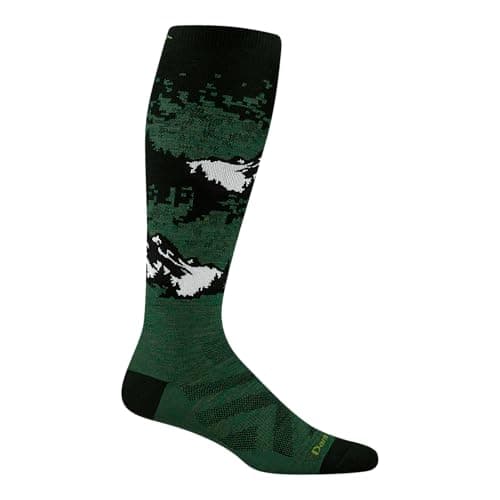
Darn Tough Alpine Over-the-Calf Lightweight
The pick, on the strength of two published facts. It is lightweight merino - the correct construction for a modern boot rather than the thick sock most people reach for - and Darn Tough publishes an unconditional lifetime guarantee, stated without qualifying conditions. On a consumable item that most people replace every couple of seasons, that is the most valuable specification anyone in this category publishes.
Over-the-calf height, published sizes S through XL, and a price that works out to a few cents a day over the years it will last. If you buy one pair of ski socks in your life, the arithmetic says buy this one.
Honest cons: it is one of the more expensive socks per pair up front, which is a real barrier for a family buying four pairs at once. Merino needs a cool wash and air drying. And a lifetime guarantee is only worth what the returns process is worth to you in time.
Smartwool Ski Zero Cushion Over-the-Calf
The same argument from the other big merino brand, and the one whose name states the point: zero cushion. Smartwool publishes the construction as having no cushioning at all, which is exactly right for a fitted boot, along with a merino blend and a limited lifetime warranty.
Choose between this and the Darn Tough on fit and on which guarantee wording you prefer - unconditional versus limited. Both are over-the-calf, both are thin on purpose, and either ends the thick-sock problem permanently.
Honest cons: the warranty is limited rather than unconditional, which is a real if narrow difference. Zero cushioning feels unforgivingly thin to anyone used to a hiking sock. And like all merino it is slow to dry, so a multi-day trip wants two pairs.
Darn Tough Kids Polar Patroller Over-the-Calf
The children’s version, and the one detail that matters on a child is the published shin pad: a small panel exactly where a boot cuff presses a small leg. Children complain about boots more than adults do, and a meaningful share of that is cuff pressure rather than fit.
It carries the same unconditional lifetime guarantee, which on a sock a child will outgrow in two seasons is faintly absurd and completely real. Merino, over-the-calf, published kids sizes. The full kids’ sock roundup has the rest of the options.
Honest cons: it costs several times what a supermarket multipack costs, on a foot that will be a size bigger next winter. And it still needs washing between days, which means two pairs for a week-long trip.
Snow Deer Rechargeable Heated Socks
Here as the honest ceiling of the category and as the skip. The published specification is genuinely good: 7.4V, 2200 mAh lithium-polymer batteries, three heat levels with run times stated for each, a removable pack so the setting can be changed without pulling a boot off, and three published sizes.
But it is solving a different problem than the one most people have. Cold feet in ski boots are usually a fit or moisture problem, and heating a compressed foot is treating the symptom at three times the price of a wool sock plus a charging routine. If you have Raynaud’s or a genuine circulation issue, this is the right buy and the heated sock roundup compares the field properly.
Buying for children, briefly
Everything above applies, with one addition: children complain about boots far more than adults do, and a meaningful share of that is the boot cuff pressing on a thin shin rather than anything wrong with the fit. A published shin pad is the specific fix, and it is the reason the kids’ pick on this page carries one.
Buy two pairs, because a child’s sock gets wet at lunch in a way an adult’s does not, and check the sock is pulled flat before the boot goes on - a wrinkle under a small foot becomes a blister by the afternoon.
Merino, synthetic or a blend
Every sock on this page is merino or a merino blend, and it is worth knowing why that is the default rather than a preference.
- Merino keeps insulating when damp. This is the property that matters in a boot, because your foot will sweat and the sock will be damp by lunchtime whatever you do. A synthetic sock that is wet is a cold sock; a merino sock that is wet is a slightly less warm sock.
- Merino does not smell. Odor resistance sounds like a luxury until day four of a trip with one pair drying on a radiator. Synthetics hold bacteria and announce it.
- Synthetics dry faster and cost less. The honest advantage, and the reason a synthetic pair makes a good second sock on a multi-day trip - it will be dry in the morning when the merino is not.
- Blends are the standard for a reason. Pure merino has no stretch and wears through at the heel; nylon and elastane keep the sock in shape over a season.
What none of this changes is thickness. A thick merino sock is still the wrong sock for a fitted boot - fiber decides how it behaves when damp, and thickness decides whether your foot has room to circulate.
Reading a sock label, which is mostly marketing
Ski sock packaging uses four words that sound technical and mean less than they appear to. Here is what each one is actually telling you.
- “Cushioned” or “padded”. Extra loops of yarn in the shin, heel or footbed. In a hiking boot that is comfort; in a fitted ski boot it is volume you did not budget for. Light cushioning in the shin only is defensible - a thick footbed is not, because the footbed is where your boot needs every millimeter.
- “Compression”. Graduated pressure up the calf. It is a real thing and it is largely irrelevant to a recreational skier, whose circulation problem comes from the boot rather than from venous return. It is also the one feature that can make a boot fit worse by adding bulk at the calf, which is exactly where the cuff closes.
- “Merino blend”. Almost every ski sock is a blend - pure merino has no stretch and wears through at the heel. Nylon and elastane in the mix are what keep the sock in shape. A blend is not a compromise here; it is the correct construction.
- “Seamless toe”. Worth having and rarely stated on the cheap multipacks. A ridge of seam across the toes, inside a boot that presses on them, is a blister by lunchtime.
What you will not find on any package in this category is a warmth rating, a gsm figure or a temperature band, because no standard for them exists. That is why the comparison above is built on cushioning, height, fiber and warranty - the four things makers actually state.
What a sock cannot fix
Socks get blamed for a lot of problems they did not cause, and buying a better pair to solve one of these is money spent on the wrong item.
| Symptom | Sock problem? | What it usually is |
|---|---|---|
| Toes numb after an hour | Sometimes - if the sock is thick | Buckles too tight, or a boot with too little volume |
| Bruised or lost toenail | No | Boot too big; your foot slides forward on every turn |
| Burning spot on the ankle bone | No | Shell shape; a fitter can punch it in twenty minutes |
| Shin pain at the boot cuff | Partly - height and a shin pad help | Cuff pressure, or leaning back against the boot |
| Cold feet on day two only | No | A damp liner that never dried overnight |
The pattern is worth internalizing: a sock changes thickness, moisture and the surface against your shin. It cannot change the shape or volume of a boot, and it cannot dry a liner. The break-in page covers which pains are normal, and the wide feet page covers the one that comes from width.
How many pairs, and how to wash them
- One pair per ski day, up to two. A damp sock is a cold sock, and merino does not dry overnight on a radiator. Two pairs covers a week if you rinse one out.
- Put them on at the car, not at home. A sock that has been inside a sneaker for a two-hour drive is already damp before the boot goes on.
- Cool wash, no fabric softener. Softener coats the fibers and kills the wicking you paid for. The washing page covers the rest of the soft goods.
- Dry the boots, not just the socks. A dry sock in a wet liner is a wet sock by the second run. The boot dryer roundup is the fix.
Who should buy what
- Anyone buying one pair. The Darn Tough Alpine, for the guarantee.
- Anyone who hates a thin sock. Still the thin sock - but try the Smartwool, which is thin without feeling papery.
- A child in rental boots. The kids’ Polar Patroller, for the shin pad, and the ski sock guide for the reasoning.
- Feet that go numb in every sock. Not a sock problem. Start with the cold feet page.
Every pick, with the working
Each entry shows the published inputs, the axis scores they produce, and what you give up. The order is the computed order, not a commercial one, and the arithmetic is open underneath each score.
1 · The one piece of ski gear worth buying before anything else
Darn Tough Alpine Over-the-Calf Lightweight Ski Socks
The only item in this entire ledger with an unconditional lifetime guarantee. It is a $30 sock that the maker will replace forever, which over any realistic number of ski days is the cheapest thing on the site.
- Published price
- $30
- Cost per day on snow
- $2 a day
- Amortized over
- 3 seasons (15 days)
- Certified to
- Not published
- Published sizes
- S through XL
- Warranty
- Unconditional lifetime guarantee
What it gets right
- Unconditional lifetime guarantee, published without qualifying conditions
- Lightweight merino, which is correct for a modern ski boot: a thick sock makes boots colder, not warmer
- Over-the-calf length, so the boot cuff never touches bare skin
What you give up
- $30 for one pair of socks reads as absurd until the replacement policy is read
- Lightweight is the right choice but feels wrong to anyone expecting a thick ski sock
The working behind the 6.4
- Cost per day on snow: 9.6
- $30 over 3 seasons at 5 days each = 15 days = $2 a day
- Published protection: not scored
- Socks carry no protective standard, so this axis does not apply.
- Size availability: 5.1
- 4 published sizes (5.1 of 8.5); no continuous adjuster published (+0); range: S through XL
- Warranty and support: 2.0
- no published term (0 of 6); no published crash replacement (+0); repair or replacement parts published (+2)
Axes with unpublished inputs are dropped and the remaining weights re-normalized, so a product is not punished for a manufacturer’s silence. Specifications compiled September 3, 2026 from Darn Tough published specifications.
2 · A boot that already fits, where any extra bulk makes it worse
Smartwool Ski Zero Cushion Over-the-Calf Socks
Zero cushion is not a compromise, it is the point: in a boot fitted properly there is no room for padding, and every millimeter of sock is a millimeter of lost contact with the shell.
- Published price
- $28.95
- Cost per day on snow
- $1.93 a day
- Amortized over
- 3 seasons (15 days)
- Certified to
- Not published
- Published sizes
- S through XL
- Warranty
- Limited lifetime warranty
What it gets right
- Zero cushioning, which is the correct construction for a fitted ski boot
- Limited lifetime warranty published
- Merino blend, so it stays warm damp and does not smell after three days
What you give up
- The limited lifetime warranty is a narrower promise than Darn Tough's unconditional one
- Anyone whose boots are slightly too big will find zero cushion uncomfortable
The working behind the 5.9
- Cost per day on snow: 9.7
- $28.95 over 3 seasons at 5 days each = 15 days = $1.93 a day
- Published protection: not scored
- Socks carry no protective standard, so this axis does not apply.
- Size availability: 5.1
- 4 published sizes (5.1 of 8.5); no continuous adjuster published (+0); range: S through XL
- Warranty and support: 0.0
- no published term (0 of 6); no published crash replacement (+0); no published repair route (+0)
Axes with unpublished inputs are dropped and the remaining weights re-normalized, so a product is not punished for a manufacturer’s silence. Specifications compiled September 3, 2026 from Smartwool published specifications.
3 · A child whose shins hurt after an afternoon in ski boots
Darn Tough Kids Polar Patroller Over-the-Calf Ski Socks
Merino wool, midweight, over-the-calf at a published 13 inches heel to cuff, with a shin pad where a ski boot presses — and the same unconditional lifetime guarantee as the adult range, on a sock for a child who will outgrow it. That guarantee is the only published warranty on anything in this ledger that a child wears.
- Published price
- Not published
- Cost per day on snow
- Not published
- Amortized over
- 1 season (5 days)
- Certified to
- Not published
- Published sizes
- Published kids sizes; over-the-calf, about 13 in heel to cuff
- Warranty
- Unconditional lifetime guarantee
What it gets right
- Unconditional lifetime guarantee published, which on a child's sock is close to absurd and entirely real
- Merino wool, so it keeps insulating when damp and does not smell after three days
- Published shin pad, which is the specific fix for boot-cuff pressure on a child's leg
- Over-the-calf at a published 13 in, so the sock covers the whole boot cuff
What you give up
- Midweight in a category where thinner is usually better inside a fitted boot
- Expensive per pair against a supermarket multipack, and children lose socks
- Kids sizes are published as ranges, so a child between sizes has to pick one
The working behind the 0.0
- Cost per day on snow: not scored
- No manufacturer-published price, so this axis is not scored.
- Published protection: not scored
- Socks carry no protective standard, so this axis does not apply.
- Size availability: not scored
- Sold in one size, so size availability does not apply.
- Warranty and support: 0.0
- no published term (0 of 6); no published crash replacement (+0); no published repair route (+0)
Axes with unpublished inputs are dropped and the remaining weights re-normalized, so a product is not punished for a manufacturer’s silence. Specifications compiled September 12, 2026 from Darn Tough published kids ski sock specifications.
4 · Someone whose feet genuinely go numb, after the boot fit has been checked
Snow Deer Rechargeable Heated Socks
Skip this one. A heated sock is the answer to a circulation problem, not to a cold boot. It publishes real numbers - 7.4V, 2200 mAh, three heat levels with run times - and it will warm feet that no wool sock reaches. But it is also a battery on your calf that has to be charged the night before, and it costs more than the three wool pairs above it combined. Fix the boot fit, the sock thickness and the wet-liner problem first; almost everyone who does never needs this.
The published runtime is the whole story: 7.4V 2200 mAh batteries giving about 6 hours on low, 3.5 on medium and 2 on high. Low will not get most people through a ski day on its own, and high will not get anybody through a morning, which is why these work as a fix for cold feet rather than as all-day heating.
- Published price
- Not published
- Cost per day on snow
- Not published
- Amortized over
- 3 seasons (15 days)
- Certified to
- Not published
- Published sizes
- S, M and L
- Warranty
- No term published on the product page
What it gets right
- Published battery specification: 7.4V, 2200 mAh, lithium-polymer, and a stated 3 to 4 hour recharge
- Three published heat levels with runtimes stated for each rather than a single vague figure
- Removable battery pack, so the level can be changed without taking a boot off
- Three sizes published, which matters more on a heated sock than a plain one because the element has to sit under the toes
What you give up
- About 2 hours on the highest setting, which is less than a lift ticket
- No published warranty term
- A battery pack at the calf is bulk inside a ski boot cuff, and some boots will not take it
The working behind the 1.7
- Cost per day on snow: not scored
- No manufacturer-published price, so this axis is not scored.
- Published protection: not scored
- Socks carry no protective standard, so this axis does not apply.
- Size availability: 3.4
- 3 published sizes (3.4 of 8.5); no continuous adjuster published (+0); range: S, M and L
- Warranty and support: 0.0
- no published term (0 of 6); no published crash replacement (+0); no published repair route (+0)
Axes with unpublished inputs are dropped and the remaining weights re-normalized, so a product is not punished for a manufacturer’s silence. Specifications compiled September 12, 2026 from Snow Deer published heated sock specifications.
Prices last verified October 19, 2026. Prices move constantly; the figure on Amazon at the moment you click is the real one.
Questions people actually ask
What are the best socks for skiing?
One thin merino over-the-calf pair. The Darn Tough Alpine publishes lightweight merino construction and an unconditional lifetime guarantee; the Smartwool Ski Zero publishes zero cushioning, which is the same idea stated as a specification. Both finish above the boot cuff, which is what stops plastic pressing on bare skin.
Are thick socks warmer for skiing?
No, and this is the most useful thing on this page. A ski boot is a fixed volume fitted to your foot; a thick sock takes up the space your circulation needs, and restricted circulation is what makes toes cold. Thick socks also hold sweat against the skin. One thin merino pair is warmer in practice.
Can you wear two pairs of socks skiing?
Don’t. Two pairs compress the foot even more than one thick pair, and the two layers slide against each other, which is how blisters form on the heel and arch. If one thin pair leaves you cold, the problem is boot fit, a damp liner or circulation.
Do ski socks need to be over-the-calf?
Yes, for a straightforward mechanical reason: a ski boot cuff closes hard against the shin, and if the sock ends below it the plastic edge presses directly on skin every time you flex forward. Over-the-calf socks finish above the cuff, so that never happens.
How many pairs of ski socks do I need for a week?
Two, and wash one mid-week. A sock worn all day is damp by the afternoon, and merino is slow to dry overnight. Two pairs also means a dry pair exists on the morning the first pair is still on the radiator.