The best women's ski goggles, and why frame size beats the label
There is no women's optical standard. What there is, and what nobody puts on the box, is a smaller frame - and that is the only part of the label worth paying for.
By Sawyer V. · Published
We have not tested this gear. Everything below is compiled from published specifications and published safety standards, and the arithmetic is public so you can check it. This page carries affiliate links: if you buy through one we earn a commission at no extra cost to you, and it does not change the order of the picks. Full disclosure.
The short answer
There is no women’s-specific optical or impact standard. What a women’s goggle usually is, is a smaller frame - which matters, because a frame too wide for your face leaves a gap at the nose and fogs. Shop on published frame size and VLT, and buy a goggle that either ships with a second lens or takes one. The Smith Squad ChromaPop is the pick.
| # | Pick | Best for | Score | Price |
|---|---|---|---|---|
| 1 | Smith Squad ChromaPop Anyone who skis in more than one kind of light | $6.20 a dayon snow | 5.3/10 | $119.95 - View on Amazon |
| 2 | OutdoorMaster PRO Magnetic A skier who wants to change lenses without taking gloves off | $2.00 a dayon snow | 6.1/10 | $39.99 - View on Amazon |
| 3 | Bolle Y7 OTG A skier who wears glasses and does not want contacts | $3.60 a dayon snow | 5.5/10 | Check price on Amazon |
| 4 | Smith Snowday A young child who will only ever own one lens, glasses or not | $5 a dayon snow | 5.1/10 | $50.00 - View on Amazon |
Prices last verified October 19, 2026. Prices move constantly; the figure on Amazon at the moment you click is the real one.
What the label changes, honestly
Nothing about the lens. Visible light transmission, ultraviolet protection and anti-fog coatings are the same technology in either column, and no maker publishes a women’s-specific optical figure because there is no such thing to publish.
What is usually different is the frame: a shorter vertical height, a narrower horizontal width, and sometimes a slightly deeper nose cutout. Those are real dimensional differences and they are the reason the query exists - a goggle designed around a larger face does not seal on a smaller one.
The frustrating part is that makers publish the label and not the dimensions. Most goggle lines are sold as small, medium and large frames with no numbers attached, which means this category cannot be ranked on frame size the way helmets can be ranked on circumference. What we can rank on is the published optical specification, and then tell you how to check the fit yourself.
The number to shop on
Visible light transmission is the percentage of light a lens lets through, and it is the only figure in this category that means the same thing across brands.
| VLT band | Conditions | Typical tint |
|---|---|---|
| About 5-20% | Bright sun on snow | Dark gray, black, heavy mirror |
| About 20-40% | Mixed sun and cloud | Rose, bronze, all-round tints |
| About 40-60% | Overcast, flat light | Rose, amber, light bronze |
| About 60-75% | Snowing, dusk | Yellow, high-contrast light tints |
The full VLT guide is here. The common error is buying by tint name: a rose lens can be a 25 percent lens or a 55 percent lens depending on the model, and the name tells you nothing without the number. If you are buying one goggle for everything, aim for the middle band and accept it will be wrong twice a season.
The picks
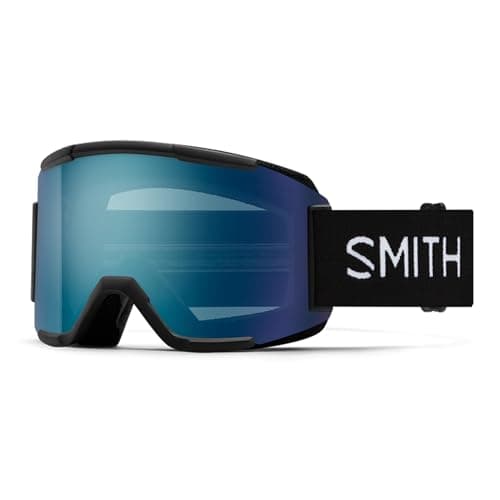
Smith Squad ChromaPop
The pick, for a structural reason rather than a gendered one: it is the only goggle in this ledger that publishes a second lens in the box. Conditions change inside a single afternoon, and the complete answer to that is being able to change lens - not owning the perfect single tint.
It publishes 100% UV protection and a Fog-X treated inner lens, and the cylindrical frame sits flat against most helmet brows. Check which second lens the specific colorway includes before buying: a spare storm lens is what you want; a spare mirror lens is not.
Honest cons: it is the most expensive goggle here, Smith publishes no impact standard for it, and it is sold in one frame size - which is the whole subject of this page. If it is too big on your face, the next pick is the answer.
OutdoorMaster PRO Magnetic
The lens-change answer at a fraction of the outlay: a magnetic system that works with gloves on. For anyone who owns one goggle and skis in changing light, being able to swap on a chairlift rather than in a lodge is the difference between doing it and not bothering.
The catch is published plainly: one lens is included, so the two-lens setup is a second purchase. The interchangeable-lens page runs that cost comparison.
Bolle Y7 OTG
The smaller-frame answer, and the one to buy if the Smith sits on your cheekbones. It is published as over-the-glasses, which is a separate benefit - the glasses page explains what OTG actually means - but the reason it is here is the frame.
Honest cons: a single lens in the box, and an OTG frame has extra internal volume it does not need if you do not wear glasses.
The helmet check, which is not optional
A goggle that fits your face can still fail against your helmet. Buy them together if you are buying both, and if you already own a helmet, check three things:
- No gap at the brow. A visible strip of forehead between goggle and helmet rim is cold on the day and wrong on every day. The fit page covers it.
- Strap outside the helmet. Over the shell, through the clip at the back, never under the rim.
- Vent alignment. The vents at the top of the goggle should not be covered by the helmet rim. A blocked top vent is a fogged goggle.
Who should buy what
- Buying one goggle to cover a season. The Smith, for the second lens.
- Small face, or a goggle that currently gaps at the nose. The Bolle.
- On a budget and skiing in changing light. The OutdoorMaster, plus a second lens later.
- Skiing mostly on overcast days. The flat-light page is the more specific answer.
- Wearing glasses. The Bolle, and read the OTG page first.
Every pick, with the working
Each entry shows the published inputs, the axis scores they produce, and what you give up. The order is the computed order, not a commercial one, and the arithmetic is open underneath each score.
1 · Anyone who skis in more than one kind of light
Smith Squad ChromaPop
The only goggle here that ships with a second lens in the box, which is the single change that makes a goggle usable in both bright sun and flat light. That, plus 100% UV and a treated inner lens, is the whole specification worth paying for.
- Published price
- $155
- Cost per day on snow
- $6.20 a day
- Amortized over
- 5 seasons (25 days)
- Certified to
- Not published
- UV protection
- 100% published
- Anti-fog
- Fog-X anti-fog inner lens
- Lenses included
- 2
- Published sizes
- One size
- Warranty
- No term published for goggles
What it gets right
- Two lenses in the box, so a flat-light day does not need a second purchase
- 100% UV protection and a Fog-X treated inner lens
- Cylindrical frame that sits flat against most helmet brows
What you give up
- $155 is more than three of the helmets on this site
- Smith publishes no impact standard for this goggle, so we cannot score it on one
- Sold in one frame size; the smaller and larger faces need a different model entirely
The working behind the 5.3
- Cost per day on snow: 6.5
- $155 over 5 seasons at 5 days each = 25 days = $6.20 a day
- Published protection: 8.0
- 100% UV protection published (+4); no published impact standard (+0); anti-fog treatment published (+2); 2 lenses included (+2)
- Size availability: not scored
- Sold in one size, so size availability does not apply.
- Warranty and support: 0.0
- no published term (0 of 6); no published crash replacement (+0); no published repair route (+0)
Axes with unpublished inputs are dropped and the remaining weights re-normalized, so a product is not punished for a manufacturer’s silence. Specifications compiled September 3, 2026 from Smith published specifications.
2 · A skier who wants to change lenses without taking gloves off
OutdoorMaster PRO Magnetic
A magnetic lens swap at a published $49.99, with 100% UV400 and an over-the-glasses frame. Spare lenses are a separate purchase, so the real cost of a two-lens setup lands closer to the Smith than the sticker suggests.
- Published price
- $49.99
- Cost per day on snow
- $2.00 a day
- Amortized over
- 5 seasons (25 days)
- Certified to
- Not published
- UV protection
- 100% published
- Anti-fog
- Anti-fog coating
- Lenses included
- 1
- Published sizes
- One size
- Warranty
- No term published for goggles
What it gets right
- Magnetic lens change, workable in gloves on a lift
- 100% UV400 protection and an anti-fog coating
- Over-the-glasses frame at a published $49.99
What you give up
- One lens included; the interchangeable system only pays off after you buy another
- No published impact standard
The working behind the 6.1
- Cost per day on snow: 9.6
- $49.99 over 5 seasons at 5 days each = 25 days = $2.00 a day
- Published protection: 6.0
- 100% UV protection published (+4); no published impact standard (+0); anti-fog treatment published (+2); single lens (+0)
- Size availability: not scored
- Sold in one size, so size availability does not apply.
- Warranty and support: 0.0
- no published term (0 of 6); no published crash replacement (+0); no published repair route (+0)
Axes with unpublished inputs are dropped and the remaining weights re-normalized, so a product is not punished for a manufacturer’s silence. Specifications compiled September 3, 2026 from OutdoorMaster published specifications.
3 · A skier who wears glasses and does not want contacts
Bolle Y7 OTG
Built around the frame depth that lets a pair of glasses sit inside without the arms pressing, which is the only thing that actually distinguishes an over-the-glasses goggle. Double lens, treated inner surface, 100% UV.
- Published price
- $90
- Cost per day on snow
- $3.60 a day
- Amortized over
- 5 seasons (25 days)
- Certified to
- Not published
- UV protection
- 100% published
- Anti-fog
- Anti-fog and anti-scratch lens treatment
- Lenses included
- 1
- Published sizes
- One size
- Warranty
- No term published for goggles
Bolle publishes several Y7 OTG lens variants; the photochromic version is published at a higher price.
What it gets right
- Purpose-built over-the-glasses frame depth rather than a normal goggle sold as OTG
- 100% UV protection with anti-fog and anti-scratch lens treatment
- Double lens with vents top and bottom, the construction that resists fogging
What you give up
- One lens in the box, so flat-light days mean buying a second
- Deeper frame is bulkier against a helmet brow than a standard goggle
The working behind the 5.5
- Cost per day on snow: 8.4
- $90 over 5 seasons at 5 days each = 25 days = $3.60 a day
- Published protection: 6.0
- 100% UV protection published (+4); no published impact standard (+0); anti-fog treatment published (+2); single lens (+0)
- Size availability: not scored
- Sold in one size, so size availability does not apply.
- Warranty and support: 0.0
- no published term (0 of 6); no published crash replacement (+0); no published repair route (+0)
Axes with unpublished inputs are dropped and the remaining weights re-normalized, so a product is not punished for a manufacturer’s silence. Specifications compiled September 3, 2026 from Bolle published specifications.
4 · A young child who will only ever own one lens, glasses or not
Smith Snowday
Skip this one. It is on this page on purpose and it is the wrong buy for most adults. The Snowday is a genuinely small frame, which is what a lot of people arrive here looking for - but Smith publishes it as a youth goggle, and buying a child's goggle because the frame fits is how you end up with a strap that will not reach around a helmet. If the adult frames here are too big, buy the Bolle rather than the kids model.
Smith's youth goggle on the RC36 lens, which is the useful part: 36% light transmission is the middle of the range, so one lens works on a gray morning and a bright afternoon without the child noticing either way. The spherical Carbonic-x lens and Fog-X treated inner lens are the same optical package Smith puts in its adult frames.
- Published price
- $50
- Cost per day on snow
- $5 a day
- Amortized over
- 2 seasons (10 days)
- Certified to
- Not published
- UV protection
- 100% published
- Anti-fog
- Fog-X anti-fog inner lens
- Lenses included
- 1
- Published sizes
- Youth fit medium
- Warranty
- No term published for goggles
What it gets right
- 36% VLT on the RC36 lens, which covers most of the conditions a family actually skis in
- 100% UVA and UVB protection with a Fog-X treated inner lens
- Spherical Carbonic-x lens published for distortion-free optics and impact resistance
- Published over-the-glasses compatibility, with a floating foam membrane that takes the pressure off eyeglass temples
- Dual-slide strap for size adjustment and a silicone-backed strap that stays put on a helmet
What you give up
- Single lens, so a genuinely dark or genuinely flat day is a compromise
- Published as a youth fit MEDIUM, so it is too big for the smallest faces
- $50 published for the RC36 lens, where the mirrored lenses are $60
- No warranty term published for Smith goggles
The working behind the 5.1
- Cost per day on snow: 7.4
- $50 over 2 seasons at 5 days each = 10 days = $5 a day
- Published protection: 6.0
- 100% UV protection published (+4); no published impact standard (+0); anti-fog treatment published (+2); single lens (+0)
- Size availability: not scored
- Sold in one size, so size availability does not apply.
- Warranty and support: 0.0
- no published term (0 of 6); no published crash replacement (+0); no published repair route (+0)
Axes with unpublished inputs are dropped and the remaining weights re-normalized, so a product is not punished for a manufacturer’s silence. Specifications compiled October 18, 2026 from Smith published specifications.
Prices last verified October 19, 2026. Prices move constantly; the figure on Amazon at the moment you click is the real one.
Questions people actually ask
Are women's ski goggles different?
Not optically. There is no women’s-specific optical or impact standard, and VLT, UV protection and anti-fog coatings are identical technology in either column. What is usually different is a smaller frame - shorter vertically, narrower horizontally, sometimes a deeper nose cutout - and that is the part worth paying for if a standard frame gaps on you.
How do I know if a ski goggle fits my face?
Hold it against your face without the strap and without a helmet. It should rest on your brow and cheekbones with no gap at the bridge of the nose. A gap there is where warm breath enters, and warm breath on a cold lens fogs it. Pressure at the temples means the frame is too small.
What VLT should I buy if I only want one goggle?
Aim for the middle, roughly 20 to 40 percent, in a rose or bronze tint - and accept it will be wrong on the brightest and the flattest days of the season. Better still, buy a goggle that ships with or takes a second lens, because no single tint covers a bluebird morning and a snowing afternoon.
Can women wear unisex ski goggles?
Yes, and most of the goggles on this page are sold unisex. The label is not the specification - frame size is, and it is the one thing makers do not publish as a number. Try it against your face, check for a nose gap, and ignore which shelf it came from.
Should I buy a small-frame kids goggle if adult frames are too big?
No. A youth goggle may fit your face and its strap is sized for a child’s head, so it will not reach comfortably around an adult helmet, and the lens area is smaller than you want for peripheral vision. Buy a smaller adult frame instead - an over-the-glasses model is often the roomiest small option.