The best kids' snow boots, ranked on published temperature rating
Almost no children's footwear publishes a number you can compare. Kamik publishes a temperature rating on every boot, which makes this one of the easiest pages on the site.
By Sawyer V. · Published
We have not tested this gear. Everything below is compiled from published specifications and published safety standards, and the arithmetic is public so you can check it. This page carries affiliate links: if you buy through one we earn a commission at no extra cost to you, and it does not change the order of the picks. Full disclosure.
The short answer
Shop on the published temperature rating where one exists - Kamik publishes -40F for the Waterbug 5 and -10F for the Snowbug 7 - and on whether the boot is seam sealed rather than just waterproof. Size with room for one thick sock and a little growth, never tight: a boot squeezing a foot is a cold foot regardless of the rating. Snow boots are not ski boots.
| # | Pick | Best for | Score | Price |
|---|---|---|---|---|
| 1 | Kamik Waterbug 5 Kids Winter Boots Severe cold, and a child who stands still in it | Not publishedon snow | 0.0/10 | $69.99 - View on Amazon |
| 2 | Kamik Snowbug 7 Toddler Winter Boots A toddler who has to get the boots on without help | Not publishedon snow | 4.3/10 | $49.99 - View on Amazon |
| 3 | HotHands Insole Foot Warmers Winter boots and standing around, not a fitted ski boot | Not publishedon snow | 0.0/10 | $15.55 - View on Amazon |
Prices last verified October 19, 2026. Prices move constantly; the figure on Amazon at the moment you click is the real one.
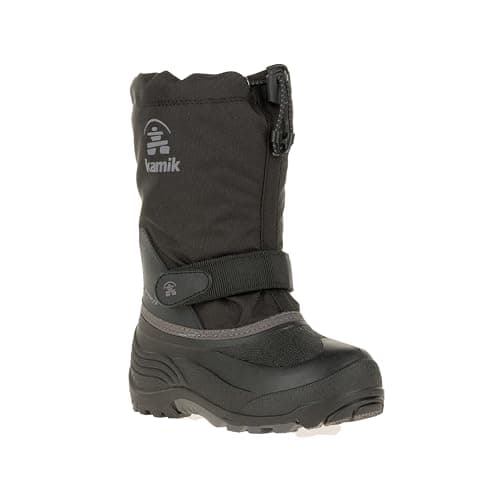
First: these are not ski boots
Worth saying plainly because it is a genuinely common confusion. A snow boot is for walking - to the lift, around a village, in a parking lot, sledding, standing about at the bottom of a hill. A ski boot is a rigid shell that clips into a binding and is unwearable for any of that.
A child skiing needs both: ski boots on the snow, and snow boots for every other part of the day. The kids ski boot chart is a different page, and it uses a completely different sizing system.
The temperature rating, and what it is worth
This category is unusual on this site: a major maker publishes a comparable number on every model. Kamik states a temperature rating in both Fahrenheit and Celsius, which lets you rank boots against each other directly.
| Boot | Published rating | Construction | Suits |
|---|---|---|---|
| Waterbug 5 | -40F / -40C | Seam sealed, foam and fleece insulation | Severe cold, standing around, deep snow |
| Snowbug 7 | -10F / -23C | Published waterproof, single Velcro strap | Ordinary winter, and a toddler who dresses themselves |
Two honest caveats about ratings. They are a maker’s own comfort figure rather than a test to a shared standard, so they compare well within a brand and less well across brands. And they assume the child is moving - a child standing still at the bottom of a sledding hill is colder than the number implies, and a child running around is warmer.
The picks
Kamik Waterbug 5
The pick, on the coldest published rating in this ledger: -40F, which is also -40C - the one temperature where the two scales meet.
More useful than the headline number is the construction behind it. Kamik publishes the Waterbug as seam sealed, with every seam - visible and hidden - treated with waterproof tapes and sealants. The insulation is fixed foam and fleece, and the liner is published as moisture-wicking, which is what stops a warm boot going damp from the inside on a child who is running about.
Honest cons: fixed insulation cannot be pulled out to dry overnight, which is a real trade against a removable-liner boot on a multi-day trip. It is more boot than a mild-winter child needs, and an over-warm boot makes its own sweat problem. No published warranty term.
Kamik Snowbug 7
The pick for a toddler, and the reason is not the rating - it is the single Velcro strap. A published -10F / -23C rating on a boot Kamik publishes as waterproof, with a closure a three-year-old can fasten alone.
That last point is worth more on a real morning than any specification. A boot a child can put on without help is a boot that gets put on, and getting a family out of the door is the actual problem being solved.
Kamik publishes it from toddler 5T through little kids 13, so it spans several years of a household rather than one.
Honest cons: a single strap is less secure in deep snow than a strap plus a collar, and it is rated well below the Waterbug so it is the wrong boot for a genuinely severe day. No published warranty term.
HotHands Insole Foot Warmers
Marked as the skip above. Genuinely useful in winter boots on a severe day - there is room for a full-length insole warmer in a snow boot in a way there is not in a ski boot - and not a substitute for a boot that fits. The warmers page has the published durations.
Sizing, which is where warmth is won or lost
A snow boot that is too tight is cold. Insulation works by trapping air, and a foot pressed against the boot wall has no air around it and reduced circulation besides. This is the same mechanism as a sock that is too thick in a ski boot, and it is the most common reason a well-rated boot fails.
- Fit with the sock they will wear. One thick wool or synthetic sock. Never two.
- About a thumb’s width at the toe, standing up, weight on the foot.
- Half a size of growing room is fine here. Unlike a ski boot, where it is not - a loose snow boot is a minor nuisance, a loose ski boot is a lost day. The growing room page draws that line properly.
- Check the calf opening over snow pants. The boot has to fit under or over a pant cuff with the boot gaiter, or snow goes straight in at the ankle.
- Re-measure every autumn. Feet move a lot between winters.
Making them last the winter
- Dry them every night, away from heat. A radiator or a hot vent degrades the materials and can delaminate a sole. Room temperature, boots open, overnight. The drying page has the method.
- Fixed insulation needs more drying time, which is the honest cost of the Waterbug’s construction. Start the night before you need them.
- Rinse road salt off. Salt is hard on materials and leaves white stains that never quite come out.
- Store them dry. A damp boot in a bin over summer comes out smelling in a way washing does not fix. The storage page.
Who should buy what
- A ski trip in a genuinely cold region. The Waterbug 5.
- A toddler, anywhere. The Snowbug 7, for the strap.
- A mild winter, city snow, school runs. The Snowbug 7. The Waterbug is more boot than is needed and an over-warm boot sweats.
- Sledding and standing around. The Waterbug, plus warmers on the worst day. The non-skier gear page has the rest of the list.
- A child who will outgrow them in one season. Buy the cheaper boot and check the budget page for what is worth hand-me-downing.
Every pick, with the working
Each entry shows the published inputs, the axis scores they produce, and what you give up. The order is the computed order, not a commercial one, and the arithmetic is open underneath each score.
1 · Severe cold, and a child who stands still in it
Kamik Waterbug 5 Kids Winter Boots
The coldest published rating in this ledger by a distance: minus 40, where Fahrenheit and Celsius meet. It is seam sealed rather than merely waterproof, with fixed foam and fleece insulation, and it is the only boot here specified for a genuinely severe day.
- Published price
- Not published
- Cost per day on snow
- Not published
- Amortized over
- 2 seasons (10 days)
- Certified to
- Not published
- Published sizes
- Published across kids sizes; see the maker's chart
- Warranty
- No term published on the product page
What it gets right
- Published temperature rating of minus 40F / minus 40C, the coldest here
- Seam sealed: every seam, visible and hidden, published as taped and sealed
- Fixed foam and fleece insulation published, so there is no removable liner to lose
- Moisture-wicking liner published, which is what stops a warm boot going damp from the inside
What you give up
- Fixed insulation cannot be pulled out to dry overnight, which is the trade against a removable liner
- More boot than a mild-winter child needs, and a hot boot is its own problem
- No published warranty term
The working behind the 0.0
- Cost per day on snow: not scored
- No manufacturer-published price, so this axis is not scored.
- Published protection: not scored
- Boots carry no US protective standard, so this axis is not scored. On a winter boot the published temperature rating is the figure that matters; on a snowboard or nordic boot it is the sole standard and the fit.
- Size availability: not scored
- Sold in one size, so size availability does not apply.
- Warranty and support: 0.0
- no published term (0 of 6); no published crash replacement (+0); no published repair route (+0)
Axes with unpublished inputs are dropped and the remaining weights re-normalized, so a product is not punished for a manufacturer’s silence. Specifications compiled September 12, 2026 from Kamik published Waterbug 5 specifications.
2 · A toddler who has to get the boots on without help
Kamik Snowbug 7 Toddler Winter Boots
A published temperature rating of minus 10F, or minus 23C, on a boot Kamik publishes as waterproof, with a single Velcro strap. The rating is the reason to buy it and the strap is the reason a three-year-old can put it on alone, which is worth more on a real morning than any other feature here.
- Published price
- Not published
- Cost per day on snow
- Not published
- Amortized over
- 2 seasons (10 days)
- Certified to
- Not published
- Published sizes
- Toddler 5T-10T and little kids 11-13
- Warranty
- No term published on the product page
What it gets right
- Published temperature rating of minus 10F / minus 23C, a comparable number most kids' boots do not state
- Published waterproof rather than water-resistant, which is the line that matters in slush
- One Velcro strap, which a small child can fasten without an adult
- Published from 5T to little kids 13, so it covers several years of a family
What you give up
- A single strap is less secure in deep snow than a strap plus a collar
- Rated well below the Waterbug, so it is the wrong boot for genuinely severe cold
- No published warranty term
The working behind the 4.3
- Cost per day on snow: not scored
- No manufacturer-published price, so this axis is not scored.
- Published protection: not scored
- Boots carry no US protective standard, so this axis is not scored. On a winter boot the published temperature rating is the figure that matters; on a snowboard or nordic boot it is the sole standard and the fit.
- Size availability: 8.5
- 9 published sizes (8.5 of 8.5); no continuous adjuster published (+0); range: Toddler 5T-10T and little kids 11-13
- Warranty and support: 0.0
- no published term (0 of 6); no published crash replacement (+0); no published repair route (+0)
Axes with unpublished inputs are dropped and the remaining weights re-normalized, so a product is not punished for a manufacturer’s silence. Specifications compiled October 12, 2026 from Kamik published Snowbug 7 specifications.
3 · Winter boots and standing around, not a fitted ski boot
HotHands Insole Foot Warmers
Skip this one. Published at up to 9 hours and included here because it is what parents reach for when a boot is not warm enough. It is the skip because it treats the symptom: a boot that needs a warmer every time is the wrong boot or the wrong size, and a warmer inside an already-tight boot restricts circulation and makes cold feet worse. Fix the boot. Keep the warmer for the genuinely severe day.
A full-length insole warmer published at up to 9 hours. The length is the problem and the point: it warms the whole foot rather than the toes, and it is the wrong shape for a ski boot that has been fitted properly around a footbed.
- Published price
- Not published
- Cost per day on snow
- Not published
- Amortized over
- 3 seasons (15 days)
- Certified to
- Not published
- Published sizes
- One size, full-length insole, single use
- Warranty
- No term published; the product is single use
What it gets right
- Published up to 9 hours, an hour longer than the toe warmer
- Full-length coverage rather than a patch over the toes
- Works in ordinary winter boots, where there is room for it
What you give up
- Wrong shape for a fitted ski boot, and it displaces the footbed that is doing the real work
- Single use, and the largest of the three foot options to carry spares of
- No published warranty term
The working behind the 0.0
- Cost per day on snow: not scored
- No manufacturer-published price, so this axis is not scored.
- Published protection: not scored
- This category carries no protective standard.
- Size availability: not scored
- Sold in one size, so size availability does not apply.
- Warranty and support: 0.0
- no published term (0 of 6); no published crash replacement (+0); no published repair route (+0)
Axes with unpublished inputs are dropped and the remaining weights re-normalized, so a product is not punished for a manufacturer’s silence. Specifications compiled September 12, 2026 from HotHands published product range.
Prices last verified October 19, 2026. Prices move constantly; the figure on Amazon at the moment you click is the real one.
Questions people actually ask
What temperature rating do kids' snow boots need?
Match it to your winter rather than buying the coldest available. Kamik publishes -10F / -23C for the Snowbug 7, which covers ordinary winter use, and -40F / -40C for the Waterbug 5, which is for genuinely severe cold and standing around. Ratings are a maker’s own comfort figure, not a shared standard, so they compare best within a brand.
What is the difference between waterproof and seam sealed?
Waterproof usually describes the material; seam sealed means the stitching has been taped and sealed too. Stitching is where water actually gets in, so seam sealing is the more meaningful claim. For most of a winter, wet feet make a child miserable before cold ones do - if you are choosing between a colder rating and seam sealing, take the sealing.
Should kids' snow boots have growing room?
About a thumb’s width at the toe with the sock they will actually wear, and half a size of growth is fine - unlike a ski boot, where it is not. A loose snow boot is a minor nuisance; a boot that is too tight is genuinely cold, because insulation needs trapped air and a squeezed foot has neither air nor good circulation.
Can kids wear snow boots for skiing?
No - they are completely different things. A ski boot is a rigid shell that clips into a binding; a snow boot is for walking to the lift, around a village and in a parking lot. A child who skis needs both, and the ski boot is sized on a different system entirely.
How do I dry kids' snow boots overnight?
At room temperature with the boots opened up, never on a radiator or over a hot vent - direct heat degrades the materials and can delaminate a sole. Boots with fixed insulation take longer than ones with a removable liner, so start the night before you need them. A boot dryer moves air rather than adding heat, which is why it works.