Trekking poles for snowshoeing, and the part most of them leave out
A trekking pole in deep snow is only as good as the disc on the end of it. That disc is a five-dollar part, and half the poles sold for winter do not include one.
By Sawyer V. · Published
We have not tested this gear. Everything below is compiled from published specifications and published safety standards, and the arithmetic is public so you can check it. This page carries affiliate links: if you buy through one we earn a commission at no extra cost to you, and it does not change the order of the picks. Full disclosure.
The short answer
Buy the MSR DynaLock Trail. It is the only pole here whose maker both builds it for snowshoeing and publishes the thing that decides deep-snow performance: winter and summer baskets included, with a published 100-140 cm usable length, an aluminum lever lock you can work in gloves, and 0.59 kg the pair. Buy the Black Diamond Trail Cork instead if you carry poles as much as you use them - 494 g, collapses to 64.8 cm, and also ships with both baskets. The TrailBuddy is the budget pair and carries this page’s skip note. One rule before any of them: a trekking basket sinks in powder - check the box contains a wide snow basket, or buy one. Prices are live; published figures as of October 21, 2026.
| # | Pick | Best for | Score | Price |
|---|---|---|---|---|
| 1 | MSR DynaLock Trail Backcountry Poles Snowshoeing and winter hiking, where the basket and the lock decide everything | $3.60 a dayon snow | 4.3/10 | $89.95 - View on Amazon |
| 2 | Black Diamond Trail Cork Trekking Poles Carrying the poles as much as using them, and anyone who hikes year round | $5.20 a dayon snow | 3.8/10 | $129.95 - View on Amazon |
| 3 | TrailBuddy Trekking Poles, 7075 Aluminum A first pair, or a spare set for a visitor who snowshoes once a winter | Not publishedon snow | 0.0/10 | $39.91 - View on Amazon |
Prices last verified October 22, 2026. Prices move constantly; the figure on Amazon at the moment you click is the real one.
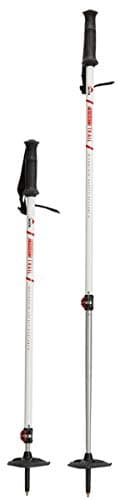
The basket is the whole product
A trekking pole has a small plastic disc near the tip called a basket. On a summer trail it stops the tip sinking into mud and wedging between rocks, and it is about 35 mm across. In snow it is the only thing stopping the pole disappearing to the grip every time you plant it.
A snow basket is the wide version - roughly 90 to 100 mm across - and the difference it makes is not subtle. With a trekking basket in fresh snow the pole sinks past the handle, gives you nothing to push against and has to be yanked back out on every stride. With a snow basket it stops at the surface and does the job you bought it for.
So the first question about any pole sold for winter is not the weight, the shaft material or the grip. It is: does a snow basket come in the box? Two of the three poles here publish that it does. The third publishes nothing at all, which is why it carries the skip note.
Do you need poles for snowshoeing at all?
Honestly, not always, and the site’s position has not changed: the poles guide walks through when they earn their place. The short version:
- Flat, packed trail: no. Snowshoeing on a groomed winter path is walking. Poles are a nuisance to carry and do little.
- Any gradient: yes. Climbing, poles give you two extra points of push. Descending, they are brakes and balance, and descending is where people fall.
- Deep or variable snow: yes. Poles turn a post-hole into a stumble rather than a fall, and they probe the surface ahead of your foot.
- Carrying a child or a pack: yes. Anything that shifts your center of gravity makes a third and fourth contact point worth having.
- Bad knees, either direction: yes. This is the most common reason people buy them and it is a good one.
What this page ranks on
- 1. Published snow baskets in the box. Pass or fail, and it decides the order on this page.
- 2. Published usable length range. A pole that does not reach your length is not your pole. Sizing rule below.
- 3. Lock type. Lever locks (FlickLock, DynaLock) work with gloves on and do not slip when the shaft is wet. Twist locks are cheaper and are the commonest winter failure.
- 4. Published weight for the pair. You lift these thousands of times an outing, and the spread here is nearly 100 g.
- 5. Published collapsed length. Only matters if the poles spend part of the day on a pack, but when it matters it matters a lot.
- Not carbon against aluminum. Carbon is lighter and fails suddenly; aluminum bends and keeps working. For winter use with a pack and a sideways fall, aluminum is the sensible default, and all three poles here are aluminum.
The three, compared
| MSR DynaLock Trail | BD Trail Cork | TrailBuddy | |
|---|---|---|---|
| Snow baskets included | Published - winter and summer | Published - trekking and snow | Not published |
| Usable length | 100-140 cm (39.5-55 in) | 100-140 cm | Not published |
| Collapsed length | 80.0 cm (31.5 in) | 64.8 cm | Not published |
| Weight, the pair | 0.59 kg (1 lb 5 oz) | 494 g | Not published |
| Shaft | 6061 aluminum, 2 sections | 7075 aluminum, 30% recycled | 7075 aluminum per the listing |
| Lock | DynaLock aluminum lever | Dual FlickLock levers | Not published |
| Grip | Ergonomic, adjustable strap | Natural cork + EVA extension | Not published |
| Maker product page | Yes | Yes | None reachable |
| Warranty | Not published | Not published | Not published |
| Maker's published price | $89.95 | $129.95 | Not published |
Read the first row and then the last. The two poles that publish their basket contents also publish everything else; the one that publishes nothing is the cheap one. That is the trade on this page, and it is a legitimate trade as long as you know you are making it.
The picks
MSR DynaLock Trail Backcountry Poles
The pick, because MSR built this pole for the job and says so in its own words: two section aluminum construction for snowshoers, winter hikers and skiers. It publishes winter and summer baskets included, which is the pass mark this page is built around.
The rest is published plainly too: a usable length of 100-140 cm (39.5 to 55 in) collapsing to 80 cm, 0.59 kg the pair, 6061 aluminum shafts and the DynaLock aluminum lever, which MSR describes as the durable part. A lever is what you want in winter: it adjusts with gloves on, and it does not creep down the shaft when the pole is wet and loaded, which is the failure that makes people give up on cheap poles.
Two sections rather than three also means fewer joints to ice up and one fewer thing to check at the top of a climb.
Honest cons. It collapses to a published 80 cm, which is long - these strap to the outside of a pack rather than disappearing into it. Two sections is what causes that. No warranty term is published. And it costs meaningfully more than a budget pair that will also accept a snow basket if you buy one separately.
Black Diamond Trail Cork Trekking Poles
The one to buy if the poles spend part of the day on your back. Black Diamond publishes 494 g for the pair and a collapsed length of 64.8 cm - nearly 100 g lighter and 15 cm shorter packed than the MSR - with the same 100-140 cm usable range.
It also publishes four-season flex tips with both trekking and snow baskets included, so it clears this page’s pass mark, and dual FlickLock levers, which are the lever locks Black Diamond is known for. The shafts are published as 7075 aluminum with 30 percent pre-consumer recycled content, UL Validated, and a minimum of 14 percent recycled content across the finished pole.
The grip is 100 percent natural cork with an EVA foam extension below it. Cork is the grip that does not turn slimy on a long sweaty climb, and the extension is there so you can choke down on a steep traverse without re-adjusting the length.
Honest cons. It is the dearest pole here, and the cork grip - its signature feature - is a bare-handed comfort upgrade you will spend most of the winter wearing gloves over. A thin liner glove is what your hand actually touches. No warranty term is published. And three sections with two locks is two more things to check before you point downhill.
TrailBuddy 7075 Aluminum Poles, and why they carry the skip
The budget pair, and the honest report is short because the published information is short. The listing states 7075 aluminum - the stronger of the two aluminum grades used in poles - and that is the end of the verifiable specification. TrailBuddy has no reachable product page, so there is no published length range, no lock type, no weight and no statement about what is in the box.
At roughly a third of the MSR that is a real option for a first pair on packed winter trails, or a spare set for visitors who snowshoe once a year and will not buy their own.
It carries the skip because of what this page ranks on. Snow baskets are not published as included, so budget for a set on top - which closes a good part of the price gap - and accept that the lock type, the length range and the weight are unknowns you are buying on trust. For packed trails, fine. For deep snow, buy the MSR.
Getting the length right, and changing it on the hill
Pole length for snowshoeing is not one number, which is the reason adjustability matters more here than it does on a summer trail.
- On the flat: stand with the pole tip on the snow beside your foot. Your elbow should sit at about 90 degrees. For most adults that lands somewhere in the 110 to 125 cm range - inside the published 100-140 cm of both documented poles here.
- Going up: shorten by 5 to 10 cm. A shorter pole lets you plant ahead and push, instead of fighting your own shoulder.
- Going down: lengthen by 5 to 10 cm, so you can plant downhill of yourself and brake rather than tip forward.
- Traversing a slope: uphill pole short, downhill pole long. This is the case where two independent locks earn their keep.
- Check the locks before a descent. A pole that collapses mid-plant on a steep section is how people fall. Levers close with gloves on; test them.
Straps are worth a sentence too: put your hand up through the loop and then down onto the grip, so the strap takes the load across your palm. Done the other way round the strap does nothing, and your forearm does all the work.
What these go with
- Snowshoes sized to your loaded weight, not your height - the snowshoe sizing guide covers the published load ranges, and the snowshoes roundup ranks the field on them.
- Boots that keep snow out, because poles do not help a wet foot - the winter boots guide.
- Traction for the icy stretches where snowshoes come off and the trail turns to boilerplate - ice cleats, ranked.
- A smaller pair for a child, which is usually not worth buying: snowshoeing with kids explains why children generally do better without poles until they are big enough for adult-length ones.
- Gloves you can work a lever lock in. Anything with a stiff gauntlet and no dexterity makes adjustment a stop-and-strip job.
Keeping them working
- Take them apart and dry them after wet days. Water inside a shaft freezes, and a frozen section will not adjust. This is the single most common reason a pole stops working in winter.
- Do not over-tighten a lever. If it slips, adjust the tension screw rather than forcing the lever shut - both makers here publish adjustable lever tension.
- Keep the snow baskets on until spring, then swap back. That is what the two basket sets are for.
- Replace tips when they go blunt, which on rock and ice happens faster than people expect.
- Store them extended and dry rather than collapsed and damp - the end-of-season storage routine applies to poles as much as to anything else.
Every pick, with the working
Each entry shows the published inputs, the axis scores they produce, and what you give up. The order is the computed order, not a commercial one, and the arithmetic is open underneath each score.
1 · Snowshoeing and winter hiking, where the basket and the lock decide everything
MSR DynaLock Trail Backcountry Poles
The pick, because MSR built it for this exact job and publishes the figure that decides it: winter AND summer baskets in the box. Two-section 6061 aluminum, a published usable length of 100-140 cm collapsing to 80 cm, 0.59 kg the pair, and an aluminum lever lock - which is the closure that still works with cold wet hands in gloves.
- Published price
- $89.95
- Cost per day on snow
- $3.60 a day
- Amortized over
- 5 seasons (25 days)
- Certified to
- Not published
- Published sizes
- One adjustable pair, published usable length 100-140 cm (39.5-55 in)
- Weight
- 590 g
- Warranty
- No term published on the product page
What it gets right
- Winter and summer baskets published as included, so the pole works in deep snow out of the box
- MSR describes it in its own words as being for snowshoers, winter hikers and skiers - not a summer pole pressed into winter service
- Published usable length of 100-140 cm, the range that covers most adults
- Aluminum lever lock published, which is operable in gloves and does not slip the way a twist lock can when wet
- Published 0.59 kg (1 lb 5 oz) the pair in 6061 aluminum, with an ergonomic grip and adjustable strap
What you give up
- Collapses to a published 80 cm, far longer than a folding pole - it will not disappear into a daypack
- Two sections rather than three, which is what makes the collapsed length long
- No published warranty term
- Dearer than the budget aluminum poles that will also hold a snow basket, if you supply the basket yourself
The working behind the 4.3
- Cost per day on snow: 8.4
- $89.95 over 5 seasons at 5 days each = 25 days = $3.60 a day
- Published protection: not scored
- Poles carry no protective standard, so this axis does not apply.
- Size availability: 1.5
- 1 published size (0.0 of 8.5); continuous in-size adjuster published (+1.5); range: One adjustable pair, published usable length 100-140 cm (39.5-55 in)
- Warranty and support: 0.0
- no published term (0 of 6); no published crash replacement (+0); no published repair route (+0)
Axes with unpublished inputs are dropped and the remaining weights re-normalized, so a product is not punished for a manufacturer’s silence. Specifications compiled October 21, 2026 from MSR published DynaLock Trail specifications.
2 · Carrying the poles as much as using them, and anyone who hikes year round
Black Diamond Trail Cork Trekking Poles
The lightest and most packable pole here on published figures - 494 g the pair, collapsing to 64.8 cm - and it also ships with both trekking and snow baskets. Dual FlickLock levers, 7075 aluminum shafts published as 30 percent pre-consumer recycled, and a 100 percent natural cork grip with a foam extension for choking down on a climb.
- Published price
- $129.95
- Cost per day on snow
- $5.20 a day
- Amortized over
- 5 seasons (25 days)
- Certified to
- Not published
- Published sizes
- One adjustable pair, published usable length 100-140 cm
- Weight
- 494 g
- Warranty
- No term published on the product page
What it gets right
- Published 494 g the pair, almost 100 g lighter than the MSR
- Collapses to a published 64.8 cm, short enough to strap to a daypack
- Four-season flex tips published with BOTH trekking and snow baskets included
- Dual FlickLock levers published - two independent adjustments, both workable in gloves
- 7075 aluminum shafts published as 30% pre-consumer recycled and UL Validated, with a minimum 14% recycled content by finished weight
- 100% natural cork grip with an EVA foam extension published, which is the grip that does not get slimy on a long climb
What you give up
- The dearest pole on this page, and the cork grip is a bare-handed comfort feature you will mostly use in gloves
- No published warranty term
- Aluminum rather than carbon at this price, which is the right call for winter durability but not the lightest option money can buy
- Three sections and two locks means two more things to check before a descent
The working behind the 3.8
- Cost per day on snow: 7.3
- $129.95 over 5 seasons at 5 days each = 25 days = $5.20 a day
- Published protection: not scored
- Poles carry no protective standard, so this axis does not apply.
- Size availability: 1.5
- 1 published size (0.0 of 8.5); continuous in-size adjuster published (+1.5); range: One adjustable pair, published usable length 100-140 cm
- Warranty and support: 0.0
- no published term (0 of 6); no published crash replacement (+0); no published repair route (+0)
Axes with unpublished inputs are dropped and the remaining weights re-normalized, so a product is not punished for a manufacturer’s silence. Specifications compiled October 21, 2026 from Black Diamond published Trail Cork specifications.
3 · A first pair, or a spare set for a visitor who snowshoes once a winter
TrailBuddy Trekking Poles, 7075 Aluminum
Skip this one. Skip it if deep snow is the actual plan. This page is about the basket and the lock, and this pole publishes neither - the listing states 7075 aluminum and stops there, because TrailBuddy has no reachable product page. It is a reasonable first pair for packed winter paths and a sensible spare set for visitors, as long as you budget for snow baskets on top, which closes much of the price gap. For anything past a groomed trail the MSR publishes the baskets, the lock and the length range for about fifty dollars more.
The budget pair, and the honest report is that almost nothing about it is published: the listing states 7075 aluminum and that is the end of the verifiable specification. No length range, no lock type, no basket contents and no weight from a maker page, because TrailBuddy has no reachable site. At roughly a third of the MSR it is a reasonable first pair - as long as you buy snow baskets with it and treat the rest as unknown.
- Published price
- Not published
- Cost per day on snow
- Not published
- Amortized over
- 5 seasons (25 days)
- Certified to
- Not published
- Published sizes
- Adjustable; no length range published by the maker
- Warranty
- No term published on the listing
An Amazon-native brand with no reachable product page of its own, so there is no published MSRP and the cost-per-day axis is not scored.
What it gets right
- 7075 aluminum published on the listing, which is the stronger of the two aluminum grades used in poles
- Roughly a third of the price of the purpose-built winter poles here
- Cheap enough that losing or bending one is annoying rather than expensive
What you give up
- No maker site exists, so no length range, lock type, weight or basket contents is published anywhere checkable
- Snow baskets are not published as included - budget on buying a set separately, which closes much of the price gap
- No published warranty term
- The two poles above both publish a complete specification; this one asks you to take the listing's word for one figure
The working behind the 0.0
- Cost per day on snow: not scored
- No manufacturer-published price, so this axis is not scored.
- Published protection: not scored
- Poles carry no protective standard, so this axis does not apply.
- Size availability: not scored
- Sold in one size, so size availability does not apply.
- Warranty and support: 0.0
- no published term (0 of 6); no published crash replacement (+0); no published repair route (+0)
Axes with unpublished inputs are dropped and the remaining weights re-normalized, so a product is not punished for a manufacturer’s silence. Specifications compiled October 21, 2026 from Published TrailBuddy trekking pole listing.
Prices last verified October 22, 2026. Prices move constantly; the figure on Amazon at the moment you click is the real one.
Questions people actually ask
Do you need special poles for snowshoeing?
You need the right basket more than you need a special pole. Any adjustable trekking pole works for snowshoeing provided it has a wide snow basket on the tip - a summer trekking basket sinks straight through fresh snow. Both documented poles here publish snow baskets in the box; if your existing poles take screw-on baskets, a cheap replacement set is a better buy than a new pair.
What length should snowshoe poles be?
Set them so your elbow sits at about 90 degrees with the tip on the snow beside your foot - for most adults that is somewhere between 110 and 125 cm, comfortably inside the 100-140 cm range both documented poles here publish. Then shorten 5-10 cm to climb and lengthen 5-10 cm to descend, which is the reason adjustable poles are worth having at all.
Lever locks or twist locks for winter?
Lever locks, without much argument. A lever - MSR calls its version DynaLock, Black Diamond calls its FlickLock - can be opened and closed with gloves on and holds when the shaft is wet. Twist locks are cheaper and are the commonest cold-weather failure: they slip under load, and tightening one properly means taking a glove off.
Carbon or aluminum trekking poles for snow?
Aluminum, for winter. Carbon is lighter and stiffer but fails suddenly when it is loaded sideways - which is exactly what happens when a pole catches between rocks or under a snowshoe as you fall. Aluminum bends and keeps working. All three poles on this page are aluminum, two of them published as 7075.
Can I use ski poles for snowshoeing?
You can, with two caveats. Alpine ski poles are fixed length, so you cannot shorten them to climb or lengthen them to descend, and the right length for skiing is usually shorter than the right length for walking uphill. They do at least come with proper snow baskets. The ski poles roundup covers that side, and adjustable against fixed covers the trade.
Do children need poles for snowshoeing?
Usually not. Children snowshoe with a lower center of gravity, fall harmlessly, and mostly treat poles as things to drop, fence with, or hand to a parent. Snowshoeing with kids covers what actually helps at that age - shorter outings, a sled for the tired leg home, and dry hands.
Sources
- MSR published DynaLock Trail Backcountry Poles specifications: winter and summer baskets included, usable length 100-140 cm, collapsed 80.0 cm, 0.59 kg, 6061 aluminum, DynaLock aluminum lever
- Black Diamond published Trail Cork specifications: 494 g, collapsed 64.8 cm, usable 100-140 cm, 7075 aluminum with 30% pre-consumer recycled content, dual FlickLock, natural cork grip, four-season flex tips with trekking and snow baskets included
- Published TrailBuddy trekking pole listing, cited for the 7075 aluminum shaft - the only specification published for this pole