Ski poles, and why the cheap aluminum ones are the right answer
Poles are the least glamorous purchase in skiing and the one most often oversold. Three that publish real length runs, and the case for spending sixty dollars.
By Sawyer V. · Published
We have not tested this gear. Everything below is compiled from published specifications and published safety standards, and the arithmetic is public so you can check it. This page carries affiliate links: if you buy through one we earn a commission at no extra cost to you, and it does not change the order of the picks. Full disclosure.
The short answer
Buy aluminum, not carbon. Aluminum bends in a fall and still gets you down the hill; carbon snaps. Size a pole by turning it upside down, gripping under the basket, and checking your elbow makes a right angle. For most adults that is 115 to 125 cm. Expect to spend about $60, and no more.
| # | Pick | Best for | Score | Price |
|---|---|---|---|---|
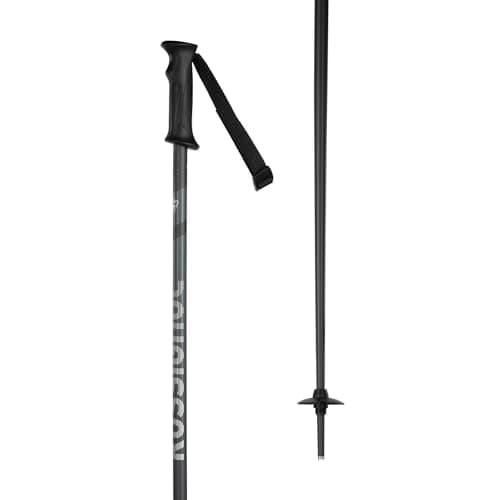
| 1 | Rossignol Tactic All-Mountain Ski Poles Almost every recreational skier, including the one reading this | $2.40 a dayon snow | 6.6/10 | $59.35 - View on Amazon |
| 2 | Rossignol Electra Women's Ski Poles A smaller hand, and a skier under about five foot four | $2.40 a dayon snow | 6.2/10 | $48.44 - View on Amazon |
| 3 | Rossignol Tactic Jr Kids Ski Poles A child between about four and twelve | $5.00 a dayon snow | 5.7/10 | $38.36 - View on Amazon |
Prices last verified October 19, 2026. Prices move constantly; the figure on Amazon at the moment you click is the real one.
What a pole is actually for
Three things, in descending order of how much they matter to a recreational skier: timing a turn, pushing along flat ground, and getting up after a fall. Notice that none of them is steering - the pole plant marks the rhythm of a turn, it does not cause the turn.
That is why this is a sixty-dollar purchase and not a three-hundred-dollar one. A lighter pole with a better swing weight is a genuine improvement for someone making forty short-radius turns a minute down a mogul field. For a family on a groomed blue run it is not detectable. The ski pole sizing page covers what poles do in more depth.
Why aluminum, specifically
Carbon poles are lighter and they are also brittle in the specific way that matters on a ski hill: a carbon shaft that takes a hard side load snaps, usually somewhere in the middle, and a snapped pole is done. An aluminum shaft under the same load bends. A bent pole is ugly, entirely usable and often straightenable.
All three poles here publish an aluminum DURAL shaft, which is the correct material for anyone who is not racing. The price of that decision is about 80 to 120 grams a pair that you will never notice.
Sizing, done in ten seconds
Turn the pole upside down so the grip is on the floor. Take hold of the shaft just under the basket. If your forearm is level and your elbow makes roughly a right angle, the pole is the right length. If your hand is above your elbow, it is too long.
| Skier height | Pole length | Which pole here |
|---|---|---|
| 4 ft 7 in - 4 ft 11 in | 100 cm | Tactic Jr |
| 4 ft 11 in - 5 ft 2 in | 105 cm | Tactic Jr or Electra |
| 5 ft 2 in - 5 ft 5 in | 110 cm | Electra or Tactic |
| 5 ft 5 in - 5 ft 8 in | 115 cm | Electra or Tactic |
| 5 ft 8 in - 5 ft 11 in | 120 cm | Electra or Tactic |
| 5 ft 11 in - 6 ft 2 in | 125 cm | Electra or Tactic |
| 6 ft 2 in - 6 ft 5 in | 130 cm | Tactic |
That table is a starting point rather than an answer, and the pole sizing page has the full chart and the reasoning. If you are consistently between two lengths, go shorter - a pole slightly too short encourages a forward stance, and a pole slightly too long pushes you back.
The picks
Rossignol Tactic
The pick, and honestly the end of the discussion for most people. A published $59.95 buys an aluminum DURAL shaft in six published lengths from 110 to 135 cm, an R-Grip with bi-injected vibration-damping components, an RTL19 strap and an SB60 basket.
Six published lengths matters more than it sounds. A pole sold in three lengths forces half its buyers into a compromise, and a compromise on pole length changes your stance for the whole day.
What Rossignol does not publish is a weight or a warranty term, which is worth knowing and is not worth much. A pole is a tube.
Rossignol Electra
The same money, the same shaft and the same basket, with two things changed: a grip of smaller circumference, and a length run that starts at 105 cm rather than 110.
Both changes matter for the same person - a smaller skier with smaller hands. A grip you cannot close your hand around properly is a grip you hold too tightly, which is how hands get cold and how poles get dropped. The cold hands page covers grip tension as a cause.
It tops out at 125 cm, so a taller woman should buy the Tactic instead. The women’s version carries no price premium, which is worth noting because in this category that is not always true.
Rossignol Tactic Jr
Marked as the skip above, conditionally. Eight published lengths in 5 cmsteps from 70 to 105 cm is the finest size grid on any product in this ledger, and it exists because a child passes through that entire range in about four winters.
It publishes a junior-specific grip and strap rather than an adult pole cut short, which is a genuine difference - an adult grip in a child’s hand cannot be held properly at all.
The reason it is the skip is simply that poles come free with rental and leased ski packages. Buy these when the child owns skis. The seasonal lease page covers what is included.
Fixed or adjustable?
Every pole on this page is fixed length. Adjustable poles exist, they are heavier and more expensive, and the case for them is specific rather than general: they suit touring, snowshoeing and a growing child, because in all three cases the correct length changes.
For resort skiing the correct length does not change, so the mechanism adds weight and a failure point in exchange for nothing. That comparison has its own page and it is more sympathetic to adjustable poles than this paragraph is.
The one habit worth learning
Put your hand up through the strap from underneath, then close your hand around the grip over the top of the strap. Done that way, the strap takes the load when you push, which means you can hold the grip loosely - and a loose grip is a warm hand.
The exception is trees and terrain parks, where many skiers deliberately ski with their hands out of the straps so a caught pole cannot wrench a shoulder. Both positions are defensible; holding the pole in a fist with the strap dangling is not.
Every pick, with the working
Each entry shows the published inputs, the axis scores they produce, and what you give up. The order is the computed order, not a commercial one, and the arithmetic is open underneath each score.
1 · Almost every recreational skier, including the one reading this
Rossignol Tactic All-Mountain Ski Poles
An aluminum DURAL shaft in six published lengths at $59.95, which is the pole most people should buy and then not think about again. Aluminum bends instead of snapping, and a bent pole gets you down the hill where a snapped carbon one does not.
- Published price
- $59.95
- Cost per day on snow
- $2.40 a day
- Amortized over
- 5 seasons (25 days)
- Certified to
- Not published
- Published sizes
- 110, 115, 120, 125, 130 and 135 cm
- Warranty
- No term published on the product page
What it gets right
- Six published lengths from 110 to 135 cm, so the sizing chart actually resolves
- Aluminum DURAL shaft, which bends rather than shatters in a fall
- Published R-Grip with bi-injected vibration-damping components
- Published SB60 basket, a real powder basket rather than a race disc
What you give up
- No published warranty term and no published weight
- Fixed length, so it does not adapt across snow conditions like an adjustable pole
- Heavier than carbon, which matters on a long traverse and nowhere else
The working behind the 6.6
- Cost per day on snow: 9.3
- $59.95 over 5 seasons at 5 days each = 25 days = $2.40 a day
- Published protection: not scored
- Poles carry no protective standard, so this axis does not apply.
- Size availability: 8.5
- 6 published sizes (8.5 of 8.5); no continuous adjuster published (+0); range: 110, 115, 120, 125, 130 and 135 cm
- Warranty and support: 0.0
- no published term (0 of 6); no published crash replacement (+0); no published repair route (+0)
Axes with unpublished inputs are dropped and the remaining weights re-normalized, so a product is not punished for a manufacturer’s silence. Specifications compiled September 12, 2026 from Rossignol published specifications.
2 · A smaller hand, and a skier under about five foot four
Rossignol Electra Women's Ski Poles
Same price and same aluminum shaft as the Tactic, with two things changed that are worth the swap: a grip of smaller circumference, and a size run that starts at 105 cm rather than 110. A pole you cannot close your hand around properly is a pole you drop.
- Published price
- $59.95
- Cost per day on snow
- $2.40 a day
- Amortized over
- 5 seasons (25 days)
- Certified to
- Not published
- Published sizes
- 105, 110, 115, 120 and 125 cm
- Warranty
- No term published on the product page
What it gets right
- Published smaller-circumference grip with vibration damping
- Five published lengths starting at 105 cm, below where the Tactic starts
- Same aluminum DURAL shaft and SB60 basket as the unisex pole
- Same $59.95 price, so the women's version carries no premium
What you give up
- Tops out at 125 cm, so a taller woman needs the Tactic instead
- No published warranty term or weight
- Fixed length
The working behind the 6.2
- Cost per day on snow: 9.3
- $59.95 over 5 seasons at 5 days each = 25 days = $2.40 a day
- Published protection: not scored
- Poles carry no protective standard, so this axis does not apply.
- Size availability: 6.8
- 5 published sizes (6.8 of 8.5); no continuous adjuster published (+0); range: 105, 110, 115, 120 and 125 cm
- Warranty and support: 0.0
- no published term (0 of 6); no published crash replacement (+0); no published repair route (+0)
Axes with unpublished inputs are dropped and the remaining weights re-normalized, so a product is not punished for a manufacturer’s silence. Specifications compiled September 12, 2026 from Rossignol published specifications.
3 · A child between about four and twelve
Rossignol Tactic Jr Kids Ski Poles
Skip this one. Buy these only if your child owns skis. A rental or leased ski package includes poles at no extra charge, and $49.95 for a pole a child outgrows in two seasons is money that would do more good on a second pair of gloves. The exception is a child who already has their own skis and is between rental sizes, where eight published lengths in 5 cm steps genuinely solves a problem.
Eight published lengths in 5 cm steps from 70 to 105 cm, which is the finest size grid on any product in this ledger, and it exists because a child grows through this range in about four winters. Junior grip and junior strap published, which is not the same as an adult pole cut short.
- Published price
- $49.95
- Cost per day on snow
- $5.00 a day
- Amortized over
- 2 seasons (10 days)
- Certified to
- Not published
- Published sizes
- 70, 75, 80, 85, 90, 95, 100 and 105 cm
- Warranty
- No term published on the product page
What it gets right
- Eight published lengths in 5 cm steps, so a child is never between sizes
- Junior-specific grip and strap published rather than an adult pole shortened
- Aluminum DURAL shaft, the same material as the adult pole
- Ten dollars cheaper than the adult poles
What you give up
- $49.95 for a pole outgrown in two seasons, when rental poles come with the skis
- No published basket detail, warranty term or weight
- Fixed length, where an adjustable junior pole would cover the whole range
The working behind the 5.7
- Cost per day on snow: 7.4
- $49.95 over 2 seasons at 5 days each = 10 days = $5.00 a day
- Published protection: not scored
- Poles carry no protective standard, so this axis does not apply.
- Size availability: 8.5
- 8 published sizes (8.5 of 8.5); no continuous adjuster published (+0); range: 70, 75, 80, 85, 90, 95, 100 and 105 cm
- Warranty and support: 0.0
- no published term (0 of 6); no published crash replacement (+0); no published repair route (+0)
Axes with unpublished inputs are dropped and the remaining weights re-normalized, so a product is not punished for a manufacturer’s silence. Specifications compiled September 12, 2026 from Rossignol published specifications.
Prices last verified October 19, 2026. Prices move constantly; the figure on Amazon at the moment you click is the real one.
Questions people actually ask
What length ski poles do I need?
Turn the pole upside down, grip the shaft just below the basket, and check that your elbow makes roughly a right angle with your forearm level. For most adults that lands between 115 and 125 cm. If you are between two lengths, choose the shorter one.
Are carbon ski poles worth it?
Not for a recreational skier. Carbon is lighter and snaps under a hard side load, where aluminum bends and remains usable. The weight saving is around 80 to 120 grams a pair, which is undetectable on a groomed run and matters only to someone making very high turn counts.
Do beginners need ski poles?
Not on day one. Most beginner lessons start without poles because they give you something else to think about and something else to drop. Poles become useful once you are linking turns and need to time them, and they are always useful on flat traverses and cat tracks.
How should you hold ski pole straps?
Put your hand up through the strap from underneath, then close your hand around the grip over the top of the strap. That way the strap carries the load when you push, so you can hold the grip loosely - which keeps your hands warmer.
Should I buy ski poles for my child?
Usually not. Rental and leased ski packages include poles, so buying separately only makes sense once the child owns their skis. If you do buy, look for a junior-specific grip and strap rather than an adult pole in a short length.