The best sleds for kids, and the safety standard that does not exist
There is no US safety certification for recreational sleds. What makers do publish is capacity and shape, and the hill matters more than either.
By Sawyer V. · Published
We have not tested this gear. Everything below is compiled from published specifications and published safety standards, and the arithmetic is public so you can check it. This page carries affiliate links: if you buy through one we earn a commission at no extra cost to you, and it does not change the order of the picks. Full disclosure.
The short answer
Worth knowing before anything else: there is no US safety standard for recreational snow sleds, so no sled carries a certification and none of the picks here does either. What makers publish is a weight capacity and dimensions. Choose a shape you can steer, a hill with a long clear runout, and put a ski helmet on the child. The helmet is the part that is actually certified.
| # | Pick | Best for | Score | Price |
|---|---|---|---|---|
| 1 | Slippery Racer Downhill Xtreme Toboggan An adult riding down with a child who is not ready alone | Not publishedon snow | 0.0/10 | $68.16 - View on Amazon |
| 2 | Flexible Flyer Winter Trek 3-Person Snow Sled Three riders together on a gentle open slope | Not publishedon snow | 0.0/10 | $99.00 - View on Amazon |
| 3 | Slippery Racer Downhill Pro Saucer Disc Sled One child on a wide, open hill with a long clear runout | Not publishedon snow | 0.0/10 | $27.99 - View on Amazon |
Prices last verified October 19, 2026. Prices move constantly; the figure on Amazon at the moment you click is the real one.
Start with what does not exist
Ski helmets are certified to ASTM F2040 or CE EN 1077. Snowshoes publish load limits. Sleds have neither: there is no US safety standard for recreational snow sleds, so there is no certification to check on any sled from any brand.
We say this plainly because it changes where you should focus. On a helmet, the product specification is most of the safety decision. On a sled, the product is a small part of it and the hill is most of it.
The three shapes, and what each one gives up
| Shape | Speed | Steering | Best for |
|---|---|---|---|
| Saucer | Fastest | None. It spins | A wide open hill with a long clear runout and one small rider |
| Toboggan | Fast | Some, by leaning and by dragging a hand or a heel | General family use; the most versatile shape |
| Long multi-rider sled | Fast under load | Least, because of the length and the weight | Several riders together on an open, gentle slope |
Steering is the property that matters most and the one nobody markets on. A saucer is the most fun and the least controllable, which is a fine combination on a big empty field and a bad one anywhere with something to hit.
Published capacity, and what to do with it
The one figure makers do publish is a weight capacity. Two of the picks here publish theirs, and it is worth reading against how you will actually use the sled:
- A 250 lb capacity on a 48 in deck means an adult can ride down with a small child. For a nervous four-year-old that is the difference between a sled they use and one they watch.
- A 300 lb combined capacity across three riders on a 66 in deck is a whole-family sled. It is also the hardest thing on this page to steer or stop, which rules out crowded hills.
- A single-rider saucer publishes no capacity we could read, which is common in this category and part of why it is our skip.
Choosing the hill, which matters more than the sled
Every piece of practical safety advice about sledding is about the hill rather than the equipment:
- A long, clear runout. The bottom of the hill needs enough flat ground to stop on, with nothing at the end of it. This is the single most important thing.
- No trees, fences, posts or rocks. Collisions with fixed objects are what turns sledding from bruises into something worse.
- Nowhere near a road or a parking lot. A sled that overshoots does not stop at a curb.
- Not into a body of water, however frozen it looks.
- Feet first, sitting up. Head first on the stomach is how head and neck injuries happen, and it is what children do naturally if nobody says otherwise.
- Walk back up at the side, not up the middle of the run.
What to wear
Exactly what you would wear skiing, which is a large part of the appeal: the waterproof layers you bought for a ski trip cover this at no extra cost. Snow pants especially, because sledding is a day spent sitting in snow by design. The layering guide.
Add the helmet, and mittens rather than gloves for a young child, because sledding involves a lot of hands in snow and no need for dexterity. Why mittens are warmer.
Why this is the best value in winter
A sled costs a fraction of one adult lift ticket at most resorts, needs no booking, no lesson and no fitting, and works on any hill with snow on it. For a family testing whether their children enjoy being outside in winter at all, it is a far better first purchase than a ski trip.
The rest of the no-lift-ticket section covers snowshoes and skates on the same logic, and the buy-versus-rent page has the arithmetic for everything that does involve a lift.
Every pick, with the working
Each entry shows the published inputs, the axis scores they produce, and what you give up. The order is the computed order, not a commercial one, and the arithmetic is open underneath each score.
1 · An adult riding down with a child who is not ready alone
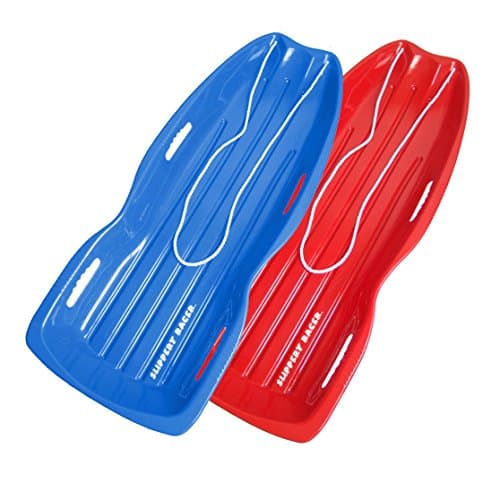
Slippery Racer Downhill Xtreme Toboggan
A 250 lb published capacity on a 48-inch deck means an adult can ride with a small child, which is the difference between a sled a four-year-old uses and one they watch. Note that no US safety standard applies to sleds at all.
- Published price
- Not published
- Cost per day on snow
- Not published
- Amortized over
- 3 seasons (15 days)
- Certified to
- Not published
- Published sizes
- One size, 48 x 18 in
- Weight
- 1360 g
- Warranty
- No term published
Slippery Racer publishes no MSRP we could read, so the cost-per-day axis is not scored for this sled. Amazon also suppresses the displayed price on this listing because it sits below the maker's minimum advertised price, so the button reads Check price rather than a figure; the listing was verified in stock on September 26, 2026 and is sold there as a two-pack.
What it gets right
- 250 lb published weight capacity, enough for an adult plus a small child
- 48 x 18 in deck with contoured edges to hold on to
- 3 lb, so a child can carry it back up the hill themselves
What you give up
- No published MSRP
- No safety standard applies to sleds in the US, so there is no certification to check on any sled, this one included
The working behind the 0.0
- Cost per day on snow: not scored
- No manufacturer-published price, so this axis is not scored.
- Published protection: not scored
- Sleds carry no US protective standard, which is itself worth knowing.
- Size availability: not scored
- Sold in one size, so size availability does not apply.
- Warranty and support: 0.0
- no published term (0 of 6); no published crash replacement (+0); no published repair route (+0)
Axes with unpublished inputs are dropped and the remaining weights re-normalized, so a product is not punished for a manufacturer’s silence. Specifications compiled September 3, 2026 from Slippery Racer published specifications.
2 · Three riders together on a gentle open slope
Flexible Flyer Winter Trek 3-Person Snow Sled
5.5 feet long with a published 300 lb combined capacity for three riders, which is the sled for the family that all wants to go at once. It is also the one that is hardest to steer, and that is worth knowing before the first run.
- Published price
- Not published
- Cost per day on snow
- Not published
- Amortized over
- 3 seasons (15 days)
- Certified to
- Not published
- Published sizes
- One size, 66 x 20 in
- Warranty
- No term published
Flexible Flyer publishes no MSRP we could read.
What it gets right
- Published 300 lb combined capacity across three riders
- 66 in deck, long enough for two children and an adult
What you give up
- No published MSRP
- A long toboggan with three riders is genuinely difficult to steer or stop, which rules out crowded or tree-lined hills
The working behind the 0.0
- Cost per day on snow: not scored
- No manufacturer-published price, so this axis is not scored.
- Published protection: not scored
- Sleds carry no US protective standard, which is itself worth knowing.
- Size availability: not scored
- Sold in one size, so size availability does not apply.
- Warranty and support: 0.0
- no published term (0 of 6); no published crash replacement (+0); no published repair route (+0)
Axes with unpublished inputs are dropped and the remaining weights re-normalized, so a product is not punished for a manufacturer’s silence. Specifications compiled September 3, 2026 from Flexible Flyer published product specification.
3 · One child on a wide, open hill with a long clear runout
Slippery Racer Downhill Pro Saucer Disc Sled
Skip this one. Fun, cheap and the one we would not buy first. A saucer spins and cannot be steered at all, so it needs a wide open hill with a long clear runout and nothing to hit. If your local hill has trees, a fence or a road at the bottom, buy a shape you can point.
A 26-inch disc, which is the fastest and least steerable shape there is. That is the whole trade: children love it and it goes where the hill sends it, so the hill has to be chosen carefully. Unlike most saucers it publishes molded hand grips, so there is at least something to hold.
- Published price
- Not published
- Cost per day on snow
- Not published
- Amortized over
- 3 seasons (15 days)
- Certified to
- Not published
- Published sizes
- One size, 26 in diameter
- Warranty
- No term published
Slippery Racer publishes no MSRP we could read.
What it gets right
- Published 26 in diameter in one-piece injection-molded polyethylene, with nothing to inflate or assemble
- Molded hand grips published, which a bare disc does not give you
- Coated with the maker's published IceVex cold-resistant treatment
What you give up
- No published MSRP
- No published rider weight limit, so there is no figure to check an adult against
- A saucer spins and cannot be steered, so it needs an open hill with no trees or fences
The working behind the 0.0
- Cost per day on snow: not scored
- No manufacturer-published price, so this axis is not scored.
- Published protection: not scored
- Sleds carry no US protective standard, which is itself worth knowing.
- Size availability: not scored
- Sold in one size, so size availability does not apply.
- Warranty and support: 0.0
- no published term (0 of 6); no published crash replacement (+0); no published repair route (+0)
Axes with unpublished inputs are dropped and the remaining weights re-normalized, so a product is not punished for a manufacturer’s silence. Specifications compiled October 12, 2026 from Slippery Racer published Downhill Pro specifications.
Prices last verified October 19, 2026. Prices move constantly; the figure on Amazon at the moment you click is the real one.
Questions people actually ask
Are there safety standards for snow sleds?
No. There is no US safety standard for recreational snow sleds, so no sled carries a certification. Choose a shape you can steer, a hill with a long clear runout, and put a ski helmet on the child.
What is the best type of sled for young kids?
A toboggan-style sled with enough capacity for an adult to ride down with a small child. It steers better than a saucer and lets a nervous child ride with a parent rather than alone.
Should kids wear helmets for sledding?
Yes, and a ski helmet works. Sledding injuries commonly involve collisions with fixed objects, and the helmet is the only certified piece of equipment in the entire activity.
How do you choose a sledding hill?
A long clear runout at the bottom with nothing at the end of it, no trees, fences or posts on the slope, nowhere near a road or water, and space to walk back up at the side rather than through the middle.
Are saucer sleds dangerous?
They cannot be steered and they spin, so the rider frequently arrives at the bottom backwards. That is fine on a wide open hill with nothing to hit and a bad idea anywhere else. It is not the sled, it is the hill.