Kids' ice skates, and the adjustable shells that cover four sizes
A growing foot is the whole problem with buying children's skates, and adjustable shells are an unusually good answer to it.
By Sawyer V. · Published
We have not tested this gear. Everything below is compiled from published specifications and published safety standards, and the arithmetic is public so you can check it. This page carries affiliate links: if you buy through one we earn a commission at no extra cost to you, and it does not change the order of the picks. Full disclosure.
The short answer
Buy an adjustable skate. The shells here each lengthen across roughly four shoe sizes, so one pair covers several winters of a growing foot, and three shells cover youth 10 through adult 9. For a child skating a handful of times a season, that is the difference between one purchase and three. If they skate once a year, rent at the rink.
| # | Pick | Best for | Score | Price |
|---|---|---|---|---|
| 1 | American Athletic Party Girl Adjustable Figure Skates A child who skates at a local rink a few times a season | $6.50 a dayon snow | 4.2/10 | $64.99 - View on Amazon |
| 2 | Jackson Ultima Softec Vibe Adjustable Skates A growing child who skates a few times each winter | Not publishedon snow | 2.5/10 | $99.95 - View on Amazon |
| 3 | American Athletic Cougar Adjustable Hockey Skates A very young beginner who keeps tripping on a toe pick | Not publishedon snow | 1.6/10 | $64.99 - View on Amazon |
Prices last verified October 19, 2026. Prices move constantly; the figure on Amazon at the moment you click is the real one.
Why adjustable skates are the right answer
Children’s skates have exactly the problem children’s ski boots have: a foot that outgrows the shell long before the shell wears out. Skating has an unusually good solution that skiing does not, which is a two-piece boot with a lever that lengthens it.
One shell covering four shoe sizes is not a marketing rounding. It is the published range, and it is the reason this is one of the few categories on this site where buying for a growing child is straightforwardly sensible.
| Skate | Published shells | Adjusts across | Blade |
|---|---|---|---|
| American Athletic Party Girl | S (10Y-13Y), M (1-4), L (5-8) | Four sizes per shell | Figure |
| Jackson Ultima Softec Vibe | S (Y11-2), M (2-6), L (6-9) | Four sizes per shell | Figure |
| American Athletic Cougar | Youth 6-9 shell published | Four sizes | Hockey |
Figure blade or hockey blade
The difference that matters for a beginner is the toe pick: the row of teeth at the front of a figure blade. It is there for jumps and it is also the thing a beginner trips over, because a child who leans forward catches it and goes down face first.
- Hockey blade: flat, no toe pick, slightly rockered. Easier for a young beginner to stand and push on, and the right choice for a child who might play hockey later.
- Figure blade: longer, with a toe pick. Better for anyone who wants figure skating lessons, and marginally more stable at a standstill because the blade is longer.
For a family that skates twice a winter at a public rink, either works. If the child is very young and keeps tripping, the toe pick is often why.
Sizing a skate
- Measure the foot in millimeters, heel to longest toe, standing, in the sock they will skate in. The method is the same as the ski boot chart.
- Skates generally run close to shoe size or half a size down, unlike ski boots. Check the maker’s chart against the measurement rather than assuming.
- Set the adjustable shell to the current size, not the top of its range. A skate with room in it means the ankle is unsupported, which is the main complaint about adjustable skates and is usually a setting problem rather than a product one.
- One thin sock, not a thick one, and not two. Same reasoning as a ski boot: a thick sock fills space the boot needs and makes feet colder. Why.
- Laced properly: loose over the toes, tight across the instep and the ankle, moderate at the top. Most children’s ankle wobble is a lacing problem.
When renting still wins
If your family skates once or twice a winter at a public rink, rent. Rink rental is inexpensive, the skates are sharpened regularly, and there is nothing to store or carry.
Buying starts to make sense at around five or six sessions a season, or as soon as a child starts asking to go. On our convention of a two-season horizon, a $64.99 pair used across two winters is genuinely cheap per session, and the adjustable shell means it may cover three.
The maintenance nobody mentions
New skates from a general retailer often arrive unsharpened or only roughly sharpened, and a blunt blade slides sideways instead of gripping, which feels exactly like being bad at skating. A rink or a skate shop will sharpen them cheaply, and it is worth doing before the first outing rather than after a disappointing one.
Then dry the blades after every session and store them with soft guards on, not hard plastic ones, which trap moisture against the steel and rust it.
Helmets on ice
Ice is harder than snow and a beginner falls backwards onto the back of the head more often than forwards. Many rinks now require helmets for young children, and a ski helmet works for public skating.
The children’s helmet picks apply here too, and it is the same helmet you would use for sledding, which is a large part of why buying one is good value even for a family that barely skis.
Every pick, with the working
Each entry shows the published inputs, the axis scores they produce, and what you give up. The order is the computed order, not a commercial one, and the arithmetic is open underneath each score.
1 · A child who skates at a local rink a few times a season
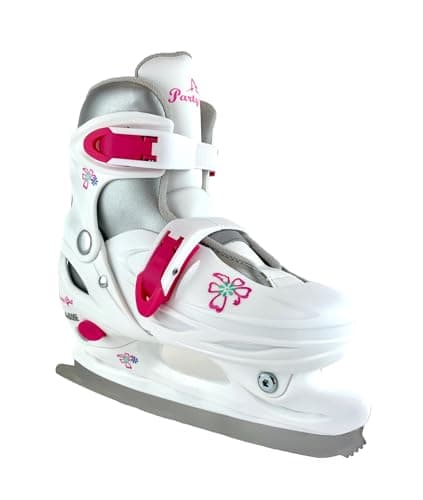
American Athletic Party Girl Adjustable Figure Skates
Three shells covering youth 10 through adult 8, each adjusting across four sizes, at a published $64.99. That is the cheapest published route to a skate that fits a child for more than one winter.
- Published price
- $64.99
- Cost per day on snow
- $6.50 a day
- Amortized over
- 2 seasons (10 days)
- Certified to
- Not published
- Published sizes
- Small 10Y-13Y, Medium 1-4, Large 5-8
- Warranty
- No term published
What it gets right
- $64.99 published, with each shell adjusting across four shoe sizes
- Three shells cover youth 10 through adult 8
What you give up
- No published warranty term
- Recreational figure blade, so it is not a starting point for lessons in either figure skating or hockey
The working behind the 4.2
- Cost per day on snow: 6.3
- $64.99 over 2 seasons at 5 days each = 10 days = $6.50 a day
- Published protection: not scored
- No certification published for this model, so protection is not scored.
- Size availability: 4.9
- 3 published sizes (3.4 of 8.5); continuous in-size adjuster published (+1.5); range: Small 10Y-13Y, Medium 1-4, Large 5-8
- Warranty and support: 0.0
- no published term (0 of 6); no published crash replacement (+0); no published repair route (+0)
Axes with unpublished inputs are dropped and the remaining weights re-normalized, so a product is not punished for a manufacturer’s silence. Specifications compiled September 3, 2026 from American Athletic published specifications.
2 · A growing child who skates a few times each winter
Jackson Ultima Softec Vibe Adjustable Skates
A two-piece boot that lengthens by pulling a lever, covering four shoe sizes per shell. For a child skating a handful of times a winter, that is the difference between one purchase and three.
- Published price
- Not published
- Cost per day on snow
- Not published
- Amortized over
- 2 seasons (10 days)
- Certified to
- Not published
- Published sizes
- Small Y11-2, Medium 2-6, Large 6-9, each adjustable across four sizes
- Warranty
- No term published
Jackson Ultima publishes no MSRP we could read; retail prices for the same skate ranged widely on the compile date.
What it gets right
- Each shell adjusts across four shoe sizes, so one pair can last several seasons
- Three shells cover youth 11 through adult 9
- Soft boot construction, which a child can put on without help
What you give up
- No published MSRP and no published warranty term
- An adjustable soft boot gives less ankle support than a fitted skate, which matters once a child skates regularly
The working behind the 2.5
- Cost per day on snow: not scored
- No manufacturer-published price, so this axis is not scored.
- Published protection: not scored
- No certification published for this model, so protection is not scored.
- Size availability: 4.9
- 3 published sizes (3.4 of 8.5); continuous in-size adjuster published (+1.5); range: Small Y11-2, Medium 2-6, Large 6-9, each adjustable across four sizes
- Warranty and support: 0.0
- no published term (0 of 6); no published crash replacement (+0); no published repair route (+0)
Axes with unpublished inputs are dropped and the remaining weights re-normalized, so a product is not punished for a manufacturer’s silence. Specifications compiled September 3, 2026 from Jackson Ultima published product specification.
3 · A very young beginner who keeps tripping on a toe pick
American Athletic Cougar Adjustable Hockey Skates
Skip this one. Only skip it on published information rather than on quality. American Athletic publishes no MSRP and no warranty term for this model that we could find, so two of our four scoring axes have nothing to work from. The flat hockey blade is genuinely easier for a young beginner than a toe pick.
The hockey-blade equivalent, adjusting across four sizes from youth 6. A hockey blade is flatter and easier for a beginner to stand on than a figure blade with a toe pick, which catches.
- Published price
- Not published
- Cost per day on snow
- Not published
- Amortized over
- 2 seasons (10 days)
- Certified to
- Not published
- Published sizes
- Adjusts across four sizes; youth 6-9 shell published
- Warranty
- No term published
American Athletic publishes no MSRP for this model that we could read.
What it gets right
- Adjusts across four sizes, starting at youth 6
- Hockey blade has no toe pick, which is one fewer thing for a beginner to catch
What you give up
- No published MSRP and no published warranty term
- Fewer shell sizes published than the figure-skate version
The working behind the 1.6
- Cost per day on snow: not scored
- No manufacturer-published price, so this axis is not scored.
- Published protection: not scored
- No certification published for this model, so protection is not scored.
- Size availability: 3.2
- 2 published sizes (1.7 of 8.5); continuous in-size adjuster published (+1.5); range: Adjusts across four sizes; youth 6-9 shell published
- Warranty and support: 0.0
- no published term (0 of 6); no published crash replacement (+0); no published repair route (+0)
Axes with unpublished inputs are dropped and the remaining weights re-normalized, so a product is not punished for a manufacturer’s silence. Specifications compiled September 3, 2026 from American Athletic published specifications.
Prices last verified October 19, 2026. Prices move constantly; the figure on Amazon at the moment you click is the real one.
Questions people actually ask
Are adjustable ice skates any good for kids?
For casual winter skating, yes: one shell covering four shoe sizes is excellent value for a growing foot. They give less ankle support than a fitted skate, which starts to matter only once a child skates regularly or joins a program.
Should kids get figure skates or hockey skates?
For a young beginner, a hockey blade is easier because it has no toe pick to trip over. Figure blades suit anyone heading for figure skating lessons. For twice-a- winter public skating, either is fine.
How should kids ice skates fit?
Snug, with the toes just brushing the end and the heel held down when the laces are tight across the instep and ankle. Set an adjustable shell to the current size rather than the top of its range.
Do kids need a helmet for ice skating?
Many rinks require one for young children, and a ski helmet works. Beginners on ice fall backwards onto the back of the head, which is exactly the impact a helmet is designed for.
Do new ice skates need sharpening?
Usually, yes. Skates from general retailers often arrive unsharpened or only roughly sharpened, and a blunt blade slides sideways instead of gripping. A rink or skate shop will do it cheaply.