Setting up a snowboard stance: width, angles and position
Three screwdriver adjustments change how a board feels more than the board model does, and nobody tells a beginner they exist.
By Sawyer V. · Published
We have not tested this gear. Everything below is compiled from published specifications and published safety standards, and the arithmetic is public so you can check it. This page carries affiliate links: if you buy through one we earn a commission at no extra cost to you, and it does not change the order of the picks. Full disclosure.
The short answer
Start at shoulder width or slightly wider, with a mild duck stance of about +15 degrees on the front foot and -9 to -6 degrees on the back, centered on the board. That setup suits almost every beginner on groomed runs. Then change one thing at a time and ride a full run before deciding, because every adjustment feels strange for the first two turns.
| # | Pick | Best for | Score | Price |
|---|---|---|---|---|
| 1 | System MTN CRCX snowboard package A household buying more than one board | Not publishedon snow | 4.3/10 | $489.95 - View on Amazon |
| 2 | Camp Seven Redwood snowboard with APX bindings A first snowboard for an adult who has had a couple of lessons | $11.60 a dayon snow | 3.0/10 | $409.95 - View on Amazon |
Prices last verified October 22, 2026. Prices move constantly; the figure on Amazon at the moment you click is the real one.
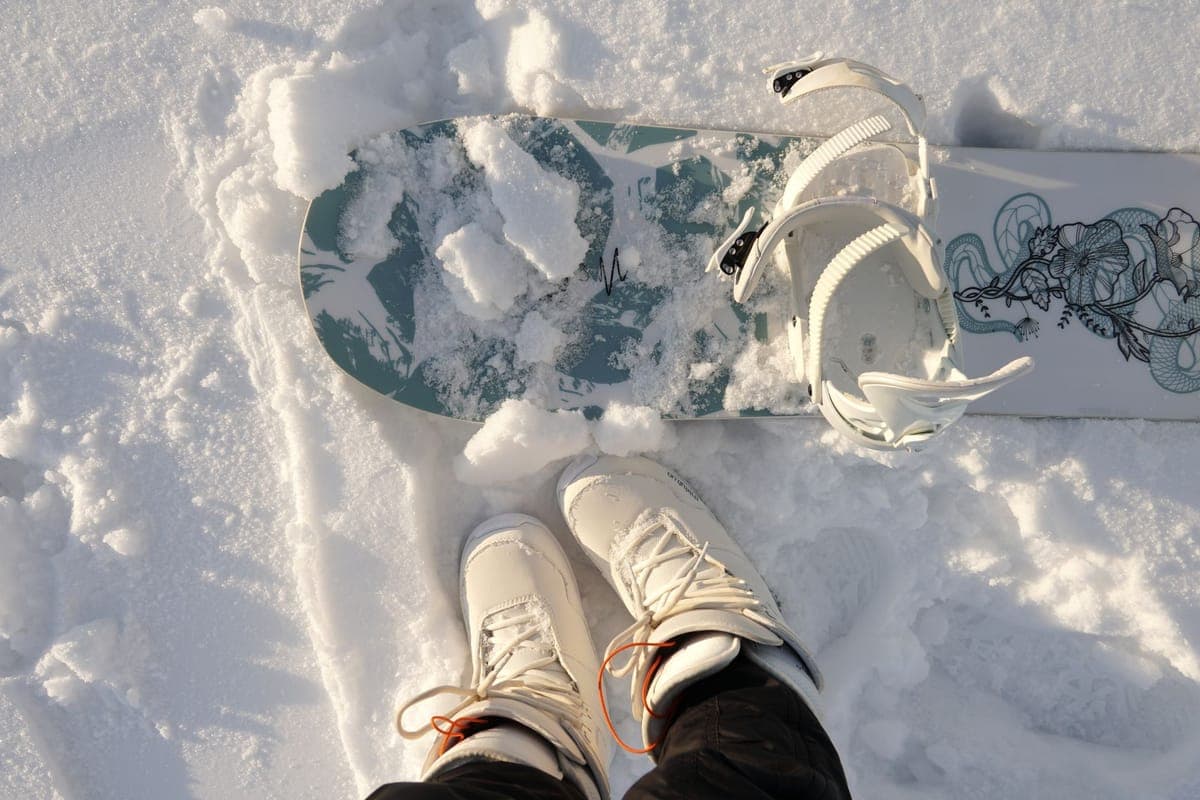
Three adjustments, one screwdriver
A snowboard binding is bolted to the board through an insert pattern, and moving it is a two-minute job with the tool that came in the box. There is no release setting to calculate and no shop appointment - alpine snowboard bindings do not release, which is a genuine difference from how a ski binding works.
What there is instead is three adjustable variables that most beginners never touch:
- Stance width. How far apart your feet are.
- Binding angles. Which way each foot points, in degrees.
- Stance position. Where the whole pair sits along the board: centered, or set back toward the tail.
All three are reversible, none of them requires a professional, and getting them roughly right makes a rental board feel dramatically better. A lot of people conclude they are bad at snowboarding when what is actually happening is that a shop set their bindings for the previous renter.
The starting point that works for almost everyone
| Setting | Start at | What it does |
|---|---|---|
| Stance width | Shoulder width, or a couple of centimeters wider | Stable enough to balance, narrow enough to turn without effort |
| Front binding angle | +15 degrees | Points your leading foot toward the nose so your hips can face forward |
| Back binding angle | -9 to -6 degrees | A mild duck stance; lets you ride backward without your knee fighting you |
| Stance position | Centered on the insert pattern | Board behaves the same in both directions, which a beginner needs |
| Highback lean | Neutral, or one click of forward lean | More lean means quicker heel-edge response and more calf fatigue |
Two notes on the angles. A positive number points the toes toward the nose; a negative number points them toward the tail. A stance with both feet angled outward, as above, is called a duck stance and it is the standard for anyone who expects to ride in both directions. And the exact figures matter less than the principle: the front foot noticeably angled, the back foot slightly negative, neither foot pointing straight across the board.
Stance width: what it changes
Wider is more stable at speed and in the air, and harder work to tip from edge to edge. Narrower turns more easily and feels less planted. Almost every published board comes with a reference stance marked on the insert pattern, and it is a genuinely good starting point.
The quick self-check: stand up, jump straight up a few centimeters and land naturally. Where your feet land is roughly where they want to be. Measure that, set the bindings to it, and adjust from there. If your knees ache after a day, try a centimeter narrower; if the board feels twitchy at speed, try a centimeter wider.
Angles: the three common setups
Mild duck, +15 and -9
The default and the right answer for a beginner or intermediate rider on groomed runs. Both feet angled outward, front more than back. It lets you ride backward comfortably, which matters more than it sounds because you will do it by accident.
Symmetric duck, +15 and -15
Park riders and anyone who genuinely rides switch as often as forward. It is harder work on long carving turns because your back leg is fighting the direction of travel. Not a beginner setup.
Forward stance, +21 and +6
Both feet pointing toward the nose. Efficient for going one direction fast and common on directional boards. It makes riding backward genuinely awkward, so it is the wrong setup for someone still learning to link turns.
One anatomical note that matters: the angle that is comfortable depends on your hips and knees, not on what a website recommends. If a setting makes your knee feel twisted after two runs, change it. Knee discomfort in a stance is your body telling you something and it does not improve with practice.
Stance position: centered or set back
The whole pair of bindings can shift toward the tail, which puts more board in front of you. On a directional board in deep snow that keeps the nose floating. On a groomed run it makes the board harder to ride backward and does nothing useful.
For a first two seasons: centered, always. Set-back stances are a powder-day adjustment and a beginner is not having powder days. The shapes page explains which boards are built for it.
How to change it without confusing yourself
- Change one variable. Not width and angle at the same time. If you change two things and it feels different, you have learned nothing.
- Make the change small. Three degrees, or one centimeter. Big changes feel dramatic for the wrong reasons.
- Ride a full run before judging. Every adjustment feels wrong for the first two turns because your body is used to the old one.
- Write down what you had. The number of people who improve their stance, forget what they changed, and cannot get back is high.
- Check the screws are tight at the end of the day. Binding screws back out with vibration, and a loose baseplate is the most common equipment failure in the sport.
The binding has to fit the boot first
None of this helps if the binding is the wrong size for the boot. Bindings publish a size range against boot sizes, and a boot that is too big for the binding hangs over the baseplate, while one that is too small does not fill the straps. The bindings page covers matching the two, and the boot page covers the fit that everything else depends on.
Check the toe strap sits over the toe cap rather than on top of the toes, and the ankle strap sits across the flex point of the ankle rather than up on the shin. Those two placements do more for how a board responds than any angle on this page.
None of the above applies in the same way if you are looking at a step-on system, where the binding and boot are a matched pair. Step-on against strap-in covers what you gain, what you give up, and the compatibility catch worth knowing before you buy either half.
If you are renting
Ask the shop to set your stance rather than accepting whatever the last renter had. Tell them your lead foot and roughly your height, and they will set a sensible starting width and a mild duck. It takes them two minutes and it is a normal request that almost nobody makes.
And if you are on a seasonal lease, get it set once at the start of the season and then leave it alone until you have enough days to know what you would change.
Every pick, with the working
Each entry shows the published inputs, the axis scores they produce, and what you give up. The order is the computed order, not a commercial one, and the arithmetic is open underneath each score.
1 · A household buying more than one board
System MTN CRCX snowboard package
Eight published lengths from 138 to 163 cm is the widest size range in this category, which for a family means one brand can fit a twelve-year-old and a six-foot adult. The camber-rocker-camber profile is aimed squarely at not catching an edge.
- Published price
- Not published
- Cost per day on snow
- Not published
- Amortized over
- 5 seasons (25 days)
- Certified to
- Not published
- Published sizes
- 138 to 163 cm including two wide sizes
- Warranty
- No term published on the product page
System sells the MTN in several package configurations at different published prices, so no single list price applies to the item you will land on.
What it gets right
- Eight published lengths, two of them wide, which is unusually broad
- Camber-rocker-camber profile with the contact points lifted, designed to resist edge catches
- Sold as a complete package with bindings
What you give up
- No single published price: the same board appears in several package configurations
- Boots again separate
The working behind the 4.3
- Cost per day on snow: not scored
- No manufacturer-published price, so this axis is not scored.
- Published protection: not scored
- Snowboards carry no protective standard of their own.
- Size availability: 8.5
- 8 published sizes (8.5 of 8.5); no continuous adjuster published (+0); range: 138 to 163 cm including two wide sizes
- Warranty and support: 0.0
- no published term (0 of 6); no published crash replacement (+0); no published repair route (+0)
Axes with unpublished inputs are dropped and the remaining weights re-normalized, so a product is not punished for a manufacturer’s silence. Specifications compiled September 3, 2026 from System published specifications.
2 · A first snowboard for an adult who has had a couple of lessons
Camp Seven Redwood snowboard with APX bindings
Rocker in the tip and tail, which is the profile that stops a beginner catching an edge, sold with bindings for $289.95. That is roughly three days of snowboard rental for two people.
- Published price
- $289.95
- Cost per day on snow
- $11.60 a day
- Amortized over
- 5 seasons (25 days)
- Certified to
- Not published
- Published sizes
- 149, 153, 156, 158 wide and 160 cm
- Warranty
- No term published on the product page
What it gets right
- Rocker zones at tip and tail, the construction that forgives a beginner's mistakes
- Bindings included, so the board arrives ready apart from boots
- Five published lengths including a wide option
What you give up
- Boots are a separate purchase and are the part that actually needs trying on
- A twin shape is a compromise for someone who will only ever ride one direction
The working behind the 3.0
- Cost per day on snow: 2.5
- $289.95 over 5 seasons at 5 days each = 25 days = $11.60 a day
- Published protection: not scored
- Snowboards carry no protective standard of their own.
- Size availability: 6.8
- 5 published sizes (6.8 of 8.5); no continuous adjuster published (+0); range: 149, 153, 156, 158 wide and 160 cm
- Warranty and support: 0.0
- no published term (0 of 6); no published crash replacement (+0); no published repair route (+0)
Axes with unpublished inputs are dropped and the remaining weights re-normalized, so a product is not punished for a manufacturer’s silence. Specifications compiled September 3, 2026 from Camp Seven published specifications.
Prices last verified October 22, 2026. Prices move constantly; the figure on Amazon at the moment you click is the real one.
Questions people actually ask
What stance width should a beginner snowboarder use?
Shoulder width or a couple of centimeters wider, which is also close to the reference stance marked on most boards. A quick check: jump up a few centimeters and land naturally, then measure where your feet landed. Wider is more stable and harder to turn; narrower turns more easily and feels less planted.
What binding angles should I start with?
About +15 degrees on the front foot and -9 to -6 on the back, which is a mild duck stance. That lets you ride backward comfortably, which matters because a beginner ends up doing it by accident. Symmetric duck and strongly forward stances both have uses, and neither is a first setup.
Should my snowboard stance be centered or set back?
Centered, for a first two seasons. A set-back stance puts more board in front of you, which keeps the nose floating in deep snow and makes riding backward harder on a groomed run. It is a powder-day adjustment and a beginner is not having powder days.
Do snowboard bindings release like ski bindings?
No. Standard alpine snowboard bindings do not release, which means there is no release value to calculate and no shop appointment to book. It also means the three adjustments that do exist - width, angles and position - are yours to set with a screwdriver.
How do I know if my stance is wrong?
Knee discomfort is the clearest signal, and it does not improve with practice: if a setting twists your knee after two runs, change the angle. Aching after a full day often means the stance is too wide. Feeling twitchy at speed often means it is too narrow. Change one thing at a time and ride a full run before judging.