Snowboard bindings, and the published number that decides it
Bindings are sized off your boot, not your height. Three compared on what each maker publishes, and why the boot-size range matters more than the materials.
By Sawyer V. · Published
We have not tested this gear. Everything below is compiled from published specifications and published safety standards, and the arithmetic is public so you can check it. This page carries affiliate links: if you buy through one we earn a commission at no extra cost to you, and it does not change the order of the picks. Full disclosure.
The short answer
Snowboard bindings are sized from your boot, not your height and not your board. Buy boots first, then match the binding to the published boot-size range. For a first or second season choose soft to medium flex with aluminum ratchets, and check the binding’s mounting pattern against your board’s inserts before you buy.
| # | Pick | Best for | Score | Price |
|---|---|---|---|---|
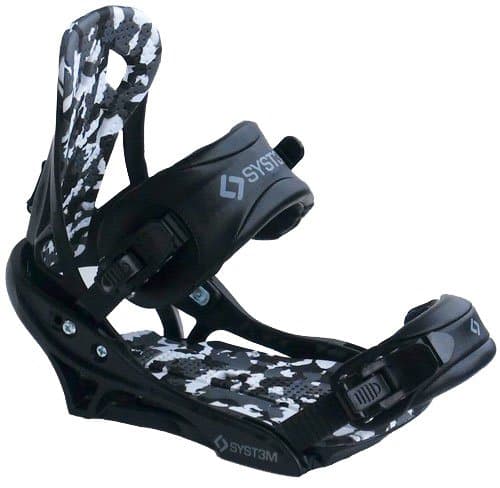
| 1 | System APX Snowboard Bindings A household where the same board gets handed between people | $4.40 a dayon snow | 5.9/10 | $119.95 - View on Amazon |
| 2 | Rossignol Soulside Snowboard Bindings (S/M) A second season, when you know your stance and want more response | $7.20 a dayon snow | 3.7/10 | $114.22 - View on Amazon |
| 3 | Rossignol Rookie Snowboard Bindings (S) A child between boot sizes 13 kids and US 4, which is most of elementary school | $14.49 a dayon snow | 0.3/10 | $79.97 - View on Amazon |
Prices last verified October 19, 2026. Prices move constantly; the figure on Amazon at the moment you click is the real one.
How a binding is actually sized
This trips people up more than anything else in snowboarding retail. A binding size is a boot size range, published by the maker, and it has nothing to do with how tall you are or how long the board is.
That means the buying order is fixed: boots, then bindings, then board. The boots roundup is the first decision and it is the only one of the three you genuinely have to try on.
A binding that is too large lets the boot move inside the straps, which puts a delay between what your ankle does and what the edge does. A binding that is too small does not close properly over the boot at all. Neither failure is subtle.
What is worth comparing
- Published boot-size range. The single most important figure, and the one a surprising number of makers decline to print.
- Ratchet material. Aluminum or plastic. Ratchets are where cheap bindings fail, usually at the worst possible moment at the top of a run.
- Highback construction. The plastic plate behind your calf. It is what transmits heelside pressure, and a padded or flex-zoned one is more comfortable on a learning day full of sitting down.
- Mounting pattern. Boards use different insert patterns. A binding whose disc does not match your board is not a binding for your board.
- Warranty. Published, or not published. The gap here is large.
The three, compared
| System APX | Rossignol Soulside | Rossignol Rookie (S) | |
|---|---|---|---|
| Published boot range | US 7-14 (Mondo 250-320) | Not published | 13 kids to US 4 |
| Sizing | One size fits most | One size, S/M | One size, toolfree adjust |
| Ratchets | Aluminum | Nylon Baselight buckles | Dual strap with ratchets |
| Highback | Padded, 15% fiberglass | Rigid center frame, flex zones | Merged with heelcup |
| Warranty | 3 years | Not published | Not published |
| Published price | $109.95 | $179.95 | $144.95 |
Read the first row before anything else. The System APX publishes a range wide enough - US 7 to 14 - that a household can share one pair of bindings between an adult and a teenager. The Soulside publishes no range at all, which means you cannot know whether it fits until it arrives.
The picks
System APX
The value pick and the one to buy. A published $109.95, aluminum ratchets, a fifteen percent fiberglass baseplate and highback, gel-padded straps, and a three-year published warranty against manufacturer defects.
The feature worth naming is the either-or toe cap: the toe strap can be positioned over the top of the toe or across the front of it. Over the top pulls the foot back into the heel cup, which is the setup that stops heel lift. Across the front is what most people are used to. Being able to choose is unusual at this price.
Its one real omission is mounting compatibility, which is not published. Check your board’s insert pattern - a four-bolt pattern is the common case and these are sold as part of boards that use it.
Rossignol Soulside
Marked as the skip above. It is a better-built binding on paper: a rigid center-frame highback with engineered flex zones for lateral movement, a one-piece 3D-molded TPU strap that wraps the boot both sideways and downwards rather than a padded ladder strap, and thermoformed EVA footbeds.
All of which is worth having on a second or third season, when you know your stance and want the board to respond faster. The stance page explains what changing a binding actually changes. But at $179.95 with no published boot range and no published warranty term, it is asking for more trust than it offers information.
Rossignol Rookie (S)
The one to buy for a child, and the reason is a single construction decision: the heelcup and highback are published as a single piece that adjusts to a different boot size without tools.
That is the whole argument for a child’s binding. The published range covers boot sizes 13 kids through US 4, which for most children is several winters. When their boots change, you move the binding in a parking lot rather than buying another one. The kids sizing page covers the board that goes under it.
The catch is the price. $144.95 is a lot for a component a child leaves behind at boot size 5, and it is more than the System APX that fits an adult. For a child who will ride four days this season, a seasonal lease is the better answer.
Flex, and why nobody publishes a number
Binding flex is usually described on a one-to-ten scale in shop copy and is almost never published by the maker as a measured figure. None of the three here states a number, and inventing one from marketing language would be inventing a number.
What you can rely on: a softer binding is more forgiving of sloppy input and more comfortable to sit in, which suits a first or second season. A stiffer binding transmits everything faster, including your mistakes. The fiberglass percentages that System publishes - fifteen percent in the baseplate and the highback - are a real construction fact, and more fiberglass means less flex, but the relationship is not a scale you can read off.
One alternative worth knowing about
Everything on this page is a strap-in binding. There is a whole other category - step-on systems, where a matched boot clips into the binding without straps - and it is a genuine trade rather than an upgrade, with a compatibility catch that is worth reading before you spend anything. That comparison has its own page.
And if you have not bought a board yet, the simplest route for a first setup is to not buy bindings separately at all. A matched package removes the compatibility question entirely, and the board roundup covers the packages worth looking at.
Every pick, with the working
Each entry shows the published inputs, the axis scores they produce, and what you give up. The order is the computed order, not a commercial one, and the arithmetic is open underneath each score.
1 · A household where the same board gets handed between people
System APX Snowboard Bindings
One size covering a published boot range of 7 to 14 is the single most useful fact about these for a family, because it means one pair survives a teenager growing three boot sizes. Aluminum ratchets and a fifteen percent fiberglass baseplate at a published $109.95.
- Published price
- $109.95
- Cost per day on snow
- $4.40 a day
- Amortized over
- 5 seasons (25 days)
- Certified to
- Not published
- Published sizes
- One size, published to fit men's boot sizes 7 to 14, Mondopoint 250 to 320
- Warranty
- System 3-year warranty against manufacturer defects
What it gets right
- One published size fits boots 7 to 14, the widest range on any binding here
- Aluminum ratchets rather than plastic, which is where cheap bindings fail first
- Three-year published warranty
- Either-or toe cap, so the toe strap can sit over the toe or across it
What you give up
- No published flex rating, only a description of the fiberglass blend
- Mounting disc compatibility is not published, so check your board's insert pattern
- One-size-fits-most is a compromise at both ends of the range
The working behind the 5.9
- Cost per day on snow: 7.9
- $109.95 over 5 seasons at 5 days each = 25 days = $4.40 a day
- Published protection: not scored
- Bindings carry no consumer-facing protective standard. A snowboard binding has no release function at all, and a ski binding release value is set by a shop rather than published by a maker.
- Size availability: not scored
- Sold in one size, so size availability does not apply.
- Warranty and support: 2.5
- 3 yr (2.5 of 6); no published crash replacement (+0); no published repair route (+0)
Axes with unpublished inputs are dropped and the remaining weights re-normalized, so a product is not punished for a manufacturer’s silence. Specifications compiled September 12, 2026 from System published specifications.
2 · A second season, when you know your stance and want more response
Rossignol Soulside Snowboard Bindings (S/M)
Skip this one. Skip unless you already know it fits your boot. Rossignol publishes what the binding is made of - a rigid center-frame highback, a one-piece molded strap, thermoformed footbeds - and does not publish a boot-size range or a warranty term anywhere on the product page. For seventy dollars more than the System APX, you are paying more and being told less about the one thing that has to be right.
A step up in construction rather than in adjustment: a rigid center-frame highback with engineered flex zones, a 3D-molded TPU strap that wraps the boot laterally and vertically, and thermoformed EVA footbeds. Rossignol publishes what it is made of and declines to publish a boot-size range or a warranty term.
- Published price
- $179.95
- Cost per day on snow
- $7.20 a day
- Amortized over
- 5 seasons (25 days)
- Certified to
- Not published
- Published sizes
- Published as one size, S/M
- Warranty
- No term published on the product page
What it gets right
- MainFrame highback with a rigid center frame and published flex zones for lateral movement
- One-piece 3D-molded TPU strap rather than a padded ladder strap
- Thermoformed EVA footbed published
What you give up
- No published boot-size range, which is the one number you need before buying
- No published warranty term at all
- Seventy dollars more than the System APX with less published fit information
The working behind the 3.7
- Cost per day on snow: 5.8
- $179.95 over 5 seasons at 5 days each = 25 days = $7.20 a day
- Published protection: not scored
- Bindings carry no consumer-facing protective standard. A snowboard binding has no release function at all, and a ski binding release value is set by a shop rather than published by a maker.
- Size availability: not scored
- Sold in one size, so size availability does not apply.
- Warranty and support: 0.0
- no published term (0 of 6); no published crash replacement (+0); no published repair route (+0)
Axes with unpublished inputs are dropped and the remaining weights re-normalized, so a product is not punished for a manufacturer’s silence. Specifications compiled September 12, 2026 from Rossignol published specifications.
3 · A child between boot sizes 13 kids and US 4, which is most of elementary school
Rossignol Rookie Snowboard Bindings (S)
The heelcup and highback are published as a single piece that adjusts to a new boot size without tools, which on a child's binding is the whole argument. A growing foot does not need a new binding, it needs this one moved, and that is a job for a parent in a parking lot rather than a shop.
- Published price
- $144.95
- Cost per day on snow
- $14.49 a day
- Amortized over
- 2 seasons (10 days)
- Certified to
- Not published
- Published sizes
- One size, published to fit boot sizes 13 kids to US 4
- Warranty
- No term published on the product page
What it gets right
- Toolfree boot-size adjustment published, because the heelcup and highback are one piece
- Published boot range of 13 kids to US 4, which is several seasons of growth
- Classic two-strap layout with ratchets, so it works exactly like an adult binding
What you give up
- No published warranty term
- $144.95 is a lot for a binding a child will outgrow at US 5
- No published flex rating or mounting compatibility
The working behind the 0.3
- Cost per day on snow: 0.4
- $144.95 over 2 seasons at 5 days each = 10 days = $14.49 a day
- Published protection: not scored
- Bindings carry no consumer-facing protective standard. A snowboard binding has no release function at all, and a ski binding release value is set by a shop rather than published by a maker.
- Size availability: not scored
- Sold in one size, so size availability does not apply.
- Warranty and support: 0.0
- no published term (0 of 6); no published crash replacement (+0); no published repair route (+0)
Axes with unpublished inputs are dropped and the remaining weights re-normalized, so a product is not punished for a manufacturer’s silence. Specifications compiled September 12, 2026 from Rossignol published specifications.
Prices last verified October 19, 2026. Prices move constantly; the figure on Amazon at the moment you click is the real one.
Questions people actually ask
How do I know what size snowboard bindings I need?
From your boot size, not your height or your board length. Every maker worth buying from publishes a boot-size range per binding size - the System APX here publishes US 7 to 14, Mondopoint 250 to 320. If a binding does not publish a boot range anywhere, you cannot size it before it arrives.
Do snowboard bindings need to match the board brand?
No, but the mounting pattern has to match. Boards use different insert patterns and bindings ship with discs to suit; check the board’s pattern against the binding before buying. A matched package removes the question completely, which is why it is the usual advice for a first setup.
What flex snowboard binding should a beginner buy?
Soft to medium. A softer binding forgives imprecise input and is more comfortable on a day that involves a lot of sitting in the snow. No maker here publishes a numeric flex rating, so treat specific numbers on retail sites as somebody else’s opinion rather than a specification.
Are expensive snowboard bindings worth it?
For a first or second season, no. The expensive binding on this page publishes better construction and less fit information than the cheap one, and construction is the thing that matters least while you are still learning to link turns. Spend the difference on boots, which is where fit actually changes how you ride.
Can kids' snowboard bindings be adjusted as they grow?
Some can. The Rossignol Rookie here publishes a merged heelcup and highback that adjusts to a different boot size without tools, over a published range of boot size 13 kids to US 4. That is several winters from one binding, which is the only way a child’s binding makes financial sense.