Snowboard bindings, explained without the marketing
Bindings are sized off your boot, not your board, and a beginner needs a soft one. Almost everything else in the category is detail.
By Sawyer V. · Published
We have not tested this gear. Everything below is compiled from published specifications and published safety standards, and the arithmetic is public so you can check it. This page carries affiliate links: if you buy through one we earn a commission at no extra cost to you, and it does not change the order of the picks. Full disclosure.
The short answer
Snowboard bindings are sized off your boot, not your height or your board, and most makers publish a boot-size range per binding size. Beginners want a soft to medium flex, which is more forgiving of the mistakes everyone makes in week one. A complete package board with bindings already mounted removes the entire compatibility question, which is why we recommend one for a first setup.
| # | Pick | Best for | Score | Price |
|---|---|---|---|---|
| 1 | System MTN CRCX snowboard package A household buying more than one board | Not publishedon snow | 4.3/10 | $489.95 - View on Amazon |
| 2 | Camp Seven Redwood snowboard with APX bindings A first snowboard for an adult who has had a couple of lessons | $11.60 a dayon snow | 3.0/10 | $409.95 - View on Amazon |
Prices last verified October 19, 2026. Prices move constantly; the figure on Amazon at the moment you click is the real one.
What a binding actually does
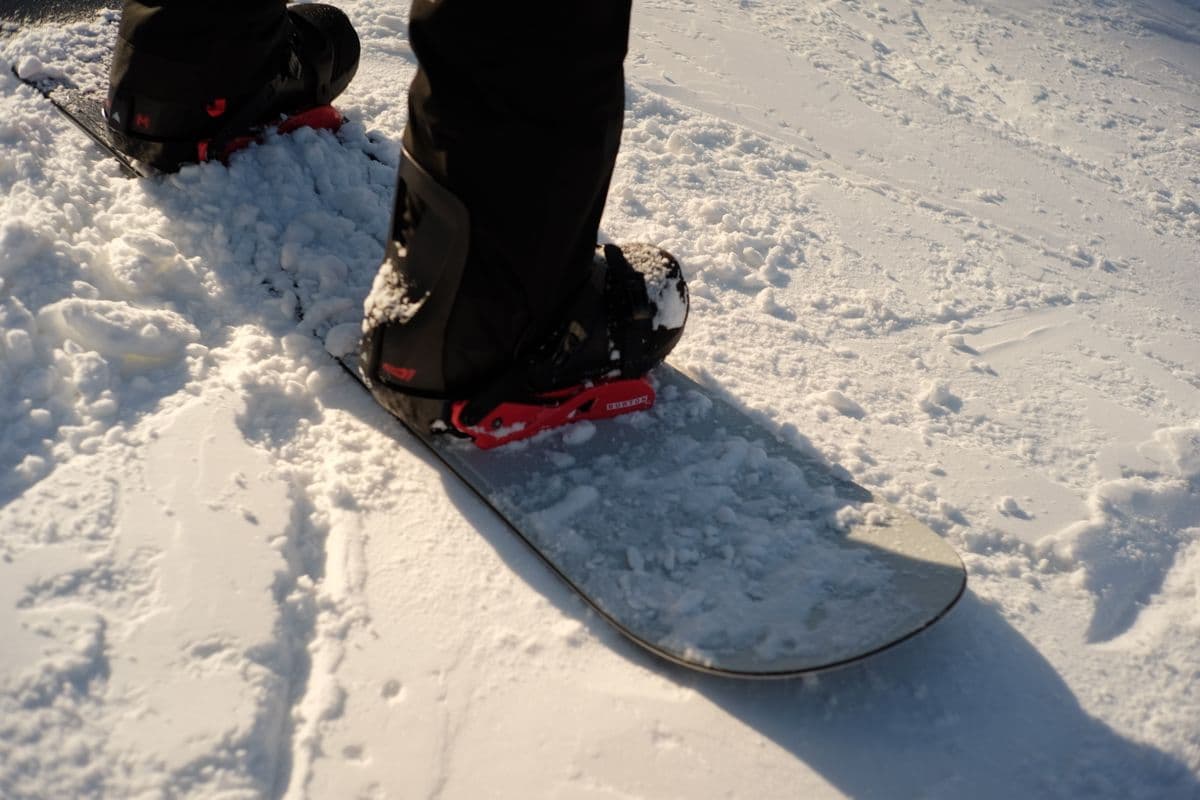
A snowboard binding is a plastic or composite baseplate with a highback and two straps that holds your boot rigidly to the board. There is no release mechanism and there is not meant to be: unlike a ski binding, a snowboard binding does not let go in a fall, because both feet are on one board and a released foot would be far more dangerous than a held one.
That single difference has a useful consequence. A ski binding is a life-safety device that must be set on a calibrated jig by a shop, and we say so on every page that touches ski setup. A snowboard binding is a mechanical connection you can and should set up yourself with a screwdriver, and getting it right is genuinely within a beginner in twenty minutes.
Sizing: it is a boot-size question
Binding sizes are published as ranges of boot size, usually as S, M and L with a stated span such as US men’s 5-8, 8-10 and 10+. The exact spans differ by brand, so read the maker’s own published range rather than assuming your letter carries across.
- Too small and the boot will not seat in the heel cup, the straps will not close over the instep, and the toe hangs off the front of the baseplate.
- Too large and the boot moves inside the binding. Every input you make with your legs gets absorbed by that movement before it reaches the board, and the board feels vague and slow to respond.
- Right and the boot sits centered in the baseplate with the heel pushed back into the cup, the straps close comfortably in the middle of their adjustment range rather than at either extreme, and there is no side-to-side play when you rock the boot.
Flex: soft is correct for a first season
Binding flex is usually published on a one-to-ten scale, and like snowboard boot flex it has no cross-brand standard. Treat it as a within-brand ranking.
| Flex | Feels like | Who it suits |
|---|---|---|
| 1 - 3, soft | Forgiving, easy to move around in | Beginners, park riders |
| 4 - 6, medium | Responsive without punishing mistakes | Improving all-mountain riders |
| 7 - 10, stiff | Immediate response, unforgiving | Fast, aggressive and heavier riders |
A stiff binding transmits every input instantly, including the wrong ones. In week one nearly all of your inputs are the wrong ones, so a soft binding gives you the room to make a mistake and recover from it. A softer setup is also physically less tiring, which matters more than most people expect on day three.
Match the binding flex roughly to the board and the boot. A soft board with stiff bindings and stiff boots fights itself, and this is the most common mismatch in a mixed second-hand setup.
Mounting patterns, and why a package sidesteps all of this
Boards use different insert patterns: a four-hole pattern, a two-by-four pattern, or a channel system that takes a sliding disc. Bindings ship with discs for the common ones, and buying a binding whose disc does not match your board is a genuinely annoying way to lose a day.
This is the main practical argument for a complete package. Both boards we cover are sold as packages with bindings included and matched: one publishes eight lengths from 138 to 163 cm and the other five lengths including a wide option, and in each case the compatibility question is answered before it is asked. For a first setup that is worth more than any incremental binding feature.
Setting your stance: width, angles and setback
Width
Start with your feet roughly shoulder-width apart, which for most adults lands between 20 and 22 in measured between the centers of the bindings. Most boards have a reference stance marked in the inserts and it is a sound starting point. Wider is more stable and harder on the knees; narrower is easier to turn and less stable at speed.
Angles
Angles are the rotation of each binding, marked in degrees on the disc. Positive points toward the nose, negative toward the tail.
- Beginner all-mountain: front +15, back 0. The classic starting point. Your front foot points where you are going and your back foot sits square across the board.
- Duck stance: front +15, back -15. Symmetrical, and the right choice if you intend to ride switch or spend time in a park. Slightly harder on the back knee for some people.
- Forward: front +21, back +6. For riding one direction only, fast, on groomed runs. Not a beginner setting.
Adjust after your first day rather than agonizing before it. If your back knee aches, reduce the back angle toward zero. If turning your shoulders feels awkward, add a few degrees to the front.
Which foot goes forward
Regular means left foot forward; goofy means right foot forward. Neither is better and roughly two thirds of people ride regular. The quickest test: have someone give you a gentle push from behind while you stand relaxed, and whichever foot steps out to catch you is usually the one that wants to be in front.
Strap-in against rear-entry
Traditional two-strap bindings have an ankle strap and a toe strap and you sit down to fasten them. Rear-entry bindings have a highback that folds down so you can step in standing up. Rear-entry is faster and more convenient, especially for children who struggle to sit down and get up in deep snow. Traditional straps are more adjustable and more common, and they give a more precise fit once set.
For a family, the convenience argument is real and worth taking seriously. Fastening bindings sitting in wet snow is a job small children genuinely dislike, and it is one of the reasons a first snowboard day can go wrong for reasons that have nothing to do with snowboarding.
There is a third format now, and it is a genuine trade rather than an upgrade: step-on bindings against strap-in covers what you gain, what you give up, and the compatibility catch that matters before you spend anything.
The twenty-minute setup, in order
- Work out which foot goes forward.
- Set the bindings to the reference stance marked on the board.
- Set angles to +15 front and 0 back, or +15 and -15 for a duck stance.
- Center the boot on the baseplate, so toe and heel overhang the board edges equally. This is the step that prevents toe drag and it is the one people skip. The board width chart explains why it matters.
- Adjust the highback so it sits flush against the back of your calf.
- Tighten every screw firmly, then check them again after your first day.
Every pick, with the working
Each entry shows the published inputs, the axis scores they produce, and what you give up. The order is the computed order, not a commercial one, and the arithmetic is open underneath each score.
1 · A household buying more than one board
System MTN CRCX snowboard package
Eight published lengths from 138 to 163 cm is the widest size range in this category, which for a family means one brand can fit a twelve-year-old and a six-foot adult. The camber-rocker-camber profile is aimed squarely at not catching an edge.
- Published price
- Not published
- Cost per day on snow
- Not published
- Amortized over
- 5 seasons (25 days)
- Certified to
- Not published
- Published sizes
- 138 to 163 cm including two wide sizes
- Warranty
- No term published on the product page
System sells the MTN in several package configurations at different published prices, so no single list price applies to the item you will land on.
What it gets right
- Eight published lengths, two of them wide, which is unusually broad
- Camber-rocker-camber profile with the contact points lifted, designed to resist edge catches
- Sold as a complete package with bindings
What you give up
- No single published price: the same board appears in several package configurations
- Boots again separate
The working behind the 4.3
- Cost per day on snow: not scored
- No manufacturer-published price, so this axis is not scored.
- Published protection: not scored
- Snowboards carry no protective standard of their own.
- Size availability: 8.5
- 8 published sizes (8.5 of 8.5); no continuous adjuster published (+0); range: 138 to 163 cm including two wide sizes
- Warranty and support: 0.0
- no published term (0 of 6); no published crash replacement (+0); no published repair route (+0)
Axes with unpublished inputs are dropped and the remaining weights re-normalized, so a product is not punished for a manufacturer’s silence. Specifications compiled September 3, 2026 from System published specifications.
2 · A first snowboard for an adult who has had a couple of lessons
Camp Seven Redwood snowboard with APX bindings
Rocker in the tip and tail, which is the profile that stops a beginner catching an edge, sold with bindings for $289.95. That is roughly three days of snowboard rental for two people.
- Published price
- $289.95
- Cost per day on snow
- $11.60 a day
- Amortized over
- 5 seasons (25 days)
- Certified to
- Not published
- Published sizes
- 149, 153, 156, 158 wide and 160 cm
- Warranty
- No term published on the product page
What it gets right
- Rocker zones at tip and tail, the construction that forgives a beginner's mistakes
- Bindings included, so the board arrives ready apart from boots
- Five published lengths including a wide option
What you give up
- Boots are a separate purchase and are the part that actually needs trying on
- A twin shape is a compromise for someone who will only ever ride one direction
The working behind the 3.0
- Cost per day on snow: 2.5
- $289.95 over 5 seasons at 5 days each = 25 days = $11.60 a day
- Published protection: not scored
- Snowboards carry no protective standard of their own.
- Size availability: 6.8
- 5 published sizes (6.8 of 8.5); no continuous adjuster published (+0); range: 149, 153, 156, 158 wide and 160 cm
- Warranty and support: 0.0
- no published term (0 of 6); no published crash replacement (+0); no published repair route (+0)
Axes with unpublished inputs are dropped and the remaining weights re-normalized, so a product is not punished for a manufacturer’s silence. Specifications compiled September 3, 2026 from Camp Seven published specifications.
Prices last verified October 19, 2026. Prices move constantly; the figure on Amazon at the moment you click is the real one.
Questions people actually ask
What size snowboard bindings do I need?
Bindings are sized off your boot, not your height or your board. Makers publish a boot-size range for each binding size, and those ranges differ by brand, so read the specific maker’s published range. Buy boots first and size the bindings around them.
Do snowboard bindings release like ski bindings?
No, and they are not meant to. Both feet are attached to one board, so a released foot would be more dangerous than a held one. That is also why binding setup is a job you can do yourself with a screwdriver, unlike ski bindings, which must be set by a shop.
What stance angles should a beginner use?
Front foot +15 degrees and back foot 0 is the standard starting point, or +15 and -15 for a duck stance if you plan to ride switch. Set the width at roughly shoulder width, which is usually the reference stance marked on the board, and adjust after your first day.
Should beginners get soft or stiff bindings?
Soft to medium. A stiff binding transmits every input instantly, and in a first season most of your inputs are mistakes. A softer binding gives you room to recover and is less tiring by day three.
Are complete snowboard packages with bindings any good?
For a first setup, yes. The board, bindings and mounting pattern are matched before you buy, which removes the compatibility question entirely, and the published price for a complete package is often close to the price of bindings alone bought separately.