Women's ski base layers, ranked on the number that predicts warmth
Base layers are sold with adjectives: lightweight, midweight, expedition. The useful figure is grams per square meter, and only some brands publish it.
By Sawyer V. · Published
We have not tested this gear. Everything below is compiled from published specifications and published safety standards, and the arithmetic is public so you can check it. This page carries affiliate links: if you buy through one we earn a commission at no extra cost to you, and it does not change the order of the picks. Full disclosure.
The short answer
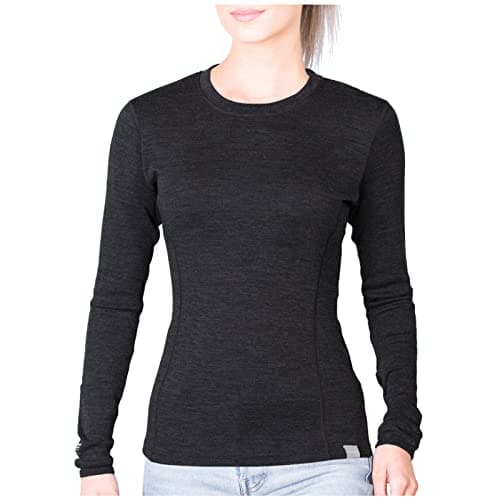
Buy the MERIWOOL Women’s Merino 250. It is the only top here that publishes the figure that actually predicts warmth - 250 g/m2, in a 100% merino interlock knit at 18.5 micron, in six sizes XS to XXL - and 250 is the ski weight: warm on a chairlift, not stifling on the way down. The Smartwool Classic All-Season is the one to buy if it will be worn every weekend for years: Core Spun merino wrapped around a nylon core, with raglan sleeves and no shoulder seam - but no published fabric weight. The MERIWOOL 400 is for sub-freezing chairlift days and carries this page’s skip note. Rough guide: 150-180 g/m2 above 30F, 250 for most ski days, 400 below about 15F. Prices are live; published figures as of October 17, 2026.
| # | Pick | Best for | Score | Price |
|---|---|---|---|---|
| 1 | MERIWOOL Women's Merino 250 Base Layer Long Sleeve Most women, most ski days, as the layer against the skin | $3.25 a dayon snow | 6.3/10 | $65.00 - View on Amazon |
| 2 | Smartwool Women's Classic All-Season Merino Base Layer Crew A woman who will wear it every weekend and wants it to last several seasons | $5 a dayon snow | 5.3/10 | $90.00 - View on Amazon |
| 3 | MERIWOOL Women's Merino 400 Heavyweight Base Layer January chairlifts, sub-freezing days, and anyone who is cold in a 250 | Not publishedon snow | 0.0/10 | $89.99 - View on Amazon |
Prices last verified October 19, 2026. Prices move constantly; the figure on Amazon at the moment you click is the real one.
The number the adjectives are hiding
Every base layer is sold as lightweight, midweight or expedition weight, and those words mean different things at different brands. The figure underneath them is fabric weight in grams per square meter - how much wool is in a given area of fabric - and it is the closest thing this category has to a warmth rating.
MERIWOOL puts the number in the product name: the 250 publishes 250 g/m2 and the heavyweight publishes 400 g. Smartwool does not publish a figure on the product page for its Classic All-Season, though it files the garment in its Merino 150 line.
So this page ranks on the published number first, and on construction second - which is the right order, because warmth is why you are buying a base layer and durability is why you might pay twice as much for one.
| Published weight | Suits | On a ski day |
|---|---|---|
| 150-180 g/m2 | Above about 30F, or anyone who runs hot | Spring skiing, hard-charging days, long hikes |
| 250 g/m2 | Roughly 15F to 30F | The default for most ski days in most places |
| 400 g/m2 | Below about 15F | Chairlift days in real cold, or layering for a sedentary day |
These are orientation bands, not published manufacturer claims - no maker here publishes a temperature rating for a base layer, and anybody who tells you a fabric weight converts to a precise temperature is making it up. Activity level moves these bands more than the weather does.
Why a women’s-cut page exists at all
The adult base layers roundup ranks three good tops, and none of its picks is a women’s cut. That matters more on a base layer than on almost any other garment, because a base layer only works in contact with skin: a men’s cut on a woman’s frame leaves air gaps at the waist and shoulders, and a gap is a cold spot that wicks nothing.
The site has women’s-cut pages for jackets, pants, bibs and gloves for the same reason. This is the layer underneath all of them.
Who each of these is for
- Most women, most ski days: the MERIWOOL 250. Published weight, published micron, six sizes, sixty-five dollars.
- Every weekend, for years: the Smartwool Classic All-Season. Core Spun construction is the one that survives repeated washing and a pack strap.
- Genuinely cold days and cold people: the MERIWOOL 400, with the skip note attached.
- Skip all three if your mid layer is the problem. A base layer moves sweat; a mid layer holds heat. If you are cold in a good base layer, the mid layer is the purchase.
- Skip merino entirely if the budget is tight. A synthetic base layer costs a third as much and wicks just as well - it simply holds odor, where merino does not. The base layers explainer covers the trade-off.
What this page ranks on
- 1. Published fabric weight in g/m2. The warmth proxy. Two of three publish one.
- 2. Published fiber content. 100 percent merino is warmer when damp and softer; a nylon-core blend lasts longer. Both are legitimate, and both should be stated.
- 3. Micron, where published. Under about 19 micron is the range that does not itch - MERIWOOL publishes 18.5 for the 250.
- 4. Published size run. A women’s-specific size run that stops at L is not a women’s page, it is a men’s page with a different photograph.
- 5. Seam placement. Raglan sleeves and no shoulder seam matter under a pack strap or a ski-bag shoulder.
- Not a temperature rating, because no maker here publishes one for a base layer.
The three, compared
| MERIWOOL 250 | Smartwool Classic All-Season | MERIWOOL 400 | |
|---|---|---|---|
| Published fabric weight | 250 g/m2 | Not published (Merino 150 line) | 400 g |
| Fiber content | 100% merino | Core Spun merino over a nylon core | 100% merino |
| Micron | 18.5 | Not published | Not published |
| Knit | Interlock | Not published | Not published |
| Sizes published | 6 (XS-XXL) | 5 (XS-XL) | Not published |
| Seams | Not published | Raglan sleeves, no shoulder seam | Not published |
| Maker product page | Yes | Yes | No current page |
| Warranty | Not published | Not published | Not published |
| Published price | $65 | $100 | Not published |
The picks
MERIWOOL Women’s Merino 250
The pick, because it publishes the number. MERIWOOL states 250 g/m2, 100 percent merino at 18.5 micron superfine, in an interlock knit, across six sizes from XS to XXL, at a published $65.
Two hundred and fifty is the right default for skiing. It is warm enough to sit on a chairlift in January without a jacket zipped to the chin, and thin enough that you are not soaked after three hard runs - and because it is merino, being slightly damp does not make it cold the way a wet synthetic does.
The micron figure matters as much as the weight. Merino under about 19 micron is the range that sits against skin without itching, and publishing 18.5 is a brand committing to the thing people actually complain about. Interlock knit, also published, holds its shape better than a rib knit under a pack strap.
Honest cons. 100 percent merino with no nylon core wears through faster - elbows first - than a blended fabric like the Smartwool’s. Two hundred and fifty is too warm for spring skiing or for anyone who runs hot; the 180 in MERIWOOL’s own range is the better buy there. No warranty term is published, and merino needs cold washing and flat drying, which is a real constraint on a week-long trip.
Smartwool Women’s Classic All-Season Merino Base Layer Crew
The one that lasts. Smartwool publishes Core Spun construction - merino spun around a nylon core - which addresses the exact way pure merino base layers die: thin spots at the elbows and shoulders after a season of washing.
It also publishes raglan sleeves with no shoulder seams and merrow stitching that wraps from side to front, which is a genuinely useful detail for anyone who carries a pack, a ski bag or a child’s skis over one shoulder. Five sizes, XS to XL, and Smartwool files it in its Merino 150 line.
Honest cons. No fabric weight in g/m2 is published on the product page, and no fiber percentages either - so the one axis this page ranks on is missing, which is why it sits second despite being the better-constructed garment. At a published $100 it is the dearest top here by a distance, and no warranty term is published.
MERIWOOL Women’s Merino 400, and why it carries the skip
The warm one: 100 percent merino at a published 400 g, which is a mid-layer weight worn as a base layer. On a genuinely cold day - a sub-freezing chairlift, a windy ridge, a day with more sitting than skiing - it does something the 250 cannot, and it can replace a thin mid layer rather than adding one.
It carries the skip because the commonest base-layer mistake is buying the warmest one. Overheat on the first run, sweat into the fabric, and then sit on a chairlift in wet wool: that is how people end up cold in an expensive layer. Buy it second, after the 250, for the week of the year that needs it.
One sourcing note, in the interests of being straight: MERIWOOL publishes no current product page for the women’s 400 top - its catalog carries the women’s 400 bottoms and the 180 and 250 tops - so the 400 g figure here comes from the published listing rather than from a maker spec page. Everything else about it is unpublished, including the size run and the micron.
Fit, because a base layer only works touching skin
- Snug, not tight. A base layer has to touch skin across the torso to move sweat off it. A loose one is a thin sweater.
- Long enough to stay tucked. The gap at the back when you lean forward on a chairlift is the coldest part of most ski days - which is the entire argument for bibs.
- Nothing cotton under it, ever. Cotton holds sweat against skin and stays wet all day - the what-not-to-wear page covers the rest of that list.
- Match the bottoms to the top. There is no sense in a 250 top over cotton leggings - the base layer bottoms roundup covers the other half.
- One layer, not two. Two thin base layers trap less air than one correct-weight one, and double the laundry.
Making merino last, which is most of the value
At sixty-five to a hundred dollars, how you wash it decides whether this is a one-season purchase or a five-season one.
- Wash cold, on gentle, with a mild or wool-specific detergent. Standard detergents contain enzymes that attack wool protein.
- No fabric softener, no bleach. Softener coats the fiber and kills the wicking you paid for.
- Lie flat to dry. A tumble dryer is how a 250 becomes a 250 that fits a child.
- Wash it less than you think. Merino resists odor, which is the main reason to own it - air it overnight and wear it again.
- Store it clean and sealed over summer. Moths are the other way merino dies. The washing page and end-of-season storage cover the rest of the kit.
Every pick, with the working
Each entry shows the published inputs, the axis scores they produce, and what you give up. The order is the computed order, not a commercial one, and the arithmetic is open underneath each score.
1 · Most women, most ski days, as the layer against the skin
MERIWOOL Women's Merino 250 Base Layer Long Sleeve
The pick, because it publishes the number that decides how warm a base layer is: 250 g/m2, in a 100 percent merino interlock knit at 18.5 micron. Two hundred and fifty is the ski weight - warm enough on a chairlift, thin enough not to cook you on the way down - and MERIWOOL publishes it where most brands publish adjectives.
- Published price
- $65
- Cost per day on snow
- $3.25 a day
- Amortized over
- 4 seasons (20 days)
- Certified to
- Not published
- Published sizes
- XS through XXL
- Warranty
- No term published on the product page
What it gets right
- Published 250 g/m2 fabric weight - the figure that actually predicts warmth, and the reason this is the pick
- 100 percent merino published at 18.5 micron superfine, so it is warm when damp and does not itch
- Interlock knit published, which holds its shape better than a rib knit under a pack
- Six published sizes, XS to XXL - the widest run on this page
- $65 published against $100 for the Smartwool
What you give up
- 100 percent merino with no nylon core wears through at the elbows faster than a blend
- 250 g/m2 is too warm for spring skiing or for anyone who runs hot
- No warranty term published
- Merino needs cold washing and flat drying, which is a real constraint on a trip
The working behind the 6.3
- Cost per day on snow: 8.7
- $65 over 4 seasons at 5 days each = 20 days = $3.25 a day
- Published protection: not scored
- Base layers carry no protective standard, so this axis does not apply.
- Size availability: 8.5
- 6 published sizes (8.5 of 8.5); no continuous adjuster published (+0); range: XS through XXL
- Warranty and support: 0.0
- no published term (0 of 6); no published crash replacement (+0); no published repair route (+0)
Axes with unpublished inputs are dropped and the remaining weights re-normalized, so a product is not punished for a manufacturer’s silence. Specifications compiled October 17, 2026 from MERIWOOL published Women's Merino 250 specifications.
2 · A woman who will wear it every weekend and wants it to last several seasons
Smartwool Women's Classic All-Season Merino Base Layer Crew
The one built to survive a season rather than a trip. Smartwool publishes Core Spun construction - merino spun around a nylon core - plus raglan sleeves with no shoulder seam, which is the detail that matters under a pack strap. What it does not publish is a fabric weight in g/m2, the figure this page ranks on.
- Published price
- $100
- Cost per day on snow
- $5 a day
- Amortized over
- 4 seasons (20 days)
- Certified to
- Not published
- Published sizes
- XS through XL
- Warranty
- No term published on the product page
What it gets right
- Core Spun construction published: merino wrapped around a nylon core, which is where pure merino fails first
- Raglan sleeves published with no shoulder seams, so nothing rubs under a pack strap
- Published as responsibly sourced merino, and Smartwool files it in its Merino 150 line
- Five published sizes, XS to XL
What you give up
- No fabric weight in g/m2 published on the product page, so it cannot be ranked against the MERIWOOL layers on warmth
- No fiber percentages published either
- $100 published, the dearest top on this page by a distance
- No warranty term published
The working behind the 5.3
- Cost per day on snow: 7.4
- $100 over 4 seasons at 5 days each = 20 days = $5 a day
- Published protection: not scored
- Base layers carry no protective standard, so this axis does not apply.
- Size availability: 6.8
- 5 published sizes (6.8 of 8.5); no continuous adjuster published (+0); range: XS through XL
- Warranty and support: 0.0
- no published term (0 of 6); no published crash replacement (+0); no published repair route (+0)
Axes with unpublished inputs are dropped and the remaining weights re-normalized, so a product is not punished for a manufacturer’s silence. Specifications compiled October 17, 2026 from Smartwool published Classic All-Season Crew specifications.
3 · January chairlifts, sub-freezing days, and anyone who is cold in a 250
MERIWOOL Women's Merino 400 Heavyweight Base Layer
Skip this one. Skip it unless you are genuinely cold in a 250. Four hundred grams per square meter is a mid-layer weight worn against the skin, and the commonest base-layer mistake is buying the warmest one: overheat on the first run, sweat into the layer, then freeze on the chairlift because wet fabric against skin is how you get cold. It is the right purchase for sub-freezing days spent mostly sitting on a lift, for anyone who runs genuinely cold, or as the second top for the coldest week of the year - and the wrong one for a 30F spring morning.
The cold-day layer, and the only top here heavier than the 250: 100 percent merino at a published 400 g. That is a mid-layer weight worn as a base layer, which is right for a sub-freezing day spent mostly on a chairlift and far too much for anything above about 20F.
- Published price
- Not published
- Cost per day on snow
- Not published
- Amortized over
- 4 seasons (20 days)
- Certified to
- Not published
- Published sizes
- Women's sizing per the listing
- Warranty
- No term published on the listing
MERIWOOL publishes no current product page for the women's 400 top, so no MSRP is quoted and the cost-per-day axis is not scored.
What it gets right
- Published 400 g weight, the warmest layer on this page
- 100 percent merino published, so the warmth still works when it is damp
- Warm enough to replace a thin mid-layer rather than add one
What you give up
- MERIWOOL publishes no current women's product page for this top, so the only published figures are on the listing
- 400 g under a ski jacket overheats fast on a warm day or a hard run
- No size count, micron figure or warranty published
- Bulky under a close-fitting women's jacket
The working behind the 0.0
- Cost per day on snow: not scored
- No manufacturer-published price, so this axis is not scored.
- Published protection: not scored
- Base layers carry no protective standard, so this axis does not apply.
- Size availability: not scored
- Sold in one size, so size availability does not apply.
- Warranty and support: 0.0
- no published term (0 of 6); no published crash replacement (+0); no published repair route (+0)
Axes with unpublished inputs are dropped and the remaining weights re-normalized, so a product is not punished for a manufacturer’s silence. Specifications compiled October 17, 2026 from Published MERIWOOL Women's Merino 400 heavyweight listing.
Prices last verified October 19, 2026. Prices move constantly; the figure on Amazon at the moment you click is the real one.
Questions people actually ask
What weight base layer is best for skiing?
A 250 g/m2 merino for most ski days, which is why the MERIWOOL 250 is the pick here. Lighter weights around 150-180 suit spring skiing and anyone who runs hot; 400 suits sub-freezing days with more sitting than skiing. Those bands are orientation rather than a published manufacturer rating - no brand here publishes a temperature figure for a base layer, and activity level shifts the answer more than the forecast does.
Do women need a women's-specific base layer?
It helps more here than on most garments, because a base layer only works in contact with skin. A men’s cut on a woman’s frame leaves gaps at the waist and shoulders, and a gap wicks nothing. The main base layers roundup picks men’s and unisex tops, which is exactly why this page exists.
Is merino worth it for a base layer, or is synthetic fine?
Synthetic wicks just as well and costs a third as much; merino wins on two things that matter on a multi-day trip - it keeps insulating when damp, and it resists odor, so one top covers several days. If money is tight, buy synthetic and spend the difference on a better mid layer. The base layers explainer covers the trade-off.
How tight should a ski base layer be?
Snug across the torso, with no bunching at the waist and no gaps when you lean forward. It should feel like a close t-shirt, not compression wear. If it is loose enough to hold air away from the skin, it has stopped being a base layer and started being a thin sweater.
Can you wear a base layer two days in a row?
With merino, yes - that is one of the two reasons to buy it. Air it overnight somewhere that is not the bottom of a damp ski bag and it will be fine for a second and often a third day. Synthetic base layers hold odor and will not take that treatment as well.
What do you wear under ski pants?
Base layer bottoms in the same weight family as your top, and nothing cotton. A 250 top over cotton leggings wastes the top. What to wear under ski pants covers it, and the bottoms roundup ranks the products on published weight the same way this page does.
Sources
- MERIWOOL published Women's Merino 250 specifications: 250 g/m2 interlock knit, 100% merino at 18.5 micron, Australian wool, XS-XXL
- Smartwool published Women's Classic All-Season Merino Base Layer Crew specifications: Core Spun merino over a nylon core, raglan sleeves with no shoulder seams
- Published MERIWOOL Women's Merino 400 heavyweight listing: 100% merino wool, 400 g
- MERIWOOL published Women's Merino 180 specifications, cited for the 180 g/m2 weight band in the table above