Women's ski bibs, and the inseam that decides whether one fits
Two bibs publish real numbers and they publish different ones - a waterproof rating against an insulation weight. Neither publishes both, and the inseam is what actually settles it.
By Sawyer V. · Published
We have not tested this gear. Everything below is compiled from published specifications and published safety standards, and the arithmetic is public so you can check it. This page carries affiliate links: if you buy through one we earn a commission at no extra cost to you, and it does not change the order of the picks. Full disclosure.
The short answer
Buy the bib that publishes the inseam you actually are. The Arctix Women’s Essential bib is the value answer - a published 5,000 mm ThermaLock rating, sealed seams, 85 g ThermaTech insulation published to -20F, in X-Short, Regular and Long. The Columbia Iceventure II is the warm-and-dry answer at a published $165: critically seam sealed Omni-Tech, 80 g Microtemp XF II insulation and an Omni-Heat reflective lining, in published 28, 31 and 34 in inseams. Neither publishes both a waterproof rating and an insulation weight - Arctix gives you the millimeters, Columbia gives you the grams. Published figures as of October 7, 2026.
| # | Pick | Best for | Score | Price |
|---|---|---|---|---|
| 1 | Arctix Women's Essential Insulated Bib Overalls A woman who is not a catalog inseam, which is most women | Not publishedon snow | 3.3/10 | $36.54 - View on Amazon |
| 2 | Columbia Women's Iceventure II Bib A woman who skis cold days and is not a standard inseam | $6.60 a dayon snow | 3.9/10 | $150.43 - View on Amazon |
| 3 | Arctix Women's Insulated Snow Pants A woman who is not a catalog inseam, which is most women | Not publishedon snow | 3.4/10 | $27.00 - View on Amazon |
Prices last verified October 19, 2026. Prices move constantly; the figure on Amazon at the moment you click is the real one.
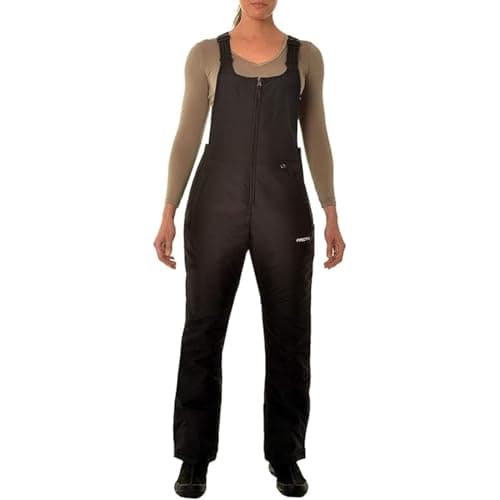
Who each of these is for, and who should skip it
- Most women, most days: the Arctix Essential bib. It publishes a waterproof number, which almost nothing in this category does, and three inseam lengths. It is also the cheapest bib on the site.
- Cold days, long or short legs, and a budget: the Columbia Iceventure II. Critically seam sealed with a published insulation weight and three published inseams in actual inches rather than labels.
- Spring skiing, or anyone who runs warm: skip both and buy a shell pant. Both of these have fixed insulation you cannot remove, and 80-85 g is too much for an April afternoon - what to change for spring.
- If the waistband gap is not your problem: buy the pant. The Arctix Women’s Insulated Snow Pant publishes the same rating and seams in four inseams, for less - which is why it carries the skip note on this page.
- If you stop for the bathroom often: think hard. A bib is a genuine nuisance in a cubicle in boots, and no amount of published waterproofing fixes that. The gap at your waist against every bathroom stop is the honest version of that trade.
What a bib actually buys you
One thing, and it is not warmth. A bib closes the gap between the top of a pant and the bottom of a jacket, which is the one place on a skier where snow reliably gets in.
That gap matters in proportion to how much time you spend sitting in snow, and for a beginner the answer is “most of the day”. It matters again in deep snow, and a third time on a chairlift, where sitting on a cold wet bench with a jacket riding up is how an otherwise fine afternoon ends early. If none of those three describes your skiing, a bib is solving a problem you do not have.
What a bib does not do is replace a layer. The published insulation weight on both of these is in the leg, not the chest panel, and the chest panel is a single layer of shell fabric - so it adds coverage, not warmth. What goes under ski pants, and what to leave at home is where the warmth actually comes from.
What this page ranks on
- 1. Published waterproof rating in millimeters. The number, where one exists. Most brands in this price band publish a trademarked name instead - what the millimeter figure means and why most brands will not print one.
- 2. Published seam treatment. “Sealed”, “critically seam sealed” or nothing. Seams are where a bib leaks first, and on a bib the seat seam is the one that matters because that is the part sitting in snow.
- 3. Published insulation weight in grams. A number you can compare. 80 g and 85 g are both midweight; a shell publishes none because it has none.
- 4. Published inseam lengths. The reason this page exists as a separate page. A bib cannot be hemmed without cutting through the boot gaiter, so the published inseam is the fit, and this is where women’s bibs differ most from men’s.
The two bibs, and the pant
| Arctix Essential bib | Columbia Iceventure II | Arctix snow pant | |
|---|---|---|---|
| Waterproof rating | 5,000 mm ThermaLock | Not published (Omni-Tech) | 5,000 mm ThermaLock |
| Seams | Sealed | Critically seam sealed | Sealed |
| Insulation | 85 g ThermaTech, to -20F | 80 g Microtemp XF II | Published ThermaTech |
| Reflective lining | Not published | Omni-Heat reflective | Not published |
| Published inseams | X-Short, Regular, Long | 28, 31 and 34 in | Four inseams |
| Bib or pant | Bib | Bib | Pant |
| Side gussets | Elasticized, published | Not published | Not published |
| Warranty | Satisfaction guarantee, no term | Not published | Satisfaction guarantee, no term |
| Maker's published price | Varies by inseam and colorway | $165 | Varies by inseam and colorway |
The row to read twice is the first two taken together. Arctix publishes a millimeter rating and “sealed” seams. Columbia publishes no millimeter rating and critically seam sealed construction. Those are not the same claim measured two ways - they are two different claims, and there is no honest way to rank one above the other on published information. What you can say is that Columbia is telling you about the construction and Arctix is telling you about the fabric.
The picks
Arctix Women’s Essential Insulated Bib Overalls
The value answer and the one most people should buy. Arctix publishes a 5,000 mm ThermaLock rating - the only waterproof number in this category we could find - alongside sealed seams, 85 g ThermaTech insulation published to -20F, elasticized side gussets, adjustable suspenders and three published inseams in X-Short, Regular and Long.
The side gussets are the detail worth noticing. A bib over a base layer and a mid layer is a tube with no give in it, and an elasticized panel at the waist is what stops it feeling like a corset by lunch. Arctix publishes them; nothing else here does.
Honest cons. 5,000 mm ThermaLock is a coating rather than a membrane, and a coating wears where fabric rubs - the inner thighs and the seat, which on a bib are exactly where it matters. An all-day wet-snow spring day will eventually find it. Arctix publishes no single MSRP because it lists per inseam and colorway, so the cost-per-day arithmetic cannot run in advance. And there is no published warranty term, only a general satisfaction guarantee.
Columbia Women’s Iceventure II Bib
The cold-day bib, and the best-constructed garment on this page. Columbia publishes an Omni-Tech Plain Weave 2L polyester shell that is critically seam sealed, 80 g Microtemp XF II insulation (published as 85% recycled polyester, 15% polyester), an Omni-Heat reflective lining, and three published inseams at 28.0 in short, 31.0 in regular and 34.0 in long, at a published $165.
Two published specifications are doing real work here. Critically seam sealed means the seams under load - seat, crotch, knees - are taped, which is a construction claim rather than a fabric one, and it addresses the exact failure a bib buyer is paying to avoid. And the Omni-Heat reflective lining - the silver dot pattern - adds warmth by reflecting body heat rather than by adding insulation weight, which is why 80 g here behaves like more than 85 g somewhere else.
The published inseams in inches, rather than as labels, are the practical reason to choose this over the Arctix if you are not a standard length. “X-Short” is a label; 28.0 in is a measurement you can check against a pair of trousers you already own.
Honest cons. No waterproof rating in millimeters published, which is Columbia’s habit across its whole range and means it cannot be compared with the Arctix on that axis at all. $165 published is roughly four times what the Arctix bib sells for. The 80 g of insulation is fixed and not removable, so it is too warm for a spring afternoon. And no warranty term is published.
Arctix Women’s Insulated Snow Pants, and why they are here
Because on this page the honest competitor to a bib is not another bib. The Arctix women’s pant publishes the same 5,000 mm ThermaLock rating, the same sealed seams and the same ThermaTech insulation as the bib above, in four published inseams, for less money.
So the question is not “which bib” - it is “do I need a bib at all”. Buy the bib if you are learning, ski powder, or have had snow up your back on a lift. Buy the pant if you ski groomed runs upright and stop for the bathroom more than twice a day. The women’s pant roundup has the alternatives if that is the answer, and the pants-against-bibs comparison makes the case at length.
How to pick the inseam without trying it on
This is the measurement that decides whether a bib works, and it is the one nobody takes.
- Measure the inseam of trousers that already fit - flat on the floor, crotch seam to hem - rather than measuring your leg. Published bib inseams are garment measurements, so compare like with like.
- Then subtract nothing. A ski bib is meant to end at the top of the boot with the gaiter over it, which is roughly where a normal trouser hem sits. Buying long “to cover the boot” puts the hem under your heel.
- Check the rise against your torso, not your legs. The commonest women’s bib fit failure is a chest panel built for a longer torso, which pulls the crotch down and makes the whole garment feel a size too big. If the shoulders need the suspenders at their shortest, the bib is too long in the body.
- Try it on over the layers you will ski in. A base layer and a mid layer is roughly a size of bulk at the waist - the layer everyone gets wrong.
- Sit down in it, in boots if you have them. Bibs fail sitting, not standing, and the chair in your kitchen tells you most of what a chairlift will.
Keeping the waterproofing working
A bib is the garment on this site most likely to be written off by neglect rather than by wear, because the seat takes everything.
- Wash it, and wash it properly. Body oils and sunscreen on the face fabric stop water beading, and a dirty bib wets out faster than a worn one - how to wash ski clothing, and why not washing it is worse.
- Dry it hanging, not on a radiator. The overnight method that costs nothing.
- Expect the seat and inner thigh to go first. Both are coatings under abrasion. A wet patch there after two seasons is normal, and re-proofing helps.
- Fix small tears early. Fixing a tear without ruining the garment.
- Check the boot gaiter grippers each season. That elastic is what keeps snow out at the ankle, and it is the first thing to perish.
Every pick, with the working
Each entry shows the published inputs, the axis scores they produce, and what you give up. The order is the computed order, not a commercial one, and the arithmetic is open underneath each score.
1 · A woman who is not a catalog inseam, which is most women
Arctix Women's Essential Insulated Bib Overalls
The only bib here that publishes an actual waterproof number, 5,000 mm, alongside sealed seams and three inseam lengths. Three inseams on a women's bib is a rarer thing than it should be, and it is the difference between a garment that fits and one that bunches over the boot.
- Published price
- Not published
- Cost per day on snow
- Not published
- Amortized over
- 5 seasons (25 days)
- Certified to
- Not published
- Waterproof rating
- 5,000 mm
- Published sizes
- Published in X-Short, Regular and Long inseams
- Warranty
- No term published; Arctix states a satisfaction guarantee
Arctix lists this across three inseam lengths and several colorways rather than publishing one MSRP, so the cost-per-day axis is not scored.
What it gets right
- Publishes a 5,000 mm ThermaLock rating, which almost nothing else in this category states
- Sealed seams and 85 g ThermaTech insulation, published to -20F
- Three published inseam lengths plus adjustable suspenders
- Elasticized side gussets published, which is what makes a bib bearable over a base layer
What you give up
- 5,000 mm is a coating rather than a membrane, and all-day wet snow will eventually find it
- No single published price
- No published warranty term beyond a general satisfaction guarantee
The working behind the 3.3
- Cost per day on snow: not scored
- No manufacturer-published price, so this axis is not scored.
- Published protection: 4.7
- 5,000mm waterproof rating (0.7 of 6); fully sealed seams published (+2); insulation or shell construction published (+2)
- Size availability: 4.9
- 3 published sizes (3.4 of 8.5); continuous in-size adjuster published (+1.5); range: Published in X-Short, Regular and Long inseams
- Warranty and support: 0.0
- no published term (0 of 6); no published crash replacement (+0); no published repair route (+0)
Axes with unpublished inputs are dropped and the remaining weights re-normalized, so a product is not punished for a manufacturer’s silence. Specifications compiled September 12, 2026 from Arctix published specifications.
2 · A woman who skis cold days and is not a standard inseam
Columbia Women's Iceventure II Bib
The only bib in this ledger published as critically seam sealed, and the only one with a published insulation weight and a published inseam for three different leg lengths. Columbia states an Omni-Tech 2L polyester shell, 80 g Microtemp XF II insulation and an Omni-Heat reflective lining - what it does not state, as usual for Columbia, is a waterproof rating in millimeters.
- Published price
- $165
- Cost per day on snow
- $6.60 a day
- Amortized over
- 5 seasons (25 days)
- Certified to
- Not published
- Waterproof rating
- Not published
- Published sizes
- Three published inseams: 28.0 in short, 31.0 in regular, 34.0 in long
- Warranty
- No term published on the product page
What it gets right
- Omni-Tech critically seam sealed published, which is the construction detail that decides whether a bib leaks where you sit
- 80 g Microtemp XF II insulation published as a weight, so it can be compared numerically
- Three published inseams (28, 31 and 34 in), so leg length is a choice rather than a compromise
- Omni-Heat reflective lining published, which adds warmth without adding insulation weight
What you give up
- No waterproof rating in millimeters published, so it cannot be compared with the Arctix bibs on that axis
- $165 published is roughly four times the Arctix women's bib
- 80 g of insulation is fixed and not removable, which is too warm for a spring afternoon
- No published warranty term
The working behind the 3.9
- Cost per day on snow: 6.2
- $165 over 5 seasons at 5 days each = 25 days = $6.60 a day
- Published protection: 4.0
- no published waterproof rating (0 of 6); fully sealed seams published (+2); insulation or shell construction published (+2)
- Size availability: 3.4
- 3 published sizes (3.4 of 8.5); no continuous adjuster published (+0); range: Three published inseams: 28.0 in short, 31.0 in regular, 34.0 in long
- Warranty and support: 0.0
- no published term (0 of 6); no published crash replacement (+0); no published repair route (+0)
Axes with unpublished inputs are dropped and the remaining weights re-normalized, so a product is not punished for a manufacturer’s silence. Specifications compiled October 7, 2026 from Columbia published Iceventure II Bib specifications.
3 · A woman who is not a catalog inseam, which is most women
Arctix Women's Insulated Snow Pants
Skip this one. Not a bib at all, and on this page deliberately. It publishes the same 5,000 mm ThermaLock rating and the same sealed seams as the Arctix bib, in four inseams, for less money - so if the waistband gap is not your problem, the pant is the better buy and the bib is a nuisance you are paying extra for. Buy the bib if you sit in snow, ski deep days, or have ever had snow go up your back on a chairlift. Buy the pant if you have not.
Publishes a 5,000 mm rating, sealed seams and four inseam lengths, which together make it the most completely specified women's snow pant we could find at a family price. The inseam run is the real story: almost nothing else in this category admits that women are different heights.
- Published price
- Not published
- Cost per day on snow
- Not published
- Amortized over
- 5 seasons (25 days)
- Certified to
- Not published
- Waterproof rating
- 5,000 mm
- Published sizes
- Published in four inseam lengths: X-Short, Short, Regular and Long
- Warranty
- No term published; Arctix states a satisfaction guarantee
Arctix lists these across inseam lengths and colorways rather than publishing one MSRP, so the cost-per-day axis is not scored.
What it gets right
- Four published inseam lengths from X-Short to Long, which is unusual at any price
- Publishes a 5,000 mm ThermaLock rating, above the 3,000 mm on the men's Arctix pant
- Sealed seams published rather than critical-seams-only
- 85 g ThermaTech insulation and 600-denier ballistic nylon reinforcement at the ankles, where ski edges do their damage
- Boot gaiters published, which is what keeps snow out of the top of a boot
What you give up
- 5,000 mm is a coating rather than a membrane, and prolonged wet snow will eventually find it
- No single published price, so cost per day cannot be computed in advance
- No published warranty term beyond a general satisfaction guarantee
The working behind the 3.4
- Cost per day on snow: not scored
- No manufacturer-published price, so this axis is not scored.
- Published protection: 4.7
- 5,000mm waterproof rating (0.7 of 6); fully sealed seams published (+2); insulation or shell construction published (+2)
- Size availability: 5.1
- 4 published sizes (5.1 of 8.5); no continuous adjuster published (+0); range: Published in four inseam lengths: X-Short, Short, Regular and Long
- Warranty and support: 0.0
- no published term (0 of 6); no published crash replacement (+0); no published repair route (+0)
Axes with unpublished inputs are dropped and the remaining weights re-normalized, so a product is not punished for a manufacturer’s silence. Specifications compiled September 9, 2026 from Arctix published specifications.
Prices last verified October 19, 2026. Prices move constantly; the figure on Amazon at the moment you click is the real one.
Questions people actually ask
Are ski bibs better than ski pants for women?
Better for three specific situations and worse otherwise. A bib closes the waistband gap, which matters if you are learning and sitting in snow, skiing deep snow, or riding chairlifts with a jacket that rides up. Against that, a bib is a real nuisance at a bathroom stop, and the Arctix women’s pant publishes the same 5,000 mm rating and sealed seams for less money. Buy the bib for the gap; otherwise buy the pant.
What waterproof rating do I need in a ski bib?
5,000 mm is enough for groomed resort skiing in normal conditions, and it is what the Arctix women’s bib publishes. Above about 10,000 mm you are buying for wet coastal snow or all-day sitting. Note that most brands in this price band publish no millimeter figure at all - Columbia publishes Omni-Tech and critically sealed seams instead, which is a construction claim rather than a fabric one.
How do I choose the right inseam for a ski bib?
Measure the inseam of trousers that already fit you - crotch seam to hem, laid flat - and match that number, because published bib inseams are garment measurements. Do not size long to cover the boot: a ski bib is meant to end at the boot top with the gaiter over it. Columbia publishes 28, 31 and 34 in; Arctix publishes X-Short, Regular and Long.
How much insulation should a women's ski bib have?
80 to 85 g is midweight and right for most winter resort days, which is what both bibs here publish. It is too warm for spring, and neither one lets you remove it, so if you ski mostly in March and April a shell bib or pant is the better buy. Remember the insulation is in the legs: the chest panel is a single layer of shell, so a bib adds coverage rather than core warmth.
Can you wear a regular bib or overall for skiing?
No. A work or fashion overall has no waterproof coating, no sealed seams and no boot gaiter, so snow gets in at the ankle and wet gets through at the seat - which is the one place you cannot afford either. The published waterproof rating and the sealed seat seam are the whole reason a ski bib costs what it costs.
Do ski bibs run large?
They fit over layers, so they are cut roomy by design - which is not the same as running large. The usual women’s fit failure is the torso rather than the waist: a chest panel built for a longer body pulls the crotch down and makes the whole bib feel oversized. If the suspenders are at their shortest setting and it still sags, the bib is too long in the body rather than too big overall.
Sources
- Arctix published Women's Essential Insulated Bib Overalls specifications: 5,000 mm ThermaLock, sealed seams, 85 g ThermaTech to -20F, three inseams, elasticized side gussets
- Columbia published Women's Iceventure II Bib specifications: Omni-Tech Plain Weave 2L critically seam sealed, 80 g Microtemp XF II insulation, Omni-Heat reflective lining, 28.0 in short / 31.0 in regular / 34.0 in long inseams
- Arctix published Women's Essential Snow Pant specifications: 5,000 mm ThermaLock, sealed seams, ThermaTech insulation, four inseams