Ski base layer bottoms, ranked by the gram weight on the label
Three merino weights, three published numbers: 165, 250 and 320 g/m2. That figure is the whole decision, and most people buy a heavier one than they need.
By Sawyer V. · Published
We have not tested this gear. Everything below is compiled from published specifications and published safety standards, and the arithmetic is public so you can check it. This page carries affiliate links: if you buy through one we earn a commission at no extra cost to you, and it does not change the order of the picks. Full disclosure.
The short answer
Buy the lightest weight you can, not the warmest. A base layer's job is to move sweat off your skin - the warmth is the mid layer's job - so 165 g/m2 merino is the right default for a normal resort day and the cheapest option here. Step up to Smartwool's Merino 250 if you ski cold days or already own a matching 250 top, and treat 320 g/m2 as a standing-still-in-real-cold layer rather than a ski one. All three publish a gram weight, which in this category is rarer than it should be and is the only number that compares one against another. Never cotton. Prices below are live; published figures as of October 11, 2026.
| # | Pick | Best for | Score | Price |
|---|---|---|---|---|
| 1 | 100% Merino Wool Base Layer Bottoms, 165 g/m2 The default base layer bottom for a normal resort day | Not publishedon snow | 0.0/10 | $44.99 - View on Amazon |
| 2 | Smartwool Merino 250 Base Layer Bottoms Cold days, and anyone who already owns and likes a 250-weight top | Not publishedon snow | 0.0/10 | $125.00 - View on Amazon |
| 3 | 100% Merino Wool Base Layer Bottoms, 320 g/m2 Genuinely cold days, and standing still at the bottom of a learning slope | Not publishedon snow | 0.0/10 | $58.49 - View on Amazon |
Prices last verified October 19, 2026. Prices move constantly; the figure on Amazon at the moment you click is the real one.
Why gram weight is the only number that matters
Base layers are sold on adjectives - thermal, midweight, performance - and almost none of that is comparable. A gram weight is: g/m2 is the mass of a square meter of the fabric, so a 320 is roughly twice the fabric of a 165, and two garments with the same figure are genuinely comparable regardless of brand.
It is the same axis our base layer roundup ranks tops on, and the reason that page exists in the shape it does. This page is the bottom half of the same wardrobe, and it was missing: the tops roundup carries four crew-neck tops and no bottoms at all.
| Published weight | Right for | On a ski day |
|---|---|---|
| 150-170 g/m2 | 30F and up, and anyone who runs warm | The default. Moves sweat, adds little warmth, no bulk under a fitted pant |
| 200-250 g/m2 | 10F to 30F | The cold-day choice, and the weight to match a 250 top |
| 300 g/m2 and up | Below 10F, or standing still | Too warm for most resort days; right for a lift operator or a watching parent |
Who each of these is for, and who should skip it
- Most people, most days: the 165 g/m2. Cheapest here, lightest published weight, and the one that will not make you sweat on a moving day.
- Cold days, or matching a 250 top: the Smartwool Merino 250. The same published weight as the Smartwool top this site already ranks, so the pair is directly comparable.
- Standing still in real cold: the 320 g/m2. It carries the skip note because that is a narrower case than people think.
- Skip bottoms entirely if you run hot and ski spring. Insulated ski pants over bare legs is a legitimate choice in April - what to change for spring.
- Skip all of these for a child and buy the kids' weight instead. The kids' base layer roundup - and it points out the half everyone forgets.
What this page ranks on
- 1. Published gram weight. The entry requirement. A bottom that does not state one cannot be compared with one that does, so it is not on this page.
- 2. Published fiber content. 100% merino, a blend, or synthetic. Merino keeps insulating when damp and resists odor; synthetic dries faster and wears longer; cotton does neither and is the one genuine mistake.
- 3. Full length to the ankle. A three-quarter bottom leaves a gap at the boot cuff, which is exactly where a ski boot presses cold plastic against a shin.
- 4. What is published beyond that - which is very little. None of these states an inseam, a warranty term or a US MSRP we could read. Two of the three are Amazon-native brands with no spec page of their own. That is the honest state of this category below the Smartwool price point.
The three, compared
| 165 g/m2 | Smartwool Merino 250 | 320 g/m2 | |
|---|---|---|---|
| Published weight | 165 g/m2 | 250 g/m2 (Merino 250) | 320 g/m2 |
| Fiber | 100% merino | Merino | 100% merino |
| Right temperature band | 30F and up | 10F to 30F | Below 10F |
| Full length | Published | Published | Published |
| Matches a top in this ledger | No | Yes, the Smartwool 250 crew | No |
| Inseam published | Not published | Not published | Not published |
| Warranty | Not published | Not published | Not published |
| Maker spec page reachable | No | No | No |
| Relative price | Lowest | Highest by a large margin | Middle |
The interesting row is the second-to-last. The dearest item here is the one from the brand with a real reputation, and it is the only one whose weight you can match against a top this site already ranks - but none of the three publishes a reachable spec page, a warranty or an inseam. You are paying the Smartwool premium for the brand and the matched weight, not for more published information.
The picks
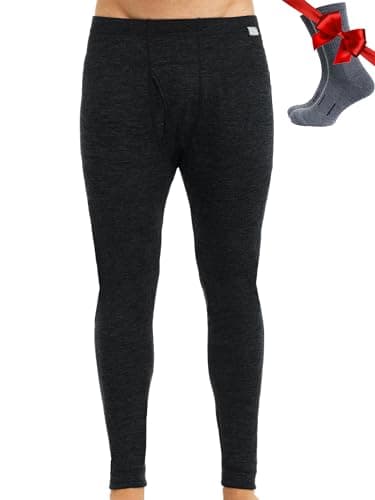
100% Merino Wool Base Layer Bottoms, 165 g/m2
The pick, and the one most people should actually buy. Published as 100% merino at 165 g/m2 - the lightest comparable weight here - in a full-length bottom, from the same line that also publishes a 320.
The case for buying light is the one thing this category gets backwards. You are wearing an insulated or shell ski pant over the top, and you are moving: the base layer is not the garment keeping you warm, it is the garment keeping you dry. A heavy base layer under a ski pant makes you sweat on the first climb to the lift queue, and then that moisture is what makes you cold sitting on the chair. Light merino moves it out; heavy merino holds it.
At this price it is also the practical answer to the actual problem most first-timers have, which is skiing in cotton leggings or jeans - what not to wear skiing, and what to wear instead. Getting somebody out of cotton matters far more than which merino weight they land on.
Honest cons. Too light on its own for a genuinely cold day without a real mid layer above. An Amazon-native brand with no reachable spec page, no warranty term and no MSRP. Light merino wears through at the heel and seat faster than heavier weights or a synthetic blend. And no inseam or fit detail is published.
Smartwool Merino 250 Base Layer Bottoms
The cold-day pick, and the only one here from a brand this site already ranks on the top half. Published as Merino 250 - the same 250 g/m2 figure our base layer roundup uses to compare fabrics - in a full-length bottom.
The genuine argument for it, beyond the badge: a matched set. If you own the Smartwool Classic Thermal Merino crew that the tops roundup ranks, a 250 bottom gives you a layer whose behavior you already know rather than a guess. That is worth something on a trip where you cannot try things.
It is also, by a wide margin, the most expensive item on this page - several times the 165. Smartwool publishes the weight and essentially nothing else we could read: no inseam, no warranty term, no MSRP.
Honest cons. The price, which is the main one. 250 g/m2 is too warm for spring and for anyone who runs hot. Merino wears through at the heel and the seat sooner than a synthetic blend, which stings more at this price. And no fit information is published at all.
100% Merino Wool Base Layer Bottoms, 320 g/m2, and why it carries the skip
The warmest published weight here, and roughly half the Smartwool price. Published as 100% merino at 320 g/m2, from the same line as the 165 - which is what makes the pair internally comparable and is the reason both are on the page.
It carries the skip because 320 is more layer than a skiing day wants. A skier generates heat; the person who needs 320 g/m2 against the skin is the one standing still - watching a lesson from the bottom of the slope, running a lift, or skiing somewhere reliably below 10F. How cold is too cold to ski is the page for that end of the range, and the temperature table puts this weight where it belongs.
Honest cons. Too warm for most resort days and far too warm for spring. Bulky under a fitted ski pant, which affects how the pant sits over the boot. Slow to dry overnight, which matters on a multi-day trip. And the same missing information as the 165: no spec page, no warranty, no MSRP, no inseam.
What else goes under a ski pant
A base layer bottom is one of three things down there, and the other two matter more than people expect.
- One pair of ski socks, thin, over the base layer not under it. The sock goes outside the long underwear so there is no seam ridge inside the boot cuff - and the thin pair is the warm one.
- Nothing cotton, anywhere. Not the base layer, not the socks, not the underwear. What to wear under ski pants, and what to leave at home is the guide this page is the commercial half of.
- No second layer unless it is genuinely bitter. Two bottoms inside a fitted ski pant compresses the air that does the insulating and restricts circulation - the same mistake as two pairs of socks.
- And the pant itself does most of the work. Why ski pants matter more than the jacket, and whether a bib closes a gap you actually have.
Making merino last
- Wash it far less than you think. Merino resists odor; washing is what wears it out. Air it overnight and wear it again.
- Cool wash, no fabric softener, no bleach. Softener coats the fiber and kills the wicking - the washing page covers the whole kit.
- Dry flat, not on heat. Heat shrinks and felts wool, and a shrunk base layer is a dead base layer.
- Expect the heel and seat to go first. Those are the abrasion points inside a boot and against a chairlift.
- Store it clean and dry over summer. Moths find merino, which is the one storage risk a synthetic does not have - the end-of-season routine.
Every pick, with the working
Each entry shows the published inputs, the axis scores they produce, and what you give up. The order is the computed order, not a commercial one, and the arithmetic is open underneath each score.
1 · The default base layer bottom for a normal resort day
100% Merino Wool Base Layer Bottoms, 165 g/m2
The one most people should actually buy, and the lightest published weight here at 165 g/m2. A base layer's job is to move sweat off your skin, not to be the warm layer - that is the mid layer's job - so the lightest weight that still insulates damp is usually the right answer under a ski pant. At this price it is also the easiest way to stop skiing in cotton.
- Published price
- Not published
- Cost per day on snow
- Not published
- Amortized over
- 4 seasons (20 days)
- Certified to
- Not published
- Published sizes
- Published in standard men's sizes, in 165 and 320 g/m2 weights
- Warranty
- No term published on the product page
Sold across weights, sizes and colorways without a published MSRP, so the cost-per-day axis is not scored.
What it gets right
- Publishes 165 g/m2, the lightest comparable weight on this page
- Published as 100% merino, so it keeps insulating when damp
- The cheapest merino bottom here, which is what gets somebody out of cotton
- Light enough to wear under a fitted ski pant without changing the fit
What you give up
- Too light on its own for a genuinely cold day without a warm mid layer
- An Amazon-native brand with no reachable spec page, warranty term or MSRP
- Light merino wears through faster than heavier weights
- No published inseam or fit detail
The working behind the 0.0
- Cost per day on snow: not scored
- No manufacturer-published price, so this axis is not scored.
- Published protection: not scored
- Base layers carry no protective standard, so this axis does not apply.
- Size availability: not scored
- Sold in one size, so size availability does not apply.
- Warranty and support: 0.0
- no published term (0 of 6); no published crash replacement (+0); no published repair route (+0)
Axes with unpublished inputs are dropped and the remaining weights re-normalized, so a product is not punished for a manufacturer’s silence. Specifications compiled October 11, 2026 from Published 100% merino composition and 165 g/m2 weight.
2 · Cold days, and anyone who already owns and likes a 250-weight top
Smartwool Merino 250 Base Layer Bottoms
The pick, and the only bottom here from a brand this ledger already ranks on the top half. Smartwool publishes this as its Merino 250 weight - the same 250 g/m2 figure that lets our base-layer roundup compare one fabric against another - in a full-length bottom. It is also by far the dearest thing on the page, and the gram weight is the reason rather than the badge.
- Published price
- Not published
- Cost per day on snow
- Not published
- Amortized over
- 4 seasons (20 days)
- Certified to
- Not published
- Published sizes
- Published in standard men's sizes
- Warranty
- No term published on the product page
Smartwool lists this across sizes and colorways rather than publishing one MSRP we could read, so the cost-per-day axis is not scored.
What it gets right
- Published at Merino 250, the same gram weight our base-layer roundup ranks tops on - so the pair is directly comparable
- Merino keeps insulating when damp, which is the whole argument for wool against a ski boot and a chairlift
- Smartwool already appears in this ledger for a 250-weight crew and a merino balaclava
- Full-length rather than three-quarter, so there is no gap at the boot cuff
What you give up
- The most expensive bottom on this page by a large multiple
- No MSRP, no warranty term and no published inseam that we could read
- 250 weight is too warm for spring skiing and for anyone who runs hot
- Merino wears through at the heel and seat faster than a synthetic blend
The working behind the 0.0
- Cost per day on snow: not scored
- No manufacturer-published price, so this axis is not scored.
- Published protection: not scored
- Base layers carry no protective standard, so this axis does not apply.
- Size availability: not scored
- Sold in one size, so size availability does not apply.
- Warranty and support: 0.0
- no published term (0 of 6); no published crash replacement (+0); no published repair route (+0)
Axes with unpublished inputs are dropped and the remaining weights re-normalized, so a product is not punished for a manufacturer’s silence. Specifications compiled October 11, 2026 from Smartwool published Merino 250 bottoms specification.
3 · Genuinely cold days, and standing still at the bottom of a learning slope
100% Merino Wool Base Layer Bottoms, 320 g/m2
Skip this one. Skip it unless you are genuinely standing still in genuine cold. 320 g/m2 is the heaviest published weight here and it is too warm for a normal resort day, where you are moving and generating heat - and a base layer that makes you sweat is a base layer that makes you cold an hour later. Buy it if you are the parent standing at the bottom of a learning slope in January, or if you ski somewhere that is reliably below 10F. For everybody else the 165 does the job better.
The warm option, and the heaviest published weight on this page: 320 g/m2 of 100% merino, against Smartwool's 250 and the light option's 165. That is a real, comparable number from a listing that states it, which in this category is rarer than it should be. It is also roughly half the Smartwool price, and the trade is a brand with no spec page of its own.
- Published price
- Not published
- Cost per day on snow
- Not published
- Amortized over
- 4 seasons (20 days)
- Certified to
- Not published
- Published sizes
- Published in standard men's sizes, in 165 and 320 g/m2 weights
- Warranty
- No term published on the product page
Sold across weights, sizes and colorways without a published MSRP, so the cost-per-day axis is not scored.
What it gets right
- Publishes a gram weight - 320 g/m2 - which is the only figure that compares one base layer with another
- Published as 100% merino rather than a blend
- The warmest published weight on this page, at about half the Smartwool price
- Same line also publishes a 165 g/m2 weight, so the range is internally comparable
What you give up
- 320 g/m2 is too warm for most resort days and far too warm for spring
- An Amazon-native brand with no reachable spec page, warranty term or MSRP
- Heavy merino is bulky under a fitted ski pant and slow to dry overnight
- No published inseam or fit detail
The working behind the 0.0
- Cost per day on snow: not scored
- No manufacturer-published price, so this axis is not scored.
- Published protection: not scored
- Base layers carry no protective standard, so this axis does not apply.
- Size availability: not scored
- Sold in one size, so size availability does not apply.
- Warranty and support: 0.0
- no published term (0 of 6); no published crash replacement (+0); no published repair route (+0)
Axes with unpublished inputs are dropped and the remaining weights re-normalized, so a product is not punished for a manufacturer’s silence. Specifications compiled October 11, 2026 from Published 100% merino composition and 320 g/m2 weight.
Prices last verified October 19, 2026. Prices move constantly; the figure on Amazon at the moment you click is the real one.
Questions people actually ask
What weight base layer bottoms do I need for skiing?
Lighter than most people buy. 150-170 g/m2 merino is the right default for a normal resort day at 30F and up, because a base layer's job is moving sweat rather than adding warmth - that is the mid layer's job. Step up to 200-250 g/m2 for 10F to 30F, and treat 300 g/m2 and above as a standing-still layer rather than a skiing one.
Do you need base layer bottoms for skiing?
On most days yes, because insulated ski pants against bare skin get clammy and cold once you sweat. The exception is spring skiing if you run hot, where ski pants alone is a legitimate choice. What is never right is cotton leggings or jeans under ski pants - cotton holds moisture against your skin and then cools it.
Merino or synthetic base layer bottoms?
Merino keeps insulating when it is damp and resists odor across a multi-day trip, which is why all three picks here are merino. Synthetic dries faster and resists abrasion better at the heel and seat, and costs less. Either beats cotton by a wide margin; the gram weight matters more than the fiber for how warm you end up.
Should ski socks go over or under base layer bottoms?
Over. Pull the sock up outside the long underwear so there is no seam ridge inside the boot cuff, where a ski boot presses hardest. Use one thin pair - never two, and never a thick pair, because a compressed foot in a fitted boot has neither trapped air nor good circulation.
Can you wear leggings under ski pants?
Only if they are synthetic or merino athletic leggings, not cotton ones. The fabric is what matters, not the name: anything cotton holds sweat against your skin and then chills you, which is the single most common clothing mistake on a first ski trip.
Is 250 weight merino too warm for skiing?
For a 30F day with you moving, usually yes - you will sweat on the climb to the lift and then feel it on the chair. 250 is the right weight for genuinely cold days, roughly 10F to 30F, or if you already own a matching 250 top and want a set whose behavior you know. Above 300 g/m2 is a standing-still weight.