The best ski mittens, and why you cannot shop them on warmth
Every mitten is sold as warm and almost none publishes a number behind it. Here is what makers do publish, which of it you can check, and the one mitten that states its insulation weight.
By Sawyer V. · Published
We have not tested this gear. Everything below is compiled from published specifications and published safety standards, and the arithmetic is public so you can check it. This page carries affiliate links: if you buy through one we earn a commission at no extra cost to you, and it does not change the order of the picks. Full disclosure.
The short answer
Buy on the membrane, not on the word warm. Almost no mitten maker publishes an insulation weight, so "warmer" is unverifiable across brands - and none of them publishes a waterproof rating in millimeters either. What you can check is whether the membrane is certified by someone other than the brand selling it. The Gordini GTX Storm Mitt is the pick: GTX is Gore-Tex, published across 5 sizes at a published $82.99. The Black Diamond Mercury Mitt is the one whose liner comes out to dry overnight, with a goat leather palm, at a published $149.95. The North Face Montana Ski Mitt is the only mitten here that publishes an insulation weight at all - 250 g on the back of the hand, 160 g in the palm, 80 g in the gauntlet. For a child, the Gordini Junior Gore-Tex Mitt puts the same certified membrane on small hands at a published $60.99. Prices below are live; published figures as of October 14, 2026.
| # | Pick | Best for | Score | Price |
|---|---|---|---|---|
| 1 | Gordini GTX Storm Mitt One pair that has to work in rain, wet snow and spring slush | $5.53 a dayon snow | 5.1/10 | $82.99 - View on Amazon |
| 2 | Black Diamond Mercury Mitt A multi-day trip with no drying room, and anyone hard on a palm | $10.00 a dayon snow | 3.5/10 | $149.95 - View on Amazon |
| 3 | The North Face Montana Ski Mitt Anyone who wants an actual number to compare rather than a tech name | Not publishedon snow | 0.0/10 | $70.00 - View on Amazon |
| 4 | Gordini Junior Gore-Tex Mitt A child who will be making snowballs between runs, which is all of them | $12.20 a dayon snow | 2.8/10 | $60.99 - View on Amazon |
| 5 | Burton Profile Mitten A first pair of mittens, or a spare pair that lives in the car | $3.53 a dayon snow | 5.4/10 | $52.95 - View on Amazon |
| 6 | OutdoorMaster Ski Mittens Anyone whose hands get cold, which the gloves will not fix | $2.33 a dayon snow | 6.4/10 | $24.95 - View on Amazon |
Prices last verified October 19, 2026. Prices move constantly; the figure on Amazon at the moment you click is the real one.
Why you cannot rank mittens on warmth
This is the honest starting point, and it is the reason this page is organized the way it is. We read the published specifications for every mitten here, and one of six publishes an insulation weight. The rest name the insulation - Megaloft, ThermacoreECO, PrimaLoft Gold Cross Core - and stop there.
A name is not a quantity. Two mittens can both say Megaloft and have twice the fill of one another, and nothing on either page would tell you. So when a listing says a mitten is warm, or warmer, or heavily insulated, there is usually no figure underneath it that you could hold the maker to. That is not a conspiracy; gloves and mittens have simply never been sold on a spec sheet the way skis and helmets are. But it means the comparison most people try to make - which of these is warmest - cannot be answered from published data, and anyone who answers it confidently is guessing.
The same is true of waterproofing, in a different way. Not one mitten here publishes a hydrostatic rating in millimeters. Jackets and pants publish that number routinely - what the millimeter rating actually measures is worth reading if you have shopped a shell. Handwear does not. Some makers put a membrane in and name it; some put a membrane in and certify it with a third party; some say waterproof and name nothing at all.
Certified, named, or nothing: the only spec you can really check
Gore-Tex is the one membrane in handwear that is not simply the brand vouching for itself. It is a licensed material with a third-party guarantee attached, which is a meaningfully different claim from a brand coining a name for its own insert. That does not make a proprietary insert bad - DryVent and DRYRIDE and BD.dry are all real membranes doing real work - but it does mean the Gore-Tex rows are the only ones where the waterproof claim is backed by somebody other than the seller.
| Mitten | Membrane as published | Certified by a third party? |
|---|---|---|
| Gordini GTX Storm Mitt | Gore-Tex | Yes |
| Gordini Junior Gore-Tex Mitt | Gore-Tex | Yes |
| Black Diamond Mercury Mitt | BD.dry insert | No, Black Diamond's own |
| The North Face Montana Ski Mitt | DryVent insert | No, The North Face's own |
| Burton Profile Mitten | DRYRIDE Membrane 2.0 | No, Burton's own |
| OutdoorMaster Ski Mittens | None published | Nothing to certify |
Read that table as a ladder of how much of the claim you have to take on trust, not as a ranking of how dry your hands will be on a given day. A well-made proprietary membrane will keep a once-a-year skier dry through a week of ordinary conditions. The difference shows up at the bottom of the table, where there is no membrane named at all and therefore nothing to compare.
The liner question, which matters more than it sounds
Only one mitten here publishes a removable liner. That sounds like a detail and it is the single most practical difference on the page.
A mitten gets wet from the inside as much as the outside, because a hand inside a sealed insulated shell sweats and the moisture has nowhere fast to go. With a fixed lining your only option is to leave the whole mitten somewhere warm and hope. With a removable liner you pull the liner out, hang it separately, and both halves dry in a fraction of the time - which is the same principle behind pulling boot liners out at the end of the day. On a one-day trip this does not matter. On a five-day trip in a condo with no drying room, it is the difference between starting day three in a dry mitten and starting it in a cold damp one. How to dry ski gear overnight without a boot dryer covers the rest of the kit.
The picks
Gordini GTX Storm Mitt
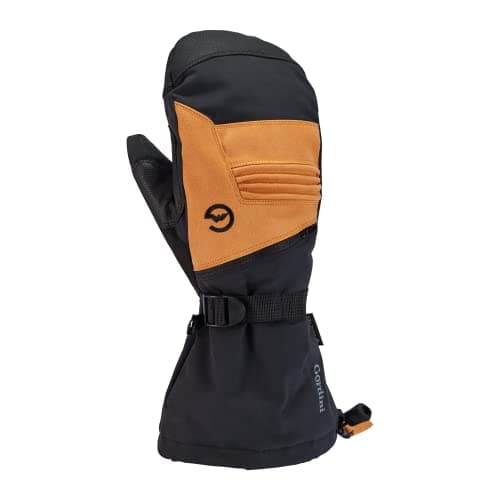
The pick, on the one criterion in this category that is checkable by somebody other than the seller. GTX is Gore-Tex, and Gordini publishes the mitt under Gore-Tex with Megaloft insulation and a Heatrap lining behind it, across 5 published sizes from S to XXL - the widest size range on this page. The published list price is $82.99, which puts it in the middle of the group rather than at the top.
What you are buying is the removal of one unknown. On every other adult mitten here except the OutdoorMaster, the question "will this actually keep water out" is answered by the brand that wants your money. On this one it is answered by a licensed third-party membrane. For a reader who skis a handful of days a year and does not want to become an expert in membrane marketing, that is the shortest path to a mitten that works.
Honest cons: Gordini publishes no insulation weight, so you cannot compare its warmth to the North Face row below even though that is the comparison you want to make. There is no waterproof rating in millimeters, because Gore-Tex is sold as a guarantee rather than a number. And there is no warranty term on the product page.
Black Diamond Mercury Mitt
The expensive one, and the only one whose liner comes out. Black Diamond publishes a BD.dry waterproof insert, a removable insulated liner filled with PrimaLoft Gold Cross Core, a four-way stretch shell, a long gauntlet cuff, and a goat leather palm with an additional reinforcement layer. The published list price is $149.95.
Two of those specifications earn the price. The removable liner is the drying advantage described above. The goat leather palm is the durability one: a leather palm with a reinforcement layer is built for repeated handling of ropes, poles and rock, and it is the part of a mitten that fails first on anybody who uses their hands. PrimaLoft Gold Cross Core is also published as insulating when wet, which is the property that matters most on the day the mitten has already lost the argument.
Honest cons: it is nearly three times the price of the Burton. BD.dry is Black Diamond’s own insert rather than a certified membrane, so on the criterion at the top of this page it ranks below a cheaper Gordini. There is no published insulation weight and no millimeter rating. And no warranty term appears on the product page.
The North Face Montana Ski Mitt
The only mitten on this page that publishes an insulation weight, and it publishes three of them: 250 g Heatseeker on the back of the hand, 160 g in the palm, 80 g in the gauntlet. Zoned figures like that tell you something real - the back of your hand faces the wind and gets the most fill, the palm is pressed against a warm pole grip and gets less, the gauntlet is over a jacket sleeve and gets least.
That is the most useful set of numbers in the category, and it is worth being clear about what it does and does not let you do. It lets you compare this mitten against other North Face handwear, and against any jacket or glove that publishes a Heatseeker figure. It does not let you compare it against the Gordini or the Black Diamond, because they publish nothing to compare it to. One maker publishing a number does not create a scale.
The retailer spec sheet also publishes a limited lifetime warranty, a faux-leather palm overlay, a WindWall gauntlet and touchscreen compatibility - which is unusual, because working a phone is normally the thing you give up when you choose mittens.
Honest cons: DryVent is The North Face’s own insert rather than a certified membrane. There is no millimeter rating. And The North Face publishes no MSRP on a page we could read, so the street price is the only price there is.
Gordini Junior Gore-Tex Mitt
The children’s pick, and a genuinely unusual product: a certified membrane in a junior mitten at a published $60.99. Gordini publishes Gore-Tex, Megaloft insulation and a moisture-wicking lining across 5 junior sizes, XS through XL.
The reason to spend this on a child is not the standard of their skiing. It is that a child puts their hands directly into snow, on purpose, repeatedly, for the entire day - building things, throwing things, falling over - and then gets back on a lift with wet hands and no way to warm them. Cold wet hands end more family ski days than cold anything else, which is the argument made at length in why your hands get cold and what actually fixes it.
Honest cons: sixty dollars is a lot for an item a growing child will outgrow in two seasons, and there is a real case for buying two cheap pairs instead of one good pair so there is always a dry set. No insulation weight is published, and no warranty term appears on the product page.
Burton Profile Mitten
The best warranty per dollar here by a wide margin. The published list price is $52.95 - the cheapest named-membrane mitten on the page - and the retailer spec sheet publishes a limited lifetime warranty with it, along with a DRYRIDE 2-layer shell and DRYRIDE Membrane 2.0, a PFC-free water-repellent finish, an extended gauntlet cuff, a removable wrist leash, and Screen Grab touchscreen panels on the thumb and palm.
There is a neat detail worth pointing out: Burton prices the Profile mitten at the same $52.95 as the Profile glove, which means the warmer of the two formats costs nothing extra. If you have already decided mittens are right for you - and the gloves-versus-mittens argument comes down to one sentence - there is no price penalty for acting on it.
Honest cons: DRYRIDE is Burton’s own membrane rather than a certified one. The brushed-microfiber lining is fixed, so there is nothing to pull out and dry. The palm is PU synthetic rather than leather. And as with everything else here, no insulation weight and no millimeter rating are published.
OutdoorMaster Ski Mittens
Marked as the skip above, and the reason is narrow rather than damning. It is roughly a third of the price of anything else on this page, it carries a published two-year warranty, and it is a real ski mitten rather than a knitted one. For a single dry-cold family trip it will get you through the day.
What it does not have is anything to check. No membrane is named, no waterproof rating is published, and no insulation weight is published, so every claim on the listing is the brand’s own word with nothing behind it. On a page built entirely on what makers publish, that puts it last. Buy it as the spare pair that lives in the car - which, per the next section, is advice worth taking seriously for any mitten.
The second pair matters more than the first
This is the recommendation we would make before any of the picks above. One good pair of mittens and one cheap pair beats one excellent pair, for a simple reason: a wet mitten cannot be dried on a mountain, and there is no specification that changes that. The second pair is what turns a soaked morning into a dry afternoon.
- For a family. One decent pair each plus one cheap spare per child. Children soak mittens first and fastest.
- For one adult, a few days a year. One certified-membrane pair and keep your old gloves in the car. The gloves are your spare.
- For a multi-day trip with no drying room. The removable-liner mitten, or two pairs. Those are the only two answers that work.
If your hands run cold regardless of what you put on them, the fix is usually not more insulation. Disposable warmers inside the mitten add heat rather than retaining it, and battery-heated mittens and gloves compare on published run time, which is one of the few numbers handwear does publish.
Sizing, cuffs and the two things that go wrong
Mittens fail in fit in two specific ways, and both are avoidable.
Too tight is colder. A mitten works by letting your fingers share a single air space and warm each other. Pack that space tight and you have removed the insulation and the mechanism at once. If you are between sizes in a mitten, size up - the opposite of the advice for a glove, where a loose finger is a cold finger. How to measure a hand and read the published charts has the method.
The cuff has to agree with your jacket. A long gauntlet cuff goes over the jacket sleeve and seals with a cinch; a short undercuff goes inside it. Either works and mixing them does not: a gauntlet under a tight jacket cuff bunches, and an undercuff over a loose sleeve lets snow straight in. Four of the mittens here publish a gauntlet or extended cuff, which is the safer default for a beginner because it works with almost any jacket.
One more thing nobody mentions until it has happened: wash them the way the maker says, and re-treat the shell when water stops beading. Washing and re-waterproofing gloves and mittens is twenty minutes a season and it is the difference between a membrane that lasts five years and one that lasts two.
The bottom line
If you want the fewest unknowns, buy the Gordini GTX Storm Mitt - the waterproof claim is the only one on this page certified by somebody other than the brand selling it. If you are going away for a week with nowhere to dry anything, buy the Black Diamond Mercury Mitt for the liner that comes out. If you want an actual number to compare, the North Face Montana is the only mitten here that gives you one. If the budget is tight, the Burton Profile Mitten brings a published lifetime warranty to the cheapest named membrane in the group. And for a child, pay for the Gordini Junior membrane or buy two cheap pairs - but do not buy one cheap pair and expect it to last the week.
Whatever you choose, the mitten is the warmer format and it is not close. Our glove picks are here if you need your fingers, and handwear sits firmly in the buy column of the buy-versus-rent arithmetic - nobody rents mittens, and you would not want the pair they handed you.
Every pick, with the working
Each entry shows the published inputs, the axis scores they produce, and what you give up. The order is the computed order, not a commercial one, and the arithmetic is open underneath each score.
1 · One pair that has to work in rain, wet snow and spring slush
Gordini GTX Storm Mitt
The only membrane here that a third party certifies rather than the maker naming it themselves: GTX is Gore-Tex, and Gore-Tex is sold on a guarantee to keep you dry rather than a number. Gordini publishes Megaloft insulation and a Heatrap lining behind it and no weight for either, which is the category norm rather than a Gordini failing.
- Published price
- $82.99
- Cost per day on snow
- $5.53 a day
- Amortized over
- 3 seasons (15 days)
- Certified to
- Not published
- Waterproof rating
- Not published
- Published sizes
- S through XXL
- Warranty
- No term published on the product page
What it gets right
- Gore-Tex membrane, which is certified by a third party rather than named by the brand that sells it
- Five published sizes, S through XXL, the widest range here
- Megaloft insulation and a Heatrap lining both published by name
What you give up
- No published insulation weight, so you cannot compare its warmth to anything
- No published waterproof rating in millimeters either, because Gore-Tex does not work that way
- No warranty term on the product page
The working behind the 5.1
- Cost per day on snow: 7.0
- $82.99 over 3 seasons at 5 days each = 15 days = $5.53 a day
- Published protection: not scored
- No waterproof rating or seam construction published.
- Size availability: 6.8
- 5 published sizes (6.8 of 8.5); no continuous adjuster published (+0); range: S through XXL
- Warranty and support: 0.0
- no published term (0 of 6); no published crash replacement (+0); no published repair route (+0)
Axes with unpublished inputs are dropped and the remaining weights re-normalized, so a product is not punished for a manufacturer’s silence. Specifications compiled October 14, 2026 from Gordini published GTX Storm Mitt specifications.
2 · A multi-day trip with no drying room, and anyone hard on a palm
Black Diamond Mercury Mitt
The only mitten here with a liner that comes out, which is the difference between a mitten that is dry tomorrow morning and one that is not. Black Diamond publishes a BD.dry insert, a goat leather palm with a reinforcement layer and a long gauntlet cuff. It is also nearly three times the price of the Burton.
- Published price
- $149.95
- Cost per day on snow
- $10.00 a day
- Amortized over
- 3 seasons (15 days)
- Certified to
- Not published
- Waterproof rating
- Not published
- Published sizes
- XS through XL
- Warranty
- No term published on the product page
What it gets right
- Removable insulated liner published, so it can be pulled out and dried overnight
- Goat leather palm with an additional reinforcement layer published
- Long gauntlet cuff published, which is what keeps spindrift out over a jacket sleeve
- PrimaLoft Gold Cross Core fill named, which is published as insulating when wet
What you give up
- The most expensive mitten here by a wide margin
- BD.dry is Black Diamond's own insert, not a third-party certified membrane
- No published insulation weight and no waterproof rating in millimeters
- No warranty term on the product page
The working behind the 3.5
- Cost per day on snow: 3.7
- $149.95 over 3 seasons at 5 days each = 15 days = $10.00 a day
- Published protection: not scored
- No waterproof rating or seam construction published.
- Size availability: 6.8
- 5 published sizes (6.8 of 8.5); no continuous adjuster published (+0); range: XS through XL
- Warranty and support: 0.0
- no published term (0 of 6); no published crash replacement (+0); no published repair route (+0)
Axes with unpublished inputs are dropped and the remaining weights re-normalized, so a product is not punished for a manufacturer’s silence. Specifications compiled October 14, 2026 from Black Diamond published Mercury Mitt specifications.
3 · Anyone who wants an actual number to compare rather than a tech name
The North Face Montana Ski Mitt
The only mitten on this page that publishes an insulation weight at all, and it publishes three: 250 g on the back of the hand, 160 g in the palm, 80 g in the gauntlet. That is the single most useful set of numbers in the category, and it is worth knowing that the waterproofing behind them is DryVent, which is The North Face's own insert rather than a certified membrane.
- Published price
- Not published
- Cost per day on snow
- Not published
- Amortized over
- 3 seasons (15 days)
- Certified to
- Not published
- Waterproof rating
- Not published
- Published sizes
- Men's S through XL on current listings
- Warranty
- Limited lifetime, per the retailer spec sheet
The North Face publishes no MSRP on a page we could read; the retailer spec sheet shows a $64.95 reference price.
What it gets right
- Published insulation weights, zoned: 250 g back of hand, 160 g palm, 80 g gauntlet
- Limited lifetime warranty published on the retailer spec sheet
- Faux-leather palm overlay and a WindWall gauntlet both published
- Published as touchscreen compatible, which most mittens are not
What you give up
- DryVent is The North Face's own insert, not a third-party certified membrane
- No published waterproof rating in millimeters
- The North Face publishes no MSRP we could read, so street price is the only price
The working behind the 0.0
- Cost per day on snow: not scored
- No manufacturer-published price, so this axis is not scored.
- Published protection: not scored
- No waterproof rating or seam construction published.
- Size availability: not scored
- Sold in one size, so size availability does not apply.
- Warranty and support: 0.0
- no published term (0 of 6); no published crash replacement (+0); no published repair route (+0)
Axes with unpublished inputs are dropped and the remaining weights re-normalized, so a product is not punished for a manufacturer’s silence. Specifications compiled October 14, 2026 from Retailer spec sheet for The North Face Montana Ski Mittens, with the published insulation weights.
4 · A child who will be making snowballs between runs, which is all of them
Gordini Junior Gore-Tex Mitt
A certified membrane in a child's mitten, which is rare at any price and almost unheard of at sixty dollars. Gordini publishes Gore-Tex, Megaloft insulation and a moisture-wicking lining across five junior sizes. The reason to care is not the standard of the skiing - it is that a child puts their hands in the snow deliberately, repeatedly, all day.
- Published price
- $60.99
- Cost per day on snow
- $12.20 a day
- Amortized over
- 1 season (5 days)
- Certified to
- Not published
- Waterproof rating
- Not published
- Published sizes
- Junior XS through XL
- Warranty
- No term published on the product page
What it gets right
- Gore-Tex in a junior mitten, the same certified membrane as the adult pick
- Five published junior sizes, XS through XL
- Megaloft insulation and a moisture-wicking lining published by name
What you give up
- Sixty dollars for a mitten a child will outgrow in two seasons
- No published insulation weight
- No warranty term on the product page
The working behind the 2.8
- Cost per day on snow: 2.1
- $60.99 over 1 season at 5 days each = 5 days = $12.20 a day
- Published protection: not scored
- No waterproof rating or seam construction published.
- Size availability: 6.8
- 5 published sizes (6.8 of 8.5); no continuous adjuster published (+0); range: Junior XS through XL
- Warranty and support: 0.0
- no published term (0 of 6); no published crash replacement (+0); no published repair route (+0)
Axes with unpublished inputs are dropped and the remaining weights re-normalized, so a product is not punished for a manufacturer’s silence. Specifications compiled October 14, 2026 from Gordini published Junior Gore-tex Mitt specifications.
5 · A first pair of mittens, or a spare pair that lives in the car
Burton Profile Mitten
Fifty-three dollars for a named membrane and a published limited lifetime warranty, which is the best warranty-per-dollar on this page by a distance. The membrane is Burton's own DRYRIDE rather than a certified one, the insulation weight is not published, and the lining is fixed so there is nothing to pull out and dry.
- Published price
- $52.95
- Cost per day on snow
- $3.53 a day
- Amortized over
- 3 seasons (15 days)
- Certified to
- Not published
- Waterproof rating
- Not published
- Published sizes
- Men's S through XL on current listings
- Warranty
- Limited lifetime, per the retailer spec sheet
What it gets right
- Limited lifetime warranty published on the retailer spec sheet, at the lowest price here
- DRYRIDE 2-layer shell with a named membrane and a PFC-free water-repellent finish
- Extended gauntlet cuff, removable wrist leash and a Screen Grab touchscreen thumb and palm all published
- Mittens at the same $52.95 as the Burton Profile gloves, so the warmer format costs nothing extra
What you give up
- DRYRIDE is Burton's own membrane, not a third-party certified one
- Fixed brushed-microfiber lining, so it cannot be removed to dry overnight
- No published insulation weight and no waterproof rating in millimeters
- Palm is PU synthetic rather than leather
The working behind the 5.4
- Cost per day on snow: 8.5
- $52.95 over 3 seasons at 5 days each = 15 days = $3.53 a day
- Published protection: not scored
- No waterproof rating or seam construction published.
- Size availability: not scored
- Sold in one size, so size availability does not apply.
- Warranty and support: 0.0
- no published term (0 of 6); no published crash replacement (+0); no published repair route (+0)
Axes with unpublished inputs are dropped and the remaining weights re-normalized, so a product is not punished for a manufacturer’s silence. Specifications compiled October 14, 2026 from Retailer spec sheet for the Burton Profile Mittens.
6 · Anyone whose hands get cold, which the gloves will not fix
OutdoorMaster Ski Mittens
Skip this one. The skip, and it is a narrow one. At roughly a third of the price of anything else here it is the cheapest adult mitten we could find that is actually sold as a ski mitten, it carries a published two-year warranty, and for a once-a-year family trip in dry cold it will do the job. What it does not have is a membrane named by anybody: OutdoorMaster publishes no waterproof rating, no membrane name and no insulation weight, so there is nothing on the row to check and nothing to compare. On a page whose whole criterion is what the maker publishes, that is the bottom of the list. Buy it as a spare pair for the car. Do not buy it as the only pair for a wet spring week.
The mitten version of the same thing, five dollars cheaper, and warmer for the same insulation because your fingers share heat instead of each losing it separately. If your hands get cold, this is the answer before more insulation is.
- Published price
- $34.99
- Cost per day on snow
- $2.33 a day
- Amortized over
- 3 seasons (15 days)
- Certified to
- Not published
- Waterproof rating
- Not published
- Published sizes
- S through XL
- Warranty
- OutdoorMaster 2-year warranty
What it gets right
- Warmer than a glove of the same insulation, because fingers share heat
- Two-year published warranty
- $34.99, the cheapest adult hand option here
What you give up
- You cannot work a zipper, a lift ticket or a phone in a mitten
- No published waterproof rating
The working behind the 6.4
- Cost per day on snow: 9.4
- $34.99 over 3 seasons at 5 days each = 15 days = $2.33 a day
- Published protection: not scored
- No waterproof rating or seam construction published.
- Size availability: 5.1
- 4 published sizes (5.1 of 8.5); no continuous adjuster published (+0); range: S through XL
- Warranty and support: 2.5
- 2 yr (2.5 of 6); no published crash replacement (+0); no published repair route (+0)
Axes with unpublished inputs are dropped and the remaining weights re-normalized, so a product is not punished for a manufacturer’s silence. Specifications compiled September 3, 2026 from OutdoorMaster published specifications.
Prices last verified October 19, 2026. Prices move constantly; the figure on Amazon at the moment you click is the real one.
Questions people actually ask
Are mittens warmer than gloves for skiing?
Yes, for the same insulation, because your fingers share one air space and warm each other instead of each losing heat separately. The trade is that you cannot work a zipper, a lift ticket or a phone in a mitten. Two of the mittens here publish touchscreen panels, which narrows but does not close that gap.
What insulation weight do ski mittens need?
You almost never get to choose, because almost no maker publishes one. Of the six mittens on this page, exactly one publishes an insulation weight: The North Face Montana, at 250 g on the back of the hand, 160 g in the palm and 80 g in the gauntlet. Everyone else names the insulation and stops, so shop on the membrane and the liner instead.
Do ski mittens have a waterproof rating?
Not one of the mittens here publishes a hydrostatic rating in millimeters, unlike jackets and pants where the number is standard. What you can check is whether the membrane is third-party certified, as Gore-Tex is, or the maker’s own name for its own insert, as DRYRIDE, DryVent and BD.dry are.
Is a removable liner worth paying for in a mitten?
On a multi-day trip with no drying room, yes. A mitten gets wet from the inside too, and a liner you can pull out and hang separately dries in a fraction of the time a sealed mitten takes. On a single day trip it makes no difference. One mitten here publishes a removable liner.
Should ski mittens fit tight or loose?
Loose, within reason. A mitten keeps your hand warm by letting your fingers share an air space, so packing that space tight removes both the insulation and the mechanism. If you are between sizes in a mitten, size up - which is the opposite of the right answer for a glove.
Are expensive ski mittens worth it?
Only for specific published features, not for unverified warmth. The things worth paying for here are a third-party certified membrane, a liner that comes out to dry, and a leather palm if you are hard on your hands. Paying more for a mitten described as warmer, with no figure published, is paying for a word.
Sources
- Gordini published GTX Storm Mitt specifications
- Gordini published Junior Gore-tex Mitt specifications
- Black Diamond published Mercury Mitt specifications, including the removable liner and goat leather palm
- Retailer spec sheet for The North Face Montana Ski Mittens, with the published zoned insulation weights
- Retailer spec sheet for the Burton Profile Mittens, with the published membrane and warranty
- OutdoorMaster published specifications