What to wear on your eyes for night skiing
The lens that was right at noon is the wrong one under floodlights. The fix is either a second lens, a swap system, or accepting a compromise you should choose deliberately.
By Sawyer V. · Published
We have not tested this gear. Everything below is compiled from published specifications and published safety standards, and the arithmetic is public so you can check it. This page carries affiliate links: if you buy through one we earn a commission at no extra cost to you, and it does not change the order of the picks. Full disclosure.
The short answer
For night skiing you want the highest visible light transmission you own: a clear or near-clear lens in the 70 to 90 percent VLT band, or failing that a yellow or rose lens above about 50 percent. A dark sun lens under floodlights removes contrast you cannot afford. The two clean solutions are a goggle that ships with a second lens or one with a quick swap system. Skiing without goggles is the wrong answer: cold air and blown snow at speed are worse in the dark, not better.
| # | Pick | Best for | Score | Price |
|---|---|---|---|---|
| 1 | OutdoorMaster PRO Magnetic A skier who wants to change lenses without taking gloves off | $2.00 a dayon snow | 6.1/10 | $39.99 - View on Amazon |
| 2 | Bolle Y7 OTG A skier who wears glasses and does not want contacts | $3.60 a dayon snow | 5.5/10 | Check price on Amazon |
| 3 | Smith Squad ChromaPop Anyone who skis in more than one kind of light | $6.20 a dayon snow | 5.3/10 | $119.95 - View on Amazon |
| 4 | Smith Snowday A young child who will only ever own one lens, glasses or not | $5 a dayon snow | 5.1/10 | $50.00 - View on Amazon |
Prices last verified October 20, 2026. Prices move constantly; the figure on Amazon at the moment you click is the real one.
One number decides this: VLT
Visible light transmission is the percentage of light a lens lets through. A dark bluebird-day lens might publish 8 to 20 percent. An all-round lens sits somewhere in the thirties. A night or storm lens is 70 percent and up, and a genuinely clear lens approaches 90. The whole of this page is a consequence of that single scale, and the full VLT and lens color guide explains where each band comes from.
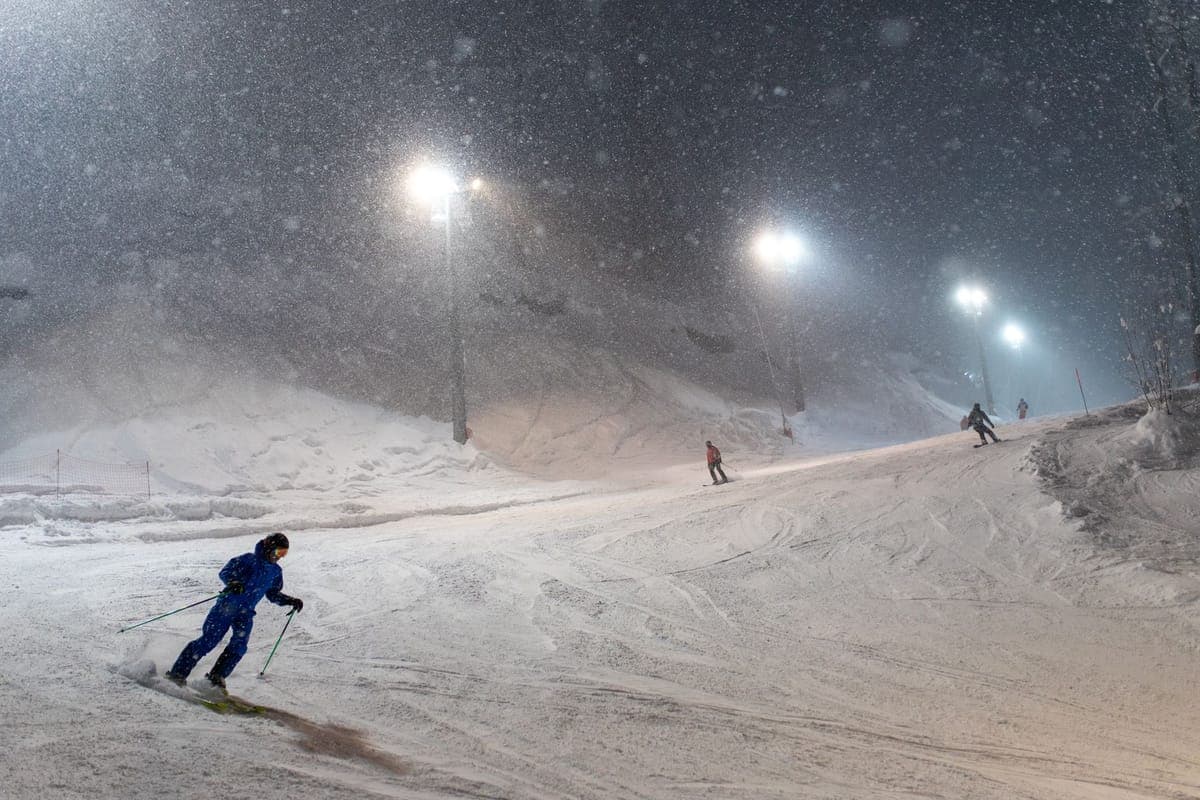
Under floodlights you have perhaps a hundredth of the light of a sunny afternoon, arriving from fixed points rather than from the whole sky. That does two things. It reduces the total amount of light your eye has to work with, and it flattens the shadows that tell you where the bumps are. A dark lens attacks the first problem in the wrong direction, and does nothing at all about the second.
| Conditions | Useful VLT band | Typical lens color |
|---|---|---|
| Bright sun on snow | About 5-20% | Dark gray, black, mirrored |
| Mixed sun and cloud | About 20-40% | Rose, bronze, all-round tints |
| Overcast and flat light | About 40-60% | Rose, amber, yellow |
| Snowfall and dusk | About 60-75% | Yellow, high-contrast light tints |
| Floodlit night skiing | About 70-90% | Clear or very pale yellow |
Why not just take the goggles off
It is the obvious idea and it is worse than it sounds. At 20 mph in still air, your eyes are dealing with a 20 mph wind, and if it is snowing you are taking those flakes at the same speed. Night sessions are also colder than the same resort at midday, and wind on a cold eye waters, which is the actual mechanism by which people lose track of where they are going.
The alternative people reach for next is clear safety glasses or their normal prescription lenses. Neither seals against the face, so both let the wind in around the edges, and neither is built to sit under a helmet brow. The full comparison against sunglasses applies here with more force, because the one advantage sunglasses have during the day, which is being able to see when the light is good, has evaporated.
Three ways to solve it
One: buy a goggle that ships with two lenses
The simplest answer. The Smith Squad ChromaPop is the only goggle in this ledger that publishes a second lens in the box, and a two-lens goggle covers both bright days and dark ones without a second purchase. Check which second lens is included before you buy, because a spare storm lens is what you want and a spare mirror lens is not.
Two: buy a goggle built for fast lens changes
The OutdoorMaster PRO Magnetic publishes a magnetic lens change, which is workable in gloves. That matters specifically for night skiing at a resort that runs a twilight session, because the swap happens in a cold parking lot or a lodge doorway rather than at a workbench. The catch is published on the product page: one lens is included, so the two-lens setup is a second purchase and the real cost is higher than the sticker. The lens-swap roundup compares the systems.
Three: own one mid-VLT lens and accept the compromise
For a family who skis a handful of days a year and might do one night session, buying two lens systems is not proportionate. A single mid-range lens is the honest compromise, and the published figure to look for is somewhere in the thirties to forties. The Smith Snowday publishes exactly this at 36% VLT, which is why it is the youth goggle recommended for a child who will only ever own one lens. It is not ideal at night, but it is far better than a dark lens and vastly better than nothing.
Fogging is worse at night, for a specific reason
Night sessions are short, cold, and interrupted. People stand in a warm lodge for twenty minutes, then go straight out into cold air, and a warm humid inner lens meeting cold outside air is exactly the condition that fogs. The behavior that causes it is also more likely at night: pushing goggles up onto the helmet while talking, then pulling them back down over a face that has been breathing into a neck gaiter.
Everything on the anti-fog page applies, but three habits matter most here. Do not park wet goggles on your forehead. Keep the gaiter below the goggle rather than tucked under it, because your breath is the humidity source. And if a lens does fog, let it clear in moving cold air rather than wiping the inside, since wiping the inner surface is how the anti-fog treatment gets destroyed.
If you wear glasses
Night skiing is the session where an over-the-glasses frame earns its bulk. Contact lenses in dry cold air at night are less comfortable than the same contacts at midday, and swapping to glasses at 6pm in a parking lot is a normal thing to want to do. The Bolle Y7 OTG publishes a frame depth built for glasses to sit inside rather than a normal goggle labeled OTG, and the goggles-for-glasses roundup covers the rest of the field.
The rest of the night kit
- One more layer than you think. A floodlit session is usually two to three hours after the temperature has dropped, and you are riding lifts more than you are working. The base layer page is the place to add it.
- Face cover. Cold air on cheeks at speed after dark is the complaint people come back with. Face protection options are here, and the fit against a goggle matters.
- A helmet, still. Nothing about reduced light makes a helmet less relevant, and floodlit runs concentrate everyone onto fewer pistes.
- Warm hands. Standing on a lift in the dark is where cold hands begin. The cold hands page is unusually practical about what actually works.
Night skiing is also the cheapest lift ticket most resorts sell, which makes it the sensible place for a beginner family to get a second or third day of practice without a second full-price ticket. That is worth factoring into the cost arithmetic: more days on snow moves the rent-or-buy line.
Every pick, with the working
Each entry shows the published inputs, the axis scores they produce, and what you give up. The order is the computed order, not a commercial one, and the arithmetic is open underneath each score.
1 · A skier who wants to change lenses without taking gloves off
OutdoorMaster PRO Magnetic
A magnetic lens swap at a published $49.99, with 100% UV400 and an over-the-glasses frame. Spare lenses are a separate purchase, so the real cost of a two-lens setup lands closer to the Smith than the sticker suggests.
- Published price
- $49.99
- Cost per day on snow
- $2.00 a day
- Amortized over
- 5 seasons (25 days)
- Certified to
- Not published
- UV protection
- 100% published
- Anti-fog
- Anti-fog coating
- Lenses included
- 1
- Published sizes
- One size
- Warranty
- No term published for goggles
What it gets right
- Magnetic lens change, workable in gloves on a lift
- 100% UV400 protection and an anti-fog coating
- Over-the-glasses frame at a published $49.99
What you give up
- One lens included; the interchangeable system only pays off after you buy another
- No published impact standard
The working behind the 6.1
- Cost per day on snow: 9.6
- $49.99 over 5 seasons at 5 days each = 25 days = $2.00 a day
- Published protection: 6.0
- 100% UV protection published (+4); no published impact standard (+0); anti-fog treatment published (+2); single lens (+0)
- Size availability: not scored
- Sold in one size, so size availability does not apply.
- Warranty and support: 0.0
- no published term (0 of 6); no published crash replacement (+0); no published repair route (+0)
Axes with unpublished inputs are dropped and the remaining weights re-normalized, so a product is not punished for a manufacturer’s silence. Specifications compiled September 3, 2026 from OutdoorMaster published specifications.
2 · A skier who wears glasses and does not want contacts
Bolle Y7 OTG
Built around the frame depth that lets a pair of glasses sit inside without the arms pressing, which is the only thing that actually distinguishes an over-the-glasses goggle. Double lens, treated inner surface, 100% UV.
- Published price
- $90
- Cost per day on snow
- $3.60 a day
- Amortized over
- 5 seasons (25 days)
- Certified to
- Not published
- UV protection
- 100% published
- Anti-fog
- Anti-fog and anti-scratch lens treatment
- Lenses included
- 1
- Published sizes
- One size
- Warranty
- No term published for goggles
Bolle publishes several Y7 OTG lens variants; the photochromic version is published at a higher price.
What it gets right
- Purpose-built over-the-glasses frame depth rather than a normal goggle sold as OTG
- 100% UV protection with anti-fog and anti-scratch lens treatment
- Double lens with vents top and bottom, the construction that resists fogging
What you give up
- One lens in the box, so flat-light days mean buying a second
- Deeper frame is bulkier against a helmet brow than a standard goggle
The working behind the 5.5
- Cost per day on snow: 8.4
- $90 over 5 seasons at 5 days each = 25 days = $3.60 a day
- Published protection: 6.0
- 100% UV protection published (+4); no published impact standard (+0); anti-fog treatment published (+2); single lens (+0)
- Size availability: not scored
- Sold in one size, so size availability does not apply.
- Warranty and support: 0.0
- no published term (0 of 6); no published crash replacement (+0); no published repair route (+0)
Axes with unpublished inputs are dropped and the remaining weights re-normalized, so a product is not punished for a manufacturer’s silence. Specifications compiled September 3, 2026 from Bolle published specifications.
3 · Anyone who skis in more than one kind of light
Smith Squad ChromaPop
The only goggle here that ships with a second lens in the box, which is the single change that makes a goggle usable in both bright sun and flat light. That, plus 100% UV and a treated inner lens, is the whole specification worth paying for.
- Published price
- $155
- Cost per day on snow
- $6.20 a day
- Amortized over
- 5 seasons (25 days)
- Certified to
- Not published
- UV protection
- 100% published
- Anti-fog
- Fog-X anti-fog inner lens
- Lenses included
- 2
- Published sizes
- One size
- Warranty
- No term published for goggles
What it gets right
- Two lenses in the box, so a flat-light day does not need a second purchase
- 100% UV protection and a Fog-X treated inner lens
- Cylindrical frame that sits flat against most helmet brows
What you give up
- $155 is more than three of the helmets on this site
- Smith publishes no impact standard for this goggle, so we cannot score it on one
- Sold in one frame size; the smaller and larger faces need a different model entirely
The working behind the 5.3
- Cost per day on snow: 6.5
- $155 over 5 seasons at 5 days each = 25 days = $6.20 a day
- Published protection: 8.0
- 100% UV protection published (+4); no published impact standard (+0); anti-fog treatment published (+2); 2 lenses included (+2)
- Size availability: not scored
- Sold in one size, so size availability does not apply.
- Warranty and support: 0.0
- no published term (0 of 6); no published crash replacement (+0); no published repair route (+0)
Axes with unpublished inputs are dropped and the remaining weights re-normalized, so a product is not punished for a manufacturer’s silence. Specifications compiled September 3, 2026 from Smith published specifications.
4 · A young child who will only ever own one lens, glasses or not
Smith Snowday
Smith's youth goggle on the RC36 lens, which is the useful part: 36% light transmission is the middle of the range, so one lens works on a gray morning and a bright afternoon without the child noticing either way. The spherical Carbonic-x lens and Fog-X treated inner lens are the same optical package Smith puts in its adult frames.
- Published price
- $50
- Cost per day on snow
- $5 a day
- Amortized over
- 2 seasons (10 days)
- Certified to
- Not published
- UV protection
- 100% published
- Anti-fog
- Fog-X anti-fog inner lens
- Lenses included
- 1
- Published sizes
- Youth fit medium
- Warranty
- No term published for goggles
What it gets right
- 36% VLT on the RC36 lens, which covers most of the conditions a family actually skis in
- 100% UVA and UVB protection with a Fog-X treated inner lens
- Spherical Carbonic-x lens published for distortion-free optics and impact resistance
- Published over-the-glasses compatibility, with a floating foam membrane that takes the pressure off eyeglass temples
- Dual-slide strap for size adjustment and a silicone-backed strap that stays put on a helmet
What you give up
- Single lens, so a genuinely dark or genuinely flat day is a compromise
- Published as a youth fit MEDIUM, so it is too big for the smallest faces
- $50 published for the RC36 lens, where the mirrored lenses are $60
- No warranty term published for Smith goggles
The working behind the 5.1
- Cost per day on snow: 7.4
- $50 over 2 seasons at 5 days each = 10 days = $5 a day
- Published protection: 6.0
- 100% UV protection published (+4); no published impact standard (+0); anti-fog treatment published (+2); single lens (+0)
- Size availability: not scored
- Sold in one size, so size availability does not apply.
- Warranty and support: 0.0
- no published term (0 of 6); no published crash replacement (+0); no published repair route (+0)
Axes with unpublished inputs are dropped and the remaining weights re-normalized, so a product is not punished for a manufacturer’s silence. Specifications compiled October 18, 2026 from Smith published specifications.
Prices last verified October 20, 2026. Prices move constantly; the figure on Amazon at the moment you click is the real one.
Questions people actually ask
What lens is best for night skiing?
A clear or near-clear lens, roughly 70 to 90 percent visible light transmission. If you do not own one, a yellow or pale rose lens above about 50 percent is the next best thing. A dark sun lens is the wrong tool: it removes light you do not have to spare and does nothing about the flat shadows that floodlighting creates.
Can you ski at night without goggles?
You can, and it is worse than during the day. At speed your eyes take the full wind, night sessions are colder than midday, and any falling snow arrives at the same speed you are moving. Watering eyes are the practical failure mode. Clear glasses do not seal against the face and are not a substitute.
Do I need two pairs of goggles?
No. Either buy a goggle that ships with two lenses, or one with a quick swap system and add a second lens, or accept a single mid-range lens around 30 to 40 percent VLT as a deliberate compromise. Two complete goggles is the most expensive way to solve it.
Why do goggles fog more at night?
Because night sessions involve going in and out of warm buildings, and a warm humid inner lens meeting cold air is the classic fogging condition. Pushing goggles onto your forehead and breathing into a gaiter tucked under the goggle both make it worse. Let a fogged lens clear in moving cold air rather than wiping the inner surface.
Is night skiing colder?
Usually yes, because the temperature falls after the sun goes down, and you spend proportionally more of a short session on lifts than working. Plan one more layer than you would wear for the same resort at midday, and pay attention to hands and face rather than to the body layers.
Sources
- Smith published Squad ChromaPop lens count and anti-fog treatment
- OutdoorMaster published PRO Magnetic lens change system and UV protection
- Smith published Snowday RC36 lens and construction
- Smith RC36 lens published at 36% VLT (retailer spec sheet; Smith names the lens on the product page but no longer publishes a VLT table of its own)
- Bolle published Y7 OTG frame depth, venting and lens treatment