Sunglasses for snow, and the 5% figure that decides them
Snow throws light back up at you, so the lens that works above the treeline is darker than any high-street pair. It is also too dark to drive in, which is the part nobody mentions.
By Sawyer V. · Published
We have not tested this gear. Everything below is compiled from published specifications and published safety standards, and the arithmetic is public so you can check it. This page carries affiliate links: if you buy through one we earn a commission at no extra cost to you, and it does not change the order of the picks. Full disclosure.
The short answer
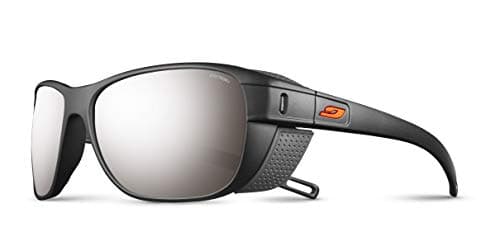
Buy a lens with a published VLT of about 5%, and know you cannot drive in it. Snow reflects a large share of the light and ultraviolet that hits it, so the eyewear that works above the treeline is darker than any ordinary pair. The Julbo Camino with the Spectron 4 lens is the pick - Julbo publishes it at 5% VLT, blocking 95% of visible light and 100% of UVA, UVB and UVC, with removable side shields at a published 25 g. If one pair has to cover the whole day including the drive home, the Julbo Shield with the REACTIV 2-4 lens is published as photochromic from 20% VLT cloudy to 5% in extreme sun. The Tifosi Moab gives you three lenses for less and publishes no VLT at all, which is why it carries the skip. And none of these replaces goggles on a lift-served downhill day. Prices below are live; published figures as of October 12, 2026.
| # | Pick | Best for | Score | Price |
|---|---|---|---|---|
| 1 | Julbo Camino, Spectron 4 Lens Cross-country, snowshoeing and spring sun, when you are not driving in them | $3.40 a dayon snow | 5.0/10 | $69.95 - View on Amazon |
| 2 | Julbo Shield, REACTIV 2-4 Polarized Lens A full day that starts in trees, peaks in glare and ends behind a windshield | $9.20 a dayon snow | 3.1/10 | $249.95 - View on Amazon |
| 3 | Tifosi Moab, Three-Lens Interchange Set Mixed light and mixed sports, if you accept that the tint figures are not published | $3.20 a dayon snow | 5.5/10 | $79.95 - View on Amazon |
Prices last verified October 19, 2026. Prices move constantly; the figure on Amazon at the moment you click is the real one.
Why snow needs a darker lens than anywhere else
Fresh snow is close to the most reflective surface you will ever stand on. The light that would normally be absorbed by ground comes back up at you instead - so you are lit twice, from above and below, and the underside of a lens is doing work it never does in summer.
Altitude compounds it. Thinner atmosphere absorbs less ultraviolet, so a bright day at a resort base is already harsher than the same day at sea level, and a day above the treeline is harsher again. The consequence is not sunburn on your eyelids - it is photokeratitis, the condition people call snow blindness, which arrives hours after the exposure that caused it and is the reason this page cares about published UV figures rather than tint fashion.
Which leads to the one number worth shopping on: VLT, visible light transmission, the percentage of light the lens lets through. A lower number is a darker lens. Our VLT and lens-color guide covers it properly for goggles; sunglasses use the same figure, and on snow you want it low.
The 0-4 category scale, and the honest caveat on driving
You will see lenses described by a filter category from 0 to 4. That scale comes from the European sunglasses standard rather than from US regulation, and it is a band rather than an exact figure. The commonly published ranges:
| Category | Published VLT band | What it is for |
|---|---|---|
| 0 | 80-100% | Clear or barely tinted; indoor and night |
| 1 | 43-80% | Overcast; too light for snow |
| 2 | 18-43% | Average sun; the everyday band |
| 3 | 8-18% | Bright sun; the usual high-street maximum |
| 4 | 3-8% | Extreme glare: high mountains, glaciers, snow |
Category 4 is where snow sits, and category 4 is widely labeled as unsuitable for driving. Be precise about what that means: the labeling requirement belongs to the European standard, not to US law, and the US uses a different standard entirely. But the practical point survives the jurisdiction question - a lens passing 5% of the light is genuinely too dark to drive in, in any country, and that is the single most useful thing to know before you buy one.
When sunglasses are right, and when they are not
This matters more than which pair you buy, and it is the question our goggles-against-sunglasses comparison exists to answer. The short version:
- Sunglasses are the right choice for cross-country skiing. You are working hard, generating heat and moving at modest speed - goggles fog and overheat, sunglasses vent. Cross-country, and whether it is the cheaper winter sport.
- Right for snowshoeing and winter hiking, for the same reason - uphill effort, low speed, no wind chill from descending. Snowshoes, sized on published load.
- Right for spring resort days, slushy afternoons and sitting outside at lunch - what else changes for spring.
- Wrong for a lift-served downhill day. No seal against wind at speed, nothing to stop spindrift, no impact rating, and nothing that works with a helmet brim - that is a goggle purchase.
- Wrong for children, as the only eyewear. Our position on the comparison page is that children are not a judgment call: a child on snow needs goggles that stay on and seal - kids’ goggles, and the two specs that matter.
- The practical answer for most people is both, which is cheaper than it sounds because the sunglasses do a second job all summer.
What this page ranks on
- 1. Published VLT percentage. The entry requirement. A lens with no published VLT cannot be compared with one that has it, which is exactly why the cheapest frame here carries the skip rather than the win.
- 2. Published UV protection. Blocking UVA, UVB and UVC, stated by the maker. Note that tint darkness and UV protection are independent - a very dark lens with poor UV filtering is worse than a light one with good filtering, because the dark tint opens your pupil and then lets ultraviolet through it.
- 3. Side shields, and whether they come off. The light on snow comes from below and from the sides. A shield blocks it; a shield you cannot remove makes the glasses unwearable anywhere else.
- 4. Published weight and dimensions. Weight for a long day, and lens width, bridge and temple length because fit is the one thing a specification can tell you about eyewear you cannot try on.
- 5. Photochromic range, where published. One lens covering several categories is worth real money if the alternative is two pairs.
- Not tint color, not style, not brand heritage. And not optical clarity, which nobody publishes in a comparable form.
The three, compared
| Julbo Camino (Spectron 4) | Julbo Shield (REACTIV 2-4) | Tifosi Moab | |
|---|---|---|---|
| Published VLT | 5% | 20% cloudy to 5% extreme sun | Not published |
| Lens category | 4 | 2 to 4 | Not published |
| Photochromic | No | Yes | Not published |
| Polarized | Optional on other lens choices | Yes, on this lens | Not published |
| UV protection | 100% UVA, UVB, UVC | 100% UVA, UVB, UVC | Not published |
| Removable side shields | Yes | Yes | No |
| Lenses included | 1 | 1 | 3, interchangeable |
| Published weight | 25 g | 32 g | Not published |
| Published dimensions | 58 x 43 mm lens, 15 mm bridge | 59 x 45 mm lens, 17 mm bridge | Not published |
| Warranty | Not published | Not published for this lens | Not published for this model |
| Maker's published price | $84.95 | $229.95 | $79.95 |
Read the first row and the last together. The two lenses with a published VLT figure cost $84.95 and $229.95; the one with no published figure costs $79.95. You are not paying a large premium for the information here - the cheapest Julbo is five dollars more than the Tifosi and tells you exactly what it does.
The picks
Julbo Camino, Spectron 4 lens
The pick, and the cheapest lens on this page dark enough for the job. Julbo publishes the Spectron 4 option at 5% VLT - 95% of visible light blocked - with 100% of UVA, UVB and UVC filtered, a polycarbonate lens, removable side shields described as soft, lightweight and easily removable, and a published weight of 25 g. Full dimensions are published too: a 58 mm by 43 mm lens, 15 mm bridge, 135 mm temples, base 6. MSRP $84.95.
The removable shields are the detail that makes this a sensible single purchase rather than a specialist one. Clipped in, you have most of the coverage of a glacier glass - the light coming off the snow from below and from the side is the half that ordinary sunglasses ignore completely. Taken out, it is a normal pair of dark sport sunglasses you will wear in July. Very few things in this ledger do two seasons’ work.
Worth knowing: Julbo publishes two other lens options on the same frame - a Spectron 3 at 13% VLT and a polarized Spectron 3 at 12%. If your use is mostly spring resort days rather than high sun on open snow, those are the better choice and the frame is identical. The Amazon listing we link is specifically the Spectron 4.
Honest cons. At 5% VLT this is too dark to drive in, and too dark for flat light or a late-afternoon return through trees - a category 4 lens is a single-condition tool. No anti-fog treatment is published, and sunglasses fog on a climb just as goggles do. No warranty term is published. And it is not a goggle: no seal, no wind protection, no impact rating.
Julbo Shield, REACTIV 2-4 Polarized lens
The one pair that can cover a whole day. Julbo publishes the REACTIV 2-4 Polarized lens as photochromic, shifting from 20% VLT when cloudy to 5% VLT in extreme sunlight - category 2 through 4 in one lens - and as polarized, with 100% UVA, UVB and UVC blocked, removable synthetic side shields, and a published 32 g weight. Julbo lists it as ideal for mountaineering, hiking and high glare. MSRP $229.95.
What you are buying is the solution to the Camino’s one real flaw. A fixed 5% lens is perfect for two hours and wrong for the rest of the day; a lens that sits at 20% in the trees and 5% in the open covers the actual arc of a winter day. The polarization is a separate benefit and a real one on snow - reflected glare off wet spring snow and ice is polarized light, so a polarized lens removes it rather than merely dimming everything. Polarized against photochromic, and which is worth it is the page on that trade for goggles, and the same physics applies here.
Honest cons. $229.95 published is roughly three times the Camino for one feature. Photochromic lenses react to ultraviolet rather than to brightness, which has a specific consequence worth planning for: a car windshield filters UV, so the lens stays at its lighter end behind glass - convenient here, but it means you cannot rely on it darkening in a bright car. 32 g against the Camino’s 25 g is noticeable over a long day. No anti-fog treatment published, and no warranty term published for this lens option. And it is still not a goggle.
Tifosi Moab, three-lens interchange set, and why it carries the skip
Three interchangeable lenses in one frame for a published $79.95, which is the cheapest frame here and the only one that lets you change tint rather than buy a second pair. For mixed light across mixed sports that is genuinely good value.
It carries the skip for one reason, and it is not price or build. Tifosi publishes no lens category and no VLT percentage for any of the three lenses on its own product page - nor a UV figure, a weight, or any dimensions. On a page whose single ranking criterion is the published light-transmission figure, a product that publishes none cannot hold the top spot, however good it may be. That is an absence of published information rather than a verdict on the hardware, and it is the same call this site has made before on helmet audio and helmet covers.
Honest cons, beyond the missing figures: no side shields, so it does nothing about the light reflecting up off the snow, which on this page is half the problem. No warranty term published for this model, only a link to a general warranty page. And a three-lens set tempts you to carry spare lenses you will not actually swap on a cold day with gloves on.
Buying eyewear you cannot try on
Two of these three publish full dimensions, which is unusually generous and worth using.
- Measure a pair you already own. Lens width, bridge and temple length are printed inside the temple arm of most sunglasses, usually as three numbers like 58-15-135. Compare those against the published figures rather than guessing from a photograph.
- Wider lenses matter more on snow than elsewhere. The light is coming from below and the side, so coverage at the edge of the lens is doing real work - a narrow fashion lens leaves a bright gap at your cheekbone.
- Check them against your helmet if you will wear both. Temple arms and a helmet’s ear pads compete for the same space, which is the same interface problem goggles and helmets have.
- If you wear prescription glasses, this page is the wrong aisle. A prescription insert or an over-the-glasses frame is the answer - ski eyewear that fits over glasses, and the three other options.
- Keep a retainer cord on them. Both Julbo frames are published with temples shaped for a cord. Sunglasses pushed onto a hat come off a chairlift; a dollar of cord prevents it.
Looking after a snow lens
- Never wipe a dry lens. Snow and grit on a dry lens is sandpaper. Rinse or breathe on it first, then use a soft cloth - the same rule as cleaning goggles without ruining the lens.
- Nothing on the inside of a coated lens. Mirror and hydrophobic coatings sit on the surface and come off with solvents, paper towel and sunscreen.
- Sunscreen is the quiet enemy. It transfers from your face to the lens and then to the coating - apply it before you pick the eyewear up.
- Hard case for a pair with removable shields. Shields bend and the hinge is the failure point.
- Do not leave them on a car dashboard. Heat warps frames and lifts coatings, which is also where the end-of-season storage rule applies - put eyewear away clean and in a case.
Every pick, with the working
Each entry shows the published inputs, the axis scores they produce, and what you give up. The order is the computed order, not a commercial one, and the arithmetic is open underneath each score.
1 · Cross-country, snowshoeing and spring sun, when you are not driving in them
Julbo Camino, Spectron 4 Lens
The pick, and the cheapest lens here dark enough for snow: Julbo publishes the Spectron 4 option at 5% VLT, blocking 95% of visible light and 100% of UVA, UVB and UVC, with removable side shields and a published 25 g weight. Five percent is the darkest band sold - which is exactly what you want above the treeline in March and exactly what you cannot drive home in.
- Published price
- $84.95
- Cost per day on snow
- $3.40 a day
- Amortized over
- 5 seasons (25 days)
- Certified to
- Not published
- UV protection
- 100% published
- Anti-fog
- Not published
- Lenses included
- 1
- Published sizes
- One size: published lens 58 mm wide by 43 mm high, 15 mm bridge, 135 mm temples, 132 mm overall width, base 6
- Weight
- 25 g
- Warranty
- No term published on the product page
What it gets right
- 5% VLT published for the Spectron 4 lens, the darkest band and the figure that matters on snow
- 100% UVA, UVB and UVC blocked per Julbo, which snow reflection makes non-negotiable
- Removable side shields published as soft and easily removable - glacier coverage when you want it, normal sunglasses when you do not
- 25 g published, light enough to forget on a long tour
- Full published dimensions (58 x 43 mm lens, 15 mm bridge, 135 mm temple), so fit is checkable before buying
- Julbo also publishes a 13% Spectron 3 and a 12% polarized option on the same frame if 5% is too dark for your use
What you give up
- At 5% VLT this is too dark to drive in, and a lens this dark in flat light or late afternoon is a liability
- No published anti-fog treatment, and sunglasses fog on a climb as readily as goggles do
- No warranty term published on the product page
- Not a goggle: no seal, no wind protection and no impact rating, so it is the wrong eyewear for a lift-served downhill day
The working behind the 5.0
- Cost per day on snow: 8.6
- $84.95 over 5 seasons at 5 days each = 25 days = $3.40 a day
- Published protection: 4.0
- 100% UV protection published (+4); no published impact standard (+0); no published anti-fog treatment (+0); single lens (+0)
- Size availability: not scored
- Sold in one size, so size availability does not apply.
- Warranty and support: 0.0
- no published term (0 of 6); no published crash replacement (+0); no published repair route (+0)
Axes with unpublished inputs are dropped and the remaining weights re-normalized, so a product is not punished for a manufacturer’s silence. Specifications compiled October 12, 2026 from Julbo published Camino specifications.
2 · A full day that starts in trees, peaks in glare and ends behind a windshield
Julbo Shield, REACTIV 2-4 Polarized Lens
The one you can wear for the whole day including the drive home. Julbo publishes the REACTIV 2-4 Polarized lens as photochromic from 20% VLT when cloudy to 5% VLT in extreme sunlight, polarized, with removable synthetic side shields and a published 32 g weight. It solves the single real problem with a fixed dark lens, and it costs roughly three times the Camino to do it.
- Published price
- $229.95
- Cost per day on snow
- $9.20 a day
- Amortized over
- 5 seasons (25 days)
- Certified to
- Not published
- UV protection
- 100% published
- Anti-fog
- Not published
- Lenses included
- 1
- Published sizes
- Standard size: published lens 59 mm wide by 45 mm high, 17 mm bridge, 130 mm temples, 130 mm overall width, base 6
- Weight
- 32 g
- Warranty
- No term published for this lens; Julbo publishes a separate Spectron 3 Polarized warranty note
What it gets right
- REACTIV 2-4 published as shifting 20% VLT cloudy to 5% VLT in extreme sunlight - one lens across the whole range
- Published as polarized, which cuts the reflected glare off wet snow and ice rather than just dimming it
- 100% UVA, UVB and UVC blocked per Julbo
- Removable synthetic side shields published, for high-elevation glare
- Julbo publishes it as ideal for mountaineering, hiking and high glare, which is the use case
- Full published dimensions and a 32 g weight
What you give up
- $229.95 published is roughly three times the Camino for one feature, however useful that feature is
- Photochromic lenses react to UV rather than to brightness, so they darken less than you expect behind a windshield - the opposite of the problem on the hill
- 32 g against the Camino's 25 g, which is noticeable over a long day
- No published anti-fog treatment, and no warranty term published for this lens option
- Still not a goggle - no seal and no impact rating
The working behind the 3.1
- Cost per day on snow: 4.3
- $229.95 over 5 seasons at 5 days each = 25 days = $9.20 a day
- Published protection: 4.0
- 100% UV protection published (+4); no published impact standard (+0); no published anti-fog treatment (+0); single lens (+0)
- Size availability: not scored
- Sold in one size, so size availability does not apply.
- Warranty and support: 0.0
- no published term (0 of 6); no published crash replacement (+0); no published repair route (+0)
Axes with unpublished inputs are dropped and the remaining weights re-normalized, so a product is not punished for a manufacturer’s silence. Specifications compiled October 12, 2026 from Julbo published Shield specifications.
3 · Mixed light and mixed sports, if you accept that the tint figures are not published
Tifosi Moab, Three-Lens Interchange Set
Skip this one. Skip it for snow, and only for that reason. Three interchangeable lenses for under eighty dollars is genuinely good value, and a swappable tint is something neither Julbo here offers. But Tifosi publishes no lens category and no VLT percentage for any of the three lenses on its own product page - so on a page whose entire criterion is the published light-transmission figure, there is no way to confirm any of them is dark enough for a bright day on snow. Buy it as a cheap mixed-condition sport frame for trail running and cycling. Do not buy it as the glacier lens.
Three lenses for eighty dollars, and the only thing on this page that lets you swap tint rather than buy a second pair. It is also the reason this page has a skip: Tifosi publishes no lens category and no VLT figure for the Moab on its own product page, so there is no way to confirm any of the three lenses is dark enough for snow. As a cheap three-lens set for mixed conditions it is good value; as a snow lens it is unverified.
- Published price
- $79.95
- Cost per day on snow
- $3.20 a day
- Amortized over
- 5 seasons (25 days)
- Certified to
- Not published
- UV protection
- Not published
- Anti-fog
- Not published
- Lenses included
- 3
- Published sizes
- One size; no dimensions published on the product page
- Warranty
- Tifosi links a general warranty page; no term published for this model
What it gets right
- Three interchangeable lenses published as included, so one frame covers bright, mixed and low light
- The cheapest frame here, at under half the Camino's published price
- Interchangeable lenses mean a scratched lens is a replacement rather than a new pair
- A sport frame with a wrap shape, which blocks more peripheral light than a flat fashion lens
What you give up
- No lens category and no VLT published for any of the three lenses, which on a page ranked on exactly those figures is disqualifying for the top spot
- No UV-protection figure, no weight and no dimensions published on the product page
- No warranty term published for this model, only a link to a general warranty page
- No side shields, so it does not address the reflected light that comes from below on snow
The working behind the 5.5
- Cost per day on snow: 8.7
- $79.95 over 5 seasons at 5 days each = 25 days = $3.20 a day
- Published protection: not scored
- No optical or impact standard published for this model.
- Size availability: not scored
- Sold in one size, so size availability does not apply.
- Warranty and support: 0.0
- no published term (0 of 6); no published crash replacement (+0); no published repair route (+0)
Axes with unpublished inputs are dropped and the remaining weights re-normalized, so a product is not punished for a manufacturer’s silence. Specifications compiled October 12, 2026 from Tifosi published Moab listing.
Prices last verified October 19, 2026. Prices move constantly; the figure on Amazon at the moment you click is the real one.
Questions people actually ask
What VLT do I need in sunglasses for skiing?
About 5% for bright days on open snow, which is the darkest band commonly sold - Julbo publishes its Spectron 4 lens at exactly that. Snow reflects a large share of the light and ultraviolet hitting it, so you are lit from above and below at once, and altitude makes it harsher again. For mostly-spring resort use, a 12-18% lens is more comfortable and still adequate.
Can you drive in category 4 sunglasses?
You should not. Category 4 lenses are widely labeled as unsuitable for driving, and that labeling requirement belongs to the European sunglasses standard rather than to US law - the US uses a different standard that does not use the 0-4 categories. Either way the practical point holds: a lens passing only 5% of the light is too dark to drive in. If one pair has to cover the drive home, buy a photochromic lens that lightens.
Can you wear sunglasses instead of goggles for skiing?
For cross-country skiing, snowshoeing and spring resort days, yes - and sunglasses are usually better there, because they vent where goggles fog on uphill effort. For a lift-served downhill day, no: sunglasses have no seal against wind at speed, nothing to stop spindrift, and no impact rating. For children on snow, goggles rather than sunglasses, always.
Are polarized sunglasses good for skiing?
On snow, yes - reflected glare off wet snow and ice is polarized light, so a polarized lens removes it rather than just dimming everything. The usual caution is that polarization can make icy patches harder to spot by removing the sheen that reveals them, which matters more to a downhill skier than to someone on a nordic track.
Do dark sunglasses protect against UV?
Not automatically, and this is the most important misconception in the category. Tint darkness and UV filtering are independent properties. A very dark lens with poor UV filtering is worse than a lighter one with good filtering, because the dark tint opens your pupil wider and then lets ultraviolet through it. Look for a published claim of 100% UVA, UVB and UVC - both Julbo picks here state it.
What are side shields on mountain sunglasses for?
Blocking the light that comes from below and from the sides, which on snow is roughly half of what reaches your eyes and is the part ordinary sunglasses ignore. Both Julbo frames here publish side shields as removable, which is what makes them wearable as normal sunglasses in summer rather than specialist glacier glasses you use three days a year.
Sources
- Julbo published Camino specifications: Spectron 4 at 5% VLT (95% blocked), Spectron 3 at 13%, polarized Spectron 3 at 12%, 100% UVA/UVB/UVC, removable side shields, 25 g, 58 x 43 mm lens, 15 mm bridge, 135 mm temple, $84.95
- Julbo published Shield specifications: REACTIV 2-4 Polarized from 20% VLT cloudy to 5% VLT extreme sun, photochromic, 100% UVA/UVB/UVC, removable synthetic side shields, 32 g, 59 x 45 mm lens, 17 mm bridge, $229.95
- Tifosi published Moab listing: three interchangeable lenses included, $79.95; no lens category, VLT, UV figure, weight or dimensions published on the product page