Sunscreen for skiing, and the places people actually burn
Snow throws light back up at you, so a ski day burns the underside of your nose, your lips and your ears - the spots nobody covers. Four compared on what the makers publish.
By Sawyer V. · Published
We have not tested this gear. Everything below is compiled from published specifications and published safety standards, and the arithmetic is public so you can check it. This page carries affiliate links: if you buy through one we earn a commission at no extra cost to you, and it does not change the order of the picks. Full disclosure.
The short answer
Buy SPF 50 broad spectrum with a published 80-minute water resistance - 80 minutes is the maximum any sunscreen is allowed to claim, so a higher number does not exist. Then buy the thing people forget: an SPF lip balm, because lips are what burns on snow and no lotion gets reapplied there. Carry a stick for the chairlift; sticks get reapplied and tubes do not.
| # | Pick | Best for | Score | Price |
|---|---|---|---|---|
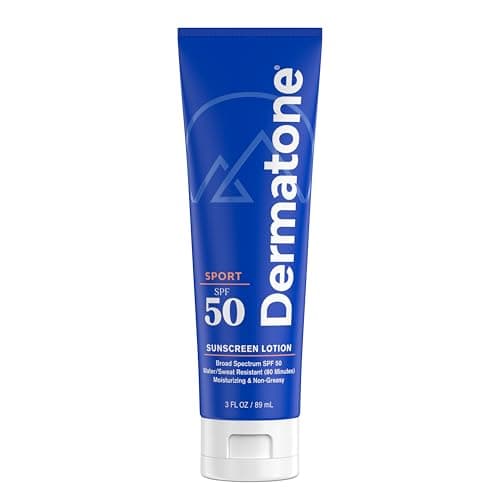
| 1 | Dermatone Sport Sunscreen Lotion SPF 50 The all-over layer you put on in the car before the first lift | $1.13 a dayon snow | 6.4/10 | $16.99 - View on Amazon |
| 2 | Blue Lizard Sensitive Mineral Sunscreen SPF 50 Children's faces, and any adult whose skin reacts to chemical filters | Not publishedon snow | 0.9/10 | $12.91 - View on Amazon |
| 3 | Dermatone Mineral Sunscreen Stick SPF 50 Reapplying on the mountain, and the nose, cheeks and ears specifically | $0.73 a dayon snow | 6.4/10 | $12.99 - View on Amazon |
| 4 | Sun Bum SPF 30 Mineral Sunscreen Lip Balm The one item to buy if you buy nothing else on this page | $0.27 a dayon snow | 6.4/10 | $3.99 - View on Amazon |
Prices last verified October 19, 2026. Prices move constantly; the figure on Amazon at the moment you click is the real one.
Why a ski day is the hard case
Three things stack up on snow that do not stack up at the beach, and together they catch out people who never burn in summer.
- Snow reflects light back up at you. So the sun hits the places that are normally shaded - the underside of your nose and chin, your nostrils, the underside of your ears, and the strip of neck under your jaw. Those are exactly the places nobody puts sunscreen.
- Altitude thins the atmosphere that would otherwise absorb some of the ultraviolet. A resort day is spent several thousand feet above where your skin is used to being. What altitude does to you more generally covers the rest of it.
- It does not feel hot. This is the one that does the damage. Burning is caused by ultraviolet, not by warmth, and a cold, bright, breezy day gives you no sensory warning at all until the evening.
Eyes are a separate problem with a separate answer - UV, snow blindness and why a dark lens is not a safe one is the page for that. This one is about skin.
What this page ranks on
Sunscreen is an unusually good category for a site that only uses published figures, because two of the numbers on the bottle are regulated rather than invented.
- 1. Published SPF, and broad spectrum. SPF describes protection against UVB. “Broad spectrum” is the separate claim that covers UVA, and a bottle without it is only doing half the job.
- 2. Published active ingredients and percentages. This is what tells you whether you are buying a mineral filter (zinc oxide, titanium dioxide) or a chemical one (avobenzone, homosalate, octocrylene), and in what concentration. Every pick here publishes the full list.
- 3. Published water-resistance minutes. Either 40 or 80 minutes, and nothing else - those are the only two claims allowed. Dermatone says so in its own copy, which is more honest than most.
- 4. Format. Not a specification, but the thing that decides whether a product gets used. A tube in a locker protects nobody at 1 p.m.
SPF numbers, and what the jump actually buys
The single most useful thing to understand before shopping: the SPF scale is not linear in usefulness. Each step up blocks a little more and the increments get very small.
| SPF | Roughly what it is for | The honest read |
|---|---|---|
| 15 | Not for snow | Fine for a walk to the car and nothing else here |
| 30 | The practical minimum on snow, and what lip balms come in | Adequate if you actually reapply |
| 50 | The default for a ski day | Blue Lizard publishes protection from 98% of UVB for its SPF 50 |
| 70 and up | Marginal gain over 50 | Buy it if it is cheaper; do not pay a premium for the number |
Which is why every lotion on this page is SPF 50 and why the page does not chase SPF 100. The variable that genuinely changes your afternoon is not the number on the bottle - it is whether the bottle gets opened again after lunch.
The picks
Dermatone Sport Sunscreen Lotion SPF 50
The all-over layer, from the brand that has been in ski shops for decades. Dermatone publishes broad-spectrum SPF 50 built from homosalate 10%, octocrylene 6% and avobenzone 3%, and publishes 80 minutes of water and sweat resistance - stating in its own copy that 80 minutes is the maximum the FDA allows anyone to claim.
It is also published as oxybenzone-free and octinoxate-free, which makes it Hawaii Act 104 compliant, and it comes in a published 3 oz tube that clears airline carry-on rules, with 16 oz and gallon sizes published for people running a family or a ski school.
Honest cons. These are chemical filters, which some people react to on the face - if that is you, the mineral pick below exists for a reason. The published 80 minutes is a ceiling, not a promise, so it needs reapplying at lunch regardless. The small tube is the dearest per ounce of the two Dermatone products here. And nothing is published about how it behaves under a goggle strap, which is where sunscreen genuinely fails.
Blue Lizard Sensitive Mineral Sunscreen SPF 50
The mineral option, and the one to put on a child’s face. Blue Lizard publishes zinc oxide 10% and titanium dioxide 8% as the only active ingredients, 80 minutes of water resistance, and a claim of protection from 98% of UVB rays - with no fragrance, parabens or phthalates, published as hypoallergenic. Two sizes are published, 3 oz and 5 oz, which is the right pair for a family: a big bottle for the house and a small one for a pocket.
Mineral filters sit on the surface rather than being absorbed, which is why they are the usual recommendation for skin that reacts, and why they are the default choice for small children. The skiing-with-kids page covers the rest of the morning routine that sunscreen belongs in.
Honest cons, and they are why this carries the skip note. Blue Lizard publishes no price on its own product page, so our cost axis cannot score it at all. Mineral filters leave a visible white cast - a genuine objection for teenagers. It is thicker than the chemical lotions, which matters when you are applying it with cold hands in a parking lot. And the published 98% figure describes the filter, not a guarantee about a full day on snow.
Dermatone Mineral Sunscreen Stick SPF 50
The format that actually gets reapplied, and the most useful thing on this page after the lip balm. Dermatone publishes SPF 50 from zinc oxide 20.0% - the highest mineral concentration here - in a no-touch stick published as Reef Safe and Hawaii Act 104 compliant, at a published $10.99 for a single stick.
The argument for a stick is entirely practical. It goes on over a cold nose at the top of a lift without taking a glove off, it does not leak in a jacket pocket, and it does not put lotion on your fingers and then on your goggle lens. A tube of SPF 50 in the car and a stick in your pocket is the combination that actually keeps a face covered all day.
Honest cons. Dermatone publishes no water-resistance figure for the stick on its own product page, where it does publish 80 minutes for the lotions - so treat it as the less documented of the two. No size in ounces is published either. Zinc at 20% leaves a clear white cast, which is the direct trade for the concentration. And a stick is slow over large areas: this is a face product, not a body one.
Sun Bum SPF 30 Mineral Sunscreen Lip Balm
The cheapest item on this page and the one most likely to change your week. Sun Bum publishes broad-spectrum SPF 30 from zinc oxide 8% in a published 0.15 oz stick at a published $3.99, fragrance-free and Hawaii Act 104 compliant.
Lips are the part of a skier that reliably burns. They get the reflected light from below, they are the one area no lotion ever gets reapplied to, and a burned lower lip ruins eating and drinking for the rest of a trip. For four dollars this is the highest-value purchase on the page by a wide margin.
Honest cons. No water-resistance figure is published, so treat it as needing frequent reapplication - which for a lip balm is realistic anyway. SPF 30 is the lowest number here. It is a lip product and does nothing for the rest of a face. And it is extremely easy to lose, which is the real argument for the multi-pack rather than the single stick.
Water resistance is 40 or 80 minutes, and nothing else
Worth knowing because it cuts through a lot of packaging. US sunscreen can only claim 40 minutes or 80 minutes of water resistance. “Waterproof,” “sweatproof” and “all-day” are not permitted claims, so if you see them, you are reading marketing rather than a specification.
What that means on snow: 80 minutes is the best available, three of the four picks here publish it or sit below it, and the practical cadence is to reapply at every natural break. First application in the car before the lifts, again at the morning break, again at lunch, again mid-afternoon on a bright spring day. A stick makes those last three happen; a tube in a locker does not.
Mineral or chemical
| Mineral (zinc oxide, titanium dioxide) | Chemical (avobenzone, homosalate, octocrylene) | |
|---|---|---|
| Works by | Sitting on the surface | Being absorbed into the top layer of skin |
| Best for | Children, sensitive skin, faces | Large areas, and not looking pale |
| Visible cast | Yes, especially at high zinc | No |
| Going on with cold hands | Thicker, slower | Easier |
| Published SPF available | Up to 50 here | Up to 50 here |
The pragmatic answer for a family is one of each: a chemical SPF 50 lotion as the bottle everyone uses, and a mineral stick for the faces that react and for the children. That is why both are on this page rather than one winning outright.
The five places skiers actually burn
Cover these and you will not get burned on a ski day. Miss them and the SPF number on the bottle is irrelevant.
- The underside of the nose and the nostrils. The classic snow burn, caused entirely by light coming back off the snow. Nobody applies sunscreen upward.
- Lips, and the lower lip especially. Reflected light again, and no lotion ever gets reapplied there. This is what the lip balm is for.
- Ears, including behind and underneath. A helmet covers the top of an ear and not the lobe. What goes under a helmet covers the fabric options.
- The goggle gap. The strip of forehead between a goggle frame and a helmet brim, and the strip of cheek below the goggle foam. Both move during the day as the goggles shift.
- The neck under the jaw. Pure reflected light, and a neck gaiter solves it for nothing - face and neck coverage compared.
The quickest fix for most of that list is fabric rather than lotion. A neck gaiter pulled up over the chin and a helmet with the goggles sitting properly against the brim removes three of the five, which is why the cheapest sun protection on a ski hill is usually something you already own.
The goggle problem
Two practical difficulties nobody mentions, both solvable.
First, sunscreen and goggle lenses do not mix. Any lotion transferred from a finger to the inside of a lens damages the anti-fog coating permanently, and no amount of careful wiping undoes it. Apply lotion before you pick the goggles up, wipe your hands, and use a stick for anything you need to touch up while wearing them. How to clean goggles without wrecking them.
Second, goggles move. The line they sit on at 9 a.m. is not the line they sit on after three falls, which is how people end up with a burned stripe rather than a clean tan line. Cover slightly past where the foam sits rather than up to it.
Spring is worse than midwinter
Counter-intuitive and worth planning for. Late-season skiing combines a higher sun angle with snow still on the ground, which is the most reflective surface you will ever ski on, and with the warmest, longest days - so people ski in fewer layers with more skin exposed and stay out longer.
Cloud does not fix it either. Ultraviolet passes through thin cloud readily, which is why overcast spring afternoons produce some of the worst burns of a season. What to wear for spring skiing covers the clothing half of the same problem.
What to carry, and when
- In the car: the SPF 50 lotion. First application goes on before boots, not at the top of the first lift.
- In a jacket pocket: the stick and the lip balm. Both survive being sat on; neither leaks.
- Not in an outside pocket in deep cold. A frozen stick does not spread. Keep it in an inner pocket against your body.
- On the packing list, in writing. Sunscreen is the single most forgotten ski item - the family packing list and the gear checklist both carry it.
Who should buy what
- If you buy one thing: the Sun Bum SPF 30 Mineral Lip Balm. Four dollars, and it fixes the thing that actually ruins trips.
- The family bottle: the Dermatone Sport Lotion SPF 50 - published actives, published 80-minute water resistance, carry-on legal.
- For the hill, to actually reapply: the Dermatone Mineral Stick SPF 50, in a pocket, used at every break.
- For children’s faces or sensitive skin: the Blue Lizard Sensitive Mineral SPF 50, accepting the white cast.
- If you only ever ski overcast midwinter days in full face cover: a lip balm and a gaiter genuinely cover most of it. Spend the rest on something that covers skin.
Every pick, with the working
Each entry shows the published inputs, the axis scores they produce, and what you give up. The order is the computed order, not a commercial one, and the arithmetic is open underneath each score.
1 · The all-over layer you put on in the car before the first lift
Dermatone Sport Sunscreen Lotion SPF 50
The ski-industry name, and the published numbers back it up: broad-spectrum SPF 50 from homosalate 10%, octocrylene 6% and avobenzone 3%, water and sweat resistant for a published 80 minutes - which is the maximum the FDA allows anyone to claim.
- Published price
- $16.99
- Cost per day on snow
- $1.13 a day
- Amortized over
- 3 seasons (15 days)
- Certified to
- Not published
- Published sizes
- 3 oz tube published, with a 16 oz family size and a 1 gallon pump also published
- Warranty
- No term published - sunscreen is a consumable, not a durable
What it gets right
- Broad-spectrum SPF 50 published, with the full active-ingredient percentages listed
- Published 80-minute water and sweat resistance, the FDA's maximum claimable figure
- Published as oxybenzone-free and octinoxate-free, so it is Hawaii Act 104 compliant
- Published in a 3 oz tube that clears airline carry-on limits, plus 16 oz and gallon sizes
What you give up
- A chemical filter rather than a mineral one, which some people react to on the face
- 80 minutes is the honest ceiling - it needs reapplying at lunch whatever the number says
- The 3 oz tube is the most expensive per ounce of the two Dermatone options here
- Nothing is published about how it behaves under a goggle strap, which is where sunscreen fails
The working behind the 6.4
- Cost per day on snow: 10.0
- $16.99 over 3 seasons at 5 days each = 15 days = $1.13 a day
- Published protection: not scored
- This category carries no protective standard.
- Size availability: not scored
- Sold in one size, so size availability does not apply.
- Warranty and support: 0.0
- no published term (0 of 6); no published crash replacement (+0); no published repair route (+0)
Axes with unpublished inputs are dropped and the remaining weights re-normalized, so a product is not punished for a manufacturer’s silence. Specifications compiled October 4, 2026 from Dermatone published specifications.
2 · Children's faces, and any adult whose skin reacts to chemical filters
Blue Lizard Sensitive Mineral Sunscreen SPF 50
Skip this one. Skip it if nobody in the group has sensitive skin and you object to a white cast. It is a genuinely good mineral formula - zinc oxide 10% and titanium dioxide 8%, published, with 80 minutes of water resistance - but Blue Lizard publishes no price of its own, mineral filters go on thicker with cold hands, and the chemical lotion here does the same published SPF with less fuss. Buy it for children's faces, not as the family bottle.
The mineral option, and the one to put on a child's face. Blue Lizard publishes zinc oxide 10% and titanium dioxide 8% as the only active ingredients, 80 minutes of water resistance and a claim of protection from 98% of UVB - with no fragrance, parabens or phthalates.
- Published price
- Not published
- Cost per day on snow
- Not published
- Amortized over
- 3 seasons (15 days)
- Certified to
- Not published
- Published sizes
- 3 oz and 5 oz published
- Warranty
- No term published - sunscreen is a consumable, not a durable
Blue Lizard publishes no price on its own product page, so the cost-per-day axis is not scored from a list price.
What it gets right
- 100% mineral actives published - zinc oxide 10% and titanium dioxide 8%, nothing else
- Published 80-minute water resistance, the same ceiling as the chemical options here
- Published as fragrance-free, paraben-free and phthalate-free, and hypoallergenic
- Two published sizes, 3 oz and 5 oz, so a family can buy the big one and a pocket one
What you give up
- Blue Lizard publishes no price of its own, so our cost axis cannot score it
- Mineral filters leave a visible white cast, which teenagers in particular object to
- Thicker than the chemical lotions, so it is slower to rub in with cold hands
- The published 98% UVB figure is a claim about the filter, not about a full day on snow
The working behind the 0.9
- Cost per day on snow: not scored
- No manufacturer-published price, so this axis is not scored.
- Published protection: not scored
- This category carries no protective standard.
- Size availability: 1.7
- 2 published sizes (1.7 of 8.5); no continuous adjuster published (+0); range: 3 oz and 5 oz published
- Warranty and support: 0.0
- no published term (0 of 6); no published crash replacement (+0); no published repair route (+0)
Axes with unpublished inputs are dropped and the remaining weights re-normalized, so a product is not punished for a manufacturer’s silence. Specifications compiled October 4, 2026 from Blue Lizard published specifications.
3 · Reapplying on the mountain, and the nose, cheeks and ears specifically
Dermatone Mineral Sunscreen Stick SPF 50
The format that actually gets reapplied. Dermatone publishes SPF 50 from zinc oxide 20.0% in a no-touch stick, which means it goes on over a cold nose at the top of a lift without taking a glove off and without getting lotion on a goggle lens.
- Published price
- $10.99
- Cost per day on snow
- $0.73 a day
- Amortized over
- 3 seasons (15 days)
- Certified to
- Not published
- Published sizes
- One stick, published singly and in 2- and 3-packs
- Warranty
- No term published - sunscreen is a consumable, not a durable
What it gets right
- Zinc oxide 20.0% published - the highest mineral concentration on this page
- A stick, so it can be used wearing gloves and will not leak in a jacket pocket
- Published as Reef Safe and Hawaii Act 104 compliant
- $10.99 published for a single stick, the cheapest way to carry SPF 50 on the hill
What you give up
- No water-resistance figure published on the maker's product page, unlike the two lotions
- No size in ounces published on the maker's page either
- Zinc at 20% leaves a clear white cast - that is the trade for the concentration
- A stick is slow over large areas; this is a face product, not a body one
The working behind the 6.4
- Cost per day on snow: 10.0
- $10.99 over 3 seasons at 5 days each = 15 days = $0.73 a day
- Published protection: not scored
- This category carries no protective standard.
- Size availability: not scored
- Sold in one size, so size availability does not apply.
- Warranty and support: 0.0
- no published term (0 of 6); no published crash replacement (+0); no published repair route (+0)
Axes with unpublished inputs are dropped and the remaining weights re-normalized, so a product is not punished for a manufacturer’s silence. Specifications compiled October 4, 2026 from Dermatone published specifications.
4 · The one item to buy if you buy nothing else on this page
Sun Bum SPF 30 Mineral Sunscreen Lip Balm
The cheapest thing on this page and the one most likely to change your week. Sun Bum publishes broad-spectrum SPF 30 from zinc oxide 8% in a 0.15 oz stick at a published $3.99 - and lips are the part of a skier that actually burns, because no lotion gets reapplied there.
- Published price
- $3.99
- Cost per day on snow
- $0.27 a day
- Amortized over
- 3 seasons (15 days)
- Certified to
- Not published
- Published sizes
- 0.15 oz stick published
- Warranty
- No term published - sunscreen is a consumable, not a durable
What it gets right
- Broad-spectrum SPF 30 published from zinc oxide 8%, a mineral filter
- $3.99 published, which is less than a resort coffee
- 0.15 oz stick published - small enough to live in a jacket pocket all season
- Published as fragrance-free and Hawaii Act 104 compliant
What you give up
- No water-resistance figure published, so treat it as needing frequent reapplication
- SPF 30 rather than 50, which is the lowest number on this page
- A lip balm only - it does nothing for the rest of a face
- Easy to lose, which is the real argument for buying the multi-pack
The working behind the 6.4
- Cost per day on snow: 10.0
- $3.99 over 3 seasons at 5 days each = 15 days = $0.27 a day
- Published protection: not scored
- This category carries no protective standard.
- Size availability: not scored
- Sold in one size, so size availability does not apply.
- Warranty and support: 0.0
- no published term (0 of 6); no published crash replacement (+0); no published repair route (+0)
Axes with unpublished inputs are dropped and the remaining weights re-normalized, so a product is not punished for a manufacturer’s silence. Specifications compiled October 4, 2026 from Sun Bum published specifications.
Prices last verified October 19, 2026. Prices move constantly; the figure on Amazon at the moment you click is the real one.
Questions people actually ask
What SPF do I need for skiing?
SPF 50 broad spectrum is the sensible default, and SPF 30 is the practical minimum. Going above 50 buys very little extra - the scale flattens out - so the thing that actually matters is reapplying every couple of hours rather than buying a bigger number.
Can you get sunburned skiing on a cloudy day?
Yes, and it is one of the most common ways people get burned. Ultraviolet passes through thin cloud, snow reflects it back up at you, and a cold overcast day gives you no warning because burning is caused by UV rather than heat.
How often should I reapply sunscreen while skiing?
Every couple of hours, and at every natural break. US sunscreen can only claim 40 or 80 minutes of water resistance - 80 is the maximum allowed - so plan on the parking lot, the morning break, lunch, and again mid-afternoon in spring. A stick in a pocket is what makes that happen.
Is mineral or chemical sunscreen better for skiing?
Mineral (zinc oxide, titanium dioxide) for children and for skin that reacts, because it sits on the surface; chemical (avobenzone, homosalate, octocrylene) for large areas and if you object to a white cast. One of each is the practical family answer - a lotion everyone uses plus a mineral stick for faces.
Where do skiers get sunburned most?
The underside of the nose and nostrils, the lips, the ears, the goggle gap on the forehead and cheeks, and the neck under the jaw - all of them from light reflecting back off the snow. A neck gaiter pulled over the chin removes several of them for nothing.
Do I need a separate lip balm with SPF?
Yes. Lips burn badly on snow and no face lotion ever gets reapplied there. A broad-spectrum SPF 30 lip balm costs about four dollars, lives in a jacket pocket all season, and is the highest-value sun purchase a skier makes.
Sources
- Dermatone published Sport Sunscreen Lotion SPF 50 actives, 80-minute water resistance, sizes and price
- Dermatone published Mineral Sunscreen Stick SPF 50 zinc oxide concentration, reef-safe claim and price
- Blue Lizard published Sensitive Mineral SPF 50 actives, 80-minute water resistance, sizes and 98% UVB claim
- Sun Bum published Mineral SPF 30 Lip Balm active ingredient, size and price