Fixing ski gear: the three products that cover almost everything
A tear, a leaking seam and a sticking zipper are three different failures with three different fixes. All three cost under ten dollars, and all three otherwise end a trip.
By Sawyer V. · Published
We have not tested this gear. Everything below is compiled from published specifications and published safety standards, and the arithmetic is public so you can check it. This page carries affiliate links: if you buy through one we earn a commission at no extra cost to you, and it does not change the order of the picks. Full disclosure.
The short answer
Put the tape in the bag; leave the sealant at home. Gear Aid Tenacious Tape is the pick - a published 3 x 20 in roll of peel-and-stick nylon repair you cut to the tear, no sewing and no heat, which is the only one of these three that works in a hotel room at 9pm. Zipper lubricant wax is the cheapest thing here and the one that prevents the failure that actually ends a ski day: a main jacket zipper that jams. Seam Grip WP fixes a leaking seam properly but needs cure time, so it is a home job. Buy the tape and the wax now; buy the sealant when you find a leak. Prices below are live; published figures as of October 11, 2026.
| # | Pick | Best for | Score | Price |
|---|---|---|---|---|
| 1 | Gear Aid Tenacious Tape Nylon Fabric Repair, 3 x 20 in A tear in a shell or a snow pant, mid-trip, with no sewing kit | Not publishedon snow | 0.0/10 | $5.95 - View on Amazon |
| 2 | Gear Aid Zipper Lubricant Wax Sticks A main jacket or pant zipper that has started to stick or catch | Not publishedon snow | 0.0/10 | $6.95 - View on Amazon |
| 3 | Gear Aid Seam Grip WP Waterproof Sealant and Adhesive A seam that has started leaking where the factory tape is peeling | Not publishedon snow | 0.9/10 | $9.95 - View on Amazon |
Prices last verified October 19, 2026. Prices move constantly; the figure on Amazon at the moment you click is the real one.
Three failures, three products
The reason this page is a roundup of three cheap things rather than one kit: these are genuinely different problems, and the product that fixes one does nothing for the others.
| What has failed | What fixes it | Doable on a trip? |
|---|---|---|
| A tear or puncture in a shell | Peel-and-stick repair tape | Yes, in minutes |
| A seam leaking where the tape has lifted | Brush-on seam sealant | No, needs cure time |
| A zipper that sticks or jams | Zipper lubricant wax | Yes, and prevents it in the first place |
| A zipper with bent or missing teeth | A shop, or a new garment | No |
| A delaminating boot sole | A strap to get down, then a shop | Partly |
| Anything on a binding | A shop, always | No |
The last two rows matter as much as the first three. A strap is what gets you off the hill with broken hardware - and it is nine dollars - and a binding is never a DIY repair, for reasons the bindings page explains.
Who each of these is for, and who should skip it
- Anyone going on a multi-day trip: the tape. A tear on day one of four is otherwise a trip-shaped problem.
- Anyone whose main zipper has started catching: the wax. Seven dollars against a day lost, and it is a pre-season job.
- Anyone with a jacket wetting out at the shoulder seams: the sealant. It carries the skip note because it is a home job, not because it is a bad product.
- Skip all three if the jacket is simply old and wetting out all over. That is a washing-and-re-proofing problem, not a repair one - what to wash a ski jacket with, and what re-proofs it.
- Skip the lot for a rental. Report the damage; do not patch somebody else's gear - what you are actually liable for.
What this page ranks on
- 1. Whether it works away from home. The single most useful property of a repair product on a ski trip, and the thing that separates the tape from the sealant.
- 2. Published form and dimensions. A roll you cut, pre-cut patches, a tube, a stick. It decides how many repairs you get and how well the patch fits the tear.
- 3. What it is published for. Jackets and rain gear, or tents and tarps. Several of these are sold across both and the fabric matters.
- 4. Not durability, because none of it is published. Gear Aid publishes no wash-durability, permanence or cure-time figure we could read on its own site - the pages render client-side. So this page ranks on form and job, states the dimensions the listings give, and does not invent a “lasts N washes” number.
The picks
Gear Aid Tenacious Tape, 3 x 20 in roll
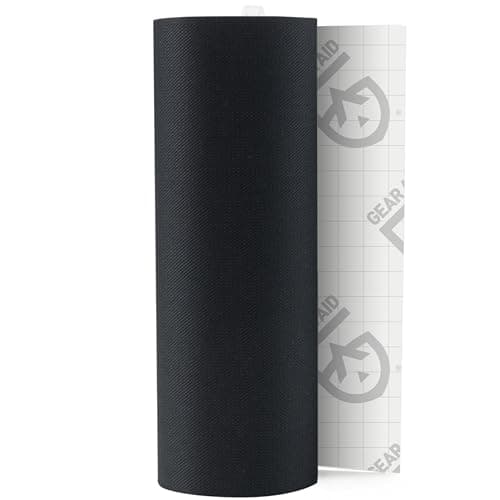
The pick, and the best six dollars in this ledger. Published as a 3 x 20 in roll of nylon fabric repair - peel-and-stick, no sewing, no heat, no iron. You cut the patch to the tear rather than hoping a pre-cut shape covers it.
The case for the roll over the pre-cut patches is simple: a 3 x 20 in roll is a lot of patch. A typical ski jacket tear is an inch or two, so one roll is several repairs across several seasons and several garments - and you get to cut the shape, which means rounded corners and a patch that follows the tear instead of overhanging it.
Where it earns its place is the timing. A tear happens on the hill, and the alternatives at 9pm in a rental condo are duct tape, which fails and leaves residue, or nothing. Two minutes with a roll of this and a pair of scissors is the difference between three more days of skiing in a working jacket and three days in a wet one. Fixing a torn ski jacket without ruining it is the method page this is the shopping half of.
Honest cons. Gear Aid publishes no wash-durability or permanence figure we could read on its own site, so how long a patch survives laundering is not something we can tell you. A cut patch has corners you must round yourself. It is not a seam fix - a leaking seam needs the sealant, and a patch over a seam will lift along the stitch line. And no MSRP is published on Gear Aid's own site.
Gear Aid Zipper Lubricant Wax
The cheapest preventable disaster on this page, and the one almost nobody owns. Published as a wax lubricant in a 2-stick pack for zippers.
Why this matters out of proportion to its price: a main jacket zipper that jams ends a ski day outright. You cannot ski a day with a jacket that will not close, and a zipper that has started to catch in October is a zipper that fails in January. Run the wax down both sides of the teeth before the season and the catching usually stops.
Wax rather than an oil or a spray is the right form here. An oil runs, picks up grit and stains the fabric either side of the zipper; a wax stays where you put it. The 2-stick pack is several seasons of pre-season maintenance for a whole family's outerwear, which is why it belongs on the pre-season slot of the maintenance schedule rather than in a drawer.
Honest cons. It prevents a failure rather than repairing one: a zipper with bent or missing teeth, or a slider that has spread, needs replacing and that is a shop job - the hardware page covers which failures are fixable. No coverage or application-frequency figure is published. And it is easy to forget, which is the whole reason it needs to be on a checklist.
Gear Aid Seam Grip WP, and why it carries the skip
The proper repair for the failure that quietly writes off jackets. Published as a waterproof sealant and adhesive for jackets, tents, tarps and rain gear - a brush-on urethane that seals a seam whose factory tape has started to lift.
That failure mode is worth describing, because people misdiagnose it as the jacket “wearing out”. Waterproof seams are taped on the inside at the factory, and after a few seasons the tape starts peeling at the shoulders - which is where a pack strap rubs and where water runs. The jacket then wets through at the shoulders while the rest of the fabric is fine. Brush sealant along the inside seam and the jacket has several more seasons in it.
It is also both a sealant and an adhesive, which means it does a second job: gluing down a repair patch whose corner has started to lift.
Honest cons, and they are the skip: it needs cure time, so it is a night-before-you-pack job and useless mid-trip. Gear Aid publishes no cure time or coverage figure we could read on its own site. An opened tube has a short life, so buying it speculatively wastes most of it. And if the whole garment is wetting out rather than just the seams, this is the wrong product - wash and re-proof it instead.
What actually goes in the trip bag
A short list, because a repair kit you do not carry is not a repair kit.
- A roll of repair tape and small scissors. Two minutes, any tear.
- Two straps. The boot-cuff, pole and binding-strap emergency - ski straps, and the one length that does the most jobs.
- A spare pair of gloves and socks. Not a repair, but the two items whose failure is wet rather than broken - and the second pair matters more than the first.
- Nothing that needs curing, mixing or heating. Leave the sealant, the seam tape that needs an iron, and anything requiring a workbench at home.
- Not a sewing kit, for outerwear. A needle through a waterproof membrane makes new holes. Sew a pack strap; tape a shell.
What to do before the season instead
Most of what this page fixes is cheaper to prevent in October than to repair in January, and all of it fits in one twenty-minute session.
- Work every zipper, and wax the ones that catch. Jacket, pants, pit zips, pockets, boot bag.
- Hold the jacket up to a light. Look for lifting seam tape at the shoulders and small punctures you did not notice. That is what the sealant and the tape are for, with time to cure.
- Run a tap over the shoulders. If water soaks in rather than beading, the fix is a wash - and not washing it is worse than washing it.
- Check the boot buckles and power straps. The cuff strap is the component most likely to tear mid-season.
- Then do the rest of the list. The season maintenance schedule has all five slots and what is due in each, and the twenty-minute mid-season check is the one that catches what October missed.
Every pick, with the working
Each entry shows the published inputs, the axis scores they produce, and what you give up. The order is the computed order, not a commercial one, and the arithmetic is open underneath each score.
1 · A tear in a shell or a snow pant, mid-trip, with no sewing kit
Gear Aid Tenacious Tape Nylon Fabric Repair, 3 x 20 in
The pick, and the single most useful six dollars in this ledger. Published as a 3 x 20 in roll of peel-and-stick nylon fabric repair - no sewing, no heat, no seam ripper. A tear in a ski jacket on day one of a four-day trip is otherwise a trip-ending problem, and this is a roll you cut to shape in a hotel room in two minutes.
- Published price
- Not published
- Cost per day on snow
- Not published
- Amortized over
- 3 seasons (15 days)
- Certified to
- Not published
- Published sizes
- Published as a 3 x 20 in roll
- Warranty
- No term published; this is a consumable
Gear Aid lists this across colors without a published MSRP we could read on its own site, so the cost-per-day axis is not scored.
What it gets right
- Published 3 x 20 in roll, so you cut the patch to the tear rather than the other way round
- Peel-and-stick: no sewing and no heat, which is what makes it a trip-saver rather than a project
- One roll covers several repairs, which is why this beats the pre-cut patches on value
- Under ten dollars, against a new jacket
What you give up
- Gear Aid publishes no wash-durability or permanence figure we could read on its own site
- A cut-from-roll patch has square corners, which lift sooner than a rounded one - round them yourself
- Not a seam fix: a leaking seam needs the sealant, not the tape
- No MSRP published on Gear Aid's own site
The working behind the 0.0
- Cost per day on snow: not scored
- No manufacturer-published price, so this axis is not scored.
- Published protection: not scored
- This category carries no protective standard.
- Size availability: 0.0
- 1 published size (0.0 of 8.5); no continuous adjuster published (+0); range: Published as a 3 x 20 in roll
- Warranty and support: 0.0
- no published term (0 of 6); no published crash replacement (+0); no published repair route (+0)
Axes with unpublished inputs are dropped and the remaining weights re-normalized, so a product is not punished for a manufacturer’s silence. Specifications compiled October 11, 2026 from Gear Aid published Tenacious Tape roll dimensions.
2 · A main jacket or pant zipper that has started to stick or catch
Gear Aid Zipper Lubricant Wax Sticks
The cheapest preventable failure on this list. Published as a wax lubricant in a 2-stick pack for zippers - run it down the teeth before the season and a main jacket zipper that has started to catch usually stops catching. A failed main zipper ends a ski day outright, and almost nobody owns the seven-dollar thing that prevents it.
- Published price
- Not published
- Cost per day on snow
- Not published
- Amortized over
- 3 seasons (15 days)
- Certified to
- Not published
- Published sizes
- Published as a 2-stick pack
- Warranty
- No term published; this is a consumable
Gear Aid lists this without a published MSRP we could read on its own site, so the cost-per-day axis is not scored.
What it gets right
- Published as a 2-stick pack, which is several seasons of pre-season maintenance
- Wax rather than an oil, so it does not run and does not stain the fabric around the zipper
- Fixes a catching zipper, which is the most common hardware failure on ski outerwear
- The least expensive item in this round and the one with the best ratio of cost to day-saved
What you give up
- Prevents a failure rather than repairing one: a zipper with bent or missing teeth needs replacing
- Gear Aid publishes no coverage or application-frequency figure we could read on its own site
- Easy to forget, which is why it belongs on a pre-season checklist rather than in a drawer
- No MSRP published on Gear Aid's own site
The working behind the 0.0
- Cost per day on snow: not scored
- No manufacturer-published price, so this axis is not scored.
- Published protection: not scored
- This category carries no protective standard.
- Size availability: 0.0
- 1 published size (0.0 of 8.5); no continuous adjuster published (+0); range: Published as a 2-stick pack
- Warranty and support: 0.0
- no published term (0 of 6); no published crash replacement (+0); no published repair route (+0)
Axes with unpublished inputs are dropped and the remaining weights re-normalized, so a product is not punished for a manufacturer’s silence. Specifications compiled October 11, 2026 from Gear Aid published zipper lubricant wax description.
3 · A seam that has started leaking where the factory tape is peeling
Gear Aid Seam Grip WP Waterproof Sealant and Adhesive
Skip this one. Skip it in the trip bag, and keep it at home. It is the right product for a seam whose factory tape has started lifting - a genuine repair that extends a jacket by seasons - but it is a brush-on urethane that needs cure time, which makes it a night-before-you-leave job rather than a mid-trip one. An opened tube also has a short life, so buying it speculatively wastes it. Buy it when you have found a leaking seam, not in case you do.
The one for a leak rather than a tear, and the distinction is the whole point of owning both. Published as a waterproof sealant and adhesive for jackets, tents and rain gear - it is a brush-on urethane that seals a seam whose factory tape has started to lift, which is how a three-year-old shell starts wetting out at the shoulders first.
- Published price
- Not published
- Cost per day on snow
- Not published
- Amortized over
- 3 seasons (15 days)
- Certified to
- Not published
- Published sizes
- Published in two tube sizes
- Warranty
- No term published; this is a consumable
Gear Aid lists this across sizes without a published MSRP we could read on its own site, so the cost-per-day axis is not scored.
What it gets right
- Published as a sealant AND an adhesive, so it both seals a seam and glues a lifting patch down
- Brush-on, so it follows a seam line that tape cannot sit flat along
- Published for jackets and rain gear specifically, not just tents
- Fixes the failure mode that makes people replace an otherwise sound jacket
What you give up
- Needs cure time, so it is a night-before job rather than a mid-trip one
- Gear Aid publishes no cure time or coverage figure we could read on its own site
- Once opened, a tube has a short life - this is not a buy-once item
- No MSRP published on Gear Aid's own site
The working behind the 0.9
- Cost per day on snow: not scored
- No manufacturer-published price, so this axis is not scored.
- Published protection: not scored
- This category carries no protective standard.
- Size availability: 1.7
- 2 published sizes (1.7 of 8.5); no continuous adjuster published (+0); range: Published in two tube sizes
- Warranty and support: 0.0
- no published term (0 of 6); no published crash replacement (+0); no published repair route (+0)
Axes with unpublished inputs are dropped and the remaining weights re-normalized, so a product is not punished for a manufacturer’s silence. Specifications compiled October 11, 2026 from Gear Aid published Seam Grip WP description.
Prices last verified October 19, 2026. Prices move constantly; the figure on Amazon at the moment you click is the real one.
Questions people actually ask
How do you fix a tear in a ski jacket?
Peel-and-stick nylon repair tape, cut to the tear with rounded corners. No sewing and no heat - a needle through a waterproof membrane just makes new holes, and duct tape fails and leaves residue. A 3 x 20 in roll costs about six dollars and is several repairs; cut it yourself rather than buying pre-cut patches so the patch follows the tear.
What is the difference between repair tape and seam sealant?
Tape patches a hole in the fabric and works immediately, which makes it the one to carry on a trip. Sealant is a brush-on urethane for a seam whose factory tape has lifted - a better repair for a different failure, but it needs cure time, so it is a job for the night before you pack rather than a hotel room on day two.
Why is my ski jacket leaking at the shoulders?
Usually the internal seam tape has started to lift, which happens first at the shoulders because that is where a pack strap rubs and where water runs. The rest of the fabric is often fine. Brush-on seam sealant along the inside of that seam adds seasons to the jacket. If it is wetting out everywhere rather than at the seams, it needs washing and re-proofing instead.
How do you fix a stuck ski jacket zipper?
Clean the teeth and run a wax lubricant down both sides. A zipper that catches is usually dirty or dry rather than broken, and wax stays where you put it where an oil runs and picks up grit. If teeth are bent or missing, or the slider has spread, waxing will not help and the zipper needs replacing - which is a shop job.
What repair kit should I take on a ski trip?
A roll of repair tape, small scissors, and two straps. That covers a tear, a torn boot cuff, a snapped pole and a failed pack strap - the four things that actually end days. Leave anything that needs curing, mixing or heating at home, and skip a sewing kit for outerwear: stitching a waterproof shell makes new holes.
How long does Tenacious Tape last on a jacket?
Gear Aid publishes no wash-durability or permanence figure we could find on its own site, so we are not going to quote one. What we can say is that the two things which decide it are in your control: round the corners of the patch so there is no lifting point, and press it onto clean dry fabric rather than onto a damp jacket on the hill.