The best all-mountain skis, ranked on published width and length range
All-mountain is the category most people should buy and the one with the loosest definition. Here is what the label actually means and which published numbers decide it.
By Sawyer V. · Published
We have not tested this gear. Everything below is compiled from published specifications and published safety standards, and the arithmetic is public so you can check it. This page carries affiliate links: if you buy through one we earn a commission at no extra cost to you, and it does not change the order of the picks. Full disclosure.
The short answer
All-mountain means a waist width roughly between 75 and 95 mm - narrow enough to turn quickly on groomed runs, wide enough not to sink instantly in soft snow. For most people buying a first or second pair, the Rossignol Experience 78 Carbon is the pick: published at beginner skill level, six lengths from 138 to 178 cm, and sold with bindings mounted. The binding still needs a shop to set and test it.
| # | Pick | Best for | Score | Price |
|---|---|---|---|---|
| 1 | Rossignol Experience 78 Carbon skis with Xpress bindings Someone certain they will ski more than about six days a season | $23.20 a dayon snow | 2.3/10 | $579.95 - View on Amazon |
| 2 | Rossignol Experience 76 skis with Xpress 10 bindings A smaller adult or a tall teenager on groomed runs | $18.00 a dayon snow | 2.3/10 | $479.95 - View on Amazon |
| 3 | K2 Disruption 75 Women's Skis A beginner who wants a women's-specific construction | $18.00 a dayon snow | 1.4/10 | $389.99 - View on Amazon |
Prices last verified October 19, 2026. Prices move constantly; the figure on Amazon at the moment you click is the real one.
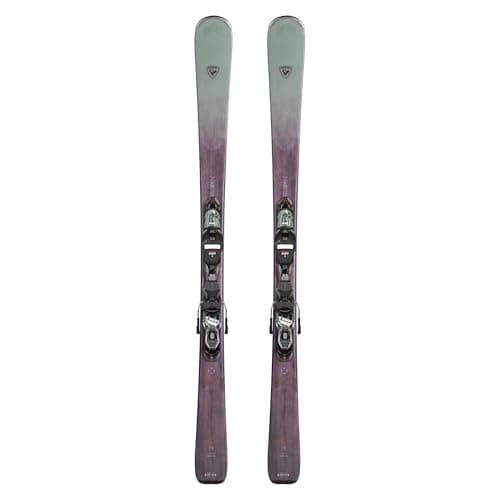
What "all-mountain" actually means
It is the loosest label in skiing. Every brand uses it, and it covers everything from a narrow groomer ski to something close to a powder ski. What it is really describing is a compromise: one pair that handles most of a normal resort day rather than excelling at one part of it.
In published terms the definition is a waist width - the narrowest point of the ski, under your foot, published in millimeters. Under about 75 mm is a dedicated groomed-run ski. Over about 100 mm is a powder ski that fights you on hard snow. All-mountain lives in between, and the narrower half of that range is where most recreational skiers should be.
| Waist width | Built for | Right for you if |
|---|---|---|
| Under 75 mm | Groomed runs and hard snow; quickest edge to edge | You ski groomers exclusively and value quick turns |
| 75-85 mm | All-mountain, groomer-biased | You ski mostly groomed with occasional soft snow - most people |
| 85-95 mm | All-mountain, genuine mixed use | You get off the groomed runs regularly |
| 95-110 mm | Soft snow and powder days | You live somewhere it actually snows and own a second pair |
All three skis on this page sit in the mid-to-high seventies, which is the groomer-biased end of all-mountain. That is deliberate: it is where the honest answer is for someone skiing a resort a handful of days a year. The shapes page explains why wider is not more forgiving, which is the most common misconception in this category.
What this page ranks on
- Published length range. The most underrated figure. A ski with six published lengths fits far more people correctly than one with four, and length is the fit decision that matters most.
- Waist width. Narrower turns more easily at the speeds most people ski.
- Whether bindings are included and mounted. This removes the one step where buying skis online goes wrong.
- Published skill level. When a maker states it rather than leaving you to infer it from a spec sheet.
Published figures side by side
| Rossignol Experience 78 Carbon | Rossignol Experience 76 | K2 Disruption 75 | |
|---|---|---|---|
| Published lengths | 138, 146, 154, 162, 170, 178 cm | 136, 144, 152, 160, 168, 176 cm | 142, 149, 156, 163 cm |
| Length count | 6 | 6 | 4 |
| Shortest length | 138 cm | 136 cm | 142 cm |
| Bindings included | Yes, Xpress | Yes, Xpress 10 | Yes |
| Published skill level | Beginner, stated by Rossignol | Beginner-oriented | Beginner, women's-specific construction |
| Warranty | None published | None published | None published |
The picks
Rossignol Experience 78 Carbon
The pick for most people. Rossignol publishes it at beginner skill level rather than leaving you to guess from a spec sheet, and it sells it with Xpress bindings already mounted - which removes the step that makes buying skis online go wrong. Six published lengths from 138 to 178 cm is a genuinely wide band, covering a tall child through a tall adult.
The honest cons: it is the most expensive ski here by a clear margin, the binding still needs a shop appointment, and boots are not included - which matters, because boots change a beginner's experience more than skis do.
Rossignol Experience 76
The value answer and, for a smaller adult, arguably the better ski. Same six-length structure but starting at 136 cm - the shortest adult ski in this ledger - with Xpress 10 bindings included at a lower published price than the 78.
A 76 mm waist is narrow, which makes edge-to-edge turns quicker to learn and makes it less forgiving in soft snow than a wider ski. For a groomed-run skier that trade is in your favor.
Length matters more than model
If you take one thing from this page: the difference between the right length and the wrong length in the same ski is far larger than the difference between any two skis on this table at the correct length.
Length comes from height and weight, and for a beginner it should be at the shorter end of the recommendation - a shorter ski turns more easily and is less work at low speed. The size chart has the bands. This is also why a six-length run beats a four-length run: a coarser band means more people end up rounding to the wrong number.
Women's-specific construction
The K2 here publishes a women's-specific construction and mounting position, which is a real engineering difference rather than a paint job - typically lighter construction, softer flex and the mounting point moved slightly forward.
It is also not compulsory. Plenty of women ski unisex models happily, and plenty of lighter men would be better served by a women's construction than a unisex one. The women's skis page covers what the label means and when to ignore it.
Should you buy skis at all?
For a family skiing five days a year, possibly never - and this site is comfortable saying so on a page that earns commission from ski links. A rental ski is well maintained, correctly sized and set for the person using it, and the cost disappears at the end of the week.
The crossover is roughly fifteen days a season on a size that has stopped changing. The cost page runs the arithmetic, and a seasonal lease covers the middle ground for anyone doing five to twenty days.
If you are buying, buy where the binding can be set: the where-to-buy page explains why hardgoods belong with a shop, and March and April are the cheapest months.
Who should buy which
- An adult certain they will keep skiing. Experience 78 Carbon, in the shortest length the chart allows.
- A smaller adult or a tall teenager. Experience 76, which starts at 136 cm.
- Someone who wants a women's construction. K2 Disruption 75, if 142 to 163 cm contains your length.
- Skiing under fifteen days a season. Lease or rent, and put the money into boots and lessons instead.
Every pick, with the working
Each entry shows the published inputs, the axis scores they produce, and what you give up. The order is the computed order, not a commercial one, and the arithmetic is open underneath each score.
1 · Someone certain they will ski more than about six days a season
Rossignol Experience 78 Carbon skis with Xpress bindings
Rossignol lists this ski's skill level as beginner and sells it with bindings mounted, which removes the one step that makes buying skis online go wrong. Six lengths from 138 to 178 cm covers a family from a tall child to a tall adult.
- Published price
- $579.95
- Cost per day on snow
- $23.20 a day
- Amortized over
- 5 seasons (25 days)
- Certified to
- Not published
- Published sizes
- 138, 146, 154, 162, 170 and 178 cm
- Warranty
- No term published on the product page
What it gets right
- Published by Rossignol at beginner skill level, not inferred from a spec sheet
- Sold with Xpress bindings included, so there is one purchase rather than three
- Six published lengths spanning 138-178 cm
What you give up
- $579.95 is $4.64 a day even on a generous five-season, five-days-a-year horizon
- The binding still has to have its release setting adjusted by a shop for the skier's height, weight and boot sole length, which is not something to skip
- Boots are not included, and boots matter more than skis for a beginner
The working behind the 2.3
- Cost per day on snow: 0.0
- $579.95 over 5 seasons at 5 days each = 25 days = $23.20 a day
- Published protection: not scored
- Skis carry no protective standard of their own. The binding release setting does, and a shop sets it.
- Size availability: 8.5
- 6 published sizes (8.5 of 8.5); no continuous adjuster published (+0); range: 138, 146, 154, 162, 170 and 178 cm
- Warranty and support: 0.0
- no published term (0 of 6); no published crash replacement (+0); no published repair route (+0)
Axes with unpublished inputs are dropped and the remaining weights re-normalized, so a product is not punished for a manufacturer’s silence. Specifications compiled September 3, 2026 from Rossignol published specifications.
2 · A smaller adult or a tall teenager on groomed runs
Rossignol Experience 76 skis with Xpress 10 bindings
The narrower, cheaper sibling of the 78, at $449.95 with bindings, and the shortest published length here at 136 cm. Six lengths starting that short is what makes it work for a smaller adult or a tall teenager.
- Published price
- $449.95
- Cost per day on snow
- $18.00 a day
- Amortized over
- 5 seasons (25 days)
- Certified to
- Not published
- Published sizes
- 136, 144, 152, 160, 168 and 176 cm
- Warranty
- No term published on the product page
What it gets right
- $449.95 with Xpress 10 bindings included, $130 under the 78
- Six lengths from 136 cm, the shortest adult ski here
- A 76 mm waist is narrow, which makes edge-to-edge turns quicker to learn
What you give up
- A narrow ski is less forgiving in soft snow than a wider one
- The binding release setting still needs a shop, as with any ski
The working behind the 2.3
- Cost per day on snow: 0.0
- $449.95 over 5 seasons at 5 days each = 25 days = $18.00 a day
- Published protection: not scored
- Skis carry no protective standard of their own. The binding release setting does, and a shop sets it.
- Size availability: 8.5
- 6 published sizes (8.5 of 8.5); no continuous adjuster published (+0); range: 136, 144, 152, 160, 168 and 176 cm
- Warranty and support: 0.0
- no published term (0 of 6); no published crash replacement (+0); no published repair route (+0)
Axes with unpublished inputs are dropped and the remaining weights re-normalized, so a product is not punished for a manufacturer’s silence. Specifications compiled September 3, 2026 from Rossignol published specifications.
3 · A beginner who wants a women's-specific construction
K2 Disruption 75 Women's Skis
Skip this one. A good ski at the same published price as the Rossignol 76, and it loses this page on one figure: four published lengths against six, with nothing shorter than 142 cm. For an all-mountain ski the length band is the whole fit conversation, and a coarser band means more people end up on the wrong length. Buy it if 142 to 163 cm contains your number.
A women's-specific beginner ski at the same $449.95 as the Rossignol 76, in four lengths from 142 cm. Fewer lengths than the Rossignol, which is the one real difference between them on published figures.
- Published price
- $449.95
- Cost per day on snow
- $18.00 a day
- Amortized over
- 5 seasons (25 days)
- Certified to
- Not published
- Published sizes
- 142, 149, 156 and 163 cm
- Warranty
- No term published on the product page
What it gets right
- $449.95 published, matching the comparable Rossignol
- Women's-specific construction and mounting position published by K2
What you give up
- Four published lengths against the Rossignol's six, so the fit band is coarser
- Nothing shorter than 142 cm, which rules out smaller adults
The working behind the 1.4
- Cost per day on snow: 0.0
- $449.95 over 5 seasons at 5 days each = 25 days = $18.00 a day
- Published protection: not scored
- Skis carry no protective standard of their own. The binding release setting does, and a shop sets it.
- Size availability: 5.1
- 4 published sizes (5.1 of 8.5); no continuous adjuster published (+0); range: 142, 149, 156 and 163 cm
- Warranty and support: 0.0
- no published term (0 of 6); no published crash replacement (+0); no published repair route (+0)
Axes with unpublished inputs are dropped and the remaining weights re-normalized, so a product is not punished for a manufacturer’s silence. Specifications compiled September 3, 2026 from K2 published specifications.
Prices last verified October 19, 2026. Prices move constantly; the figure on Amazon at the moment you click is the real one.
Questions people actually ask
What is an all-mountain ski?
A ski built as a compromise for most of a normal resort day rather than specializing in one part of it. In published terms it means a waist width roughly between 75 and 95 mm - narrow enough to turn quickly on groomed runs, wide enough not to sink instantly in soft snow.
What width all-mountain ski should I buy?
For most recreational skiers, the narrower half: 75 to 85 mm at the waist. That turns quickly on the groomed runs where you actually ski. Wider is only more forgiving in deep soft snow, and on hard snow it is slower to tip on edge and more tiring.
Do all-mountain skis come with bindings?
Packages do, and it is worth seeking out - it removes the step where buying skis online goes wrong. All three skis compared here are sold with bindings included. The binding still has to have its release value set and tested by a shop, which is not optional.
What length all-mountain skis do I need?
From height and weight, and toward the shorter end of the recommendation if you are a beginner, because a shorter ski turns more easily at low speed. Length matters more than model: the wrong length in a good ski is worse than the right length in an average one.
Are all-mountain skis good for beginners?
The narrower ones are, and all three here are published as beginner or beginner-oriented. Avoid buying a stiff ski to grow into - it will not teach you anything, it just refuses to turn until you are fast and strong enough to bend it, which takes several seasons.
Sources
- Rossignol published Experience 78 Carbon skill level, six lengths and included Xpress bindings
- Rossignol published Experience 76 lengths, waist and Xpress 10 bindings
- K2 published Disruption 75 lengths, women's construction and mounting position
- ISO 11088:2023, alpine ski/binding/boot system, assembly, adjustment and inspection