The best snow tubes, and why they go faster than you expect
A tube has almost no friction and no steering at all. That combination is the whole appeal and the entire safety argument in one sentence.
By Sawyer V. · Published
We have not tested this gear. Everything below is compiled from published specifications and published safety standards, and the arithmetic is public so you can check it. This page carries affiliate links: if you buy through one we earn a commission at no extra cost to you, and it does not change the order of the picks. Full disclosure.
The short answer
Shop on published inflated diameter and cover material. A 42 in tube takes an adult or an adult-and-child tandem; smaller ones are single-child. A nylon canvas cover with a cold-resistant treatment is what stops a cheap tube splitting in real cold, and a hard polyethylene base is what stops it wearing through. A tube has no steering and no brake - the hill matters more than the product.
| # | Pick | Best for | Score | Price |
|---|---|---|---|---|
| 1 | Slippery Racer Grande XL Snow Tube An adult and a child riding together on a groomed tubing hill | Not publishedon snow | 0.0/10 | $174.52 - View on Amazon |
| 2 | Slippery Racer Downhill Xtreme Toboggan An adult riding down with a child who is not ready alone | Not publishedon snow | 0.0/10 | $68.16 - View on Amazon |
| 3 | Slippery Racer Downhill Pro Saucer Disc Sled One child on a wide, open hill with a long clear runout | Not publishedon snow | 0.0/10 | $27.99 - View on Amazon |
Prices last verified October 19, 2026. Prices move constantly; the figure on Amazon at the moment you click is the real one.
Why a tube is faster than a sled
A plastic sled sits on the snow with its whole base in contact, and that base has friction. A tube rides on a curved, slick surface with a small contact patch, and it deforms over bumps instead of being slowed by them.
The result is a vehicle with dramatically less friction than a sled, no directional stability at all, and no way to stop other than rolling off it. That is genuinely fun and it is the reason resorts run tubing on dedicated lanes with banked sides and a long flat runout rather than letting people do it anywhere.
The snow tubing page covers the resort activity, which is the safest way to do this by a wide margin.
What to compare, and what makers actually publish
| Specification | What it tells you | Published? |
|---|---|---|
| Inflated diameter | Who fits on it - one child, one adult, or a tandem | Usually |
| Cover material | Whether it survives a season. Nylon canvas beats bare vinyl. | Usually |
| Cold-resistance treatment | Whether the cover stiffens and splits at low temperatures | Sometimes |
| Base material | Hard polyethylene wears far better than the cover alone | Sometimes |
| Handles and tow rope | Whether you can hold on, and whether you can drag it back up | Usually |
| Maximum rider weight | The figure you most want | Often not, including by the maker of our pick |
That last row is worth dwelling on. Retailers list weight capacities for snow tubes and the makers frequently do not publish one. This site cites the maker, so where the maker is silent, we say so rather than repeating a retailer’s number as though it were a specification.
The picks
Slippery Racer Grande XL
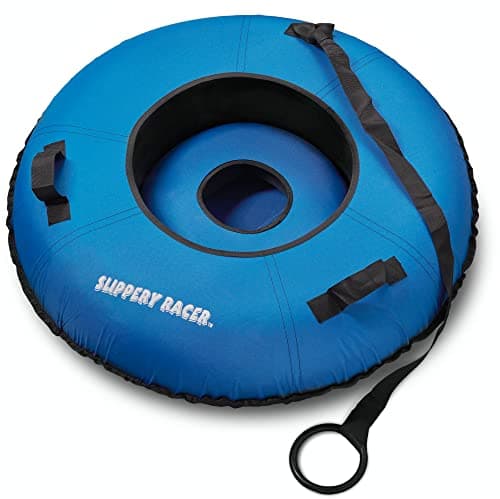
The pick, on a published 42 in inflated diameter - big enough for genuine adult-and-child tandem riding rather than nominally two-person. Slippery Racer publishes it as accommodating riders of all ages and as working well for tandem, and for a family that is the use case that actually happens.
The construction is where it separates from a supermarket tube. The cover is heavy nylon canvas with a published cold-resistant treatment, which is the specification that stops a cover stiffening and splitting on a genuinely cold day - the standard failure mode of a cheap tube. Underneath is a slick-coated hard polyethylene base rather than bare vinyl, which is what takes the wear. Double-reinforced webbed grip handles and a reinforced pulley tow rope are both published.
Honest cons: the maker publishes no maximum rider weight, which is the figure you most want before putting two people on it. It is inflatable, so it needs a pump and it is the only sled here that can go flat halfway down a hill. No published warranty term. And no steering and no brake, which is inherent rather than a fault.
Slippery Racer Downhill Xtreme Toboggan
Not a tube, and here as the honest alternative. A published 48 x 18 in hard plastic toboggan at 1,360 g, which is the format to buy if the hill is short, if you want something that survives being left outside, or if an adult wants to ride down with a child who is not ready alone.
Honest cons: considerably more friction than a tube, so a gentle hill is slow. Hard plastic goes brittle in severe cold. No published warranty term.
Slippery Racer Downhill Pro Saucer Disc
A published 26 in disc, marked as the skip above. It is a cheap second sled for a small hill and it is not a tube.
Tube or sled, for your hill
- Short, gentle hill. A sled. A tube barely gets moving and the pumping is not worth it.
- Long hill with a big clear runout. A tube, and this is where it is genuinely better than everything else.
- Hill with anything at the bottom. Neither. Find a different hill.
- Icy, hard-packed surface. A sled you can at least partly steer. Ice is the surface where a tube’s lack of control becomes a real problem.
- Resort tubing lane. They provide the tube. Bring nothing.
Using one properly
- Inflate it warm, top it up cold. Air contracts in the cold, so a tube inflated indoors goes soft outside. A soft tube drags and steers even less.
- Do not over-inflate. A drum-tight tube is more likely to split at a seam and bounces rather than absorbing bumps.
- Feet first, lying back, hands on the handles. Head first is how neck and head injuries happen, and it is worth being firm about with children.
- Helmets. A ski or snowboard helmet is exactly right for this, and a child who already owns one should wear it. The kids helmet roundup is here.
- Never tow a tube behind a vehicle. Including a snowmobile, an ATV, or a car on a quiet road.
- Dry it before storing. A damp cover in a garage over summer grows mildew and the cover is the expensive part.
Who should buy what
- A family with a long local hill. The Grande XL.
- A parent riding with a small child. The Grande XL, published for tandem.
- A short garden slope. The toboggan or the saucer.
- A non-skiing day on a ski trip. Buy nothing and book a resort tubing lane. The non-skier page covers what to wear.
- Children under about five. A small sled with a parent, not a tube. The kids sled roundup.
Every pick, with the working
Each entry shows the published inputs, the axis scores they produce, and what you give up. The order is the computed order, not a commercial one, and the arithmetic is open underneath each score.
1 · An adult and a child riding together on a groomed tubing hill
Slippery Racer Grande XL Snow Tube
A published 42 inch inflated diameter with a heavy nylon canvas cover, an IceVex cold-resistant treatment and a slick-coated polyethylene hard base. It is published as suitable for adult and child tandem riding, which is the use case most families actually have, and the maker publishes no maximum rider weight at all.
- Published price
- Not published
- Cost per day on snow
- Not published
- Amortized over
- 3 seasons (15 days)
- Certified to
- Not published
- Published sizes
- One size, 42 in inflated diameter
- Warranty
- No term published on the product page
What it gets right
- 42 in published diameter, big enough for tandem riding rather than nominally two-person
- Nylon canvas cover with a published cold-resistant treatment, which is what stops a cheap tube splitting at low temperatures
- Slick-coated polyethylene hard base published, rather than bare vinyl
- Double-reinforced webbed grip handles and a pulley tow rope published
What you give up
- The maker publishes no maximum rider weight, which is the figure you most want
- Inflatable, so it needs a pump and it is the one sled that can go flat on the hill
- No published warranty term
- A tube has no steering and no brake, which is a real limit on any hill with obstacles
The working behind the 0.0
- Cost per day on snow: not scored
- No manufacturer-published price, so this axis is not scored.
- Published protection: not scored
- Sleds carry no US protective standard, which is itself worth knowing.
- Size availability: not scored
- Sold in one size, so size availability does not apply.
- Warranty and support: 0.0
- no published term (0 of 6); no published crash replacement (+0); no published repair route (+0)
Axes with unpublished inputs are dropped and the remaining weights re-normalized, so a product is not punished for a manufacturer’s silence. Specifications compiled September 12, 2026 from Slippery Racer published Grande XL specifications.
2 · An adult riding down with a child who is not ready alone
Slippery Racer Downhill Xtreme Toboggan
A 250 lb published capacity on a 48-inch deck means an adult can ride with a small child, which is the difference between a sled a four-year-old uses and one they watch. Note that no US safety standard applies to sleds at all.
- Published price
- Not published
- Cost per day on snow
- Not published
- Amortized over
- 3 seasons (15 days)
- Certified to
- Not published
- Published sizes
- One size, 48 x 18 in
- Weight
- 1360 g
- Warranty
- No term published
Slippery Racer publishes no MSRP we could read, so the cost-per-day axis is not scored for this sled. Amazon also suppresses the displayed price on this listing because it sits below the maker's minimum advertised price, so the button reads Check price rather than a figure; the listing was verified in stock on September 26, 2026 and is sold there as a two-pack.
What it gets right
- 250 lb published weight capacity, enough for an adult plus a small child
- 48 x 18 in deck with contoured edges to hold on to
- 3 lb, so a child can carry it back up the hill themselves
What you give up
- No published MSRP
- No safety standard applies to sleds in the US, so there is no certification to check on any sled, this one included
The working behind the 0.0
- Cost per day on snow: not scored
- No manufacturer-published price, so this axis is not scored.
- Published protection: not scored
- Sleds carry no US protective standard, which is itself worth knowing.
- Size availability: not scored
- Sold in one size, so size availability does not apply.
- Warranty and support: 0.0
- no published term (0 of 6); no published crash replacement (+0); no published repair route (+0)
Axes with unpublished inputs are dropped and the remaining weights re-normalized, so a product is not punished for a manufacturer’s silence. Specifications compiled September 3, 2026 from Slippery Racer published specifications.
3 · One child on a wide, open hill with a long clear runout
Slippery Racer Downhill Pro Saucer Disc Sled
Skip this one. A published 26 inch plastic saucer, and it is the cheapest thing here by a distance - which is why it ends up compared against a tube. It is not a tube and it does not behave like one: a saucer spins, and it puts a child on a rigid disc on the snow rather than on an air cushion. Buy it as a second sled for a small hill. Do not buy it expecting a tube.
A 26-inch disc, which is the fastest and least steerable shape there is. That is the whole trade: children love it and it goes where the hill sends it, so the hill has to be chosen carefully. Unlike most saucers it publishes molded hand grips, so there is at least something to hold.
- Published price
- Not published
- Cost per day on snow
- Not published
- Amortized over
- 3 seasons (15 days)
- Certified to
- Not published
- Published sizes
- One size, 26 in diameter
- Warranty
- No term published
Slippery Racer publishes no MSRP we could read.
What it gets right
- Published 26 in diameter in one-piece injection-molded polyethylene, with nothing to inflate or assemble
- Molded hand grips published, which a bare disc does not give you
- Coated with the maker's published IceVex cold-resistant treatment
What you give up
- No published MSRP
- No published rider weight limit, so there is no figure to check an adult against
- A saucer spins and cannot be steered, so it needs an open hill with no trees or fences
The working behind the 0.0
- Cost per day on snow: not scored
- No manufacturer-published price, so this axis is not scored.
- Published protection: not scored
- Sleds carry no US protective standard, which is itself worth knowing.
- Size availability: not scored
- Sold in one size, so size availability does not apply.
- Warranty and support: 0.0
- no published term (0 of 6); no published crash replacement (+0); no published repair route (+0)
Axes with unpublished inputs are dropped and the remaining weights re-normalized, so a product is not punished for a manufacturer’s silence. Specifications compiled October 12, 2026 from Slippery Racer published Downhill Pro specifications.
Prices last verified October 19, 2026. Prices move constantly; the figure on Amazon at the moment you click is the real one.
Questions people actually ask
What size snow tube do I need?
Published inflated diameter is the figure to shop on. A 42 inch tube like the Slippery Racer Grande XL takes an adult, or an adult and a child riding tandem. Smaller tubes are single-child. Bigger is not automatically better - a large tube on a short hill is slow and awkward to drag back up.
Are snow tubes faster than sleds?
Considerably. A tube rides on a curved slick surface with a small contact patch and deforms over bumps instead of being slowed by them, where a plastic sled has its whole base in contact and correspondingly more friction. The trade is that a tube has no steering and no brake at all.
Are snow tubes safe for kids?
On the right hill, with the right rules. A tube cannot be steered or stopped, so the hill has to do both jobs: a long clear runout with nothing at the bottom and nothing to hit on either side. Ride feet first lying back, wear a helmet, and never tow a tube behind any vehicle.
What should I look for in a snow tube?
A nylon canvas cover with a published cold-resistant treatment, which is what stops a cheap tube stiffening and splitting in real cold, and a hard polyethylene base rather than bare vinyl, which is what takes the wear. Then reinforced handles and a tow rope. Maximum rider weight is the figure you most want and many makers do not publish it.
How much should I inflate a snow tube?
Firm but not drum-tight, and top it up once it is outside - air contracts in the cold, so a tube inflated in a warm garage goes soft on the hill. Over-inflating makes it more likely to split at a seam and makes it bounce over bumps rather than absorbing them.