Snowboard boots, compared on what the makers actually publish
The boot is the only component you should buy before you can ride properly. Here is what three of them publish, and what the published numbers do not tell you.
By Sawyer V. · Published
We have not tested this gear. Everything below is compiled from published specifications and published safety standards, and the arithmetic is public so you can check it. This page carries affiliate links: if you buy through one we earn a commission at no extra cost to you, and it does not change the order of the picks. Full disclosure.
The short answer
Buy boots first, before a board and before bindings - the boot decides your binding size and whether you need a wide board. For a first or second season, buy a soft to medium flex boot with a heat-moldable liner, and choose the closure you will still be able to work with cold wet hands. Your heel must not lift. Everything else on the spec sheet is secondary.
| # | Pick | Best for | Score | Price |
|---|---|---|---|---|
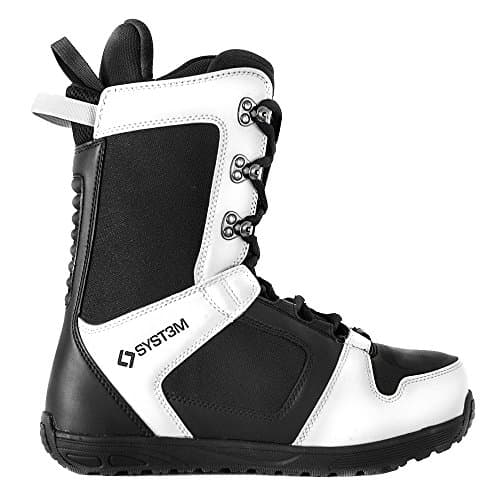
| 1 | System APX Lace Snowboard Boots A first pair of snowboard boots for an adult, bought on a budget | $9.33 a dayon snow | 4.9/10 | $139.95 - View on Amazon |
| 2 | Siren Lux Women's Snowboard Boots A woman buying her first pair rather than renting again | $8.66 a dayon snow | 4.7/10 | $169.95 - View on Amazon |
| 3 | System APX Pro Twist Snowboard Boots Anyone who has tried to re-lace a boot with cold wet hands | $12.66 a dayon snow | 4.1/10 | $189.95 - View on Amazon |
Prices last verified October 19, 2026. Prices move constantly; the figure on Amazon at the moment you click is the real one.
Why the boot is the one thing to buy
This site normally tells families to rent the hardware, and for skis that advice stands. The what-to-buy-first page sets out the order and boards are near the bottom of it. Snowboard boots are the exception, for a reason that is mechanical rather than sentimental.
A snowboard has no release setting and no shop calibration. Every input you make travels from your ankle, through the boot cuff, into the binding highback and out to the edge. If the boot is loose the input arrives late and weaker than you meant it, and the board does not do what you asked. A rental boot with a heel that lifts half an inch is not a minor annoyance - it removes an entire steering method.
The second reason is sizing order. Your boot size sets your binding size and it sets whether you need a wide board. The boot sizing page explains shell sizing and the toe-brush test, and it is worth reading before you look at any product on this page.
The four things worth comparing
- Closure. Laces, a dial, or a two-stage system. This is the decision most people get wrong by assuming more expensive is better. The lacing systems page compares them properly.
- Liner. A heat-moldable liner can be shaped to your foot at a shop, usually free with the boot. A non-moldable liner packs out to whatever shape it ends up in.
- Size run. How many sizes the maker publishes, and where the run starts and stops. A boot that does not exist in your size is not a pick.
- Warranty. A published term, or the absence of one. Three of these boots publish three years, which is longer than most snow gear states.
Notice what is not on that list: flex numbers. None of these makers publishes a numeric flex rating, only a description, and a number invented from a description would be a number we made up. What you can rely on is the shape of the advice - for a first or second season you want soft to medium, because a stiff boot transmits every mistake straight to the edge. The snowboard boot explainer covers flex and fit in detail.
The three, side by side
| APX Lace | APX Pro Twist | Siren Lux | |
|---|---|---|---|
| Closure | Laces plus heel-lock loop | Twist dial and cable | Quicklace liner in outer laces |
| Liner | Thermofit, heat-moldable | Thermofit, heat-moldable | Thermofit, heat-moldable |
| Published sizes | 6 (US 8-13) | 6 (US 8-13) | 5 (women's 6-10) |
| Warranty | 3 years | 3 years | 3 years |
| Published flex | Described, not rated | Described, not rated | Flex panels published |
| Adjustable mid-day | Slowly | Yes, with gloves on | Two stages, slowly |
The row that decides it for most people is the last one. Everything else on that table is close to identical across the three, which is itself useful information: you are choosing a closure and a last, not a fundamentally different boot.
The picks
System APX Lace
The value pick, and for a first season it is the one to buy. A published $139.95 gets a heat-moldable liner, a three-year published warranty and a heel-locking loop - a separate lace loop that cinches the boot at the ankle, which is the specific mechanical answer to a lifting heel.
Laces get called old-fashioned. They are also the only closure you can diagnose without a shop: if the boot is loose across the forefoot and tight at the ankle, you loosen the forefoot. A dial applies one tension to a whole zone and you take what it gives you.
The real limitation is the size run. Six published sizes, all US 8 and up. If you wear a 7, this boot does not exist for you.
System APX Pro Twist
Marked as the skip above, and the skip is conditional rather than absolute. It is the same shell and the same liner with a twist dial and a cable running through reinforced eyelets, for $50 more.
There is one situation where that fifty dollars is obviously worth it: you have poor circulation, you ride with the boot deliberately loose on the lift and tight on the run, and you need to change that with gloves on. If that describes you in that sentence, buy the dial. The cold hands page covers why loosening things helps.
Siren Lux
The cheapest boot in this ledger at a published $129.95, and the only one built on a women’s last rather than a unisex one sold in smaller sizes.
Its closure is genuinely interesting: a quicklace system on the inner liner, inside reinforced traditional laces on the outer shell. Two stages means the forefoot and the ankle can be set to different tensions, which is exactly what a narrower foot in a boot with a fixed volume needs. Published flex panels in the shell are what stop a soft boot bulging out at the ankle instead of bending.
Five published sizes, women’s 6 to 10. Outside that, none of the three boots on this page fit you.
What none of this tells you
Whether it fits. That is not modesty, it is the honest limit of a page built from published specifications.
A snowboard boot should feel snug everywhere with your toes just brushing the end when you stand upright, and your toes should pull back off the end as soon as you flex your knees into a riding stance. Your heel should stay down through that movement. If it lifts, the boot is too big or the wrong shape, and no amount of published specification changes that.
Two practical consequences. First, buy where you can return them, and try them on at the end of the day when your feet are largest. Second, if a shop offers to heat mold the liner, let them - all three boots here publish a moldable liner and it is usually free with the boot.
And the case for not buying at all
If you will ride two days this winter, rent. Two days of rental boots is cheaper than any boot here and you learn what size you actually are. The rent-or-buy page on boots runs the arithmetic and it comes out for renting more often than a gear site normally admits.
The point at which buying wins is around the fourth or fifth day on snow, and it arrives sooner if you are unusual in size - because the rental fleet has three of your size and they are gone by nine o’clock.
Every pick, with the working
Each entry shows the published inputs, the axis scores they produce, and what you give up. The order is the computed order, not a commercial one, and the arithmetic is open underneath each score.
1 · A first pair of snowboard boots for an adult, bought on a budget
System APX Lace Snowboard Boots
The cheapest boot here that publishes a heat-moldable liner and a three-year warranty, and traditional laces are the closure a beginner can actually diagnose: if it is loose in one place you tighten that place. The published heel-locking loop is the detail that matters, because heel lift is what stops a beginner steering.
- Published price
- $139.95
- Cost per day on snow
- $9.33 a day
- Amortized over
- 3 seasons (15 days)
- Certified to
- Not published
- Published sizes
- US 8, 9, 10, 11, 12 and 13
- Warranty
- System 3-year warranty against manufacturer defects
What it gets right
- Three-year published warranty against manufacturer defects, longer than most makers state at any price
- Thermofit heat-moldable liner published, so a shop can shape it to your foot
- Published heel-locking loop, which is the specific fix for a lifting heel
- Laces are repairable anywhere, unlike a failed dial
What you give up
- Six published sizes, all US 8 and up, so smaller feet are not catered for at all
- Laces are slower to adjust with cold hands than a dial, every single time
- No published flex number, only a description
The working behind the 4.9
- Cost per day on snow: 4.2
- $139.95 over 3 seasons at 5 days each = 15 days = $9.33 a day
- Published protection: not scored
- Boots carry no US protective standard, so this axis is not scored. On a winter boot the published temperature rating is the figure that matters; on a snowboard or nordic boot it is the sole standard and the fit.
- Size availability: 8.5
- 6 published sizes (8.5 of 8.5); no continuous adjuster published (+0); range: US 8, 9, 10, 11, 12 and 13
- Warranty and support: 2.5
- 3 yr (2.5 of 6); no published crash replacement (+0); no published repair route (+0)
Axes with unpublished inputs are dropped and the remaining weights re-normalized, so a product is not punished for a manufacturer’s silence. Specifications compiled September 12, 2026 from System published specifications.
2 · A woman buying her first pair rather than renting again
Siren Lux Women's Snowboard Boots
The cheapest boot in this ledger and the only one built on a women's last, with a two-stage closure: a quicklace inner liner inside reinforced traditional outer laces. Two stages is the point, because it sets forefoot and ankle tension separately, which is the adjustment a narrower foot actually needs.
- Published price
- $129.95
- Cost per day on snow
- $8.66 a day
- Amortized over
- 3 seasons (15 days)
- Certified to
- Not published
- Published sizes
- US women's 6, 7, 8, 9 and 10
- Warranty
- Siren 3-year warranty against manufacturer defects
What it gets right
- Quicklace liner inside traditional outer laces, so forefoot and ankle tension are set separately
- Thermofit heat-moldable liner and the same three-year published warranty as the men's range
- Published flex panels in the shell, which is what stops a soft boot bulging at the ankle
- Cheapest snowboard boot here by ten dollars
What you give up
- Five published sizes, US 6 to 10, so smaller and larger feet fall outside it
- No published flex number and no published outsole detail
- Two lacing stages is more to learn on the first morning than one dial
The working behind the 4.7
- Cost per day on snow: 4.7
- $129.95 over 3 seasons at 5 days each = 15 days = $8.66 a day
- Published protection: not scored
- Boots carry no US protective standard, so this axis is not scored. On a winter boot the published temperature rating is the figure that matters; on a snowboard or nordic boot it is the sole standard and the fit.
- Size availability: 6.8
- 5 published sizes (6.8 of 8.5); no continuous adjuster published (+0); range: US women's 6, 7, 8, 9 and 10
- Warranty and support: 2.5
- 3 yr (2.5 of 6); no published crash replacement (+0); no published repair route (+0)
Axes with unpublished inputs are dropped and the remaining weights re-normalized, so a product is not punished for a manufacturer’s silence. Specifications compiled September 12, 2026 from Siren published specifications.
3 · Anyone who has tried to re-lace a boot with cold wet hands
System APX Pro Twist Snowboard Boots
Skip this one. Only if the dial solves a problem you actually have. It is the same shell, the same heat-moldable liner and the same warranty as the lace version for fifty dollars more, and the whole fifty dollars buys convenience. A dial or cable that fails is a shop repair; a lace that fails is a two-dollar fix in the parking lot. Buy it if you have cold hands and re-tension boots mid-day. Do not buy it because it looks like the better one.
The same boot with a dial instead of laces, for fifty dollars more. That fifty dollars buys one thing and it is a real thing: you can re-tension the boot on a chairlift with gloves on, which is exactly when you discover the boot is too loose.
- Published price
- $189.95
- Cost per day on snow
- $12.66 a day
- Amortized over
- 3 seasons (15 days)
- Certified to
- Not published
- Published sizes
- US 8, 9, 10, 11, 12 and 13
- Warranty
- System 3-year warranty against manufacturer defects
What it gets right
- Twist-dial closure with a cable through reinforced eyelets, adjustable in seconds with gloves on
- Same Thermofit heat-moldable liner and same three-year warranty as the lace version
- A continuous adjuster means the fit can be changed through the day rather than only at the start
What you give up
- A broken dial or cable is a shop repair, where a broken lace is a two-dollar fix in the parking lot
- Fifty dollars more than the lace model for the same shell and liner
- Still only six published sizes, all US 8 and up
The working behind the 4.1
- Cost per day on snow: 1.7
- $189.95 over 3 seasons at 5 days each = 15 days = $12.66 a day
- Published protection: not scored
- Boots carry no US protective standard, so this axis is not scored. On a winter boot the published temperature rating is the figure that matters; on a snowboard or nordic boot it is the sole standard and the fit.
- Size availability: 10.0
- 6 published sizes (8.5 of 8.5); continuous in-size adjuster published (+1.5); range: US 8, 9, 10, 11, 12 and 13
- Warranty and support: 2.5
- 3 yr (2.5 of 6); no published crash replacement (+0); no published repair route (+0)
Axes with unpublished inputs are dropped and the remaining weights re-normalized, so a product is not punished for a manufacturer’s silence. Specifications compiled September 12, 2026 from System published specifications.
Prices last verified October 19, 2026. Prices move constantly; the figure on Amazon at the moment you click is the real one.
Questions people actually ask
Should I buy snowboard boots before a board?
Yes. The boot decides which binding size fits and whether you need a wide board, so buying it first removes two compatibility problems. It is also the component that most affects control: a boot with a lifting heel makes steering by ankle pressure impossible, whatever board is underneath it.
Are BOA or dial snowboard boots better than laces?
They are faster, not better. A dial lets you re-tension the boot in seconds with gloves on, which genuinely matters if you ride with cold hands. Laces let you set different tensions in different places and can be repaired anywhere. A failed dial or cable usually needs a shop.
How should a snowboard boot fit?
Snug everywhere, with your toes just brushing the end when you stand upright and pulling back off the end as soon as you bend your knees into a riding stance. Your heel must stay down through that movement. Try boots on at the end of the day when your feet are at their largest.
What flex should a beginner snowboard boot be?
Soft to medium. A stiff boot transmits every input to the edge instantly, including the ones you did not mean to make, which is the opposite of what a beginner needs. None of the makers here publishes a numeric flex rating, only a description, so treat any specific number you see elsewhere with suspicion.
Is a heat-moldable liner worth it?
Yes, and all three boots here publish one. A shop heats the liner and you stand in it while it cools, so it takes the shape of your foot rather than packing out to a random shape over the first ten days. It is usually free with the boot, which makes it the best-value fitting service in snowboarding.