The best snowboard helmets, and the impact they are actually for
A snowboarder catches a heel edge and lands on the back of the head, flat, with no hands out. It is the single most specific reason to wear a helmet in either sport.
By Sawyer V. · Published
We have not tested this gear. Everything below is compiled from published specifications and published safety standards, and the arithmetic is public so you can check it. This page carries affiliate links: if you buy through one we earn a commission at no extra cost to you, and it does not change the order of the picks. Full disclosure.
The short answer
Buy the same certified helmets skiers buy - there is no separate snowboard standard, and ASTM F2040 covers both. What changes is the priority: a snowboarder falls backward onto the back of the head far more often than a skier does, so a published rotational-impact system and real coverage at the back of the shell move up the list. The Smith Cache Mips is the pick.
| # | Pick | Best for | Score | Price |
|---|---|---|---|---|
| 1 | Smith Cache Mips A head at the edges of the size range, or one between two sizes | $5 a dayon snow | 6.7/10 | $160.00 - View on Amazon |
| 2 | Giro Ledge Mips A rider who wants a low-profile hard shell and knows their size | $5.00 a dayon snow | 6.2/10 | $99.99 - View on Amazon |
| 3 | OutdoorMaster Kelvin 2 Mips Families buying several helmets at once | $2.80 a dayon snow | 6.9/10 | $59.99 - View on Amazon |
| 4 | Retrospec Comstock A spare helmet, or a second one for a visiting relative | $1.92 a dayon snow | 5.5/10 | $47.99 - View on Amazon |
Prices last verified October 19, 2026. Prices move constantly; the figure on Amazon at the moment you click is the real one.
The fall this page is about
Both feet are strapped to one board. When a snowboarder catches the heel edge, the board stops, the body keeps going backward, and there is no way to step out of it and no free foot to catch it with. The hands go back, the wrists take a load they are not built for, and the back of the head arrives last.
That sequence is why the injury profile differs from skiing even though the equipment standard does not. Skiers fall forward and sideways and their legs release from the skis; snowboarders fall backward with both feet fixed. The wrist and impact protection page covers the other end of that same fall, and it is genuinely the more common injury.
What to prioritize, in order
| Priority | What to check | Why it moves up for snowboarding |
|---|---|---|
| 1. Published certification | ASTM F2040 stated for that exact model | Unchanged. This is the floor in either sport. |
| 2. Rotational system | Mips or an equivalent the maker names | Designed for angled impacts, which is what a flat backward landing produces |
| 3. Rear coverage | Shell extending down over the occiput | That is the part of the head that lands |
| 4. Published size band | A centimeter range containing your measurement | A loose helmet rotates on impact, which defeats the other three |
| 5. Goggle integration | No gap at the brow | A gap is a cold forehead and a helmet sitting wrong |
Notice what is not on that list: vents, audio compatibility, weight and price. They are all real considerations and none of them belongs above the first four.
The picks
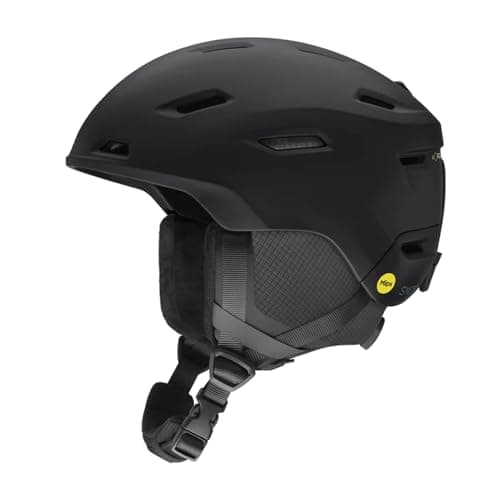
Smith Cache Mips
The pick. It publishes both ASTM F2040 and CE EN 1077:2007 Class B, carries Mips, and covers 51 to 67 cm across four sizes - which is the widest published band on this site and the reason it suits the largest number of people.
Eleven vents with five adjustable, a dial adjuster and a published three-year warranty, the longest term here. For a rider learning heel-edge turns, the combination of a published US certification and a published rotational system is exactly the specification this page is asking for.
Honest cons: at 550 g it is the heaviest here, and it is the second most expensive.
Giro Ledge Mips
The hard-shell alternative, and the shape is the reason it is on this page. A hard outer shell takes the scuffing that a snowboarder’s helmet gets from being dropped, sat on and stacked on a rack - which is not a safety argument, but it is an honest durability one.
Published certification and Mips. Honest cons: fewer published sizes than the Smith, and hard shells tend to be less ventilated than in-mold ones on a warm day.
OutdoorMaster Kelvin II Mips
The value pick, and it publishes the two things that matter: a certification and a rotational system. If the alternative is skipping the helmet because of the price, this is the answer.
Honest cons: shorter published warranty and fewer published sizes than the Smith.
Fit, and the one snowboard-specific check
The fit process is the same as skiing - measure, buy inside the published band, set the dial - with one addition worth doing.
Put the helmet on and tip your head back as if you were looking up a lift line. The rear rim should not push the helmet forward over your eyes. A helmet that does that is either too far back or too shallow at the rear, and on the one fall this page is about, that rim is the part doing the work.
The rest is standard: no gap at the brow, the shake test with the strap undone, and nothing thick underneath that changes the fit.
The rest of the beginner snowboard protection list
A helmet is first and it is not the whole answer, because the same fall lands on wrists and tailbone on the way down.
- Wrist guards. The most-broken bone in snowboarding, and the cheapest thing on this list. The protection page compares what is published.
- Impact shorts. Two or three days of landing on a tailbone is exactly the learning period, and it is the injury that ends a trip without breaking anything.
- A lesson. Heel-edge control is the thing being taught, and it is the thing that stops the fall happening. The lessons page runs that arithmetic.
- Goggles that fit the helmet. Not protection, but a rider who cannot see the terrain catches more edges.
Who should buy what
- Learning to snowboard. The Smith, or the OutdoorMaster if the budget is tight. Both publish a rotational system.
- Already riding, replacing a helmet. The Giro, for the hard shell.
- A child. A kids-specific shell, not an adult one sized down. The kids roundup is here and the size chart has the measuring method.
- Skiing too. The same helmet. One shell covers both sports and there is no version of this where you need two.
Every pick, with the working
Each entry shows the published inputs, the axis scores they produce, and what you give up. The order is the computed order, not a commercial one, and the arithmetic is open underneath each score.
1 · A head at the edges of the size range, or one between two sizes
Smith Cache Mips
The widest published head range of any helmet on this page and the only one certified to both the US and European standards while carrying a rotational-impact liner, a dial adjuster and a three-year warranty. It is also the second most expensive, and 550 g is not light.
- Published price
- $125
- Cost per day on snow
- $5 a day
- Amortized over
- 5 seasons (25 days)
- Certified to
- ASTM F2040, CE EN 1077:2007 Class B
- Rotational system
- Mips
- Published sizes
- 51-67 cm across S, M, L and XL
- Weight
- 550 g
- Warranty
- Smith 3-year limited warranty
What it gets right
- Certified to ASTM F2040 and CE EN 1077:2007 Class B
- Four published sizes covering 51-67 cm, so odd-sized heads are actually catered for
- Three-year warranty, the longest published term in this group
- Eleven vents, five of them adjustable, which matters more than it sounds on a warm spring afternoon
What you give up
- 550 g in size medium is the heaviest here, and a child or a light adult will notice it
- No published crash-replacement program
The working behind the 6.7
- Cost per day on snow: 7.4
- $125 over 5 seasons at 5 days each = 25 days = $5 a day
- Published protection: 9.0
- ASTM F2040 (+4); CE EN 1077 (+2); Mips rotational system (+3)
- Size availability: 6.6
- 4 published sizes (5.1 of 8.5); continuous in-size adjuster published (+1.5); range: 51-67 cm across S, M, L and XL
- Warranty and support: 2.5
- 3 yr (2.5 of 6); no published crash replacement (+0); no published repair route (+0)
Axes with unpublished inputs are dropped and the remaining weights re-normalized, so a product is not punished for a manufacturer’s silence. Specifications compiled September 3, 2026 from Smith published specifications.
2 · A rider who wants a low-profile hard shell and knows their size
Giro Ledge Mips
A hard-shell helmet with the same two certifications and the same rotational liner as the Smith, 50 g lighter, at effectively the same price. What it does not publish is a dial adjuster, and its warranty is a year against Smith's three.
- Published price
- $124.95
- Cost per day on snow
- $5.00 a day
- Amortized over
- 5 seasons (25 days)
- Certified to
- ASTM F2040-11, CE EN 1077
- Rotational system
- Mips
- Published sizes
- 52-65 cm across S, M, L and XL
- Weight
- 500 g
- Warranty
- Giro 1-year limited warranty
What it gets right
- ASTM F2040-11 and CE EN 1077 certified, with the Mips liner included
- 500 g in medium, 50 g under the Smith
- Molded ABS outer shell bonded to an EPS liner, the tougher of the two common constructions
What you give up
- Giro publishes a one-year limited warranty on snow helmets, the shortest term here
- No continuous dial adjuster published for this model, so getting the right size first time matters more
- Six vents, and none of them published as adjustable
The working behind the 6.2
- Cost per day on snow: 7.4
- $124.95 over 5 seasons at 5 days each = 25 days = $5.00 a day
- Published protection: 9.0
- ASTM F2040 (+4); CE EN 1077 (+2); Mips rotational system (+3)
- Size availability: 5.1
- 4 published sizes (5.1 of 8.5); no continuous adjuster published (+0); range: 52-65 cm across S, M, L and XL
- Warranty and support: 1.5
- 1 yr (1.5 of 6); no published crash replacement (+0); no published repair route (+0)
Axes with unpublished inputs are dropped and the remaining weights re-normalized, so a product is not punished for a manufacturer’s silence. Specifications compiled September 3, 2026 from Giro published specifications.
3 · Families buying several helmets at once
OutdoorMaster Kelvin 2 Mips
The cheapest helmet here that carries both certifications and a rotational liner, at a published $69.99. For a family buying four helmets at once that difference is most of a lift ticket, and nothing in the published safety spec is missing.
- Published price
- $69.99
- Cost per day on snow
- $2.80 a day
- Amortized over
- 5 seasons (25 days)
- Certified to
- ASTM F2040-18, CE EN 1077:2007 Class B
- Rotational system
- Mips
- Published sizes
- Three published sizes, S through L
- Warranty
- OutdoorMaster 2-year warranty
What it gets right
- ASTM F2040-18 and CE EN 1077:2007 Class B, with Mips, for a published $69.99
- Two-year warranty, double Giro's published term
- Fourteen vents and a dial adjuster
What you give up
- Three published sizes rather than four, so the extremes of the range are less well covered
- No published weight, so you cannot compare it on the scale before you buy
The working behind the 6.9
- Cost per day on snow: 9.0
- $69.99 over 5 seasons at 5 days each = 25 days = $2.80 a day
- Published protection: 9.0
- ASTM F2040 (+4); CE EN 1077 (+2); Mips rotational system (+3)
- Size availability: 4.9
- 3 published sizes (3.4 of 8.5); continuous in-size adjuster published (+1.5); range: Three published sizes, S through L
- Warranty and support: 2.5
- 2 yr (2.5 of 6); no published crash replacement (+0); no published repair route (+0)
Axes with unpublished inputs are dropped and the remaining weights re-normalized, so a product is not punished for a manufacturer’s silence. Specifications compiled September 3, 2026 from OutdoorMaster published specifications.
4 · A spare helmet, or a second one for a visiting relative
Retrospec Comstock
Skip this one. It publishes a certification and a dial, which is genuinely all a helmet has to do, and for skiing we recommend it happily. For snowboarding specifically it is the one to skip, because it publishes no rotational-impact system - and the flat backward fall a snowboarder takes is the exact loading those systems were designed around. Buy it as a ski helmet or a second helmet; buy a Mips shell to learn to snowboard in.
Certified to both standards at under fifty dollars, with a dial adjuster and ten vents. What it does not have, at any price or size, is a rotational-impact liner, and that is the one thing on this page worth paying for.
- Published price
- $47.99
- Cost per day on snow
- $1.92 a day
- Amortized over
- 5 seasons (25 days)
- Certified to
- ASTM F2040, CE EN 1077 Class B
- Rotational system
- None published
- Published sizes
- 55-58 cm and 59-62 cm
- Warranty
- Limited warranty; no term published
What it gets right
- ASTM F2040 and CE EN 1077 Class B certified at a published $47.99
- ErgoKnob dial adjuster, which several helmets costing three times as much do not publish
- ABS shell over an EPS liner, the tougher construction
What you give up
- No rotational-impact system in any version
- Only two adult sizes, covering 55-62 cm, so anything outside that is not served
- Retrospec publishes a limited warranty but no term we could find
The working behind the 5.5
- Cost per day on snow: 9.7
- $47.99 over 5 seasons at 5 days each = 25 days = $1.92 a day
- Published protection: 6.0
- ASTM F2040 (+4); CE EN 1077 (+2); no rotational-impact system (+0)
- Size availability: 3.2
- 2 published sizes (1.7 of 8.5); continuous in-size adjuster published (+1.5); range: 55-58 cm and 59-62 cm
- Warranty and support: 0.0
- no published term (0 of 6); no published crash replacement (+0); no published repair route (+0)
Axes with unpublished inputs are dropped and the remaining weights re-normalized, so a product is not punished for a manufacturer’s silence. Specifications compiled September 3, 2026 from Retrospec published specifications.
Prices last verified October 19, 2026. Prices move constantly; the figure on Amazon at the moment you click is the real one.
Questions people actually ask
Do I need a snowboard-specific helmet?
No. There is no snowboard-specific standard - ASTM F2040 in the US and CE EN 1077 in Europe are written for non-motorized recreational snow sports and cover both. What changes is priority: a published rotational-impact system and real coverage at the back of the shell matter more, because the snowboarder’s fall lands there.
Why do snowboarders hit the back of their head?
Because both feet are strapped to one board. When the heel edge catches, the board stops and the body continues backward with no free foot to step out with and no way to release. The hands go back, then the back of the head lands flat. It is the most characteristic fall in the sport and the reason wrist guards and a helmet go together.
Is MIPS worth it for snowboarding?
It matters more here than in skiing, for a specific reason: rotational systems are designed for angled impacts, and a flat backward landing on a hard-packed run produces exactly that loading. It is not a substitute for certification - buy a helmet that publishes ASTM F2040 first, then treat a published rotational system as the next criterion.
Can I use my ski helmet for snowboarding?
Yes. It is tested to the same standard and there is no technical reason to own two. The only thing worth rechecking is rear coverage and fit - tip your head back as if looking up a lift line and confirm the rear rim does not push the helmet forward over your eyes.
What else should a beginner snowboarder wear?
Wrist guards, then impact shorts, in that order, because the same backward fall lands on both before the head. Wrists are the most commonly broken bone in snowboarding and guards are the cheapest protective item you can buy. A lesson that teaches heel-edge control prevents more injuries than any of it.