Ski lessons: group or private, how many, and what to bring
The most common way a family wastes money on a first ski trip is by skipping the lesson and spending three days making the same mistake.
By Sawyer V. · Published
We have not tested this gear. Everything below is compiled from published specifications and published safety standards, and the arithmetic is public so you can check it. This page carries affiliate links: if you buy through one we earn a commission at no extra cost to you, and it does not change the order of the picks. Full disclosure.
The short answer
Book a lesson. For an adult beginner, a group lesson on each of the first two days is the best value; for a nervous adult or an adult with a specific problem, one private lesson beats three group ones. Children go in group lessons, which are better for them socially and cheaper for you. Bring your own socks, base layer, goggles, gloves and helmet - the school supplies instruction, not clothing.
| # | Pick | Best for | Score | Price |
|---|---|---|---|---|
| 1 | Darn Tough Alpine Over-the-Calf Lightweight Ski Socks The one piece of ski gear worth buying before anything else | $2 a dayon snow | 6.4/10 | $30.95 - View on Amazon |
| 2 | Retrospec Comstock A spare helmet, or a second one for a visiting relative | $1.92 a dayon snow | 5.5/10 | $47.99 - View on Amazon |
| 3 | Smith Snowday A young child who will only ever own one lens, glasses or not | $5 a dayon snow | 5.1/10 | $50.00 - View on Amazon |
Prices last verified October 22, 2026. Prices move constantly; the figure on Amazon at the moment you click is the real one.
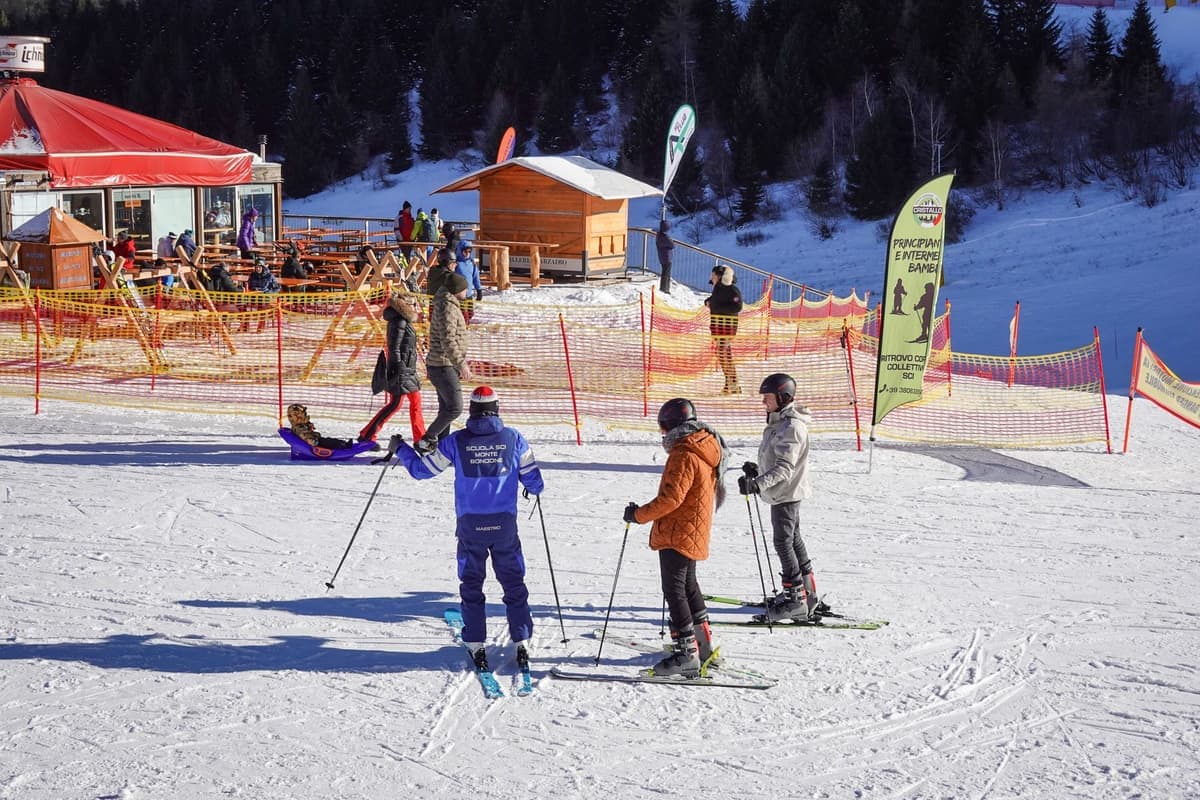
Why a lesson is the cheapest thing on a first trip
Add up a first family trip: travel, accommodation, four lift tickets, four rentals. Against that, a group lesson is a small fraction, and it is the only line item that changes whether anybody wants to come back.
The alternative that families try is a competent friend or relative teaching them. It fails for a reason that is nothing to do with the friend: skiing well and knowing how to teach a wedge turn are unrelated skills, and a person who learned as a child genuinely cannot remember what the difficult part was. What actually happens is three days of copying somebody, building habits that a later instructor has to undo, in a relationship where nobody can be honest about how it is going.
Group or private
| Group lesson | Private lesson | |
|---|---|---|
| Cost | Much lower per person | Several times the group rate, but split across a family |
| Pace | The pace of the slowest person in the group | Yours |
| Best for | Children, and confident adult beginners | Nervous adults, awkward ages, and specific problems |
| Length | Usually a half day, sometimes full | One to three hours |
| Social effect | Children learn faster with other children | Undivided attention, no peer pressure |
| Group size | Often up to eight or ten | One instructor, one to four family members |
The pattern most families land on: children in group lessons, adults in group lessons for a first day, and one private lesson booked for whichever adult is finding it hardest. A private lesson shared between two adults of similar ability is frequently cheaper per person than two separate group lessons and better than either.
How many days to book
Two half days on the first two days, rather than one full day at the start. The reasoning is straightforward: a beginner is physically tired after about three hours and stops learning, and the second lesson is where an instructor fixes what the first day taught you wrong.
- A three-day trip: lessons on days one and two, free skiing on day three. That is the trip most families should book.
- A week: lessons on days one, two and four. Day three off gives the learning time to settle; day four fixes what has drifted.
- A single day: one morning lesson, then two hours of practice, then stop. A first-timer on skis for a full unstructured day is a first-timer who never comes back.
- Children under seven: mornings only, always, whatever the length of the trip. The skiing-with-kids page covers the wider timing.
What the school expects you to have
Ski schools supply instruction and, in some countries, a lift pass for the beginner area. They do not supply equipment or clothing, and the rental shop does not supply anything that touches skin. The rental counter page covers that split. For a lesson specifically, bring:
- A helmet. Many schools require one for children and most expect one for adults. Rent it if you do not own one; a certified adult helmet with both published standards is inexpensive to own.
- Goggles. Sunglasses fall off and do not seal against wind. The comparison is here.
- One thin pair of ski socks. Not two, not cotton. Why thick socks make boots colder.
- Gloves, and a spare pair for a child. Wet hands end a lesson faster than anything else.
- A snack and water. Group lessons run two to three hours and children run out of fuel.
- Sunscreen. Beginner areas are low, open and reflective. Altitude and reflected light burn faster than people expect.
Booking, and the mistakes to avoid
Book before you arrive
Beginner group lessons at a busy resort sell out, and the ones that sell out first are the children’s morning sessions. Booking at the ticket window on the morning of day one is how a family ends up with an afternoon slot on day two.
Ask about the bundle
Almost every resort sells a beginner package that combines a lesson, a rental and a limited lift ticket at a lower combined price. It is nearly always cheaper than buying the three separately, and it also guarantees the rental gear matches what the class expects. The cost page shows where the money actually goes on a first trip, and it is not the gear.
Be honest on the booking form
Beginner means never. If you have skied twice, say so, because a genuine never-ever group moves at a pace that will bore you and an improver group will leave you behind. The same honesty applies at the rental counter, where the ability question feeds the binding release setting.
What to do after the lesson
Practice the thing you just did, on the same slope, for an hour. The temptation after a good lesson is to go and find a bigger run, and the result is a person doing an unfamiliar thing badly on terrain that punishes it, which undoes the morning.
Then stop. A beginner who quits while it is still fun comes back tomorrow; a beginner who skis until they are exhausted and cold has a bad last hour, and the last hour is what everyone remembers.
So, are they worth it?
For a first-timer: yes, unambiguously, and it is the highest-value line on the whole trip. For a second or third trip: a single private lesson to fix a specific problem is usually better value than more group time. For a confident intermediate: optional, and the money is better spent on more days on snow.
And if the budget is genuinely tight, the order to cut is: buy less gear, not fewer lessons. The budget setups page shows how far a small equipment budget goes, and the what-to-buy-first page puts lessons where they belong, which is above almost everything you could buy.
Every pick, with the working
Each entry shows the published inputs, the axis scores they produce, and what you give up. The order is the computed order, not a commercial one, and the arithmetic is open underneath each score.
1 · The one piece of ski gear worth buying before anything else
Darn Tough Alpine Over-the-Calf Lightweight Ski Socks
The only item in this entire ledger with an unconditional lifetime guarantee. It is a $30 sock that the maker will replace forever, which over any realistic number of ski days is the cheapest thing on the site.
- Published price
- $30
- Cost per day on snow
- $2 a day
- Amortized over
- 3 seasons (15 days)
- Certified to
- Not published
- Published sizes
- S through XL
- Warranty
- Unconditional lifetime guarantee
What it gets right
- Unconditional lifetime guarantee, published without qualifying conditions
- Lightweight merino, which is correct for a modern ski boot: a thick sock makes boots colder, not warmer
- Over-the-calf length, so the boot cuff never touches bare skin
What you give up
- $30 for one pair of socks reads as absurd until the replacement policy is read
- Lightweight is the right choice but feels wrong to anyone expecting a thick ski sock
The working behind the 6.4
- Cost per day on snow: 9.6
- $30 over 3 seasons at 5 days each = 15 days = $2 a day
- Published protection: not scored
- Socks carry no protective standard, so this axis does not apply.
- Size availability: 5.1
- 4 published sizes (5.1 of 8.5); no continuous adjuster published (+0); range: S through XL
- Warranty and support: 2.0
- no published term (0 of 6); no published crash replacement (+0); repair or replacement parts published (+2)
Axes with unpublished inputs are dropped and the remaining weights re-normalized, so a product is not punished for a manufacturer’s silence. Specifications compiled September 3, 2026 from Darn Tough published specifications.
2 · A spare helmet, or a second one for a visiting relative
Retrospec Comstock
Skip this one. It is a legitimately certified helmet and it is cheap, but every other adult pick here includes a rotational-impact liner and the cheapest of those is $69.99. Twenty-two dollars is not the place to economize on the one feature that addresses the kind of impact skiers actually have.
Certified to both standards at under fifty dollars, with a dial adjuster and ten vents. What it does not have, at any price or size, is a rotational-impact liner, and that is the one thing on this page worth paying for.
- Published price
- $47.99
- Cost per day on snow
- $1.92 a day
- Amortized over
- 5 seasons (25 days)
- Certified to
- ASTM F2040, CE EN 1077 Class B
- Rotational system
- None published
- Published sizes
- 55-58 cm and 59-62 cm
- Warranty
- Limited warranty; no term published
What it gets right
- ASTM F2040 and CE EN 1077 Class B certified at a published $47.99
- ErgoKnob dial adjuster, which several helmets costing three times as much do not publish
- ABS shell over an EPS liner, the tougher construction
What you give up
- No rotational-impact system in any version
- Only two adult sizes, covering 55-62 cm, so anything outside that is not served
- Retrospec publishes a limited warranty but no term we could find
The working behind the 5.5
- Cost per day on snow: 9.7
- $47.99 over 5 seasons at 5 days each = 25 days = $1.92 a day
- Published protection: 6.0
- ASTM F2040 (+4); CE EN 1077 (+2); no rotational-impact system (+0)
- Size availability: 3.2
- 2 published sizes (1.7 of 8.5); continuous in-size adjuster published (+1.5); range: 55-58 cm and 59-62 cm
- Warranty and support: 0.0
- no published term (0 of 6); no published crash replacement (+0); no published repair route (+0)
Axes with unpublished inputs are dropped and the remaining weights re-normalized, so a product is not punished for a manufacturer’s silence. Specifications compiled September 3, 2026 from Retrospec published specifications.
3 · A young child who will only ever own one lens, glasses or not
Smith Snowday
Smith's youth goggle on the RC36 lens, which is the useful part: 36% light transmission is the middle of the range, so one lens works on a gray morning and a bright afternoon without the child noticing either way. The spherical Carbonic-x lens and Fog-X treated inner lens are the same optical package Smith puts in its adult frames.
- Published price
- $50
- Cost per day on snow
- $5 a day
- Amortized over
- 2 seasons (10 days)
- Certified to
- Not published
- UV protection
- 100% published
- Anti-fog
- Fog-X anti-fog inner lens
- Lenses included
- 1
- Published sizes
- Youth fit medium
- Warranty
- No term published for goggles
What it gets right
- 36% VLT on the RC36 lens, which covers most of the conditions a family actually skis in
- 100% UVA and UVB protection with a Fog-X treated inner lens
- Spherical Carbonic-x lens published for distortion-free optics and impact resistance
- Published over-the-glasses compatibility, with a floating foam membrane that takes the pressure off eyeglass temples
- Dual-slide strap for size adjustment and a silicone-backed strap that stays put on a helmet
What you give up
- Single lens, so a genuinely dark or genuinely flat day is a compromise
- Published as a youth fit MEDIUM, so it is too big for the smallest faces
- $50 published for the RC36 lens, where the mirrored lenses are $60
- No warranty term published for Smith goggles
The working behind the 5.1
- Cost per day on snow: 7.4
- $50 over 2 seasons at 5 days each = 10 days = $5 a day
- Published protection: 6.0
- 100% UV protection published (+4); no published impact standard (+0); anti-fog treatment published (+2); single lens (+0)
- Size availability: not scored
- Sold in one size, so size availability does not apply.
- Warranty and support: 0.0
- no published term (0 of 6); no published crash replacement (+0); no published repair route (+0)
Axes with unpublished inputs are dropped and the remaining weights re-normalized, so a product is not punished for a manufacturer’s silence. Specifications compiled October 18, 2026 from Smith published specifications.
Prices last verified October 22, 2026. Prices move constantly; the figure on Amazon at the moment you click is the real one.
Questions people actually ask
Are ski lessons worth it for adults?
For a first-timer, yes, and they are the highest-value line item on the trip. Skiing well and knowing how to teach a wedge turn are unrelated skills, so a friend teaching you usually builds habits a later instructor has to undo. An instructor also picks the right slope, which is what most first days get wrong.
How many ski lessons does a beginner need?
Two half days, on the first two days, rather than one long day at the start. A beginner stops learning after about three hours, and the second lesson is where an instructor fixes what the first day taught you wrong. On a week-long trip, add a third on day four.
Group or private ski lessons?
Children in groups, which is better socially and cheaper. Adults in a group for a first day, then a private lesson for whoever is finding it hardest. A private lesson shared between two adults of similar ability is often cheaper per person than two group places and better than either.
What do I need to bring to a ski lesson?
A helmet, goggles, one thin pair of ski socks, gloves with a spare pair for a child, water, a snack and sunscreen. The school supplies instruction and the rental shop supplies skis, boots and poles. Neither supplies anything that touches your skin.
Should I book ski lessons in advance?
Yes. Beginner group lessons sell out at busy resorts and the children’s morning sessions go first. Also ask about a beginner package combining lesson, rental and a limited lift ticket, which is nearly always cheaper than buying the three separately.