The best ski helmets, ranked on what the maker actually publishes
Four helmets, compared on the two certifications that matter, whether they carry a rotational-impact liner, how many sizes exist, and what each one costs per day on snow.
By Sawyer V. · Published
We have not tested this gear. Everything below is compiled from published specifications and published safety standards, and the arithmetic is public so you can check it. This page carries affiliate links: if you buy through one we earn a commission at no extra cost to you, and it does not change the order of the picks. Full disclosure.
The short answer
The best ski helmet for most families is the one that carries both ASTM F2040 and CE EN 1077 certification, includes a rotational-impact liner such as MIPS, and fits without moving when you shake your head. On published figures that is the Smith Cache Mips at $125 for the widest size range, or the OutdoorMaster Kelvin 2 Mips at $69.99 for the same two certifications and the same kind of liner at half the price.
| # | Pick | Best for | Score | Price |
|---|---|---|---|---|
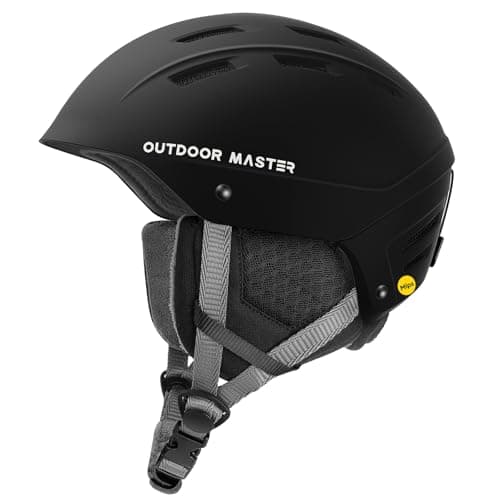
| 1 | OutdoorMaster Kelvin 2 Mips Families buying several helmets at once | $2.80 a dayon snow | 6.9/10 | $59.99 - View on Amazon |
| 2 | Smith Cache Mips A head at the edges of the size range, or one between two sizes | $5 a dayon snow | 6.7/10 | $160.00 - View on Amazon |
| 3 | Giro Ledge Mips A rider who wants a low-profile hard shell and knows their size | $5.00 a dayon snow | 6.2/10 | $99.99 - View on Amazon |
| 4 | Retrospec Comstock A spare helmet, or a second one for a visiting relative | $1.92 a dayon snow | 5.5/10 | $47.99 - View on Amazon |
Prices last verified October 19, 2026. Prices move constantly; the figure on Amazon at the moment you click is the real one.
How these were chosen
We have not worn any of these helmets and we are not going to tell you which one feels best, because we do not know. What we did instead was compile what each maker publishes and do arithmetic on it: the certifications named on the product page, whether a rotational-impact system is included, how many sizes exist and what head circumferences they cover, the published warranty term, and the published price divided by a realistic number of days on snow.
That produces a ranking a reader can check line by line, and the working sits under every score below. The weightings and breakpoints are published on the methodology page so you can disagree with them specifically rather than in general.
The two certifications, and why both matter
A snow helmet sold in the US should name at least one of two standards, and the good ones name both:
| Standard | Where it applies | What it covers |
|---|---|---|
| ASTM F2040 | United States | Impact attenuation, coverage area and retention-system strength for recreational snow sports |
| CE EN 1077 | Europe | The European equivalent, in Class A and Class B. Class B covers slightly less around the ears in exchange for hearing and ventilation, and is what most recreational ski helmets carry |
A helmet that names neither is not a ski helmet, whatever the listing photograph shows. This is the single most useful filter when buying online, and it eliminates a surprising amount of what a marketplace search returns. The standards guide goes through what each test actually involves.
The thirty-dollar question
The clearest price break in this category is between helmets with a rotational-impact system and helmets without one. MIPS, the most common, is a low-friction layer inside the shell that lets the helmet rotate a few millimeters against your head during an angled impact. Skiing crashes are almost never a clean straight-on hit: a skier who catches an edge arrives at the snow at an angle, and an angle produces twist.
In this group the cheapest helmet with a rotational liner is $69.99 and the cheapest certified helmet without one is $47.99. Over five seasons at five days each, that $22 difference works out at about nine cents a day. That is why the Retrospec is the skip on this page despite being a properly certified helmet at a good price. The full explainer on what MIPS is and is not goes into the evidence.
Getting the size right the first time
Half of what people call comfort is fit, and fit is measurable before you buy. Run a soft tape around the head about a centimeter above the eyebrows and around the widest point at the back, then match that number to the maker’s own chart, not a generic one. The ranges differ: the Smith here covers 51-67 cm across four sizes and the Retrospec covers 55-62 cm across two.
Then check it on your head. Without doing the chin strap up, shake your head side to side. If the helmet slides, it is too big, and a helmet that is too big does not do its job. The full fit check is here, and the children’s size chart is here.
Why a dial matters
Three of these four publish a dial adjuster at the back. It is a convenience for an adult and a genuine cost saving for a child, because a dial with a published range can absorb a season or two of head growth inside one size. Giro publishes 6 cm of adjustment on its youth helmet for exactly that reason, which is why that model appears on the children’s page rather than this one.
Two adjacent questions get their own pages. Women’s helmets is mostly a page about size runs rather than a different product, and snowboard helmets explains why there is no separate standard and what the backward fall changes about your priorities.
What we deliberately did not rank on
- Vent count. Fourteen vents is not twice as good as seven. Ventilation depends on where the vents sit and whether they close, and no maker publishes airflow, so any ranking on vent count would be invented.
- Weight, as a headline. It appears in the specification table because it is published and it genuinely matters for children, but a 50 g difference between two adult helmets is not a reason to choose one.
- Audio compatibility, colors and goggle clips. Real features, none of which change whether the helmet protects you.
If your measurement sits below the smallest size these brands publish, the answer is a different model rather than a tighter dial. The small-head roundup compares published circumference bands at that end of the range, where nominal S/M/L labels stop meaning anything across brands.
Should you buy a helmet at all?
Every resort that rents skis will rent you a helmet, so this is a real question and the answer is not automatic. Our answer is buy, for two reasons that have nothing to do with the commission: a rental helmet has been adjusted by hundreds of other heads and the retention system shows it, and a helmet is one of the cheapest items in a ski kit to own outright.
Run it yourself on the buy versus rent page, which lists the rental rates we use as inputs and shows the break-even day count for every category. For skis and boots the same arithmetic says rent, and we say so there.
Every pick, with the working
Each entry shows the published inputs, the axis scores they produce, and what you give up. The order is the computed order, not a commercial one, and the arithmetic is open underneath each score.
1 · Families buying several helmets at once
OutdoorMaster Kelvin 2 Mips
The cheapest helmet here that carries both certifications and a rotational liner, at a published $69.99. For a family buying four helmets at once that difference is most of a lift ticket, and nothing in the published safety spec is missing.
- Published price
- $69.99
- Cost per day on snow
- $2.80 a day
- Amortized over
- 5 seasons (25 days)
- Certified to
- ASTM F2040-18, CE EN 1077:2007 Class B
- Rotational system
- Mips
- Published sizes
- Three published sizes, S through L
- Warranty
- OutdoorMaster 2-year warranty
What it gets right
- ASTM F2040-18 and CE EN 1077:2007 Class B, with Mips, for a published $69.99
- Two-year warranty, double Giro's published term
- Fourteen vents and a dial adjuster
What you give up
- Three published sizes rather than four, so the extremes of the range are less well covered
- No published weight, so you cannot compare it on the scale before you buy
The working behind the 6.9
- Cost per day on snow: 9.0
- $69.99 over 5 seasons at 5 days each = 25 days = $2.80 a day
- Published protection: 9.0
- ASTM F2040 (+4); CE EN 1077 (+2); Mips rotational system (+3)
- Size availability: 4.9
- 3 published sizes (3.4 of 8.5); continuous in-size adjuster published (+1.5); range: Three published sizes, S through L
- Warranty and support: 2.5
- 2 yr (2.5 of 6); no published crash replacement (+0); no published repair route (+0)
Axes with unpublished inputs are dropped and the remaining weights re-normalized, so a product is not punished for a manufacturer’s silence. Specifications compiled September 3, 2026 from OutdoorMaster published specifications.
2 · A head at the edges of the size range, or one between two sizes
Smith Cache Mips
The widest published head range of any helmet on this page and the only one certified to both the US and European standards while carrying a rotational-impact liner, a dial adjuster and a three-year warranty. It is also the second most expensive, and 550 g is not light.
- Published price
- $125
- Cost per day on snow
- $5 a day
- Amortized over
- 5 seasons (25 days)
- Certified to
- ASTM F2040, CE EN 1077:2007 Class B
- Rotational system
- Mips
- Published sizes
- 51-67 cm across S, M, L and XL
- Weight
- 550 g
- Warranty
- Smith 3-year limited warranty
What it gets right
- Certified to ASTM F2040 and CE EN 1077:2007 Class B
- Four published sizes covering 51-67 cm, so odd-sized heads are actually catered for
- Three-year warranty, the longest published term in this group
- Eleven vents, five of them adjustable, which matters more than it sounds on a warm spring afternoon
What you give up
- 550 g in size medium is the heaviest here, and a child or a light adult will notice it
- No published crash-replacement program
The working behind the 6.7
- Cost per day on snow: 7.4
- $125 over 5 seasons at 5 days each = 25 days = $5 a day
- Published protection: 9.0
- ASTM F2040 (+4); CE EN 1077 (+2); Mips rotational system (+3)
- Size availability: 6.6
- 4 published sizes (5.1 of 8.5); continuous in-size adjuster published (+1.5); range: 51-67 cm across S, M, L and XL
- Warranty and support: 2.5
- 3 yr (2.5 of 6); no published crash replacement (+0); no published repair route (+0)
Axes with unpublished inputs are dropped and the remaining weights re-normalized, so a product is not punished for a manufacturer’s silence. Specifications compiled September 3, 2026 from Smith published specifications.
3 · A rider who wants a low-profile hard shell and knows their size
Giro Ledge Mips
A hard-shell helmet with the same two certifications and the same rotational liner as the Smith, 50 g lighter, at effectively the same price. What it does not publish is a dial adjuster, and its warranty is a year against Smith's three.
- Published price
- $124.95
- Cost per day on snow
- $5.00 a day
- Amortized over
- 5 seasons (25 days)
- Certified to
- ASTM F2040-11, CE EN 1077
- Rotational system
- Mips
- Published sizes
- 52-65 cm across S, M, L and XL
- Weight
- 500 g
- Warranty
- Giro 1-year limited warranty
What it gets right
- ASTM F2040-11 and CE EN 1077 certified, with the Mips liner included
- 500 g in medium, 50 g under the Smith
- Molded ABS outer shell bonded to an EPS liner, the tougher of the two common constructions
What you give up
- Giro publishes a one-year limited warranty on snow helmets, the shortest term here
- No continuous dial adjuster published for this model, so getting the right size first time matters more
- Six vents, and none of them published as adjustable
The working behind the 6.2
- Cost per day on snow: 7.4
- $124.95 over 5 seasons at 5 days each = 25 days = $5.00 a day
- Published protection: 9.0
- ASTM F2040 (+4); CE EN 1077 (+2); Mips rotational system (+3)
- Size availability: 5.1
- 4 published sizes (5.1 of 8.5); no continuous adjuster published (+0); range: 52-65 cm across S, M, L and XL
- Warranty and support: 1.5
- 1 yr (1.5 of 6); no published crash replacement (+0); no published repair route (+0)
Axes with unpublished inputs are dropped and the remaining weights re-normalized, so a product is not punished for a manufacturer’s silence. Specifications compiled September 3, 2026 from Giro published specifications.
4 · A spare helmet, or a second one for a visiting relative
Retrospec Comstock
Skip this one. It is a genuinely certified helmet and it is cheap, but every other pick here includes a rotational-impact liner and the cheapest of those is $69.99. Twenty-two dollars is not the place to economize on the one feature that addresses the kind of impact skiers actually have.
Certified to both standards at under fifty dollars, with a dial adjuster and ten vents. What it does not have, at any price or size, is a rotational-impact liner, and that is the one thing on this page worth paying for.
- Published price
- $47.99
- Cost per day on snow
- $1.92 a day
- Amortized over
- 5 seasons (25 days)
- Certified to
- ASTM F2040, CE EN 1077 Class B
- Rotational system
- None published
- Published sizes
- 55-58 cm and 59-62 cm
- Warranty
- Limited warranty; no term published
What it gets right
- ASTM F2040 and CE EN 1077 Class B certified at a published $47.99
- ErgoKnob dial adjuster, which several helmets costing three times as much do not publish
- ABS shell over an EPS liner, the tougher construction
What you give up
- No rotational-impact system in any version
- Only two adult sizes, covering 55-62 cm, so anything outside that is not served
- Retrospec publishes a limited warranty but no term we could find
The working behind the 5.5
- Cost per day on snow: 9.7
- $47.99 over 5 seasons at 5 days each = 25 days = $1.92 a day
- Published protection: 6.0
- ASTM F2040 (+4); CE EN 1077 (+2); no rotational-impact system (+0)
- Size availability: 3.2
- 2 published sizes (1.7 of 8.5); continuous in-size adjuster published (+1.5); range: 55-58 cm and 59-62 cm
- Warranty and support: 0.0
- no published term (0 of 6); no published crash replacement (+0); no published repair route (+0)
Axes with unpublished inputs are dropped and the remaining weights re-normalized, so a product is not punished for a manufacturer’s silence. Specifications compiled September 3, 2026 from Retrospec published specifications.
Prices last verified October 19, 2026. Prices move constantly; the figure on Amazon at the moment you click is the real one.
Questions people actually ask
Is MIPS worth it on a ski helmet?
On the published prices in this roundup the difference between the cheapest certified helmet without a rotational liner and the cheapest with one is about $22, which is roughly nine cents per day on snow over five seasons. For a feature aimed at the angled impacts that make up most real crashes, we think that is an easy yes. Full detail on what MIPS actually does.
What is the safest ski helmet?
There is no published ranking that lets anyone name a single safest helmet, and any site that does is inventing it. What you can check is whether a helmet is certified to ASTM F2040 and CE EN 1077, whether it includes a rotational-impact system, and whether it fits without moving. All three are published or checkable, and together they are the honest answer.
How should a ski helmet fit?
It should sit level, cover your forehead down to just above the goggle line, and not move when you shake your head with the chin strap undone. If it slides, it is too big. There should be no gap between the top of your goggles and the helmet brow.
Can I use my ski helmet for snowboarding?
Yes. Ski and snowboard helmets are certified to the same standards and the differences are in shape and styling only. The full comparison is on ski helmet versus snowboard helmet.
How often should I replace a ski helmet?
Immediately after any impact you noticed. Absent an impact, makers suggest replacement every few years as the foam and retention system age, but they do not agree on an interval, so we do not publish one as though they did.