Ski or snowboard first? The honest comparison
The learning curves cross somewhere around day four. Which side of that crossing you care about depends entirely on how many days you are actually going to get.
By Sawyer V. · Published
We have not tested this gear. Everything below is compiled from published specifications and published safety standards, and the arithmetic is public so you can check it. This page carries affiliate links: if you buy through one we earn a commission at no extra cost to you, and it does not change the order of the picks. Full disclosure.
The short answer
Ski if you have one to three days, if the learner is under about seven, or if the group is mixed and needs to stay together. Snowboard if you have five or more days and the learner is a teenager or adult who is willing to spend two of them falling. Skiing is markedly easier on day one and gets harder later; snowboarding is brutal at the start and then progresses quickly. Nearly all the expensive gear transfers either way.
| # | Pick | Best for | Score | Price |
|---|---|---|---|---|
| 1 | System MTN CRCX snowboard package A household buying more than one board | Not publishedon snow | 4.3/10 | $489.95 - View on Amazon |
| 2 | Camp Seven Redwood snowboard with APX bindings A first snowboard for an adult who has had a couple of lessons | $11.60 a dayon snow | 3.0/10 | $409.95 - View on Amazon |
| 3 | Rossignol Experience 76 skis with Xpress 10 bindings A smaller adult or a tall teenager on groomed runs | $18.00 a dayon snow | 2.3/10 | $479.95 - View on Amazon |
Prices last verified October 21, 2026. Prices move constantly; the figure on Amazon at the moment you click is the real one.
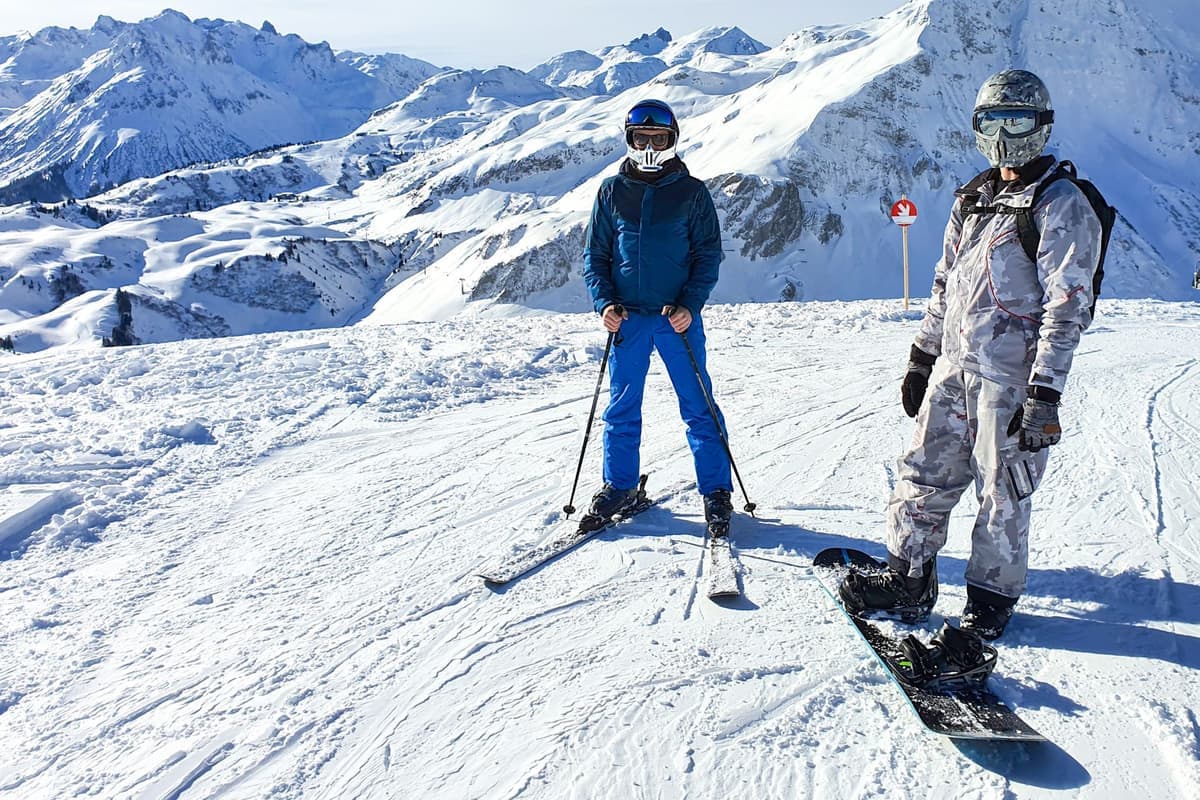
The two learning curves, plainly
The cliche is that skiing is easy to learn and hard to master, while snowboarding is hard to learn and easy to master. Like most cliches it is roughly true and the detail is where the decision lives.
Skiing is easier at the start because your feet are independent and your body already knows how to face the direction it is going. You can stand still, shuffle, and stop yourself with a wedge within the first hour. What gets harder later is that skiing has more separate skills to stack: edging, pressure, rotation, pole use, and eventually doing all four at once.
Snowboarding is harder at the start because both feet are strapped to one board, your body faces sideways, and the only way to learn the two edges is to fall on each of them repeatedly. What gets easier later is that once you can link turns on both edges, most of the sport is variations on one motion, and progression from the green runs to the whole mountain tends to be fast.
| Skiing | Snowboarding | |
|---|---|---|
| Day one | Sliding, stopping, first wedge turns | Falling; learning to stand up and slide on one edge |
| Day two | Linking wedge turns on a green run | Still falling; first controlled slides on both edges |
| Day three | Comfortable on greens | First linked turns, often late in the day |
| Day five | Confident on greens, starting blues | Linking turns on greens, sometimes on blues |
| What hurts | Shins and thighs | Wrists and tailbone |
| What limits you later | A long stack of separate skills | Mostly confidence and terrain |
Age changes the answer
For children under about seven, skiing wins clearly and for concrete reasons. Small children have a higher center of mass and less core strength, which makes the strapped-in balance of a snowboard genuinely hard. They also fall a lot, and snowboard falls go onto wrists and tailbones rather than sideways into snow. And ski school programs for the youngest ages are almost universally ski-based, so a four year old who wants to snowboard often cannot find a class.
From around eight to ten, snowboarding becomes a real option, and by the early teens it is often the one children ask for. If a child is going to snowboard, the kids snowboard gear page covers the protective kit that should come before the board, because the falls really are the thing.
There is also a practical family argument. A group that skis stays together on a green run. A group where one person is learning to snowboard spends a lot of the day waiting at the bottom of a slope, and a snowboarder cannot easily traverse a flat section that skiers glide across. For a first family trip, everyone doing the same thing is worth more than it sounds. The skiing-with-kids page covers the rest of the logistics.
Two comfort differences worth knowing
Boots
A snowboard boot is soft, flexible and closer to a very supportive winter boot. A ski boot is a rigid plastic shell, and for most beginners it is the single most uncomfortable object they will wear all year. If someone in your family has already declared that they hate ski boots, that is a genuine argument for a snowboard rather than a trivial one. The snowboard boot page and the ski boot page compare what each is trying to do.
Lifts and flat ground
This is the underrated one. A snowboarder rides a chairlift with the back foot unstrapped and has to skate off the top on one foot, which is awkward for the first few days. Drag lifts are harder still. And any flat section, of which every resort has several, means unstrapping and walking. A skier glides across all of it. Over a beginner week that difference adds up to a lot of small frustrations.
What it costs either way
Less different than people expect, because the expensive shared items are shared. The helmet, goggles, jacket, snow pants, base layers, socks and gloves are the same purchases for both, and the gear checklist covers them once. What differs is the hardware.
| Published lengths | What is included | |
|---|---|---|
| Rossignol Experience 76 (ski) | 136 to 176 cm, six lengths | Skis with Xpress 10 bindings mounted |
| Camp Seven Redwood (snowboard) | 149 cm and up | Board with bindings included |
| System MTN (snowboard) | 138 to 163 cm, including two wide sizes | Board with bindings included |
A ski setup also needs poles, which a snowboard does not, and a ski binding needs its release value set and tested by a shop, which a snowboard binding does not. That last point is not a small difference in effort: the bindings page explains what that appointment involves. A snowboard binding is bolted on and adjusted with a screwdriver, though stance width and angles still benefit from someone who knows what they are doing.
For a first season, neither answer justifies buying hardware. A seasonal lease or daily rental covers it for both sports, and the cost page shows where the crossover into buying falls.
Switching later, and doing both
Plenty of people learn one and add the other. Going from skiing to snowboarding is the more common direction and the skills do not transfer much, though the mountain sense does: reading a slope, choosing a line and judging speed all carry over. Going the other way, a snowboarder learning to ski usually finds the independent legs strange for a day and then gets on with it.
If you do both, the good news is that the shared kit really is shared. The helmet is the same helmet, whatever the marketing says, and that comparison is a page of its own. The goggles, outerwear and gloves are all the same. Only boots and hardware are duplicated.
The decision
- A three-day family trip with children under eight. Ski. Everyone stays together and everyone has fun on day one.
- A teenager or adult with a season pass or a week or more. Snowboard, if that is what they want. There are enough days for the hard start to pay off.
- Someone who has tried ski boots and hated them. Snowboard. The boot really is more comfortable and this is a legitimate reason.
- Anyone who wants to be independent on the whole mountain fastest. Ski, and the beginner ski roundup is the starting point.
- Anyone genuinely undecided with five days available. Take a two-hour lesson in each on day one and let the learner choose. It costs less than the wrong week of rentals.
Every pick, with the working
Each entry shows the published inputs, the axis scores they produce, and what you give up. The order is the computed order, not a commercial one, and the arithmetic is open underneath each score.
1 · A household buying more than one board
System MTN CRCX snowboard package
Eight published lengths from 138 to 163 cm is the widest size range in this category, which for a family means one brand can fit a twelve-year-old and a six-foot adult. The camber-rocker-camber profile is aimed squarely at not catching an edge.
- Published price
- Not published
- Cost per day on snow
- Not published
- Amortized over
- 5 seasons (25 days)
- Certified to
- Not published
- Published sizes
- 138 to 163 cm including two wide sizes
- Warranty
- No term published on the product page
System sells the MTN in several package configurations at different published prices, so no single list price applies to the item you will land on.
What it gets right
- Eight published lengths, two of them wide, which is unusually broad
- Camber-rocker-camber profile with the contact points lifted, designed to resist edge catches
- Sold as a complete package with bindings
What you give up
- No single published price: the same board appears in several package configurations
- Boots again separate
The working behind the 4.3
- Cost per day on snow: not scored
- No manufacturer-published price, so this axis is not scored.
- Published protection: not scored
- Snowboards carry no protective standard of their own.
- Size availability: 8.5
- 8 published sizes (8.5 of 8.5); no continuous adjuster published (+0); range: 138 to 163 cm including two wide sizes
- Warranty and support: 0.0
- no published term (0 of 6); no published crash replacement (+0); no published repair route (+0)
Axes with unpublished inputs are dropped and the remaining weights re-normalized, so a product is not punished for a manufacturer’s silence. Specifications compiled September 3, 2026 from System published specifications.
2 · A first snowboard for an adult who has had a couple of lessons
Camp Seven Redwood snowboard with APX bindings
Rocker in the tip and tail, which is the profile that stops a beginner catching an edge, sold with bindings for $289.95. That is roughly three days of snowboard rental for two people.
- Published price
- $289.95
- Cost per day on snow
- $11.60 a day
- Amortized over
- 5 seasons (25 days)
- Certified to
- Not published
- Published sizes
- 149, 153, 156, 158 wide and 160 cm
- Warranty
- No term published on the product page
What it gets right
- Rocker zones at tip and tail, the construction that forgives a beginner's mistakes
- Bindings included, so the board arrives ready apart from boots
- Five published lengths including a wide option
What you give up
- Boots are a separate purchase and are the part that actually needs trying on
- A twin shape is a compromise for someone who will only ever ride one direction
The working behind the 3.0
- Cost per day on snow: 2.5
- $289.95 over 5 seasons at 5 days each = 25 days = $11.60 a day
- Published protection: not scored
- Snowboards carry no protective standard of their own.
- Size availability: 6.8
- 5 published sizes (6.8 of 8.5); no continuous adjuster published (+0); range: 149, 153, 156, 158 wide and 160 cm
- Warranty and support: 0.0
- no published term (0 of 6); no published crash replacement (+0); no published repair route (+0)
Axes with unpublished inputs are dropped and the remaining weights re-normalized, so a product is not punished for a manufacturer’s silence. Specifications compiled September 3, 2026 from Camp Seven published specifications.
3 · A smaller adult or a tall teenager on groomed runs
Rossignol Experience 76 skis with Xpress 10 bindings
The narrower, cheaper sibling of the 78, at $449.95 with bindings, and the shortest published length here at 136 cm. Six lengths starting that short is what makes it work for a smaller adult or a tall teenager.
- Published price
- $449.95
- Cost per day on snow
- $18.00 a day
- Amortized over
- 5 seasons (25 days)
- Certified to
- Not published
- Published sizes
- 136, 144, 152, 160, 168 and 176 cm
- Warranty
- No term published on the product page
What it gets right
- $449.95 with Xpress 10 bindings included, $130 under the 78
- Six lengths from 136 cm, the shortest adult ski here
- A 76 mm waist is narrow, which makes edge-to-edge turns quicker to learn
What you give up
- A narrow ski is less forgiving in soft snow than a wider one
- The binding release setting still needs a shop, as with any ski
The working behind the 2.3
- Cost per day on snow: 0.0
- $449.95 over 5 seasons at 5 days each = 25 days = $18.00 a day
- Published protection: not scored
- Skis carry no protective standard of their own. The binding release setting does, and a shop sets it.
- Size availability: 8.5
- 6 published sizes (8.5 of 8.5); no continuous adjuster published (+0); range: 136, 144, 152, 160, 168 and 176 cm
- Warranty and support: 0.0
- no published term (0 of 6); no published crash replacement (+0); no published repair route (+0)
Axes with unpublished inputs are dropped and the remaining weights re-normalized, so a product is not punished for a manufacturer’s silence. Specifications compiled September 3, 2026 from Rossignol published specifications.
Prices last verified October 21, 2026. Prices move constantly; the figure on Amazon at the moment you click is the real one.
Questions people actually ask
Is skiing or snowboarding easier to learn?
Skiing is easier for the first two or three days, because your legs are independent and your body faces where you are going. Snowboarding is harder at the start and then progresses faster, so the curves cross around day four or five. Choose based on how many days you will actually get.
Should a child learn to ski or snowboard first?
Under about seven, skiing. Small children have less core strength for the strapped-in balance a board requires, snowboard falls land on wrists and tailbones, and most ski school programs for the youngest ages are ski-based. From eight or so, snowboarding becomes a genuine option.
Does ski gear work for snowboarding?
Most of it. Helmet, goggles, jacket, snow pants, base layers, socks and gloves all transfer. Boots do not, and poles are simply not used. That means switching sports later costs you the hardware and none of the clothing.
Is snowboarding cheaper than skiing?
Marginally, because there are no poles and no binding release setup appointment. Lift tickets, lessons and clothing are identical, and those are where most of the money goes. Neither sport justifies buying hardware in a first season; renting or leasing is cheaper for both.
Which hurts more when you fall?
Different places. Beginner skiers get sore shins and thighs; beginner snowboarders land on wrists and tailbones, which is why wrist guards and padded shorts are standard advice for a first snowboard week and are not for skiing.