Snow tubing: the activity that converts reluctant skiers
No lesson, no equipment to fit, no ability required, and a lift to the top. It is the thing a family should book on the day the weather is wrong for skiing.
By Sawyer V. · Published
We have not tested this gear. Everything below is compiled from published specifications and published safety standards, and the arithmetic is public so you can check it. This page carries affiliate links: if you buy through one we earn a commission at no extra cost to you, and it does not change the order of the picks. Full disclosure.
The short answer
A resort tubing park is a set of groomed lanes with banked sides, a long flat runout and usually a lift or conveyor back to the top. Nobody needs a lesson and nothing needs fitting, which makes it the best fallback activity a family has. Wear exactly what you would ski in - waterproof everything, gloves, a hat - and take a helmet if you have one, because the speeds are real.
| # | Pick | Best for | Score | Price |
|---|---|---|---|---|
| 1 | Retrospec Comstock Kids A first helmet for a toddler who may not ski again | $4.00 a dayon snow | 5.0/10 | $39.99 - View on Amazon |
| 2 | Slippery Racer Downhill Pro Saucer Disc Sled One child on a wide, open hill with a long clear runout | Not publishedon snow | 0.0/10 | $27.99 - View on Amazon |
| 3 | Flexible Flyer Winter Trek 3-Person Snow Sled Three riders together on a gentle open slope | Not publishedon snow | 0.0/10 | $99.00 - View on Amazon |
Prices last verified October 22, 2026. Prices move constantly; the figure on Amazon at the moment you click is the real one.
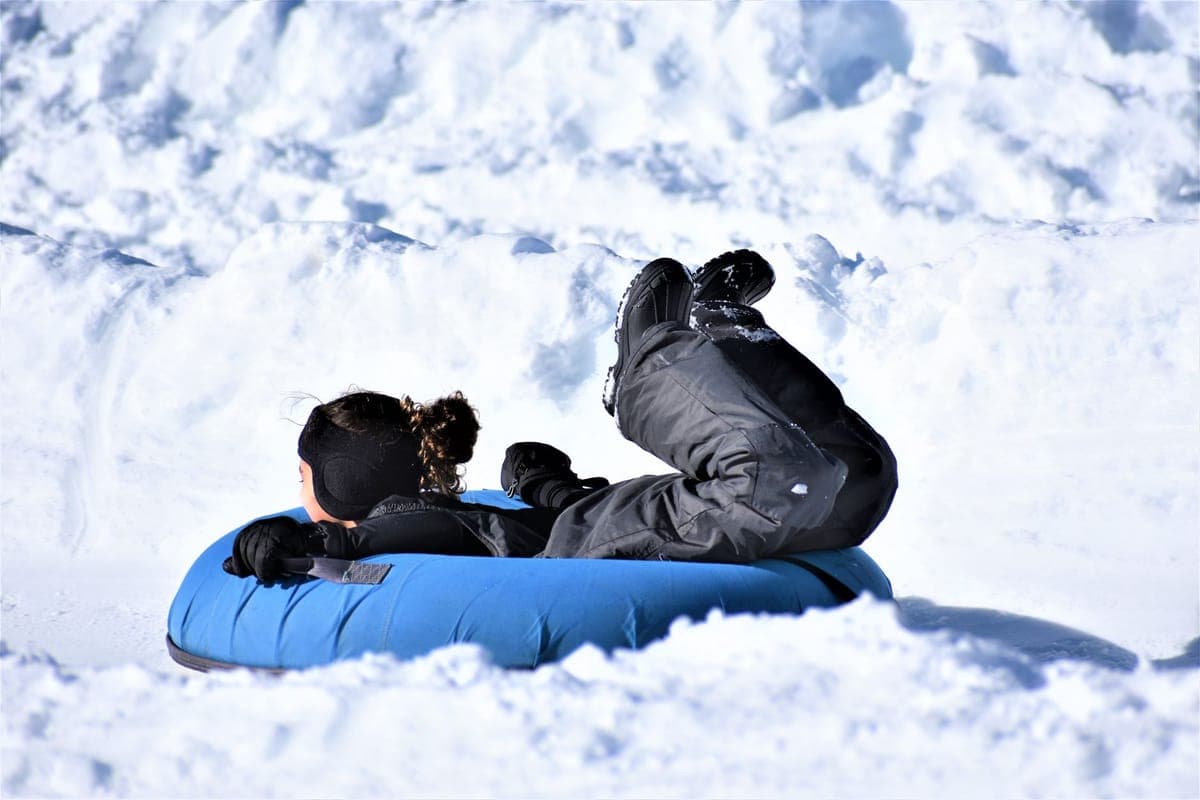
What a tubing park actually is
Not a hill with tubes on it. A commercial tubing park is a purpose-built piece of terrain: parallel lanes carved into the snow with banked walls, a consistent gradient, a long flat runout at the bottom, and a lift, conveyor or tow to get you and the tube back up.
Every one of those features is a safety feature, and together they are what makes tubing at a resort a different proposition from tubing on a local slope. The banks keep you in the lane. The runout is long enough to stop in. Staff release riders one at a time. And nobody is walking up the middle of the track, which is the most common collision on an uncontrolled hill.
Who it suits
| Person | Verdict |
|---|---|
| A toddler too young for lessons | Ideal, on a lane that allows adults to ride with a child |
| A child who has refused to ski | The single best route back to enjoying being on snow |
| A teenager | Genuinely enjoys it, whatever they say beforehand |
| An adult non-skier | The one snow activity that needs nothing learned |
| A grandparent | Depends on the park; the impact at the runout is not nothing |
| A skier on a lift-hold day | Better than the alternative, which is a bar at eleven in the morning |
The one caution is the fourth row down. Tubing looks gentle and the deceleration at the bottom is more abrupt than it appears from the side, particularly on a fast day. Anyone with a back or neck problem should watch a few runs before committing.
Park rules, and why they exist
- Minimum height, not age. Most parks publish a height requirement, because the tube and the harness are sized rather than the person.
- One person per tube unless the park says otherwise. Some parks allow an adult and a small child together; many do not, and it changes the speed and the stopping distance substantially.
- Feet first, or facing forward sitting up. Never head first, which is the same rule as on a sledding hill.
- Hold the handles, not the rope. The tow rope on a conveyor is not a handle.
- Wait for the attendant to release you. The spacing between riders is the whole safety system.
- Clear the runout immediately. Somebody is coming behind you.
What to wear
Exactly what you would wear to ski, and for once that is not an exaggeration. Tubing is wetter than skiing, because you are sitting in contact with the snow the whole way down, and it is colder than skiing because you are not generating heat.
- Waterproof jacket and pants, ideally bibs. The seat gets soaked; this is exactly the case bibs solve. The bibs comparison.
- Waterproof boots. Not trainers. You walk on packed snow between runs. What to look for.
- Gloves, and mittens for children. Hands are on a cold wet rubber handle the whole way down.
- A hat, and a neck gaiter rather than a scarf. Never a scarf near a tow.
- Goggles or sunglasses on a bright day. The glare is the same glare as on a piste.
- A helmet if you own one. Not usually required and worth wearing; the speeds on a good lane are comparable to a beginner ski run.
For the full list, the kids layering page applies unchanged, and the single most useful thing to carry is a dry spare pair of mittens.
The helmet question
Most parks do not require one and most people do not wear one. The argument for wearing one anyway is straightforward: a tubing lane produces speeds comparable to a beginner ski run on a surface just as hard, with no ability to steer or stop, and riders sometimes spin so the head is leading.
If your family owns ski helmets, there is no reason they should sit in the car. If not, a bike helmet is far better than nothing for this specific activity, with the caveats on the ski-versus-bike helmet page: no ear coverage, and a different impact profile.
Buying your own tube for a local hill
A consumer snow tube is a different object from a park one, and it is worth being honest about the difference. Park tubes are heavy commercial units with a hard base that runs fast in a groomed lane. A consumer inflatable is lighter, slower, and punctures.
On a local hill, an inflatable tube is fast on packed snow, bounces over bumps, and cannot be steered at all - which makes it the worst of the sled types for a small child on uncontrolled terrain, and a lot of fun for an older one on a wide open slope with a long runout. The sled roundup compares the published options, and for most families a toboggan or a saucer is the better buy.
If you do buy a tube: check the published weight capacity, get one with handles rather than a rope, and carry a pump, because they arrive flat and lose pressure in the cold.
If you are buying rather than renting a lane, the snow tube roundup compares published diameters and cover materials - and is direct about the hill you need before any of it matters.
Cost, and why it belongs in the trip budget
Tubing is usually sold in one or two-hour sessions at a fraction of a lift ticket, and an hour is genuinely enough - it is more tiring than it looks, because you walk or ride up and pull a tube around between runs.
For a family, that makes it one of the few genuinely cheap lines on a ski trip, and a good use of the afternoon after a morning lesson. The cost page puts the whole trip in proportion, and the page for the non-skiers in the family lists the alternatives for the rest of the day.
Every pick, with the working
Each entry shows the published inputs, the axis scores they produce, and what you give up. The order is the computed order, not a commercial one, and the arithmetic is open underneath each score.
1 · A first helmet for a toddler who may not ski again
Retrospec Comstock Kids
Skip this one. If the child is going to ski more than one weekend, the extra $70 for a Mips youth helmet works out at about $3.50 per day on snow on our two-season convention. That is a small number for the one feature this helmet lacks.
Properly certified, dial-adjusted and $39.99, which makes it the cheapest legitimate route to getting a small child into a helmet. It has no rotational-impact liner, and on a two-season horizon the Mips helmets are only about three dollars a day more.
- Published price
- $39.99
- Cost per day on snow
- $4.00 a day
- Amortized over
- 2 seasons (10 days)
- Certified to
- ASTM F2040, CE EN 1077 Class B
- Rotational system
- None published
- Published sizes
- Kids XS 48-51 cm and Youth 52-55 cm
- Warranty
- Limited warranty; no term published
What it gets right
- ASTM F2040 and CE EN 1077 Class B at $39.99
- ErgoKnob dial adjuster
- Covers 48-55 cm, which reaches younger than most youth helmets
What you give up
- No rotational-impact system
- No published warranty term
The working behind the 5.0
- Cost per day on snow: 8.1
- $39.99 over 2 seasons at 5 days each = 10 days = $4.00 a day
- Published protection: 6.0
- ASTM F2040 (+4); CE EN 1077 (+2); no rotational-impact system (+0)
- Size availability: 3.2
- 2 published sizes (1.7 of 8.5); continuous in-size adjuster published (+1.5); range: Kids XS 48-51 cm and Youth 52-55 cm
- Warranty and support: 0.0
- no published term (0 of 6); no published crash replacement (+0); no published repair route (+0)
Axes with unpublished inputs are dropped and the remaining weights re-normalized, so a product is not punished for a manufacturer’s silence. Specifications compiled September 3, 2026 from Retrospec published specifications.
2 · One child on a wide, open hill with a long clear runout
Slippery Racer Downhill Pro Saucer Disc Sled
A 26-inch disc, which is the fastest and least steerable shape there is. That is the whole trade: children love it and it goes where the hill sends it, so the hill has to be chosen carefully. Unlike most saucers it publishes molded hand grips, so there is at least something to hold.
- Published price
- Not published
- Cost per day on snow
- Not published
- Amortized over
- 3 seasons (15 days)
- Certified to
- Not published
- Published sizes
- One size, 26 in diameter
- Warranty
- No term published
Slippery Racer publishes no MSRP we could read.
What it gets right
- Published 26 in diameter in one-piece injection-molded polyethylene, with nothing to inflate or assemble
- Molded hand grips published, which a bare disc does not give you
- Coated with the maker's published IceVex cold-resistant treatment
What you give up
- No published MSRP
- No published rider weight limit, so there is no figure to check an adult against
- A saucer spins and cannot be steered, so it needs an open hill with no trees or fences
The working behind the 0.0
- Cost per day on snow: not scored
- No manufacturer-published price, so this axis is not scored.
- Published protection: not scored
- Sleds carry no US protective standard, which is itself worth knowing.
- Size availability: not scored
- Sold in one size, so size availability does not apply.
- Warranty and support: 0.0
- no published term (0 of 6); no published crash replacement (+0); no published repair route (+0)
Axes with unpublished inputs are dropped and the remaining weights re-normalized, so a product is not punished for a manufacturer’s silence. Specifications compiled October 12, 2026 from Slippery Racer published Downhill Pro specifications.
3 · Three riders together on a gentle open slope
Flexible Flyer Winter Trek 3-Person Snow Sled
5.5 feet long with a published 300 lb combined capacity for three riders, which is the sled for the family that all wants to go at once. It is also the one that is hardest to steer, and that is worth knowing before the first run.
- Published price
- Not published
- Cost per day on snow
- Not published
- Amortized over
- 3 seasons (15 days)
- Certified to
- Not published
- Published sizes
- One size, 66 x 20 in
- Warranty
- No term published
Flexible Flyer publishes no MSRP we could read.
What it gets right
- Published 300 lb combined capacity across three riders
- 66 in deck, long enough for two children and an adult
What you give up
- No published MSRP
- A long toboggan with three riders is genuinely difficult to steer or stop, which rules out crowded or tree-lined hills
The working behind the 0.0
- Cost per day on snow: not scored
- No manufacturer-published price, so this axis is not scored.
- Published protection: not scored
- Sleds carry no US protective standard, which is itself worth knowing.
- Size availability: not scored
- Sold in one size, so size availability does not apply.
- Warranty and support: 0.0
- no published term (0 of 6); no published crash replacement (+0); no published repair route (+0)
Axes with unpublished inputs are dropped and the remaining weights re-normalized, so a product is not punished for a manufacturer’s silence. Specifications compiled September 3, 2026 from Flexible Flyer published product specification.
Prices last verified October 22, 2026. Prices move constantly; the figure on Amazon at the moment you click is the real one.
Questions people actually ask
What is snow tubing?
Riding an inflatable tube down a purpose-built lane of groomed snow with banked sides and a long flat runout, usually with a lift or conveyor back to the top. It needs no lesson and nothing to fit, which makes it the best fallback activity on a family ski trip.
What should you wear snow tubing?
What you would wear to ski, and if anything warmer. Tubing is wetter, because you are in contact with the snow all the way down, and colder, because you are not generating heat. Waterproof jacket and pants or bibs, waterproof boots, gloves, a hat and a neck gaiter rather than a scarf.
Is snow tubing safe for young children?
At a commercial park, yes, within the published height requirement. The banked lanes, the long runout and the attendants releasing one rider at a time are all safety features that an uncontrolled local hill does not have. Check whether the park allows an adult to ride with a small child.
Do you need a helmet for snow tubing?
Most parks do not require one, and it is worth wearing if you own one. A tubing lane produces speeds comparable to a beginner ski run on equally hard snow, with no ability to steer or stop, and riders sometimes spin so the head leads.
Is it worth buying a snow tube?
For a local hill, only for older children on a wide open slope with a long runout. A tube is fast on packed snow, bounces over bumps and cannot be steered at all, which makes it the least controllable option for a small child. A toboggan or a saucer is usually the better family buy.