Two-way radios for skiing, and the range number to ignore
Every radio box claims 35 miles. The useful figures are battery days, a water rating and whether you need a license - and the makers publish all three.
By Sawyer V. · Published
We have not tested this gear. Everything below is compiled from published specifications and published safety standards, and the arithmetic is public so you can check it. This page carries affiliate links: if you buy through one we earn a commission at no extra cost to you, and it does not change the order of the picks. Full disclosure.
The short answer
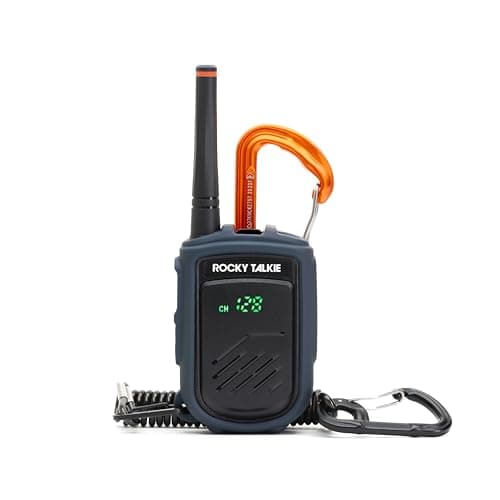
For a family at a resort, buy the Rocky Talkie Mountain Radio. It publishes 3 to 5 days of battery from a replaceable 1,550 mAh cell, an IP56 snowproof rating, a 3-year warranty and 2-watt FRS - which needs no license in the US. The Midland GXT1000VP4 is the value answer at a published $99.99 for two radios with headsets and chargers, and it is the only maker here honest enough to publish the real range - half a mile to 2 miles in normal conditions - but it is GMRS, so US users need a license. The Expedition is the waterproof 5-watt upgrade and carries the skip note. Prices are live; published figures as of October 17, 2026.
| # | Pick | Best for | Score | Price |
|---|---|---|---|---|
| 1 | Rocky Talkie Mountain Radio A family or group who need to find each other, not a soundtrack | $8 a dayon snow | 4.2/10 | $120.00 - View on Amazon |
| 2 | Midland GXT1000VP4 GMRS Two-Way Radios, 2-Pack A family of four who need two radios today, not one perfect one | $6.67 a dayon snow | 3.6/10 | $89.99 - View on Amazon |
| 3 | Rocky Talkie Expedition 5 Watt Radio A parent who skis trees, a group that splits up, or anyone who has drowned a radio | $13 a dayon snow | 0.7/10 | $195.00 - View on Amazon |
Prices last verified October 19, 2026. Prices move constantly; the figure on Amazon at the moment you click is the real one.
The 35-mile number, and what it actually means
Every radio in this category is sold on a range figure, and every range figure is measured mountain top to mountain top with nothing in between. Midland prints 36 miles on the box and then publishes, on its own product page, that the GXT series averages half a mile to 2 miles in normal conditions. Rocky Talkie publishes the same honesty differently: over 35 miles maximum, 2 to 8 miles typical in backcountry terrain, and 1 to 5 miles in mountains for its FRS model.
At a ski resort you are asking a radio to reach across two ridges and a lift line, which is a mile or two of broken terrain with a mountain in the middle. Every radio here does that. None of them does 35 miles, and no amount of extra wattage changes the fact that radio waves do not bend around a ridge.
So rank them on what does vary: battery life, whether snow kills them, and whether you need a license to transmit.
FRS or GMRS: the question that decides two of these
This is the detail that catches families out, and the makers publish it plainly.
- FRS is the low-power service. Rocky Talkie publishes its Mountain Radio as 2-watt FRS across 128 channels and states that it needs no license in the US. Open the box, turn it on, done.
- GMRS allows more power - Rocky Talkie publishes 5 watts as the highest allowed for a handheld GMRS radio - and Rocky Talkie’s own Expedition page points buyers at getting a GMRS license. The Midland GXT1000VP4 is a GMRS radio too.
- The practical consequence: if nobody in the family wants to deal with an FCC license, the Mountain Radio is the only radio on this page you can buy and use the same afternoon.
Who each of these is for, and who should skip them all
- Most families: the Rocky Talkie Mountain Radio. No license, a published 3 to 5 day battery you can swap, IP56 and a 3-year warranty.
- A family that needs two radios tonight: the Midland pair. Two radios, two chargers, two headsets and a 3-year warranty for a published $99.99 - less than one Mountain Radio - with a GMRS license to sort out.
- Trees, touring or repeat drownings: the Expedition. IP67 to one meter and 5 watts, with the skip note attached for resort use.
- Skip all three if you ski one groomed mountain with phone signal. A text message does the job, and the lift map has meeting points on it. Radios earn their place when the mountain is big, the signal is patchy or the group splits by ability.
- Skip them for young children. A radio is only useful if the person carrying it answers it. Under about eight, a meeting plan beats a device.
What this page ranks on
- 1. Published battery life. A radio that is flat at 2pm is a brick. Rocky Talkie publishes days; Midland publishes no hours figure at all.
- 2. Published water rating. IP56, IP67 and JIS4 are not the same thing, and only one of them survives being dropped in deep snow and dug out later.
- 3. Licensing. FRS or GMRS, as published by the maker.
- 4. How it attaches. A radio in a pocket is a radio you cannot hear. Clips, leashes and carabiners are published features and they matter.
- 5. Published warranty. Two of the three publish a term, which in this ledger counts as a good category.
- Not the headline range. See above. Where a maker publishes a realistic figure as well, that is the one quoted here.
The three, compared
| Rocky Talkie Mountain | Midland GXT1000VP4 | Rocky Talkie Expedition | |
|---|---|---|---|
| Service and power | 2 W FRS, no license in the US | GMRS, license required | 5 W GMRS, license required |
| Published battery life | 3 to 5 days | Not published | 4 to 6 days |
| Battery | 1,550 mAh, replaceable | Rechargeable packs included | 1,800 mAh |
| Water rating | IP56 (splash and snow) | JIS4 (splash) | IP67 (1 m submersion) |
| Published realistic range | 1-5 mi mountains, 0.5-3 mi forest | 0.5-2 mi normal conditions | 2-8 mi backcountry |
| Weather alerts | Not published | NOAA alert + weather scan | NOAA weather alerts |
| Attachment | Carabiner + backup leash | Belt clips | Steel gator clip + backup leash |
| Warranty | 3 years, personal use | 3 years | Not published |
| Published price | $120 each | $99.99 for two | $195 each |
| Cost for a family of four | $240 (two radios) | $99.99 (two radios) | $390 (two radios) |
The picks
Rocky Talkie Mountain Radio
The pick, and the best-documented product in this whole category. Rocky Talkie publishes a 3 to 5 day battery from a replaceable 1,550 mAh cell, 2-watt FRS across 128 channels that needs no license in the US, an IP56 splashproof and snowproof rating, 6.1 oz, and a 3-year personal-use warranty - every figure on its own page.
Days of battery is the specification that changes how a radio gets used. A radio you charge weekly lives in the ski jacket all season and is charged when you need it; a radio you must charge nightly is a radio that is flat on the one morning it matters.
It ships with a Trango carabiner and a metal-reinforced backup leash, which is the other thing this category gets wrong: a radio in a zipped pocket cannot be heard, and a radio clipped to the outside of a jacket with nothing backing it up ends up in the snow under a chairlift.
Honest cons. $120 per radio published, and a family needs two, so this is the dearest route to a working pair except the Expedition. IP56 is splash and snow, not submersion - Rocky Talkie says so plainly. It does nothing for music, and 6.1 oz on a jacket zipper is noticeable, which is the price of a battery that lasts days.
Midland GXT1000VP4, 2-pack
The value answer, and the honest one. For a published $99.99 you get two radios, two belt clips, a desktop charger, rechargeable battery packs, AC and DC adapters and two boom-mic headsets - less than the price of one Mountain Radio.
Midland also publishes the figure the rest of the category hides. The box says 36 miles; the product page says the GXT averages half a mile to 2 miles in normal conditions. A maker that publishes its own worst number is a maker worth reading.
The specification is otherwise solid for a resort: 50 channels, 142 privacy codes, NOAA weather alert with weather scan, an SOS siren, JIS4 water resistance and a published 3-year warranty.
Honest cons. It is GMRS, so US users need a license before transmitting - the single reason it is not the pick for a family that wants to buy and go. JIS4 is splash resistance, not submersion, so a radio dropped off a chairlift into deep snow is a gamble. No battery life in hours is published anywhere on the page, which on this page’s first criterion is a real gap. And the rechargeable packs are not swappable AAs, so a flat radio stays flat until it reaches the charger.
Rocky Talkie Expedition 5 Watt, and why it carries the skip
The best radio here and the wrong one for most readers of this page. Rocky Talkie publishes IP67, hand-tested to one meter of submersion, with a water-shedding design; 5 watts, the highest allowed for a handheld GMRS radio; 4 to 6 days from an 1,800 mAh battery in frigid conditions; 2 to 8 miles of typical backcountry range; 8 GMRS repeater channels; and both a 7.5 cm and a 17 cm antenna in the box.
If you ski trees, tour beyond the boundary, or have already killed a radio in wet snow, that IP67 rating is worth the money on its own.
It carries the skip because a groomed resort day uses almost none of it. Five watts does not see through a ridge any better than two for the distances a family actually needs, the GMRS license applies, and at $195 per radio two of them cost 390 dollars - against 99.99 for the Midland pair that does the same job at the same resort.
Using radios with a family, which is mostly a habit
- Agree the channel in the parking lot, not on the hill. Write it on a piece of tape inside the radio. Half the failed radio days are two people on different channels.
- Clip it outside, high. Shoulder strap or chest pocket, not the bottom of a backpack. You cannot hear a radio through a jacket and a pack.
- Use a headset or a shoulder mic for the adult who ranges furthest. Midland includes two boom-mic headsets in the box.
- Keep the batteries warm overnight. A radio left in the car develops a shorter day. Bring it inside with the boots - the same trip as the drying routine.
- Radios are not a tracking device. They do not tell you where a child is; they let a child tell you. A meeting plan at a named lift is still the backbone.
Every pick, with the working
Each entry shows the published inputs, the axis scores they produce, and what you give up. The order is the computed order, not a commercial one, and the arithmetic is open underneath each score.
1 · A family or group who need to find each other, not a soundtrack
Rocky Talkie Mountain Radio
Not headphones, and the best-documented product in this whole category: Rocky Talkie publishes a 3 to 5 day battery from a replaceable 1550 mAh cell, 2 watt FRS across 128 channels, an IP56 snowproof rating, 6.1 oz, and a 3-year personal-use warranty - every figure stated on its own page. If the real goal is keeping a family in touch rather than listening to music, this is the purchase.
- Published price
- $120
- Cost per day on snow
- $8 a day
- Amortized over
- 3 seasons (15 days)
- Certified to
- Not published
- Published sizes
- One size, published 9.3 cm tall x 6.3 cm wide x 2.8 cm thick
- Weight
- 173 g
- Warranty
- Rocky Talkie 3-year warranty for personal use
What it gets right
- 3 to 5 day battery life published from a replaceable 1550 mAh lithium-ion cell - nothing else here publishes a battery you can swap
- 3-year personal-use warranty published, the longest term in this ledger's accessory section
- IP56 published as splashproof and snowproof, with the honest caveat that it is not submersible
- Published range figures by terrain rather than one marketing number: 1 to 5 miles in mountains, 0.5 to 3 in forest
- Ships with a Trango Quantum carabiner, a metal-reinforced backup leash and a USB-C cable, all published
- 2 watt FRS across 128 channels, so it needs no license in the US
What you give up
- It is a radio, not audio - it does nothing for music and does not go in a helmet
- $120 published per radio, and a family needs at least two
- 6.1 oz on a jacket zipper is noticeable, which is the cost of a battery that lasts days
- FRS range figures depend entirely on terrain; the 35+ mile line-of-sight number is not a resort number
The working behind the 4.2
- Cost per day on snow: 5.2
- $120 over 3 seasons at 5 days each = 15 days = $8 a day
- Published protection: not scored
- This category carries no protective standard.
- Size availability: not scored
- Sold in one size, so size availability does not apply.
- Warranty and support: 2.5
- 3 yr (2.5 of 6); no published crash replacement (+0); no published repair route (+0)
Axes with unpublished inputs are dropped and the remaining weights re-normalized, so a product is not punished for a manufacturer’s silence. Specifications compiled October 8, 2026 from Rocky Talkie published Mountain Radio specifications.
2 · A family of four who need two radios today, not one perfect one
Midland GXT1000VP4 GMRS Two-Way Radios, 2-Pack
Two radios, two chargers and two headsets for the price of one premium radio, and the only maker here honest enough to publish the real number: Midland states a 36-mile range in perfect conditions and then states that the GXT averages half a mile to 2 miles in normal conditions. That second figure is the one that matters at a resort.
- Published price
- $99.99
- Cost per day on snow
- $6.67 a day
- Amortized over
- 3 seasons (15 days)
- Certified to
- Not published
- Published sizes
- One size, published 7.91 in x 2.44 in x 1.52 in
- Warranty
- Midland 3-year warranty
What it gets right
- A published pair, with belt clips, desktop charger, rechargeable battery packs, AC and DC adapters and boom mic headsets in the box
- Midland publishes the honest range as well as the marketing range: half a mile to 2 miles in normal conditions
- 50 channels and 142 privacy codes published, with NOAA weather alert and weather scan
- 3-year warranty published
- JIS4 water resistance published - rain and splash, which is what a ski day actually involves
What you give up
- JIS4 is splash resistance, not submersion: a radio dropped into deep snow is at risk
- GMRS, so US users should check licensing before transmitting
- No battery life in hours published anywhere on the product page
- Rechargeable packs rather than swappable AAs, so a flat radio stays flat until it reaches a charger
The working behind the 3.6
- Cost per day on snow: 6.2
- $99.99 over 3 seasons at 5 days each = 15 days = $6.67 a day
- Published protection: not scored
- This category carries no protective standard.
- Size availability: 0.0
- 1 published size (0.0 of 8.5); no continuous adjuster published (+0); range: One size, published 7.91 in x 2.44 in x 1.52 in
- Warranty and support: 2.5
- 3 yr (2.5 of 6); no published crash replacement (+0); no published repair route (+0)
Axes with unpublished inputs are dropped and the remaining weights re-normalized, so a product is not punished for a manufacturer’s silence. Specifications compiled October 17, 2026 from Midland published GXT1000VP4 specifications.
3 · A parent who skis trees, a group that splits up, or anyone who has drowned a radio
Rocky Talkie Expedition 5 Watt Radio
Skip this one. Skip it for a resort day. It is the best-specified radio on this page - IP67 to one meter of submersion, 5 watts, 4 to 6 days of battery - and almost none of that is doing any work on a groomed mountain where nobody is more than two miles from the base lodge. At $195 per radio, a family of four is spending $390 on reach it does not use and a license it now needs. Buy it if you ski trees, tour, or have already drowned a radio; otherwise the Mountain Radio is the same company's answer to the same problem for $75 less.
The upgrade, and the only radio here published to survive being dropped in the snow: hand-tested to IP67, which Rocky Talkie publishes as one meter of submersion. It also publishes 5 watts - the highest allowed for a handheld GMRS radio - a 1,800 mAh battery good for 4 to 6 days even in frigid conditions, and 2 to 8 miles of typical backcountry range.
- Published price
- $195
- Cost per day on snow
- $13 a day
- Amortized over
- 3 seasons (15 days)
- Certified to
- Not published
- Published sizes
- One size; 7.5 cm antenna fitted and a 17 cm antenna included
- Warranty
- No term published on the Expedition product page
What it gets right
- IP67 published, hand-tested to one meter of submersion, with a water-shedding design
- Published 4 to 6 days of use per charge from a 1,800 mAh battery, stated for frigid conditions
- 5 watts published, the highest allowed for a handheld GMRS radio, with 8 GMRS repeater channels
- Published range stated by terrain - over 35 miles maximum, 2 to 8 miles typical in backcountry
- Steel gator clip with 360-degree rotation and a backup leash published, plus NOAA weather alerts
- Published as compatible with the FRS Mountain Radio, so a family can mix the two
What you give up
- $195 per radio published, and a family needs at least two of them
- GMRS: Rocky Talkie's own page points buyers at a GMRS license, where the FRS Mountain Radio needs none
- No warranty term published on the Expedition page itself
- More radio than a groomed-run family day needs
The working behind the 0.7
- Cost per day on snow: 1.5
- $195 over 3 seasons at 5 days each = 15 days = $13 a day
- Published protection: not scored
- This category carries no protective standard.
- Size availability: 0.0
- 1 published size (0.0 of 8.5); no continuous adjuster published (+0); range: One size; 7.5 cm antenna fitted and a 17 cm antenna included
- Warranty and support: 0.0
- no published term (0 of 6); no published crash replacement (+0); no published repair route (+0)
Axes with unpublished inputs are dropped and the remaining weights re-normalized, so a product is not punished for a manufacturer’s silence. Specifications compiled October 17, 2026 from Rocky Talkie published Expedition Radio specifications.
Prices last verified October 19, 2026. Prices move constantly; the figure on Amazon at the moment you click is the real one.
Questions people actually ask
Do you need a license for a two-way radio at a ski resort?
It depends on the service. Rocky Talkie publishes its Mountain Radio as 2-watt FRS and states that it needs no license in the US - buy it, turn it on, use it. The Midland GXT1000VP4 and the Rocky Talkie Expedition are both GMRS, and Rocky Talkie’s own Expedition page points buyers at getting a GMRS license. For a family that wants to buy radios this week and use them this weekend, FRS is the simpler answer.
What range do ski radios really get?
Half a mile to a few miles across resort terrain, which is what the makers themselves publish when they are being specific. Midland publishes that the GXT series averages half a mile to 2 miles in normal conditions despite a 36-mile figure on the box; Rocky Talkie publishes 1 to 5 miles in mountains and 0.5 to 3 in forest for the FRS Mountain Radio. Ridges block radio waves, and no handheld power level changes that.
Are radios better than phones for skiing?
For a group, yes, for two published reasons and one practical one. Radios reach everyone at once rather than one person at a time; they work where cell coverage does not; and a radio clipped to a shoulder strap survives weather that kills a phone - a cold phone shuts down under load long before its battery indicator says so. Keep the phone for the lift map and the photographs.
Will a radio survive being dropped in the snow?
Depends on the rating. The Rocky Talkie Expedition publishes IP67, hand-tested to one meter of submersion, so a radio dug out of a drift should be fine. The Mountain Radio publishes IP56 - splashproof and snowproof, explicitly not submersible - and the Midland publishes JIS4, which is splash resistance. A backup leash is cheaper than a higher rating.
How many radios does a family need?
Two is the useful minimum: one with the adult who ranges furthest and one with whoever is likeliest to get separated. Four is better for a family that splits by ability. That is why price per pair matters so much on this page - the Midland is a published $99.99 for two, where two Mountain Radios are $240 and two Expeditions are $390.
Can different brands of radio talk to each other?
Within the same service, yes. Rocky Talkie publishes the Expedition as fully compatible with the FRS Mountain Radio, and Midland publishes that its GXT series drops to FRS wattage on channels 8 to 14 to work with FRS handhelds. Set everyone to the same channel and the same privacy code and brand stops mattering.
Sources
- Rocky Talkie published Mountain Radio specifications: 2 W FRS, 128 channels, no US license, 1,550 mAh replaceable battery, 3-5 days, IP56, 3-year warranty
- Rocky Talkie published Expedition Radio specifications: 5 W GMRS, IP67 to one meter, 1,800 mAh, 4-6 days, 2-8 miles typical backcountry range
- Midland published GXT1000VP4 specifications: 50 channels, 142 privacy codes, JIS4, NOAA weather alert, 3-year warranty, and the published 0.5-2 mile normal-conditions range