Kids' snowboards, and the three numbers a maker should publish
Length, waist width and sidecut radius. Most children's boards publish one of the three. These publish all of them, which is why they are here.
By Sawyer V. · Published
We have not tested this gear. Everything below is compiled from published specifications and published safety standards, and the arithmetic is public so you can check it. This page carries affiliate links: if you buy through one we earn a commission at no extra cost to you, and it does not change the order of the picks. Full disclosure.
The short answer
Size a child’s snowboard from weight first, height second. The board should reach somewhere between the child’s chin and nose as a sanity check, not as the method. Look for a rocker profile and a true twin shape, check the published waist width against the child’s boot. For most families, lease rather than buy - a lease includes a mid-season size swap and a purchase does not.
| # | Pick | Best for | Score | Price |
|---|---|---|---|---|
| 1 | Rossignol Scan Kids Snowboard A child of roughly 6 to 11 on their second or third season | $19.99 a dayon snow | 0.9/10 | $174.95 - View on Amazon |
| 2 | Rossignol Scan Smalls Kids Snowboard A child of roughly 3 to 6 who is too small for every other board here | $24.99 a dayon snow | 0.5/10 | $162.46 - View on Amazon |
| 3 | Rossignol Rookie Snowboard Bindings (S) A child between boot sizes 13 kids and US 4, which is most of elementary school | $14.49 a dayon snow | 0.3/10 | $79.97 - View on Amazon |
Prices last verified October 19, 2026. Prices move constantly; the figure on Amazon at the moment you click is the real one.
Start with the part that saves you money
A child on a snowboard grows out of the board, the boots and the bindings at different rates and none of them wait for the others. A board bought at eight is wrong at ten. That is not a reason never to buy one, but it is the reason to run the numbers first.
A seasonal lease from a shop typically includes a mid-season size swap, which is the feature that actually matches how children grow. The seasonal lease page covers what those programs include, and the growing-room page covers what you can and cannot size up.
Buy when one of three things is true: the child rides past the break-even for your local rental rate, there is a younger sibling to hand it down to, or the local rental fleet never has their size. The second is the most common and the most persuasive.
The three numbers, and why most boards publish one
- Length. Everyone publishes this. On its own it tells you almost nothing about whether the board suits your child.
- Waist width. How wide the board is at its narrowest point. A child with a size 3 boot on a board built around a size 6 foot cannot reach the edges properly, which means they cannot turn properly.
- Sidecut radius. How tight a turn the board’s shape wants to make. A small radius makes a small turn happen with less effort, which is what a light rider needs.
Both Rossignol boards on this page publish all three, per length. That is the reason they are the picks here rather than a cheaper board whose entire published specification is a length and a graphic.
| Board | Lengths | Waist width | Sidecut radius |
|---|---|---|---|
| Scan Smalls | 80, 90 cm | 18, 18.5 cm | 2.2/2.7 m and 2.5/3 m |
| Scan | 100, 110, 120 cm | 21.5, 22, 22.5 cm | 6, 6.1, 6.2 m |
The picks
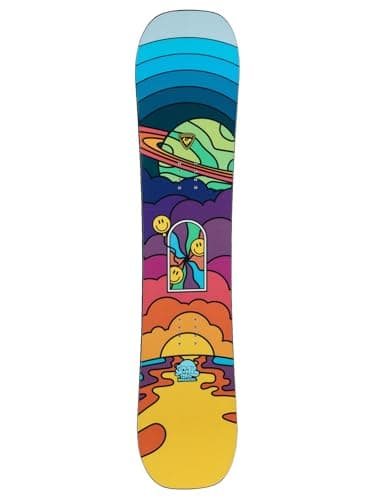
Rossignol Scan
The pick for most families. Three published lengths from 100 to 120 cm, which covers roughly ages six to eleven depending on the child, and a full auto-turn rocker profile.
Rocker is the right profile for a child for the same reason it is right for an adult beginner: it lifts the board’s contact points away from the snow, which is where an edge gets caught. A caught edge on a child is not just a fall, it is often the fall that ends the day.
True twin shape means the board is symmetrical, so riding backwards - which children do constantly, mostly by accident - behaves the same as riding forwards. At $199.95 it is board only: bindings are a separate decision, which is the next section.
Rossignol Scan Smalls
Marked as the skip above, conditionally. An 80 cm snowboard with an 18 cm waist is an unusual thing to find published at all, and it exists because a four-year-old cannot steer a 100 cm board - there is not enough of them to lever it.
The reason it is the skip is the price. $249.95 is fifty dollars more than the bigger Scan for a board with a shorter usable life, which is the arithmetic of a niche size rather than a better product. If your child is three to six and already on snow regularly, it is the right board. If this is a first try, an afternoon of sledding costs a fraction of it.
Rossignol Rookie (S) bindings
Neither board comes with bindings, so here is the one to put on them. The heelcup and highback are published as a single piece that adjusts to a different boot size without tools, across a published range of boot size 13 kids to US 4.
That range is several winters. When the child’s boots change, the binding moves rather than being replaced, which is the only way a child’s binding ever makes financial sense. The full bindings comparison is here.
Sizing, done properly
Weight first. A child’s weight is what has to bend the board, and a board too long for their weight will not flex into a turn no matter how good their technique is.
Height second, as a cross-check: stood on end, the board should reach somewhere between the chin and the nose. This is where the old rule came from and it is genuinely useful as a sanity test - it just is not a method. The kids snowboard sizing page has the full chart, and the adult chart is here for a teenager crossing over.
Then check the waist width against the child’s boot. A boot that hangs over the edges drags in the snow mid-turn; a boot far narrower than the waist means the child has to lean much further to get the board on edge.
The rest of the kit
A helmet, always and first - the kids helmet roundup covers certified picks by size range. Wrist guards second, because beginner snowboard falls land on outstretched hands and a child’s wrists are exactly what breaks; the protection page compares what makers publish.
And then clothing, which for snowboarding matters slightly differently than for skiing because a learning child spends most of the day sitting in snow. The kids snowboard gear page covers what to buy first.
Every pick, with the working
Each entry shows the published inputs, the axis scores they produce, and what you give up. The order is the computed order, not a commercial one, and the arithmetic is open underneath each score.
1 · A child of roughly 6 to 11 on their second or third season
Rossignol Scan Kids Snowboard
Three published lengths, three published waist widths and a published sidecut radius for each, which is more measurement than any other children's board here offers. Full auto-turn rocker and a true twin shape, so the board turns whichever way the child happens to be facing.
- Published price
- $199.95
- Cost per day on snow
- $19.99 a day
- Amortized over
- 2 seasons (10 days)
- Certified to
- Not published
- Published sizes
- 100, 110 and 120 cm, with published waist widths of 21.5, 22 and 22.5 cm
- Warranty
- No term published on the product page
What it gets right
- Waist width and sidecut radius published for every length, which almost no kids board does
- Full rocker profile, which is the construction that forgives a caught edge
- True twin, so riding backwards by accident is not a problem
- Wood core from sustainably harvested forests, published
What you give up
- Board only: bindings are a separate purchase and a separate decision
- No published warranty term
- Shortest length is 100 cm, so it does not cover the smallest beginners
The working behind the 0.9
- Cost per day on snow: 0.0
- $199.95 over 2 seasons at 5 days each = 10 days = $19.99 a day
- Published protection: not scored
- Snowboards carry no protective standard of their own.
- Size availability: 3.4
- 3 published sizes (3.4 of 8.5); no continuous adjuster published (+0); range: 100, 110 and 120 cm, with published waist widths of 21.5, 22 and 22.5 cm
- Warranty and support: 0.0
- no published term (0 of 6); no published crash replacement (+0); no published repair route (+0)
Axes with unpublished inputs are dropped and the remaining weights re-normalized, so a product is not punished for a manufacturer’s silence. Specifications compiled September 12, 2026 from Rossignol published specifications.
2 · A child of roughly 3 to 6 who is too small for every other board here
Rossignol Scan Smalls Kids Snowboard
Skip this one. Fifty dollars more than the larger Scan for less board, and outgrown faster. It is genuinely the right answer for a three- to five-year-old, because an 80 cm board is the only thing a child that size can physically steer - but it is a niche size premium rather than a better board, and a child at that age will get more out of an afternoon of sledding than a lesson. Buy it only if the child is already skiing or riding regularly.
An 80 cm snowboard is a genuinely unusual thing to find published, and it exists because a four-year-old on a 100 cm board cannot physically steer it. Fifty dollars more than the larger Scan for less board, which is the arithmetic of a niche size rather than a better product.
- Published price
- $249.95
- Cost per day on snow
- $24.99 a day
- Amortized over
- 2 seasons (10 days)
- Certified to
- Not published
- Published sizes
- 80 and 90 cm, with published waist widths of 18 and 18.5 cm
- Warranty
- No term published on the product page
What it gets right
- 80 cm published length, the shortest board in this ledger by 20 cm
- Waist widths of 18 and 18.5 cm published, narrow enough for a small boot to reach the edges
- Same auto-turn rocker and true twin shape as the bigger Scan
What you give up
- Fifty dollars more than the larger Scan, for a board a child outgrows sooner
- Two published lengths only, so it is outgrown fast
- No published warranty term, and board only
The working behind the 0.5
- Cost per day on snow: 0.0
- $249.95 over 2 seasons at 5 days each = 10 days = $24.99 a day
- Published protection: not scored
- Snowboards carry no protective standard of their own.
- Size availability: 1.7
- 2 published sizes (1.7 of 8.5); no continuous adjuster published (+0); range: 80 and 90 cm, with published waist widths of 18 and 18.5 cm
- Warranty and support: 0.0
- no published term (0 of 6); no published crash replacement (+0); no published repair route (+0)
Axes with unpublished inputs are dropped and the remaining weights re-normalized, so a product is not punished for a manufacturer’s silence. Specifications compiled September 12, 2026 from Rossignol published specifications.
3 · A child between boot sizes 13 kids and US 4, which is most of elementary school
Rossignol Rookie Snowboard Bindings (S)
The heelcup and highback are published as a single piece that adjusts to a new boot size without tools, which on a child's binding is the whole argument. A growing foot does not need a new binding, it needs this one moved, and that is a job for a parent in a parking lot rather than a shop.
- Published price
- $144.95
- Cost per day on snow
- $14.49 a day
- Amortized over
- 2 seasons (10 days)
- Certified to
- Not published
- Published sizes
- One size, published to fit boot sizes 13 kids to US 4
- Warranty
- No term published on the product page
What it gets right
- Toolfree boot-size adjustment published, because the heelcup and highback are one piece
- Published boot range of 13 kids to US 4, which is several seasons of growth
- Classic two-strap layout with ratchets, so it works exactly like an adult binding
What you give up
- No published warranty term
- $144.95 is a lot for a binding a child will outgrow at US 5
- No published flex rating or mounting compatibility
The working behind the 0.3
- Cost per day on snow: 0.4
- $144.95 over 2 seasons at 5 days each = 10 days = $14.49 a day
- Published protection: not scored
- Bindings carry no consumer-facing protective standard. A snowboard binding has no release function at all, and a ski binding release value is set by a shop rather than published by a maker.
- Size availability: not scored
- Sold in one size, so size availability does not apply.
- Warranty and support: 0.0
- no published term (0 of 6); no published crash replacement (+0); no published repair route (+0)
Axes with unpublished inputs are dropped and the remaining weights re-normalized, so a product is not punished for a manufacturer’s silence. Specifications compiled September 12, 2026 from Rossignol published specifications.
Prices last verified October 19, 2026. Prices move constantly; the figure on Amazon at the moment you click is the real one.
Questions people actually ask
What size snowboard does my child need?
Size from weight first, because weight is what bends the board into a turn. Use height as a cross-check: on end, the board should reach between the child’s chin and nose. Then check the published waist width against their boot size so their feet neither overhang nor sit far inside the edges.
Should I buy or lease a snowboard for my child?
Lease, unless the child rides past the break-even for your local rental rate, there is a younger sibling to hand it down to, or the rental fleet never has their size. A seasonal lease usually includes a mid-season size swap, which is the only arrangement that actually matches how children grow.
What profile is best for a child learning to snowboard?
Rocker. It lifts the board’s contact points away from the snow, which is where an edge gets caught, and a caught edge is usually the fall that ends a child’s day. Both boards here publish a full auto-turn rocker profile for exactly that reason.
Do kids' snowboards come with bindings?
The two here do not - they are sold as boards only. That is not unusual for children’s boards, and it lets you choose a binding that adjusts across several boot sizes rather than one matched to this winter’s feet.
How young can a child start snowboarding?
Boards exist from about 80 cm, which suits a child of roughly three to five, but most instructors will tell you snowboarding suits a slightly older child than skiing does because it demands more balance and more falling. If a first try is the goal, an afternoon of sledding costs far less and tells you more.