The best ski jackets, and the number most brands will not print
Three jackets compared on waterproof rating, seam construction and cost per day, including the awkward fact that two of them publish no rating at all.
By Sawyer V. · Published
We have not tested this gear. Everything below is compiled from published specifications and published safety standards, and the arithmetic is public so you can check it. This page carries affiliate links: if you buy through one we earn a commission at no extra cost to you, and it does not change the order of the picks. Full disclosure.
The short answer
The most useful thing to know about ski jackets is that most major brands do not publish a waterproof rating at all. They publish a fabric name instead. Of these three, only one publishes a number: the Wantdo 3-in-1 at 10,000 mm, which is a genuine resort-day figure. If you want the number, that is the pick. If you want the 3-in-1 system and the wider size range, the Columbia Whirlibird V at $250 is the jacket.
| # | Pick | Best for | Score | Price |
|---|---|---|---|---|
| 1 | Arctix Men's Icecap Insulated Jacket A cold dry week where price matters more than a spec sheet | $4.20 a dayon snow | 4.7/10 | $92.11 - View on Amazon |
| 2 | Wantdo Men's 3-in-1 Ski Jacket A wet-snow resort at a price that does not assume a season pass | Not publishedon snow | 3.8/10 | $59.97 - View on Amazon |
| 3 | Columbia Whirlibird V Interchange Jacket One jacket that has to work on the mountain and at home | $10 a dayon snow | 3.2/10 | $250.00 - View on Amazon |
Prices last verified October 19, 2026. Prices move constantly; the figure on Amazon at the moment you click is the real one.
The waterproof number, and who prints it
Waterproofing is measured in millimeters of hydrostatic head: how tall a column of water the fabric holds back before it leaks. Roughly:
| Rating | Handles | Where it struggles |
|---|---|---|
| 3,000 mm | Cold dry snow, short exposure | Wet spring snow, sitting down repeatedly, rain |
| 5,000 - 10,000 mm | A normal wet resort day | Sustained heavy rain |
| 10,000 - 15,000 mm | Wet coastal snow, long days | Almost nothing a resort skier meets |
| 20,000 mm and up | Everything | Nothing, and you are paying for it |
Here is the awkward part. Columbia publishes a fabric name and no number. Arctix publishes a number on its pants and not on this jacket. That is not necessarily worse fabric, but it does mean you cannot compare those jackets numerically against anything, and any site showing you a table of ratings for them got the numbers from somewhere other than the maker.
Seams leak before fabric does
A jacket is only as waterproof as its stitching, and stitching is thousands of small holes. Sealing the seams with tape fixes it. Three descriptions, and the difference is real:
- Fully sealed or fully taped: every seam. What you want for genuinely wet snow.
- Critically sealed: shoulders, hood and other high-exposure seams only. This is what every jacket on this page publishes, and it is adequate for most conditions.
- No mention of seams: usually untaped.
Why a 3-in-1 is often the right family buy
A three-in-one jacket is a waterproof shell with a separate insulated liner that zips inside it, and each layer works alone. That matters more for a once-a-year skier than for anybody else, because the shell gets worn in the rain in April and the liner gets worn to school in November. A jacket that is used fifty days a year instead of five is a completely different cost-per-day figure.
It also solves the temperature problem. A fixed-insulation jacket is right for one temperature band; a 3-in-1 covers a range, which is what you want when you book a trip five months ahead and cannot know the weather.
When fixed insulation is fine
If you ski somewhere reliably cold and the jacket is only ever going to be a ski jacket, fixed insulation is simpler and cheaper. The Arctix here is that jacket, and the reason it is our skip is the missing rating rather than the fixed liner.
Two adjacent pages. If you snowboard, the snowboard jacket page covers the longer cut and the powder skirt that genuinely differ. And if you are trying to choose between brands rather than between jackets, the brands page explains why the cheapest options here publish the most comparable numbers.
Fit, and the features that actually matter
- A powder skirt, the elasticated band inside the hem, keeps snow out when you fall. A beginner falls a lot.
- Pit zips, the vents under the arms, matter more than breathability claims. Being able to dump heat on a warm afternoon is worth more than a fabric specification.
- Wrist gaiters, the inner cuffs with a thumb hole, stop snow going up your sleeve. This is where beginners get wet.
- A hood that fits over a helmet. Try it on with the helmet if you can, because a hood cut for a hat is useless once a helmet is on.
- An internal pocket for goggles. Small, and you will use it every time you go inside for lunch.
Every jacket above is compared on the same published figures regardless of who it is cut for, but fit is not interchangeable. The women’s jacket roundup runs the same criteria across women’s cuts, including the size ranges that decide whether the rest of the specification is any use to you.
If the budget only stretches to one
Buy the pants. A beginner spends a significant part of the first two days sitting in snow, and the jacket spends that time nowhere near the ground. This is the most consistently useful thing on this entire section of the site. The ski pants picks are here.
And before buying either, run the clothing-specific rent-or-buy arithmetic. Clothing is genuinely borderline, particularly for children, and the answer changes if a younger sibling will inherit it.
Every pick, with the working
Each entry shows the published inputs, the axis scores they produce, and what you give up. The order is the computed order, not a commercial one, and the arithmetic is open underneath each score.
1 · A cold dry week where price matters more than a spec sheet
Arctix Men's Icecap Insulated Jacket
Skip this one. It is the cheapest jacket here and it publishes insulation and critical seam sealing, but Arctix publishes a 3,000 mm rating on its snow pants and no rating at all on this jacket. Buying an unrated shell when a rated one is available for less is the wrong trade, and the Wantdo publishes 10,000 mm.
Arctix publishes a 3,000 mm rating on its insulated snow pants and no rating at all on this jacket, which is worth saying out loud rather than quietly borrowing the pants figure. What it does publish is insulation and critical seam sealing at $105.
- Published price
- $105
- Cost per day on snow
- $4.20 a day
- Amortized over
- 5 seasons (25 days)
- Certified to
- Not published
- Waterproof rating
- Not published
- Published sizes
- S through XXL
- Warranty
- No term published on the product page
What it gets right
- $105 published, which over five seasons is $4.20 a day on snow
- Critical seams sealed, which is what most family-price outerwear does
- Five published sizes
What you give up
- No waterproof rating published for this jacket, so it cannot be compared numerically
- Critical seams rather than fully sealed
The working behind the 4.7
- Cost per day on snow: 8.0
- $105 over 5 seasons at 5 days each = 25 days = $4.20 a day
- Published protection: 2.0
- no published waterproof rating (0 of 6); critically taped or untaped seams (+0); insulation or shell construction published (+2)
- Size availability: 6.8
- 5 published sizes (6.8 of 8.5); no continuous adjuster published (+0); range: S through XXL
- Warranty and support: 0.0
- no published term (0 of 6); no published crash replacement (+0); no published repair route (+0)
Axes with unpublished inputs are dropped and the remaining weights re-normalized, so a product is not punished for a manufacturer’s silence. Specifications compiled September 3, 2026 from Arctix published specifications.
2 · A wet-snow resort at a price that does not assume a season pass
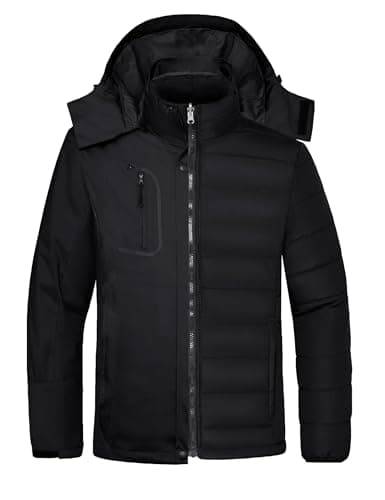
Wantdo Men's 3-in-1 Ski Jacket
Publishes a 10,000 mm waterproof rating, which is a genuine resort-day figure and more than three times what the budget snow pants on this site publish. It is also the only jacket here that names a membrane rather than a coating.
- Published price
- Not published
- Cost per day on snow
- Not published
- Amortized over
- 5 seasons (25 days)
- Certified to
- Not published
- Waterproof rating
- 10,000 mm
- Published sizes
- S through XXL
- Warranty
- No term published on the product page
Wantdo lists this jacket across a price range that varies by colorway and size rather than publishing a single MSRP, so the cost-per-day axis is not scored.
What it gets right
- Publishes 10,000 mm, a number most brands at any price decline to state
- Names a microporous TPU membrane rather than a surface coating
- Three-in-one construction with a zip-out fleece liner
What you give up
- No single published price, so cost per day cannot be computed in advance
- Seam construction is not published, and seams leak before fabric does
The working behind the 3.8
- Cost per day on snow: not scored
- No manufacturer-published price, so this axis is not scored.
- Published protection: 4.5
- 10,000mm waterproof rating (2.5 of 6); seam sealing not published (+0); insulation or shell construction published (+2)
- Size availability: 6.8
- 5 published sizes (6.8 of 8.5); no continuous adjuster published (+0); range: S through XXL
- Warranty and support: 0.0
- no published term (0 of 6); no published crash replacement (+0); no published repair route (+0)
Axes with unpublished inputs are dropped and the remaining weights re-normalized, so a product is not punished for a manufacturer’s silence. Specifications compiled September 3, 2026 from Wantdo published specifications.
3 · One jacket that has to work on the mountain and at home
Columbia Whirlibird V Interchange Jacket
Two jackets in one: a waterproof shell and a zip-out insulated liner that each work alone. For a family that skis one week a year and spends the other fifty-one weeks in a cold parking lot, that is genuinely two purchases avoided.
- Published price
- $250
- Cost per day on snow
- $10 a day
- Amortized over
- 5 seasons (25 days)
- Certified to
- Not published
- Waterproof rating
- Not published
- Published sizes
- S through XXL
- Warranty
- No term published on the product page
What it gets right
- Three-in-one construction, so the shell and the liner are each usable on their own
- Omni-Tech waterproof-breathable fabric with critical seams sealed
- Sold in five sizes with regular, big and tall variants
What you give up
- Columbia publishes no hydrostatic-head figure, so its waterproofing cannot be compared numerically against a rated jacket
- Critical seams are sealed rather than every seam
- $250 is the most expensive item in this ledger apart from the skis
The working behind the 3.2
- Cost per day on snow: 3.7
- $250 over 5 seasons at 5 days each = 25 days = $10 a day
- Published protection: 2.0
- no published waterproof rating (0 of 6); critically taped or untaped seams (+0); insulation or shell construction published (+2)
- Size availability: 6.8
- 5 published sizes (6.8 of 8.5); no continuous adjuster published (+0); range: S through XXL
- Warranty and support: 0.0
- no published term (0 of 6); no published crash replacement (+0); no published repair route (+0)
Axes with unpublished inputs are dropped and the remaining weights re-normalized, so a product is not punished for a manufacturer’s silence. Specifications compiled September 3, 2026 from Columbia published specifications.
Prices last verified October 19, 2026. Prices move constantly; the figure on Amazon at the moment you click is the real one.
Questions people actually ask
What waterproof rating do I need for a ski jacket?
For a family resort skier, 5,000 to 10,000 mm covers a normal wet day comfortably. 3,000 mm is the entry level and will let you down in wet snow. Above 15,000 mm you are paying for conditions a resort skier rarely meets.
Are ski jackets and snowboard jackets the same?
Functionally, close to identical: the same fabrics, ratings and construction. Snowboard cuts are often longer and looser, ski cuts trimmer. Either works for either sport. More on jacket types.
Is a 3-in-1 ski jacket worth it?
For a family that skis a few days a year, usually yes, because both layers get worn separately for the rest of the winter. That turns a five-day-a-year item into a fifty-day-a-year one, which changes the cost per day completely.
Can I wear a normal winter coat skiing?
If it is genuinely waterproof, for a first day, yes. What it will lack is a powder skirt, wrist gaiters and pit zips, so expect snow up the sleeves and to overheat on the way up. Snow pants matter far more than the jacket.
Why do brands not publish waterproof ratings?
Mostly because they market a proprietary fabric name instead, and a name is not comparable to a competitor’s number. It is not evidence of bad fabric, but it does mean you cannot compare it, and this site says so rather than filling the gap.