The beginner ski setup, part by part
What each piece of a first setup actually does, what it costs from published prices, and which parts a family should not be buying yet.
By Sawyer V. · Published
We have not tested this gear. Everything below is compiled from published specifications and published safety standards, and the arithmetic is public so you can check it. This page carries affiliate links: if you buy through one we earn a commission at no extra cost to you, and it does not change the order of the picks. Full disclosure.
The short answer
A complete beginner setup is skis, bindings, boots and poles, plus a helmet, goggles and clothing. Of those, the skis, bindings, boots and poles should be rented for a family skiing a few days a year, and the helmet, goggles, socks, base layers and gloves should be bought. The buy side comes to roughly $220 at the cheapest published prices in our ledger.
| # | Pick | Best for | Score | Price |
|---|---|---|---|---|
| 1 | OutdoorMaster Kelvin 2 Mips Families buying several helmets at once | $2.80 a dayon snow | 6.9/10 | $59.99 - View on Amazon |
| 2 | Darn Tough Alpine Over-the-Calf Lightweight Ski Socks The one piece of ski gear worth buying before anything else | $2 a dayon snow | 6.4/10 | $30.64 - View on Amazon |
| 3 | OutdoorMaster PRO Magnetic A skier who wants to change lenses without taking gloves off | $2.00 a dayon snow | 6.1/10 | $39.99 - View on Amazon |
| 4 | Rossignol Experience 76 skis with Xpress 10 bindings A smaller adult or a tall teenager on groomed runs | $18.00 a dayon snow | 2.3/10 | $479.95 - View on Amazon |
Prices last verified October 19, 2026. Prices move constantly; the figure on Amazon at the moment you click is the real one.
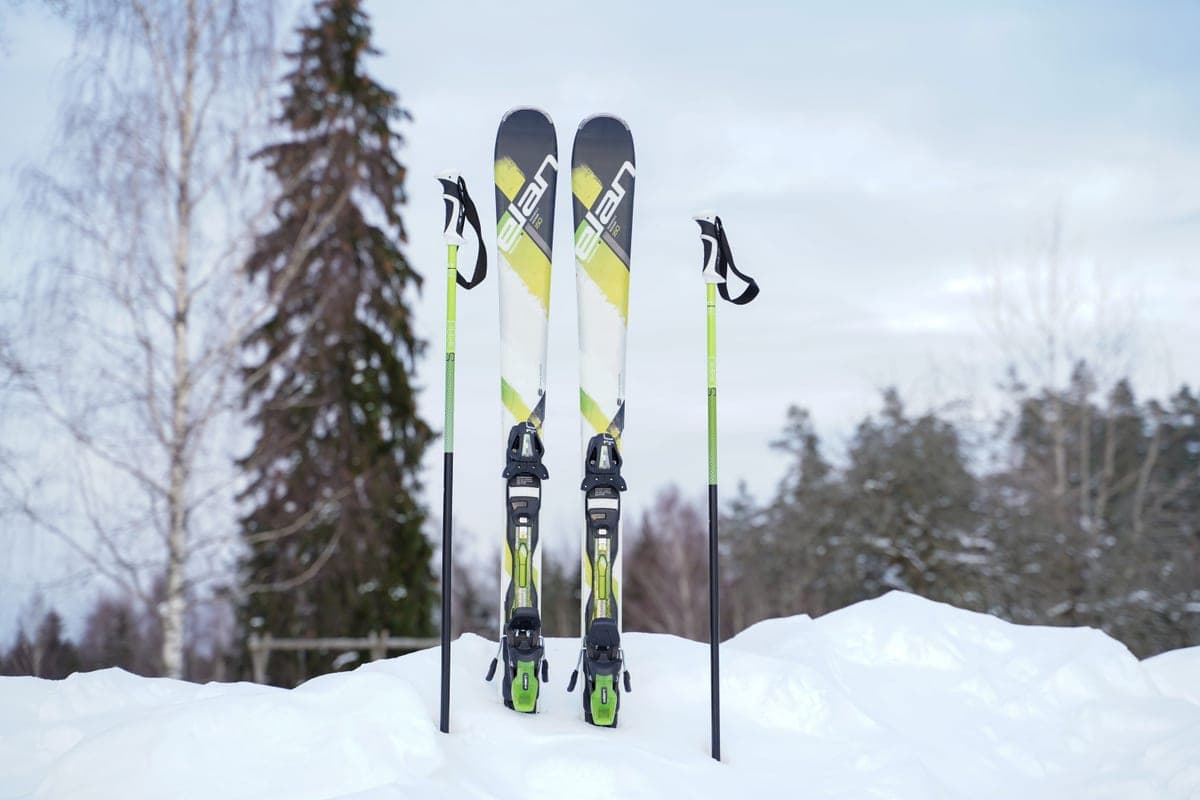
The parts, and what each one does
| Part | What it does | Buy, rent or skip |
|---|---|---|
| Skis | The thing you slide on. Length and width decide how easy they are to turn | Rent |
| Bindings | Hold the boot and release it in a fall, at a setting a shop calculates | Rent (included with skis) |
| Boots | The steering control. Everything you do reaches the ski through them | Rent, and fit them properly |
| Poles | Balance and pushing along flat ground | Rent (included), and often unused in a first lesson |
| Helmet | Protection, plus warmth and a place for goggles to sit | Buy |
| Goggles | Wind, snow and light management | Buy |
| Clothing | Staying warm and dry, which decides the whole day | Buy the layers, consider renting outerwear |
The part nobody explains
A ski binding is not a clip. It is a calibrated mechanism that holds your boot firmly enough to steer the ski and releases it when a twisting or forward force exceeds a set threshold, so that your leg does not take that force instead.
That threshold is calculated from your height, weight, age, boot sole length and ability, and it is set by a technician with a machine that tests the release. For a beginner it is set deliberately low, because beginners fall at low speed in ways that twist a knee.
Boots matter more than skis
If there is one thing to take from this page: a beginner in rental skis and well-fitting boots will have a better day than a beginner on their own new skis in boots that do not fit. Everything you do with your body reaches the snow through the boot.
Measure your foot in millimeters before you go, because ski boots are sized in Mondopoint, which is simply foot length in centimeters. The adult chart and how to measure and the children’s version. Then wear one thin sock, not a thick one: the reason is counterintuitive and it matters.
What it costs, from published prices
The buy side of a first setup, using the cheapest published prices in our ledger:
- Helmet with a rotational liner: $69.99
- Goggles: $49.99
- Snow pants: $50
- Gloves: $32.99
- Ski socks: around $29
That is roughly $232 per person, once, for items that last years. Skis with bindings start at $449.95 published and boots are separate, which is the entire argument for renting the hardware. The full cost page, with the break-even table.
On poles
Most first lessons happen without them. They come with a ski rental anyway, so there is no purchase decision to make, and a beginner learning to turn is better off with both hands free. Once you do use them, the rough sizing rule is that holding the pole upside down just under the basket should put your elbow at ninety degrees.
The order to acquire it in
- Ski socks and a base layer, because nobody rents them and cotton is the enemy
- Gloves, plus a spare pair for a child
- Goggles
- A helmet, measured and fitted
- Snow pants
- A jacket, or a genuinely waterproof coat you already own
- Skis, boots and poles: rent these until the fee starts to annoy you
That order is by how badly each item ruins a day when it is wrong, not by price. The budget page builds real kits in that order against three price ceilings.
The part that is not gear
We sell no lessons and earn nothing either way, so this is free of any commercial interest: book the lesson. A beginner taught by an instructor for one morning typically spends the afternoon skiing. A beginner taught by a family member typically spends the afternoon in the lodge, and the family member has a worse day too.
Every pick, with the working
Each entry shows the published inputs, the axis scores they produce, and what you give up. The order is the computed order, not a commercial one, and the arithmetic is open underneath each score.
1 · Families buying several helmets at once
OutdoorMaster Kelvin 2 Mips
The cheapest helmet here that carries both certifications and a rotational liner, at a published $69.99. For a family buying four helmets at once that difference is most of a lift ticket, and nothing in the published safety spec is missing.
- Published price
- $69.99
- Cost per day on snow
- $2.80 a day
- Amortized over
- 5 seasons (25 days)
- Certified to
- ASTM F2040-18, CE EN 1077:2007 Class B
- Rotational system
- Mips
- Published sizes
- Three published sizes, S through L
- Warranty
- OutdoorMaster 2-year warranty
What it gets right
- ASTM F2040-18 and CE EN 1077:2007 Class B, with Mips, for a published $69.99
- Two-year warranty, double Giro's published term
- Fourteen vents and a dial adjuster
What you give up
- Three published sizes rather than four, so the extremes of the range are less well covered
- No published weight, so you cannot compare it on the scale before you buy
The working behind the 6.9
- Cost per day on snow: 9.0
- $69.99 over 5 seasons at 5 days each = 25 days = $2.80 a day
- Published protection: 9.0
- ASTM F2040 (+4); CE EN 1077 (+2); Mips rotational system (+3)
- Size availability: 4.9
- 3 published sizes (3.4 of 8.5); continuous in-size adjuster published (+1.5); range: Three published sizes, S through L
- Warranty and support: 2.5
- 2 yr (2.5 of 6); no published crash replacement (+0); no published repair route (+0)
Axes with unpublished inputs are dropped and the remaining weights re-normalized, so a product is not punished for a manufacturer’s silence. Specifications compiled September 3, 2026 from OutdoorMaster published specifications.
2 · The one piece of ski gear worth buying before anything else
Darn Tough Alpine Over-the-Calf Lightweight Ski Socks
The only item in this entire ledger with an unconditional lifetime guarantee. It is a $30 sock that the maker will replace forever, which over any realistic number of ski days is the cheapest thing on the site.
- Published price
- $30
- Cost per day on snow
- $2 a day
- Amortized over
- 3 seasons (15 days)
- Certified to
- Not published
- Published sizes
- S through XL
- Warranty
- Unconditional lifetime guarantee
What it gets right
- Unconditional lifetime guarantee, published without qualifying conditions
- Lightweight merino, which is correct for a modern ski boot: a thick sock makes boots colder, not warmer
- Over-the-calf length, so the boot cuff never touches bare skin
What you give up
- $30 for one pair of socks reads as absurd until the replacement policy is read
- Lightweight is the right choice but feels wrong to anyone expecting a thick ski sock
The working behind the 6.4
- Cost per day on snow: 9.6
- $30 over 3 seasons at 5 days each = 15 days = $2 a day
- Published protection: not scored
- Socks carry no protective standard, so this axis does not apply.
- Size availability: 5.1
- 4 published sizes (5.1 of 8.5); no continuous adjuster published (+0); range: S through XL
- Warranty and support: 2.0
- no published term (0 of 6); no published crash replacement (+0); repair or replacement parts published (+2)
Axes with unpublished inputs are dropped and the remaining weights re-normalized, so a product is not punished for a manufacturer’s silence. Specifications compiled September 3, 2026 from Darn Tough published specifications.
3 · A skier who wants to change lenses without taking gloves off
OutdoorMaster PRO Magnetic
A magnetic lens swap at a published $49.99, with 100% UV400 and an over-the-glasses frame. Spare lenses are a separate purchase, so the real cost of a two-lens setup lands closer to the Smith than the sticker suggests.
- Published price
- $49.99
- Cost per day on snow
- $2.00 a day
- Amortized over
- 5 seasons (25 days)
- Certified to
- Not published
- UV protection
- 100% published
- Anti-fog
- Anti-fog coating
- Lenses included
- 1
- Published sizes
- One size
- Warranty
- No term published for goggles
What it gets right
- Magnetic lens change, workable in gloves on a lift
- 100% UV400 protection and an anti-fog coating
- Over-the-glasses frame at a published $49.99
What you give up
- One lens included; the interchangeable system only pays off after you buy another
- No published impact standard
The working behind the 6.1
- Cost per day on snow: 9.6
- $49.99 over 5 seasons at 5 days each = 25 days = $2.00 a day
- Published protection: 6.0
- 100% UV protection published (+4); no published impact standard (+0); anti-fog treatment published (+2); single lens (+0)
- Size availability: not scored
- Sold in one size, so size availability does not apply.
- Warranty and support: 0.0
- no published term (0 of 6); no published crash replacement (+0); no published repair route (+0)
Axes with unpublished inputs are dropped and the remaining weights re-normalized, so a product is not punished for a manufacturer’s silence. Specifications compiled September 3, 2026 from OutdoorMaster published specifications.
4 · A smaller adult or a tall teenager on groomed runs
Rossignol Experience 76 skis with Xpress 10 bindings
The narrower, cheaper sibling of the 78, at $449.95 with bindings, and the shortest published length here at 136 cm. Six lengths starting that short is what makes it work for a smaller adult or a tall teenager.
- Published price
- $449.95
- Cost per day on snow
- $18.00 a day
- Amortized over
- 5 seasons (25 days)
- Certified to
- Not published
- Published sizes
- 136, 144, 152, 160, 168 and 176 cm
- Warranty
- No term published on the product page
What it gets right
- $449.95 with Xpress 10 bindings included, $130 under the 78
- Six lengths from 136 cm, the shortest adult ski here
- A 76 mm waist is narrow, which makes edge-to-edge turns quicker to learn
What you give up
- A narrow ski is less forgiving in soft snow than a wider one
- The binding release setting still needs a shop, as with any ski
The working behind the 2.3
- Cost per day on snow: 0.0
- $449.95 over 5 seasons at 5 days each = 25 days = $18.00 a day
- Published protection: not scored
- Skis carry no protective standard of their own. The binding release setting does, and a shop sets it.
- Size availability: 8.5
- 6 published sizes (8.5 of 8.5); no continuous adjuster published (+0); range: 136, 144, 152, 160, 168 and 176 cm
- Warranty and support: 0.0
- no published term (0 of 6); no published crash replacement (+0); no published repair route (+0)
Axes with unpublished inputs are dropped and the remaining weights re-normalized, so a product is not punished for a manufacturer’s silence. Specifications compiled September 3, 2026 from Rossignol published specifications.
Prices last verified October 19, 2026. Prices move constantly; the figure on Amazon at the moment you click is the real one.
Questions people actually ask
What do you need for a beginner ski setup?
Skis, bindings, boots and poles, plus a helmet, goggles and layered clothing. For a family skiing a few days a year, rent the first four and buy the rest.
How much is a full beginner ski setup?
The clothing and safety gear comes to roughly $230 per person at the cheapest published prices in our ledger. Skis with bindings start around $450 and boots are separate, which is why we recommend renting the hardware.
Do beginners need ski poles?
Not for the first lessons; most instructors start people without them. They come with a ski rental, so it is not a purchase decision anyway.
Do I need to get ski bindings adjusted?
Yes, always, including on a package that arrives with bindings mounted. The release setting is calculated from height, weight, age, boot sole length and ability, and it is what allows the ski to come off in a fall.
What is the most important part of a ski setup?
Boots. Everything you do with your body reaches the ski through them, and a badly fitting boot is the most common reason people decide they dislike skiing.