How to size and fit ice skates, especially for a growing child
A skate is not a shoe with a blade. It is sized tighter, laced in three zones, and the most common cause of a miserable first hour is a skate that is a size too big.
By Sawyer V. · Published
We have not tested this gear. Everything below is compiled from published specifications and published safety standards, and the arithmetic is public so you can check it. This page carries affiliate links: if you buy through one we earn a commission at no extra cost to you, and it does not change the order of the picks. Full disclosure.
The short answer
Ice skates run smaller than street shoes, typically about a half to one full size down, and they should fit snugly with the toes just brushing the end when standing and pulling back when you bend your knees. Lace loose over the toes, tightest across the ankle, moderate at the top. For a child, adjustable shells cover about four shoe sizes each, which is what makes one pair last several winters.
| # | Pick | Best for | Score | Price |
|---|---|---|---|---|
| 1 | American Athletic Party Girl Adjustable Figure Skates A child who skates at a local rink a few times a season | $6.50 a dayon snow | 4.2/10 | $64.99 - View on Amazon |
| 2 | Jackson Ultima Softec Vibe Adjustable Skates A growing child who skates a few times each winter | Not publishedon snow | 2.5/10 | $99.95 - View on Amazon |
| 3 | American Athletic Cougar Adjustable Hockey Skates A very young beginner who keeps tripping on a toe pick | Not publishedon snow | 1.6/10 | $64.99 - View on Amazon |
Prices last verified October 20, 2026. Prices move constantly; the figure on Amazon at the moment you click is the real one.
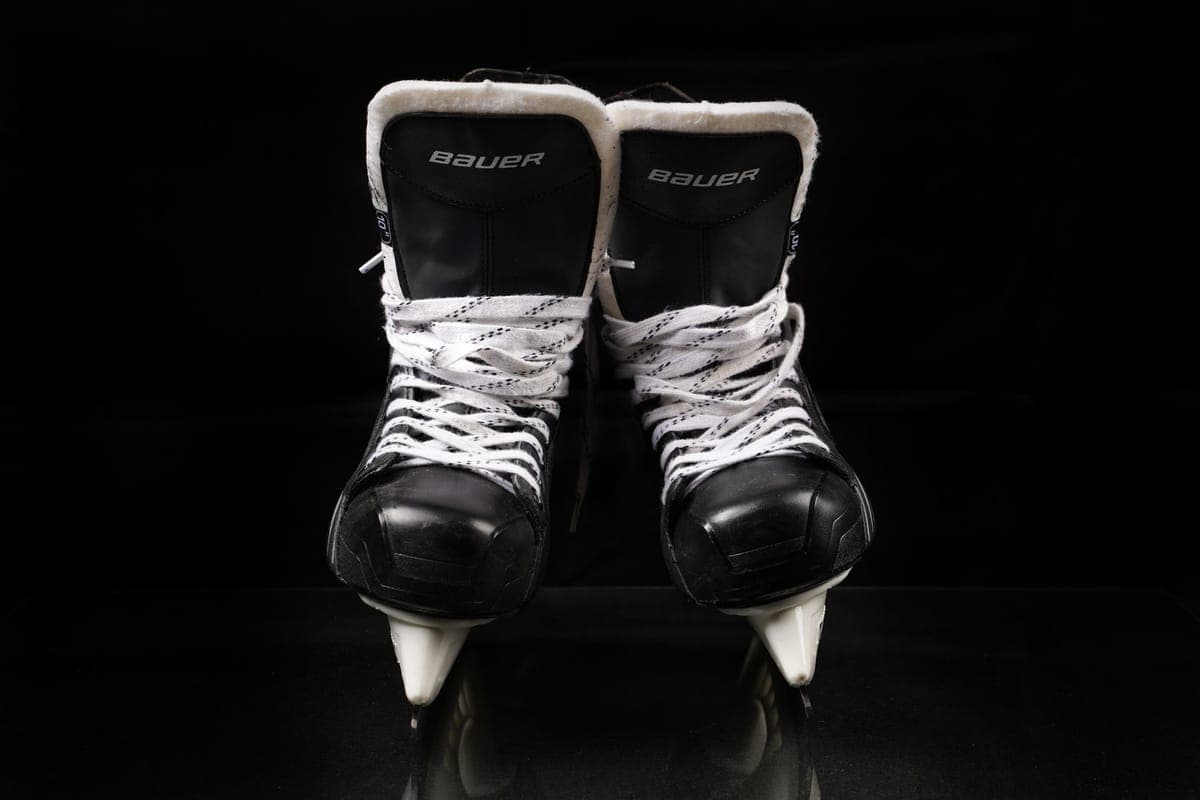
A skate is not a shoe with a blade on it
The reason skate sizing feels wrong is that skates are doing a different job from shoes. A shoe lets your foot move. A skate has to transmit what your ankle does into a blade an inch wide, and any space between your foot and the boot is movement that never reaches the ice.
So a correctly fitted skate feels tighter than a shoe, in the same way and for the same reason that a correctly fitted ski boot does. It should feel snug and slightly alarming when you first stand up in it, and correct after twenty minutes on the ice. Loose is the failure state: a foot sliding inside a skate produces wobbling ankles, which everybody misdiagnoses as weak ankles.
Sizing against your shoe size
As a starting point, most skates run about a half to one full size below street shoe size for adults, and roughly a size down for children. That is a starting point rather than a rule, because sizing is not standardized between skate brands and the published charts differ.
The reliable method is the same one a shop uses. With the skate unlaced, push your foot forward until your toes touch the front. There should be room for about one finger behind your heel, no more. Then push your heel back, lace it, and stand: your toes should just brush the toe cap. Now bend your knees forward as if skating. The toes should pull back off the end. If they stay jammed against the front when you bend, the skate is too short.
| Symptom | Cause | Fix |
|---|---|---|
| Ankles fold inward | Boot too large, or laces too loose across the ankle | Size down, or relace with the ankle zone tightest |
| Heel lifts when pushing off | Heel pocket too big or ankle laces loose | Tighten the ankle zone; if it persists, size down |
| Toes numb and cold | Too tight, or too many socks | One thin sock, and loosen the toe zone |
| Pain across the top of the foot | Laces too tight over the instep | Loosen the middle, keep the ankle tight |
| Heel blisters | Foot moving in the boot | Tighter ankle lacing; the boot may be too large |
One thin sock, always
Thin socks in skates, exactly as in ski boots. Two pairs, or one thick pair, fills space that should be filled by your foot, reduces control, and makes your feet colder rather than warmer because your toes cannot move enough to circulate blood. A single thin wool or synthetic sock is the answer; the sock page makes the full argument, and it applies unchanged here.
Lacing, in three zones
Lacing is where most of the fit actually happens, and doing it in one uniform tension from bottom to top is the standard mistake.
- Toe zone, the lowest few eyelets: snug but not tight. Your toes need to move a little. Cranking this zone is what causes numb toes and cramping.
- Ankle zone, the middle: tightest. This is the part doing the work. It locks the heel down into the heel pocket and stops the ankle folding. Pull hard here.
- Cuff zone, the top hooks: moderate. Firm enough to support, loose enough to let the ankle bend forward. A skate laced rigid at the top prevents the knee bend that skating depends on.
A child cannot generate the tension needed in the ankle zone, so an adult should lace children’s skates. That single change fixes more first-session problems than any equipment purchase.
Adjustable skates: how they work and when they are right
Adjustable skates are two-piece boots that lengthen with a lever, so one shell covers several shoe sizes. The published figures in this ledger are specific: Jackson Ultima publishes three shells covering youth 11 through adult 9, each adjusting across four shoe sizes. American Athletic publishes a small at 10Y to 13Y, a medium at 1 to 4 and a large at 5 to 8, also adjusting across four sizes, and a hockey-blade version adjusting across four sizes from youth 6.
For a child who skates a handful of times a winter, that is the difference between one purchase and three. The trade-off is published honestly on the picks below: an adjustable soft boot gives less ankle support than a fitted skate, which starts to matter once a child skates regularly or takes lessons.
The buying rule that follows is simple. Buy the shell whose range your child sits near the bottom of, and set the adjuster to today’s size. Do not buy the next shell up and run it at its smallest setting, which is the same mistake as buying a helmet to grow into and it produces the same wobbly result.
Figure blade or hockey blade for a beginner
A figure blade has a toe pick, the row of teeth at the front. It is there for jumps and stops in figure skating, and for an absolute beginner it is one more thing to catch and trip on. A hockey blade has no toe pick and is flatter, which many beginners find easier to simply stand on.
If the child is going to take figure skating lessons, buy a figure skate, because the lessons will assume one. If the goal is a family afternoon at the rink, a hockey blade removes an obstacle. Neither is faster or safer in general; this is a match-to-intent decision.
Rental skates, and why they feel bad
Rink rentals feel worse than they should for two reasons that have nothing to do with the boot design. They are usually a size too large, because the counter sizes by street shoe and errs upward. And their blades are often dull, because sharpening a whole fleet is expensive, and a dull blade slides sideways instead of biting.
If you rent, ask for a half size smaller than you were handed and lace the ankle zone hard. If you skate more than three or four times a winter, owning becomes worthwhile quickly, and it is the same logic as the ski cost arithmetic at a much smaller scale.
For specific models rather than the fit method, the adult skate roundup compares published size runs and linings, and leads on the one specification that decides a first outing.
Two habits that keep skates working
- Dry the blades every time. Wipe them with a cloth before the skates go in a bag. Blades rust, and rust ruins an edge. This is the same principle as keeping rust off ski edges.
- Loosen the laces fully before putting them away. Leaving a skate laced compresses the tongue and the padding, and it makes getting into them next time harder.
Soft blade guards for the bag, hard guards for walking on anything that is not ice, and never store skates in hard guards, which trap moisture against the steel. Once fit is settled, the kids skate roundup compares the published shells, blade types and adjustment ranges.
Every pick, with the working
Each entry shows the published inputs, the axis scores they produce, and what you give up. The order is the computed order, not a commercial one, and the arithmetic is open underneath each score.
1 · A child who skates at a local rink a few times a season
American Athletic Party Girl Adjustable Figure Skates
Three shells covering youth 10 through adult 8, each adjusting across four sizes, at a published $64.99. That is the cheapest published route to a skate that fits a child for more than one winter.
- Published price
- $64.99
- Cost per day on snow
- $6.50 a day
- Amortized over
- 2 seasons (10 days)
- Certified to
- Not published
- Published sizes
- Small 10Y-13Y, Medium 1-4, Large 5-8
- Warranty
- No term published
What it gets right
- $64.99 published, with each shell adjusting across four shoe sizes
- Three shells cover youth 10 through adult 8
What you give up
- No published warranty term
- Recreational figure blade, so it is not a starting point for lessons in either figure skating or hockey
The working behind the 4.2
- Cost per day on snow: 6.3
- $64.99 over 2 seasons at 5 days each = 10 days = $6.50 a day
- Published protection: not scored
- No certification published for this model, so protection is not scored.
- Size availability: 4.9
- 3 published sizes (3.4 of 8.5); continuous in-size adjuster published (+1.5); range: Small 10Y-13Y, Medium 1-4, Large 5-8
- Warranty and support: 0.0
- no published term (0 of 6); no published crash replacement (+0); no published repair route (+0)
Axes with unpublished inputs are dropped and the remaining weights re-normalized, so a product is not punished for a manufacturer’s silence. Specifications compiled September 3, 2026 from American Athletic published specifications.
2 · A growing child who skates a few times each winter
Jackson Ultima Softec Vibe Adjustable Skates
A two-piece boot that lengthens by pulling a lever, covering four shoe sizes per shell. For a child skating a handful of times a winter, that is the difference between one purchase and three.
- Published price
- Not published
- Cost per day on snow
- Not published
- Amortized over
- 2 seasons (10 days)
- Certified to
- Not published
- Published sizes
- Small Y11-2, Medium 2-6, Large 6-9, each adjustable across four sizes
- Warranty
- No term published
Jackson Ultima publishes no MSRP we could read; retail prices for the same skate ranged widely on the compile date.
What it gets right
- Each shell adjusts across four shoe sizes, so one pair can last several seasons
- Three shells cover youth 11 through adult 9
- Soft boot construction, which a child can put on without help
What you give up
- No published MSRP and no published warranty term
- An adjustable soft boot gives less ankle support than a fitted skate, which matters once a child skates regularly
The working behind the 2.5
- Cost per day on snow: not scored
- No manufacturer-published price, so this axis is not scored.
- Published protection: not scored
- No certification published for this model, so protection is not scored.
- Size availability: 4.9
- 3 published sizes (3.4 of 8.5); continuous in-size adjuster published (+1.5); range: Small Y11-2, Medium 2-6, Large 6-9, each adjustable across four sizes
- Warranty and support: 0.0
- no published term (0 of 6); no published crash replacement (+0); no published repair route (+0)
Axes with unpublished inputs are dropped and the remaining weights re-normalized, so a product is not punished for a manufacturer’s silence. Specifications compiled September 3, 2026 from Jackson Ultima published product specification.
3 · A very young beginner who keeps tripping on a toe pick
American Athletic Cougar Adjustable Hockey Skates
The hockey-blade equivalent, adjusting across four sizes from youth 6. A hockey blade is flatter and easier for a beginner to stand on than a figure blade with a toe pick, which catches.
- Published price
- Not published
- Cost per day on snow
- Not published
- Amortized over
- 2 seasons (10 days)
- Certified to
- Not published
- Published sizes
- Adjusts across four sizes; youth 6-9 shell published
- Warranty
- No term published
American Athletic publishes no MSRP for this model that we could read.
What it gets right
- Adjusts across four sizes, starting at youth 6
- Hockey blade has no toe pick, which is one fewer thing for a beginner to catch
What you give up
- No published MSRP and no published warranty term
- Fewer shell sizes published than the figure-skate version
The working behind the 1.6
- Cost per day on snow: not scored
- No manufacturer-published price, so this axis is not scored.
- Published protection: not scored
- No certification published for this model, so protection is not scored.
- Size availability: 3.2
- 2 published sizes (1.7 of 8.5); continuous in-size adjuster published (+1.5); range: Adjusts across four sizes; youth 6-9 shell published
- Warranty and support: 0.0
- no published term (0 of 6); no published crash replacement (+0); no published repair route (+0)
Axes with unpublished inputs are dropped and the remaining weights re-normalized, so a product is not punished for a manufacturer’s silence. Specifications compiled September 3, 2026 from American Athletic published specifications.
Prices last verified October 20, 2026. Prices move constantly; the figure on Amazon at the moment you click is the real one.
Questions people actually ask
What size ice skates should I buy?
Usually about a half to one full size below your street shoe size, though sizing is not standardized between brands. Check by pushing your foot forward until the toes touch: there should be about one finger of space behind the heel. Laced and standing, the toes should just brush the end and pull back when you bend your knees.
Should ice skates be tight?
Snug, yes. Any space between your foot and the boot is movement that never reaches the blade, which is why loose skates feel like weak ankles. They should not be tight enough to make toes numb; that usually means the lowest lacing zone is over-tightened or you are wearing too many socks.
How do you lace ice skates properly?
In three zones: snug but not tight over the toes, tightest across the ankle, and moderate at the top hooks so the ankle can still bend forward. The ankle zone is what locks the heel down. An adult should lace a child’s skates, since a child cannot generate enough tension there.
Are adjustable ice skates any good for kids?
For a child who skates a handful of times a winter, yes. Published shells adjust across about four shoe sizes each, so one pair can last several seasons. The trade-off is less ankle support than a fitted skate, which starts to matter once a child skates regularly or takes lessons.
Should a beginner use figure skates or hockey skates?
If they are taking figure skating lessons, figure skates, because the lessons assume a toe pick. Otherwise a hockey blade is flatter with no toe pick to catch, which many first-timers find easier to stand on. Neither is inherently safer.