What size ski jacket to buy, and how much room to leave
A ski jacket is sized to be worn over other clothing, which is why your normal size is often right and sizing up is usually wrong. Here is how to check without a fitting room.
By Sawyer V. · Published
We have not tested this gear. Everything below is compiled from published specifications and published safety standards, and the arithmetic is public so you can check it. This page carries affiliate links: if you buy through one we earn a commission at no extra cost to you, and it does not change the order of the picks. Full disclosure.
The short answer
Buy your normal size in a ski jacket, not a size up. Ski outerwear is already cut with room for a base layer and a mid layer, so sizing up gives you a jacket that lets cold air circulate and rides up when you reach. Check fit with the arms-overhead test: if the hem lifts above your waist or the cuffs pull back past your wrist bone, it is too small. The one real exception is a shell you intend to wear over a thick insulated jacket.
| # | Pick | Best for | Score | Price |
|---|---|---|---|---|
| 1 | Columbia Men's Bugaboo IV Pants Anyone between two inseams, which is most people | $4.80 a dayon snow | 4.8/10 | $130.00 - View on Amazon |
| 2 | Arctix Men's Icecap Insulated Jacket A cold dry week where price matters more than a spec sheet | $4.20 a dayon snow | 4.7/10 | $92.12 - View on Amazon |
| 3 | Wantdo Men's 3-in-1 Ski Jacket A wet-snow resort at a price that does not assume a season pass | Not publishedon snow | 3.8/10 | $59.97 - View on Amazon |
| 4 | Columbia Whirlibird V Interchange Jacket One jacket that has to work on the mountain and at home | $10 a dayon snow | 3.2/10 | $250.00 - View on Amazon |
Prices last verified October 20, 2026. Prices move constantly; the figure on Amazon at the moment you click is the real one.
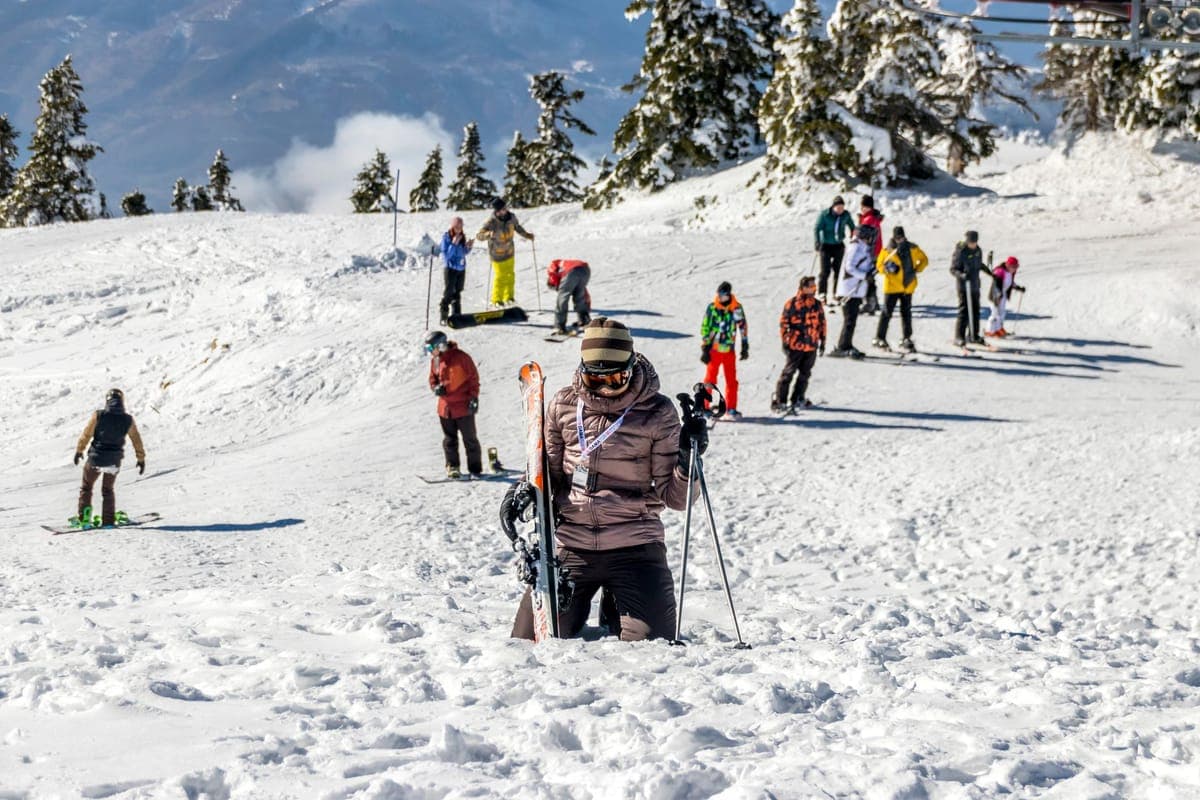
Ski jackets are already sized for layers
The most common sizing mistake in ski outerwear comes from a reasonable assumption: you will be wearing a lot underneath, so go up a size. It is wrong because the jacket makers already did that. A ski jacket in a given size is cut wider through the chest and longer in the sleeve than a street jacket in the same size, because the pattern assumes a base layer and a mid layer are underneath. Add a size on top of that and you get a garment with a large volume of air in it.
That air is the problem. Warmth comes from still air trapped close to the body. A jacket with too much room lets that air move, and moving air carries heat away. It is the same reason a thick sock makes a ski boot colder, and it is counterintuitive in exactly the same way. An oversized jacket is also the one that rides up when you lift your arms, which drops snow down your back on the first fall.
The four movement checks
Do these wearing what you will actually ski in: a base layer and a mid layer, not a t-shirt. Each one takes seconds and each one catches a different failure.
| Check | What you do | Fails if |
|---|---|---|
| Arms overhead | Reach both arms straight up | The hem lifts above your waistband, or the cuffs pull back past the wrist bone |
| Pole plant | Reach both arms forward and across your body | The shoulders bind or the back pulls tight across the shoulder blades |
| Zip and hood | Zip fully with the hood up over a helmet | The collar chokes, or the hood will not close over a helmet |
| Sit down | Sit on a chair as if on a chairlift | The jacket rides up so far it exposes your lower back |
The hood test is the one people skip and regret. A hood that fits a bare head and not a helmet is useless on the day it matters, because the day you want a hood is a day with wind and snow, and that is also a day you are wearing a helmet. Any jacket sold for skiing should publish a helmet-compatible hood; if it does not say so, assume it is not.
Length is the specification nobody checks
Two lengths matter and they behave differently.
Body length
A ski jacket should cover your waistband when your arms are over your head, which for most people means a hem somewhere around the top of the thigh. Shorter than that and every fall puts snow between the jacket and the pants. This is what a powder skirt exists to fix, and the features page covers whether you need one.
Sleeve length
Sleeves should reach past the wrist bone with your arms forward, because that is where your arms are when you ski, not at your sides. A sleeve that is correct in the shop with your arms hanging down will be two inches short in a pole plant. On a jacket with a gauntlet cuff on the gloves, the sleeve goes over the glove; on a jacket with an inner cuff, the cuff goes under it. Either works, but you have to pick one and buy gloves to match. The glove sizing page covers the cuff question.
Body length and sleeve length are also where brands differ most. Columbia publishes regular, big and tall variants for the Whirlibird V, which is the cleanest solution available at family prices if you are outside the standard pattern. Most brands publish only one length per size.
Pants have one extra variable: inseam
Snow pants get sized on waist and inseam, and the inseam is where family sizing falls apart, because a household of four rarely contains four catalog inseams. It is worth knowing which brands publish more than one option. Arctix publishes its insulated cargo pants in 28, 32 and 34 inch inseams. Columbia publishes an adjustable inner leg length on the Bugaboo IV, which quietly solves the same problem from the other direction.
Snow pants should sit long enough that the cuff covers the top of the boot with a knee bent, and the internal gaiter should sit over the boot rather than inside it. Too short and you get snow in the boot; too long and you stand on the hem with a ski edge, which cuts it. The pants roundup compares the published specifications.
Women, children, and the sizes brands do not publish
Women’s ski outerwear is usually cut with a different shoulder-to-hip ratio rather than simply scaled down, so a men’s jacket in a smaller size fits differently rather than fitting smaller. If a brand publishes both, take the one cut for your shape; if it publishes only one, run the four movement checks and judge on those.
Children are the opposite problem: they are between sizes constantly, and the temptation is to buy two sizes up so it lasts. A jacket two sizes up has sleeves that swallow the hands and a hem that catches under a chairlift. The growing-room page draws the line at where extra room is fine, and outerwear is the one category where a single size of growing room genuinely works, especially in a jacket with roll-back cuffs. The kids jacket roundup lists what publishes what.
Buying without a fitting room
- Measure your chest and your sleeve, and use the brand chart. Not the generic one. Sizing runs differently at every brand and the maker chart is the only one that describes the garment you are buying.
- Order one size, not two. The two-size return strategy sounds sensible and mostly results in keeping whichever arrived first.
- Try it on over your real layers, indoors, immediately. Run the four checks. A jacket that binds in your living room binds harder in the cold.
- Keep the tags on until you have done the hood-over-helmet test. It is the check that most often sends a jacket back.
- Check the return window against your trip date. Buying in November for a February trip is how people discover a bad fit two months after the window closed.
If the whole question is making you wonder whether to buy at all, the rent-or-buy page on clothing is worth reading first. Outerwear is the category where the arithmetic is least obvious, because a ski jacket also works as a winter coat for the other fifty-one weeks.
Every pick, with the working
Each entry shows the published inputs, the axis scores they produce, and what you give up. The order is the computed order, not a commercial one, and the arithmetic is open underneath each score.
1 · Anyone between two inseams, which is most people
Columbia Men's Bugaboo IV Pants
The one pair here with an adjustable inner leg length, which quietly solves the problem of a family where nobody is a catalog size. Columbia publishes no hydrostatic number, so it cannot be compared numerically against the Arctix.
- Published price
- $120
- Cost per day on snow
- $4.80 a day
- Amortized over
- 5 seasons (25 days)
- Certified to
- Not published
- Waterproof rating
- Not published
- Published sizes
- S through XXL, with adjustable inner leg
- Warranty
- No term published on the product page
What it gets right
- Adjustable inner leg length, unusual at any price
- Omni-Tech waterproof-breathable fabric with critical seams sealed
- Thermal reflective lining published
What you give up
- $120, more than double the Arctix, with no published rating to justify it numerically
- Critical seams rather than fully sealed
The working behind the 4.8
- Cost per day on snow: 7.6
- $120 over 5 seasons at 5 days each = 25 days = $4.80 a day
- Published protection: 2.0
- no published waterproof rating (0 of 6); critically taped or untaped seams (+0); insulation or shell construction published (+2)
- Size availability: 8.3
- 5 published sizes (6.8 of 8.5); continuous in-size adjuster published (+1.5); range: S through XXL, with adjustable inner leg
- Warranty and support: 0.0
- no published term (0 of 6); no published crash replacement (+0); no published repair route (+0)
Axes with unpublished inputs are dropped and the remaining weights re-normalized, so a product is not punished for a manufacturer’s silence. Specifications compiled September 3, 2026 from Columbia published specifications.
2 · A cold dry week where price matters more than a spec sheet
Arctix Men's Icecap Insulated Jacket
Arctix publishes a 3,000 mm rating on its insulated snow pants and no rating at all on this jacket, which is worth saying out loud rather than quietly borrowing the pants figure. What it does publish is insulation and critical seam sealing at $105.
- Published price
- $105
- Cost per day on snow
- $4.20 a day
- Amortized over
- 5 seasons (25 days)
- Certified to
- Not published
- Waterproof rating
- Not published
- Published sizes
- S through XXL
- Warranty
- No term published on the product page
What it gets right
- $105 published, which over five seasons is $4.20 a day on snow
- Critical seams sealed, which is what most family-price outerwear does
- Five published sizes
What you give up
- No waterproof rating published for this jacket, so it cannot be compared numerically
- Critical seams rather than fully sealed
The working behind the 4.7
- Cost per day on snow: 8.0
- $105 over 5 seasons at 5 days each = 25 days = $4.20 a day
- Published protection: 2.0
- no published waterproof rating (0 of 6); critically taped or untaped seams (+0); insulation or shell construction published (+2)
- Size availability: 6.8
- 5 published sizes (6.8 of 8.5); no continuous adjuster published (+0); range: S through XXL
- Warranty and support: 0.0
- no published term (0 of 6); no published crash replacement (+0); no published repair route (+0)
Axes with unpublished inputs are dropped and the remaining weights re-normalized, so a product is not punished for a manufacturer’s silence. Specifications compiled September 3, 2026 from Arctix published specifications.
3 · A wet-snow resort at a price that does not assume a season pass
Wantdo Men's 3-in-1 Ski Jacket
Publishes a 10,000 mm waterproof rating, which is a genuine resort-day figure and more than three times what the budget snow pants on this site publish. It is also the only jacket here that names a membrane rather than a coating.
- Published price
- Not published
- Cost per day on snow
- Not published
- Amortized over
- 5 seasons (25 days)
- Certified to
- Not published
- Waterproof rating
- 10,000 mm
- Published sizes
- S through XXL
- Warranty
- No term published on the product page
Wantdo lists this jacket across a price range that varies by colorway and size rather than publishing a single MSRP, so the cost-per-day axis is not scored.
What it gets right
- Publishes 10,000 mm, a number most brands at any price decline to state
- Names a microporous TPU membrane rather than a surface coating
- Three-in-one construction with a zip-out fleece liner
What you give up
- No single published price, so cost per day cannot be computed in advance
- Seam construction is not published, and seams leak before fabric does
The working behind the 3.8
- Cost per day on snow: not scored
- No manufacturer-published price, so this axis is not scored.
- Published protection: 4.5
- 10,000mm waterproof rating (2.5 of 6); seam sealing not published (+0); insulation or shell construction published (+2)
- Size availability: 6.8
- 5 published sizes (6.8 of 8.5); no continuous adjuster published (+0); range: S through XXL
- Warranty and support: 0.0
- no published term (0 of 6); no published crash replacement (+0); no published repair route (+0)
Axes with unpublished inputs are dropped and the remaining weights re-normalized, so a product is not punished for a manufacturer’s silence. Specifications compiled September 3, 2026 from Wantdo published specifications.
4 · One jacket that has to work on the mountain and at home
Columbia Whirlibird V Interchange Jacket
Two jackets in one: a waterproof shell and a zip-out insulated liner that each work alone. For a family that skis one week a year and spends the other fifty-one weeks in a cold parking lot, that is genuinely two purchases avoided.
- Published price
- $250
- Cost per day on snow
- $10 a day
- Amortized over
- 5 seasons (25 days)
- Certified to
- Not published
- Waterproof rating
- Not published
- Published sizes
- S through XXL
- Warranty
- No term published on the product page
What it gets right
- Three-in-one construction, so the shell and the liner are each usable on their own
- Omni-Tech waterproof-breathable fabric with critical seams sealed
- Sold in five sizes with regular, big and tall variants
What you give up
- Columbia publishes no hydrostatic-head figure, so its waterproofing cannot be compared numerically against a rated jacket
- Critical seams are sealed rather than every seam
- $250 is the most expensive item in this ledger apart from the skis
The working behind the 3.2
- Cost per day on snow: 3.7
- $250 over 5 seasons at 5 days each = 25 days = $10 a day
- Published protection: 2.0
- no published waterproof rating (0 of 6); critically taped or untaped seams (+0); insulation or shell construction published (+2)
- Size availability: 6.8
- 5 published sizes (6.8 of 8.5); no continuous adjuster published (+0); range: S through XXL
- Warranty and support: 0.0
- no published term (0 of 6); no published crash replacement (+0); no published repair route (+0)
Axes with unpublished inputs are dropped and the remaining weights re-normalized, so a product is not punished for a manufacturer’s silence. Specifications compiled September 3, 2026 from Columbia published specifications.
Prices last verified October 20, 2026. Prices move constantly; the figure on Amazon at the moment you click is the real one.
Questions people actually ask
Should I size up in a ski jacket?
Usually no. Ski jackets are already cut with room for a base layer and a mid layer, so your normal size is generally right. Sizing up creates volume that lets warm air circulate away, and makes the jacket ride up when you reach. The exception is a bare shell you intend to wear over a separate insulated jacket.
How long should a ski jacket be?
Long enough that the hem still covers your waistband when both arms are stretched overhead, which for most people means a hem around the top of the thigh. Shorter than that and snow gets between jacket and pants on every fall, which is the problem a powder skirt is designed to solve.
How do I know if a ski jacket is too small?
Reach both arms overhead. If the hem lifts above your waist or the cuffs pull back past your wrist bone, it is too small. Then reach forward and across your body: binding across the shoulders or tightness across the shoulder blades is the same verdict.
What inseam do I need in snow pants?
Long enough that the cuff covers the top of your boot with a knee bent, with the internal gaiter over the boot rather than inside it. Some brands publish multiple inseams, such as 28, 32 and 34 inch options, and some publish an adjustable inner leg, which is the easier answer if you are between lengths.
Does a ski jacket hood need to fit over a helmet?
Yes, because the weather that makes you want a hood is the same weather in which you are wearing a helmet. Test it with the helmet on before removing tags. If the maker does not publish a helmet-compatible hood, assume the hood was designed for a bare head.