The best ski helmets for a big head, ranked on published size range
Most helmet roundups compare vents. If your head measures over 60 cm, the only column that matters is the one almost nobody publishes clearly: how far the range actually goes.
By Sawyer V. · Published
We have not tested this gear. Everything below is compiled from published specifications and published safety standards, and the arithmetic is public so you can check it. This page carries affiliate links: if you buy through one we earn a commission at no extra cost to you, and it does not change the order of the picks. Full disclosure.
The short answer
Measure the circumference of your head first. If it lands between 63 and 67 cm, the Smith Cache Mips is the only helmet on this page whose published range reaches you, at 51 to 67 cm across four sizes with a dial adjuster. Between 60 and 65 cm the Giro Ledge Mips also fits, and the OutdoorMaster Kelvin 2 Mips is the value option in three published sizes. Under 62 cm you are not the reader this page is for; go to the main helmet roundup instead.
| # | Pick | Best for | Score | Price |
|---|---|---|---|---|
| 1 | Smith Cache Mips A head at the edges of the size range, or one between two sizes | $5 a dayon snow | 6.7/10 | $160.00 - View on Amazon |
| 2 | Giro Ledge Mips A rider who wants a low-profile hard shell and knows their size | $5.00 a dayon snow | 6.2/10 | $99.99 - View on Amazon |
| 3 | OutdoorMaster Kelvin 2 Mips Families buying several helmets at once | $2.80 a dayon snow | 6.9/10 | $59.99 - View on Amazon |
| 4 | Retrospec Comstock A spare helmet, or a second one for a visiting relative | $1.92 a dayon snow | 5.5/10 | $47.99 - View on Amazon |
Prices last verified October 20, 2026. Prices move constantly; the figure on Amazon at the moment you click is the real one.
Measure before you read any further
Head circumference is the only input to this decision and it takes fifteen seconds. Run a soft tape around your head about a centimeter above your eyebrows and around the widest part at the back, level all the way round. Write the number down in centimeters. Nearly every snow helmet on the market publishes its sizes in centimeters of head circumference, so that single figure is directly comparable across brands. The full sizing method is on its own page, with the common mistakes.
The reason this matters more at the top of the range is arithmetic. Manufacturers build size runs around the middle of the population, so a head at 56 cm has dozens of options from every brand and a head at 64 cm has a handful. Once you are over 62 cm, most published ranges have already stopped, and the ones that continue are the entire shortlist.
The published ranges, side by side
Every figure below comes from the maker’s own product page. Where a maker publishes only size names and not centimeters, we say so rather than inferring a range from a generic chart.
| Helmet | Published range | Sizes | Dial adjuster | Rotational liner |
|---|---|---|---|---|
| Smith Cache Mips | 51-67 cm | 4 (S, M, L, XL) | Yes | Mips |
| Giro Ledge Mips | 52-65 cm | 4 (S, M, L, XL) | Not published | Mips |
| OutdoorMaster Kelvin 2 Mips | Three sizes, S through L; no cm range published | 3 | Yes | Mips |
| Retrospec Comstock | 55-62 cm | 2 | Yes | None |
Two things jump out of that table. The Smith is the only one that publishes a range reaching 67 cm, which is why it wins a page about big heads despite being the heaviest here at a published 550 g. And the Giro, which is otherwise a close match on certifications and 50 g lighter, does not publish a dial adjuster for this model, which matters more at the top of a size run than anywhere else.
If you are between two sizes, buy the adjuster
A published size range like 51 to 67 cm is not four discrete points, it is four overlapping bands, and almost everyone lands near a boundary. That is what the dial at the back of a helmet is for: a continuous adjuster that takes up a centimeter or so of slack inside a size rather than forcing you to jump to the next shell.
For a head near the top of the range, the dial does something extra. The largest shell in a run is normally the one with the most spare volume, because it is built to catch everyone above the previous size. A dial closes that gap. Without one you are relying on the pads that came in the box, and pads are a coarse adjustment. The comparison of fit systems works through dials against pads in detail.
Round heads, oval heads, and why two helmets in the same size feel different
Circumference is one number describing a three-dimensional object. Two heads can both measure 62 cm and have completely different front-to-back and side-to-side proportions. That is why a helmet that fits your friend can press on your temples at the same nominal size, and it is not something any brand publishes.
The practical test, once the helmet is on and the dial is snug: shake your head firmly side to side and nod hard. The helmet should move your scalp rather than slide over it. Then check for pressure points with the helmet on for a full five minutes, not five seconds. A hot spot at five minutes is a headache at two hours. If the shell is right but there is one specific pressure point, that is a shape mismatch and no adjuster fixes it.
Do not trade safety for size
The temptation, once the shortlist is short, is to take whatever fits. Two things are worth holding on to even then.
- Published certification. Every helmet on this page publishes ASTM F2040, and three of the four also publish CE EN 1077. That combination is the baseline and there is no reason to drop below it. What each standard covers is a page of its own.
- A rotational-impact liner. Three of the four publish Mips. The fourth does not, at any size, which is the reason it is the skip on this page. The honest version of the Mips argument is next door, including where the evidence is thinner than the marketing.
The good news is that this is not a real trade-off at the top of the size range. The helmet with the widest published range here is also the one with two certifications, a dial, a rotational liner and the longest published warranty term at three years. You are not paying for size by giving up specification.
The goggle gap gets worse on a big helmet
A large shell has a large brow, and a goggle frame sized for an average face leaves a strip of forehead exposed between the two. That gap is the single most common complaint from people at either end of the size range, and it is a purchase decision rather than an adjustment: some goggle frames are simply taller.
Buy the helmet first and the goggles second, and if you can, try them together. The helmet and goggle fit page covers what to look for, and the goggle sizing guide covers frame size on its own terms. The Smith on this page publishes a cylindrical frame profile that sits flat against most helmet brows, which is one fewer variable.
Who should buy which
- Head measures 63 cm or more. Smith Cache Mips. It is the only published range here that reaches you, and it happens to be the best-specified helmet on the page.
- Head measures 60 to 65 cm and you want the lightest option. Giro Ledge Mips at a published 500 g, accepting a one-year warranty and no published dial.
- Head measures 60 to 62 cm and you are buying two or three at once. OutdoorMaster Kelvin 2 Mips, with the caveat that the sizes are published by name rather than by centimeter, so measure and check the maker chart before ordering.
- Head measures under 58 cm. You have the whole market. Start from the main helmet roundup instead, which is written for the middle of the range.
If you are still deciding whether to own a helmet at all rather than take the rental one, the rent-or-buy arithmetic is unusually one-sided for this item, and a hard-to-fit head makes it more so: rental fleets are stocked around the middle of the size chart.
Every pick, with the working
Each entry shows the published inputs, the axis scores they produce, and what you give up. The order is the computed order, not a commercial one, and the arithmetic is open underneath each score.
1 · A head at the edges of the size range, or one between two sizes
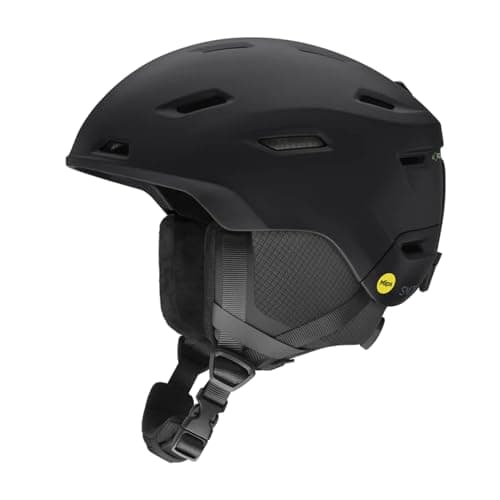
Smith Cache Mips
The widest published head range of any helmet on this page and the only one certified to both the US and European standards while carrying a rotational-impact liner, a dial adjuster and a three-year warranty. It is also the second most expensive, and 550 g is not light.
- Published price
- $125
- Cost per day on snow
- $5 a day
- Amortized over
- 5 seasons (25 days)
- Certified to
- ASTM F2040, CE EN 1077:2007 Class B
- Rotational system
- Mips
- Published sizes
- 51-67 cm across S, M, L and XL
- Weight
- 550 g
- Warranty
- Smith 3-year limited warranty
What it gets right
- Certified to ASTM F2040 and CE EN 1077:2007 Class B
- Four published sizes covering 51-67 cm, so odd-sized heads are actually catered for
- Three-year warranty, the longest published term in this group
- Eleven vents, five of them adjustable, which matters more than it sounds on a warm spring afternoon
What you give up
- 550 g in size medium is the heaviest here, and a child or a light adult will notice it
- No published crash-replacement program
The working behind the 6.7
- Cost per day on snow: 7.4
- $125 over 5 seasons at 5 days each = 25 days = $5 a day
- Published protection: 9.0
- ASTM F2040 (+4); CE EN 1077 (+2); Mips rotational system (+3)
- Size availability: 6.6
- 4 published sizes (5.1 of 8.5); continuous in-size adjuster published (+1.5); range: 51-67 cm across S, M, L and XL
- Warranty and support: 2.5
- 3 yr (2.5 of 6); no published crash replacement (+0); no published repair route (+0)
Axes with unpublished inputs are dropped and the remaining weights re-normalized, so a product is not punished for a manufacturer’s silence. Specifications compiled September 3, 2026 from Smith published specifications.
2 · A rider who wants a low-profile hard shell and knows their size
Giro Ledge Mips
A hard-shell helmet with the same two certifications and the same rotational liner as the Smith, 50 g lighter, at effectively the same price. What it does not publish is a dial adjuster, and its warranty is a year against Smith's three.
- Published price
- $124.95
- Cost per day on snow
- $5.00 a day
- Amortized over
- 5 seasons (25 days)
- Certified to
- ASTM F2040-11, CE EN 1077
- Rotational system
- Mips
- Published sizes
- 52-65 cm across S, M, L and XL
- Weight
- 500 g
- Warranty
- Giro 1-year limited warranty
What it gets right
- ASTM F2040-11 and CE EN 1077 certified, with the Mips liner included
- 500 g in medium, 50 g under the Smith
- Molded ABS outer shell bonded to an EPS liner, the tougher of the two common constructions
What you give up
- Giro publishes a one-year limited warranty on snow helmets, the shortest term here
- No continuous dial adjuster published for this model, so getting the right size first time matters more
- Six vents, and none of them published as adjustable
The working behind the 6.2
- Cost per day on snow: 7.4
- $124.95 over 5 seasons at 5 days each = 25 days = $5.00 a day
- Published protection: 9.0
- ASTM F2040 (+4); CE EN 1077 (+2); Mips rotational system (+3)
- Size availability: 5.1
- 4 published sizes (5.1 of 8.5); no continuous adjuster published (+0); range: 52-65 cm across S, M, L and XL
- Warranty and support: 1.5
- 1 yr (1.5 of 6); no published crash replacement (+0); no published repair route (+0)
Axes with unpublished inputs are dropped and the remaining weights re-normalized, so a product is not punished for a manufacturer’s silence. Specifications compiled September 3, 2026 from Giro published specifications.
3 · Families buying several helmets at once
OutdoorMaster Kelvin 2 Mips
The cheapest helmet here that carries both certifications and a rotational liner, at a published $69.99. For a family buying four helmets at once that difference is most of a lift ticket, and nothing in the published safety spec is missing.
- Published price
- $69.99
- Cost per day on snow
- $2.80 a day
- Amortized over
- 5 seasons (25 days)
- Certified to
- ASTM F2040-18, CE EN 1077:2007 Class B
- Rotational system
- Mips
- Published sizes
- Three published sizes, S through L
- Warranty
- OutdoorMaster 2-year warranty
What it gets right
- ASTM F2040-18 and CE EN 1077:2007 Class B, with Mips, for a published $69.99
- Two-year warranty, double Giro's published term
- Fourteen vents and a dial adjuster
What you give up
- Three published sizes rather than four, so the extremes of the range are less well covered
- No published weight, so you cannot compare it on the scale before you buy
The working behind the 6.9
- Cost per day on snow: 9.0
- $69.99 over 5 seasons at 5 days each = 25 days = $2.80 a day
- Published protection: 9.0
- ASTM F2040 (+4); CE EN 1077 (+2); Mips rotational system (+3)
- Size availability: 4.9
- 3 published sizes (3.4 of 8.5); continuous in-size adjuster published (+1.5); range: Three published sizes, S through L
- Warranty and support: 2.5
- 2 yr (2.5 of 6); no published crash replacement (+0); no published repair route (+0)
Axes with unpublished inputs are dropped and the remaining weights re-normalized, so a product is not punished for a manufacturer’s silence. Specifications compiled September 3, 2026 from OutdoorMaster published specifications.
4 · A spare helmet, or a second one for a visiting relative
Retrospec Comstock
Skip this one. It is a genuinely certified helmet and it is the cheapest here, but its published range stops at 62 cm across only two adult sizes. For the specific reader of this page, a head at or over 60 cm, that is the wrong end of the chart to be shopping at. It is on the list so the comparison is honest, not because it is a candidate.
Certified to both standards at under fifty dollars, with a dial adjuster and ten vents. What it does not have, at any price or size, is a rotational-impact liner, and that is the one thing on this page worth paying for.
- Published price
- $47.99
- Cost per day on snow
- $1.92 a day
- Amortized over
- 5 seasons (25 days)
- Certified to
- ASTM F2040, CE EN 1077 Class B
- Rotational system
- None published
- Published sizes
- 55-58 cm and 59-62 cm
- Warranty
- Limited warranty; no term published
What it gets right
- ASTM F2040 and CE EN 1077 Class B certified at a published $47.99
- ErgoKnob dial adjuster, which several helmets costing three times as much do not publish
- ABS shell over an EPS liner, the tougher construction
What you give up
- No rotational-impact system in any version
- Only two adult sizes, covering 55-62 cm, so anything outside that is not served
- Retrospec publishes a limited warranty but no term we could find
The working behind the 5.5
- Cost per day on snow: 9.7
- $47.99 over 5 seasons at 5 days each = 25 days = $1.92 a day
- Published protection: 6.0
- ASTM F2040 (+4); CE EN 1077 (+2); no rotational-impact system (+0)
- Size availability: 3.2
- 2 published sizes (1.7 of 8.5); continuous in-size adjuster published (+1.5); range: 55-58 cm and 59-62 cm
- Warranty and support: 0.0
- no published term (0 of 6); no published crash replacement (+0); no published repair route (+0)
Axes with unpublished inputs are dropped and the remaining weights re-normalized, so a product is not punished for a manufacturer’s silence. Specifications compiled September 3, 2026 from Retrospec published specifications.
Prices last verified October 20, 2026. Prices move constantly; the figure on Amazon at the moment you click is the real one.
Questions people actually ask
What size ski helmet do I need for a 62 cm head?
A 62 cm head sits at the top of most brands’ large or the bottom of their extra large, so it is a size boundary and a dial adjuster is worth having. Among the helmets here, both the Smith Cache Mips at a published 51 to 67 cm and the Giro Ledge Mips at 52 to 65 cm cover it. Measure first, then check the published range on the specific model.
Do ski helmets come in extra large?
Some do and many stop at large. Ranges published in centimeters are the only reliable comparison: the widest here is 51 to 67 cm across four sizes. Brands that publish only size letters without a centimeter range make it impossible to check before ordering, which is worth knowing before you buy online.
How should a ski helmet fit a large head?
The same way it fits any head: snug all the way round with no pressure points, sitting level with about a finger width above the eyebrows, and moving the scalp rather than sliding when you shake your head. On a larger shell, check the brow-to-goggle gap as well, because a big helmet and an average goggle frame often leave forehead exposed.
Is a bigger ski helmet less safe?
Not inherently. Certification is per model across its published sizes, and a helmet correctly sized to a large head performs as tested. What is unsafe is wearing a shell that is too small because it was the largest available, since it will not sit where the testing assumed.
Why does one 62 cm helmet fit and another does not?
Because circumference is one number describing a three-dimensional shape. Two heads of the same circumference can differ in front-to-back and side-to-side proportion, and no brand publishes head shape. If a helmet is the right circumference but presses in one specific place, that is a shape mismatch and an adjuster will not fix it.